

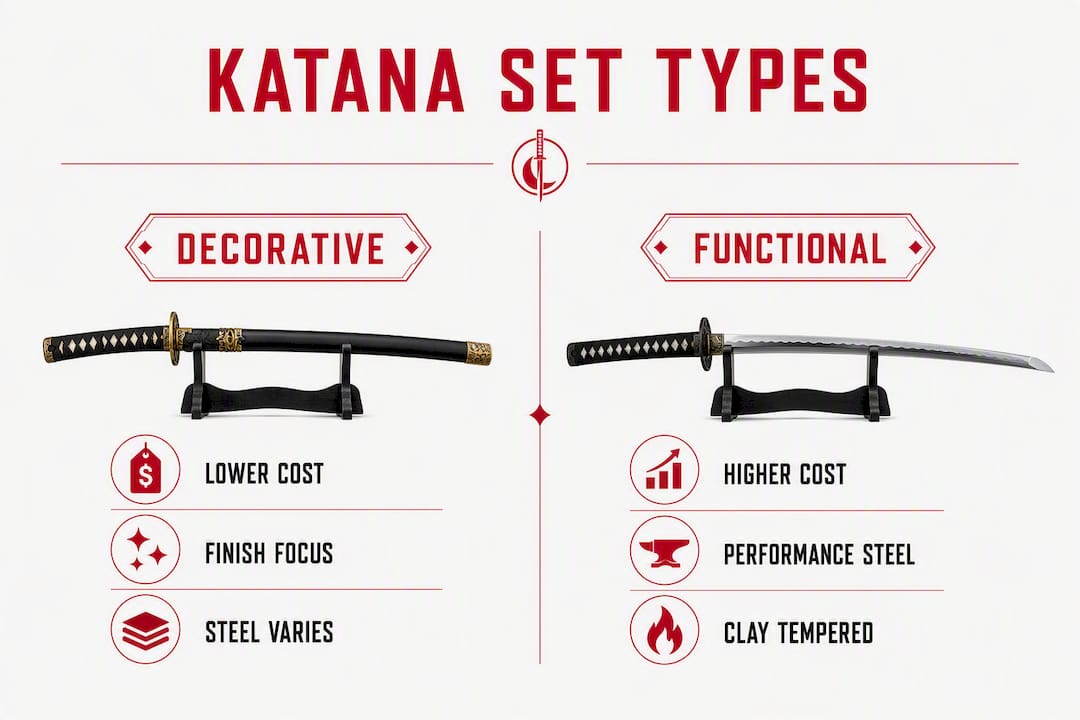
A 3-piece katana set — known in Japanese tradition as a daishō — pairs a full-length katana, a shorter wakizashi, and a compact tanto into a matched trio with unified fittings, finish, and aesthetic. For display collectors, a decorative set with polished manganese steel and coordinated saya (scabbards) is the right choice. For light-training martial artists, a functional set built on clay-tempered T10 or Damascus steel with full-tang construction is what actually matters.
Our top Moonswords picks by primary use:
- Display and gifting: Black Dragon Katana matched set — manganese steel, striking decorative finish, coordinated fittings
- Light training and collectors who want functional steel: Atsu Katana (Ghost of Yōtei) — Damascus or T10 steel, full-tang, clay-tempered options
- Premium collector investment: Kyōjin (狂刃) Katana — clay-tempered, tamahagane-style, master collection piece with artisan documentation
Table of Contents
- Which 3-piece katana sets does Moonswords recommend?
- How do you choose the right 3-piece katana set?
- What materials and construction methods actually matter?
- How should you care for and display a matched katana set?
- What should U.S. buyers know about shipping, returns, and legality?
- Why Moonswords matched sets carry documented artisan proof
- How do you verify authenticity and spot counterfeit sets?
- Which U.S.-based sellers are worth considering?
- Safe storage and handling of a matched katana set
- Key Takeaways
- The case for prioritizing documentation over aesthetics
- Moonswords handcrafted matched sets, ready to order
- Further reading and resources
- FAQ
Which 3-piece katana sets does Moonswords recommend?
Moonswords handcrafts matched daishō sets using centuries-old forging techniques, with every blade attributed to documented artisan processes. Whether you’re assembling a wall display or preparing for light iaido practice, the right set depends on steel, construction, and how closely the fittings match across all three pieces.
Black Dragon Katana matched set
The Black Dragon Katana is built for display. Its manganese steel blade holds a clean edge and resists surface corrosion, making it ideal for wall mounts or tiered stands where visual impact matters more than cutting performance.
- Best for: Display, gifting, interior decoration
- Steel: Manganese steel with decorative finish
- Blade length: Standard katana length (typical for display and training katanas)
- Fittings: Coordinated tsuba, menuki, and saya across all three pieces
- Accessories: Display stand included in matched configurations
- Price bracket: Entry-level to mid-range decorative
Atsu Katana (Ghost of Yōtei)
The Atsu Katana offers a genuine choice between Damascus and T10 steel, both available with full-tang construction and clay-tempered options. This set is for buyers who want a samurai sword trio that can handle light training without sacrificing visual quality.
- Best for: Light training, functional collectors, martial arts practitioners
- Steel: Damascus or T10 high-carbon steel, clay-tempered variants available
- Construction: Full-tang nakago, hand-forged
- Fittings: Custom finish options; matching wakizashi and tanto available
- Price bracket: Mid-range functional
Kyōjin (狂刃) Katana — master collection
The Kyōjin sits at the top of the Moonswords lineup. Clay-tempered with tamahagane-style construction, it comes with artisan attribution, heat-treatment documentation, and a certificate of authenticity. Collectors who treat their daishō as an investment piece should start here.
- Best for: Premium collecting, ceremonial display, investment-grade acquisition
- Steel: Tamahagane-style, clay-tempered
- Construction: Hand-forged, premium finishing
- Documentation: Certificate of authenticity, artisan attribution (Zhao Peiyan master collection)
- Price bracket: High-end / master collection
Zhao Peiyan Master Collection
The Zhao Peiyan collection represents Moonswords’ most documented artisan work. Named bladesmith attribution, forging notes, and hardness (HRC) data accompany each piece. For a collector who needs verifiable provenance, this is the standard to request.
| Set | Best for | Steel / Forging | Included pieces | Price band | Customization | Warranty / lead time |
|---|---|---|---|---|---|---|
| Black Dragon Katana | Display, gifting | Manganese steel, decorative | Katana + wakizashi + tanto, stand | Entry–mid | Limited finish options | Standard warranty; in-stock |
| Atsu Katana (Damascus) | Light training, functional collecting | Damascus, clay-tempered, full-tang | Katana + matched fittings | Mid-range | Damascus / T10 choice, finish | Standard warranty; made-to-order |
| Atsu Katana (T10) | Light training, cutting | T10 high-carbon, full-tang | Katana + matched fittings | Mid-range | Finish and fittings | Standard warranty; made-to-order |
| Kyōjin (狂刃) | Premium collecting, ceremonial | Tamahagane-style, clay-tempered | Full matched trio, certificate | High-end | Master collection options | Extended; longer lead time |
| Zhao Peiyan Collection | Investment, artisan verification | Master-forged, documented HRC | Full matched trio, documentation | Premium | Commission available | Extended; custom lead time |
Pro Tip: If your primary use is display, the Black Dragon set delivers the most visual impact per dollar. If you plan any light training, step up to the Atsu Katana in T10 steel — the full-tang construction and clay tempering make a meaningful difference in handling and durability.
Moonswords ships in-stock decorative sets within standard U.S. parcel timelines. Custom and master collection pieces are made-to-order; see the high-end katana collection page for current lead times.
How do you choose the right 3-piece katana set?
Start with one question: what will you actually do with this set? That single decision shapes every other choice, from steel type to price bracket.
- Define your primary use. Display collectors can prioritize finish, fittings, and visual cohesion. Light-training practitioners must prioritize heat treatment, tang construction, and blade geometry. Buyers who want both should lean functional — a well-made T10 blade looks excellent on a stand and can handle iaido practice.
- Check steel and forging method. For functional use, look for T10, 1095, or Damascus steel with documented clay tempering. For display, manganese steel and decorative finishes are appropriate. Read the material tradeoffs for decorative vs functional swords before committing.
- Verify tang construction. A full-tang blade runs the full length of the handle. Partial-tang and rat-tail constructions are common in decorative sets and are fine for display — but they will not hold up to training stress. Ask for photos of the nakago before purchasing.
- Measure blade lengths and check balance. A standard katana runs approximately 27–29 inches (blade only). The wakizashi typically measures 16–24 inches; the tanto, 6–12 inches. Weight distribution matters for training use — a blade that is too heavy at the tip fatigues the wrist quickly.
- Inspect fittings and finish cohesion. On a matched set, the tsuba (guard), menuki (handle ornaments), and saya should share a unified design language. Mismatched fittings are a common shortcut in low-quality sets.
- Confirm warranty, return policy, and shipping insurance. A reputable seller provides a clear return window, a warranty against manufacturing defects, and insured shipping for high-value orders.
- Account for accessories. A maintenance kit (uchiko powder ball, choji oil, cleaning cloth, mekugi punch) and a display stand are either included or should be budgeted separately.
Questions to ask any seller before purchasing:
- What steel is used, and what is the documented hardness (HRC)?
- Is the blade full-tang? Can you provide a photo of the nakago?
- Is there a visible hamon (temper line), and was it produced by clay tempering or acid etching?
- What is the return window and warranty coverage?
- Is shipping insured, and is signature-on-delivery available?
Red flags to walk away from:
- Vague specs (“high-carbon steel” with no grade specified)
- No close-up photos of the hamon or tang
- No return policy or a “no returns on blades” clause with no explanation
- Missing maintenance kit and no mention of care requirements
- Shipping without insurance on orders above $200
Typical price brackets for a 3-piece daishō set in the U.S.: decorative sets generally start below $200; entry-level functional sets with verified carbon steel run $200–$500; premium functional and master-forged sets with documentation sit above $500, with custom commissions ranging higher. Moonswords’ functional katanas under $300 collection illustrates what entry-level functional construction looks like in practice.
What materials and construction methods actually matter?
For functional blades, steel type and heat treatment are decisive. For display pieces, finish quality and fitting cohesion carry more weight. Understanding the difference saves you from overpaying for decorative features on a training blade — or buying a display piece you expect to cut with.
Common steel types and what they mean:
- 1095 high-carbon steel: The workhorse of functional katana production. Slightly less wear-resistant than T10 but easier to sharpen and widely available. Read the T10 vs 1095 comparison for a detailed breakdown.
- Damascus steel: — Produced by folding and welding multiple steel layers, creating the distinctive watered pattern. Visually striking and genuinely functional when properly heat-treated. The Atsu Katana uses Damascus construction with full-tang options.
- Manganese steel: — Common in decorative sets. Corrosion-resistant and visually clean, but not optimized for cutting performance. Appropriate for display-only applications like the Black Dragon set.
Clay tempering and the hamon: Clay tempering is the process of applying a clay slurry to the blade before the final quench, insulating the spine and allowing the edge to harden faster. The result is a visible temper line called the hamon — the wavy or straight boundary between the hardened edge (ha) and the softer spine (mune). A legitimate hamon produced by clay tempering has a natural, organic appearance with visible activity (nie and nioi). An acid-etched “hamon” looks flat and uniform. Always request close-up photos of the hamon before purchasing a set claimed to be clay-tempered.
Full-tang vs traditional nakago: A full-tang blade extends through the entire handle, secured by one or more mekugi (bamboo pegs). This construction distributes stress across the full handle length and is the standard for any blade intended for training. Traditional nakago construction, used in authentic Japanese swords, tapers toward the handle end — also structurally sound when properly fitted. Rat-tail tangs (a thin rod welded to the blade) are a cost-cutting measure found in low-quality decorative pieces and should be avoided for any functional use.
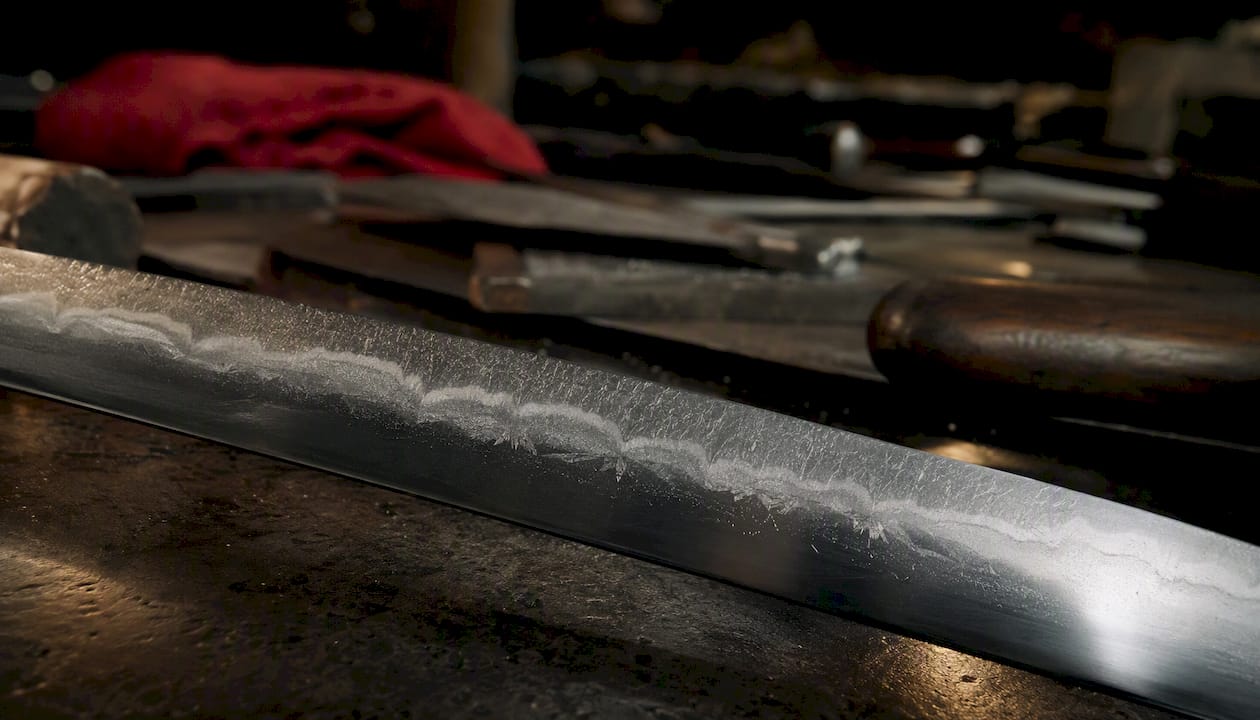
Pro Tip: When a seller claims clay tempering, ask for a macro photo of the hamon at the monouchi (the upper third of the blade). Genuine clay-tempered hamon shows texture and variation; an etched line looks printed. That one photo tells you more than any spec sheet.
Fittings deserve attention too. On a quality matched set, the tsuba, fuchi (collar), kashira (pommel cap), and saya should share materials, finish, and design motifs. Loose-fitting saya that rattle or tsuba with visible casting seams are indicators of rushed production.
How should you care for and display a matched katana set?
The single most important rule: keep every blade lightly oiled and away from moisture. A neglected blade can develop rust within days in a humid environment, and rust on a polished surface is difficult to remove without professional re-polishing.
Routine care steps:
- Inspect the blade before and after any handling. Look for fingerprints, moisture, or surface discoloration.
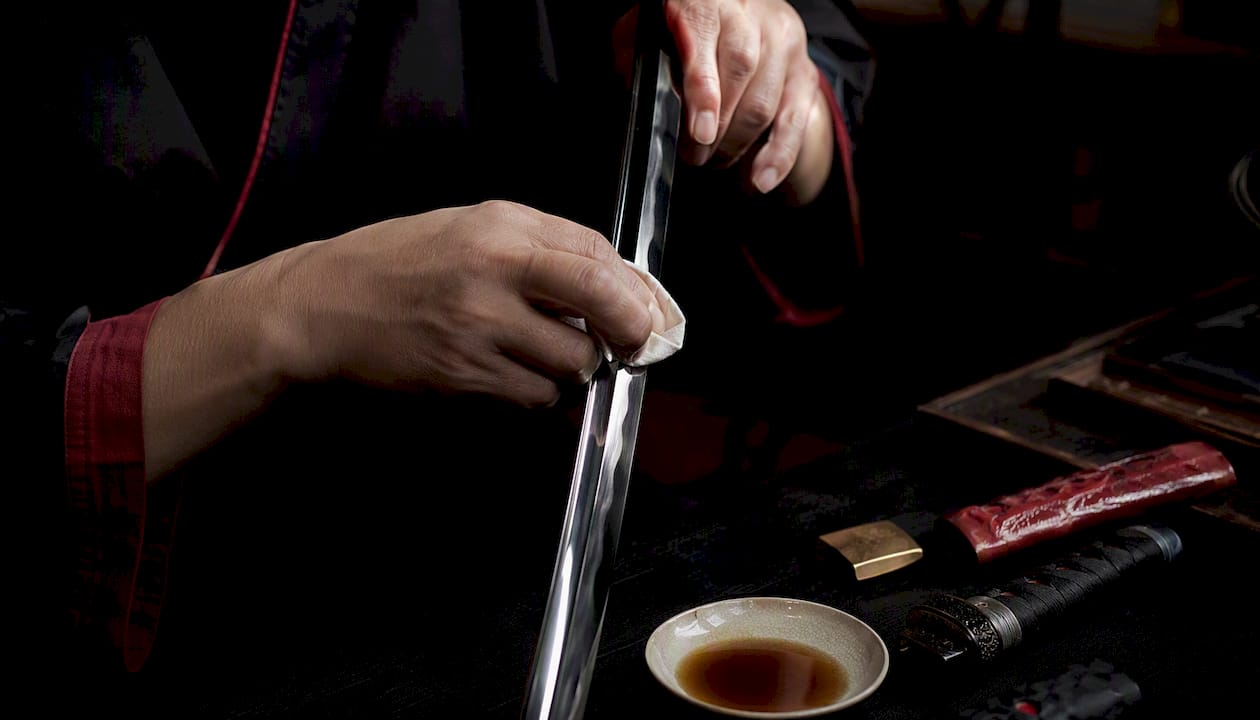
- Remove old oil and residue using a soft cloth or uchiko powder ball (a silk ball filled with fine polishing powder). Tap the uchiko lightly along the flat of the blade, then wipe clean with a soft cloth.
- Apply a thin coat of choji oil (a light mineral oil with clove oil) using a fresh cloth. Work from the habaki (blade collar) toward the tip, following the blade’s length. Less is more — excess oil attracts dust.
- Store or display safely. Blades stored in their saya should be oriented edge-up on a horizontal stand to prevent oil from pooling at the tip.
- Inspect fittings monthly. Check mekugi for looseness, saya for cracks, and tsuba for play. Tighten or replace mekugi before any handling session.
Full guidance on cleaning frequency and storage is available in the Moonswords katana care and maintenance guide.
Display options:
- Three-tier horizontal stand: The traditional choice for a matched daishō set. Positions all three blades at the correct angle and keeps them accessible for inspection.
- Wall mount: Visually dramatic, but requires careful humidity control. Avoid exterior walls in humid climates.
- Shadowbox / enclosed case: Best for long-term preservation. Limits UV exposure and dust accumulation, though it reduces accessibility.
Accessories checklist:
- Uchiko powder ball
- Choji oil (or equivalent light mineral oil)
- Soft cleaning cloths (nunoko)
- Mekugi punch and replacement mekugi
- Three-tier display stand
- Storage sleeves (shirasaya bags) for transport
- Insurance documentation for high-value pieces
Pro Tip: Display sets should be re-oiled every 2–3 months in a climate-controlled room. If you live in a coastal or high-humidity area, increase that to monthly. Direct sunlight fades the saya lacquer and accelerates oxidation on the blade — keep your display away from south-facing windows.
What should U.S. buyers know about shipping, returns, and legality?
Before completing any purchase, confirm three things: shipping insurance, the return window, and your state’s blade laws. These details vary more than most buyers expect.
| Order type | Typical lead time | Shipping method | Insurance | Return window |
|---|---|---|---|---|
| In-stock decorative set | 3–7 business days | Standard parcel (UPS/FedEx) | Recommended; confirm with seller | Typically within standard U.S. parcel timelines |
| Made-to-order functional set | 2–6 weeks | Parcel or freight depending on value | Required for high-value orders | Confirm pre-purchase; custom orders may be final sale |
| Master collection / custom commission | 6–12+ weeks | Insured freight | Required | Confirm terms at order placement |
Legal considerations for U.S. buyers:
- Owning a katana is legal in all 50 states for adults. No federal permit is required for possession in your home.
- Carrying a katana in public is a different matter. State laws vary significantly: California, New York, and several other states restrict carrying bladed weapons in public, even in a case. Some states require blades to be transported unloaded (sheathed) and out of reach.
- Concealed carry of any blade above a certain length is restricted or prohibited in most states.
- Always research your state’s specific statutes before transporting a blade in a vehicle or to a public location. The Giffords Law Center maintains updated state-by-state weapon law summaries.
Moonswords provides authenticity documentation and warranty coverage with its master collection and high-end pieces. For custom orders, confirm the warranty terms and lead time in writing before placing the order.
Pro Tip: For any order above $300, request signature-on-delivery and confirm the shipment is insured for full replacement value. Carriers occasionally mishandle long packages, and a damaged blade on an uninsured shipment leaves you with limited recourse.
Why Moonswords matched sets carry documented artisan proof
Moonswords matched sets are recommended because the artisan process is documented, not just described. Every blade in the master collection comes with a specification sheet, close-up photos of the hamon and tang, a certificate of authenticity, and artisan attribution — the kind of paper trail that separates a genuine collector piece from a decorative replica.
The forging process begins with steel selection appropriate to the blade’s intended use. Clay is applied by hand before the quench, producing the hamon that collectors and practitioners both recognize as a mark of proper heat treatment. Hand-finishing follows: the blade is polished through progressive grits, fittings are fitted and tested for play, and the saya is lacquered and fitted to the specific blade profile.
Buyers of the Zhao Peiyan master collection receive artisan attribution with forging notes and HRC hardness data where available. The Kyōjin (狂刃) Katana, for example, comes with tamahagane-style documentation and premium finishing details that support both display and long-term value.
Trust signals Moonswords provides:
- Certificate of authenticity with artisan attribution
- Heat-treatment notes and HRC range documentation
- Close-up photos of hamon, nakago, and fittings
- Customer reviews and verified purchase photos
- Warranty against manufacturing defects
- Post-sale maintenance support and care guidance
- Customization options with documented lead times
Custom finish requests and master collection commissions are available through the high-end katana collection. Plan lead times accordingly — master-forged pieces take weeks, not days, and that timeline is a feature, not a delay.
How do you verify authenticity and spot counterfeit sets?
The counterfeit katana market is real, and the tells are consistent once you know what to look for. Most fake “authentic” sets share a handful of shortcuts that a careful buyer can identify before purchase.
Verification methods:
- Request a macro photo of the hamon. Genuine clay-tempered hamon shows organic variation, nie (bright crystalline activity), and a natural boundary. Acid-etched lines look uniform and printed.
- Ask for a photo of the full nakago (tang). A legitimate full-tang blade shows the steel running the full handle length, often with file marks (yasurime) and a maker’s signature (mei). A rat-tail tang is immediately visible.
- Check the hardness claim. Functional blades should specify HRC hardness. A blade claimed to be T10 or 1095 with no hardness data is unverified.
- Examine the saya fit. On a quality blade, the saya holds the blade snugly with a satisfying click (koiguchi). A loose or rattling fit indicates poor fitting.
- Look for artisan attribution. Named bladesmiths with verifiable credentials — like the Zhao Peiyan collection at Moonswords — provide a traceable proof point. Anonymous “master craftsmen” with no documentation are a warning sign.
- Verify the certificate. A genuine certificate of authenticity names the bladesmith, steel type, forging method, and hardness. A generic printed card with no specifics is decorative, not documentary.
Counterfeit sets often arrive with impressive-looking packaging but reveal themselves in the details: mismatched fittings across the three pieces, hamon that disappears under raking light, and tang photos that are either absent or show obvious welds.
Which U.S.-based sellers are worth considering?
The U.S. market for matched daishō sets ranges from mass-market decorative pieces to genuinely handcrafted functional sets. The difference in quality is significant, and the price gap reflects it.
Moonswords operates as a direct-to-consumer e-commerce seller with a focus on handcrafted, artisan-documented blades. The master collection by Zhao Peiyan and the high-end collection represent the upper tier of what’s available online without commissioning a Japanese sword directly from Japan.
For buyers seeking entry-level decorative sets, major online marketplaces carry options at lower price points, though documentation and artisan verification are typically absent. Specialty martial arts retailers stock functional sets in the mid-range, often with basic carbon steel and limited customization.
When evaluating any U.S.-based seller, apply the same checklist: steel documentation, tang photos, hamon verification, return policy, and warranty. A seller who cannot or will not provide these details before purchase is not a seller worth trusting with a significant purchase.
Safe storage and handling of a matched katana set
A sharp blade demands consistent habits. Most katana injuries happen during casual handling — drawing the blade without a proper grip, reaching into a storage bag without checking orientation, or handing a sword to someone without confirming they know how to receive it.
Storage safety:
- Store all three blades in their saya, edge-up on a horizontal stand or in individual storage sleeves.
- Keep the set out of reach of children. A locked display case is the right choice in any home with young visitors.
- Never store blades in a damp basement or garage. Humidity accelerates rust and can warp wooden saya.
- Label storage sleeves if blades are stored separately — a tanto and wakizashi can look similar in a bag.
Handling safety:
- Always draw with a controlled grip, keeping fingers clear of the edge.
- When handing a blade to another person, present it horizontally with the edge facing away, and confirm the recipient has a firm grip before releasing.
- Never test sharpness by running a finger along the edge. Use a sheet of paper held vertically.
- Wear cut-resistant gloves during cleaning if you are new to blade maintenance.
For collectors who purchase a set as a gift, the Moonswords gift katana buyer’s guide covers packaging, presentation, and safety orientation for recipients unfamiliar with blade handling.
Key Takeaways
A matched 3-piece daishō set is only as good as its weakest blade — verify steel, tang, and heat treatment before any purchase, and choose your set based on actual intended use, not aesthetics alone.
| Point | Details |
|---|---|
| Choose by use first | Display sets prioritize finish and fittings; functional sets require documented heat treatment and full-tang construction. |
| Verify materials and temper | Request macro photos of the hamon and nakago; clay-tempered blades show organic hamon variation, not uniform etched lines. |
| Check tang and warranty | Full-tang construction is required for any training use; confirm warranty coverage and return policy before ordering. |
| Plan for care and shipping | Re-oil blades every 2–3 months for display; insure shipments above $300 and request signature-on-delivery. |
| Moonswords for documented sets | Moonswords offers handcrafted matched sets from the Black Dragon to the Zhao Peiyan master collection, with artisan documentation and U.S. shipping. |
The case for prioritizing documentation over aesthetics
There’s a tendency in the collector market to judge a daishō set by its box — the lacquered saya, the dramatic tsuba, the velvet-lined case. Those details matter for display, but they’re the last thing I’d evaluate when deciding whether a set is worth its price.
The collectors and practitioners who get the most from their sets are the ones who asked for the nakago photo before they asked about the finish color. A clay-tempered T10 blade with a modest tsuba will outlast and outperform a visually spectacular piece built on a rat-tail tang and an etched “hamon” — every time, without exception.
For collectors, my recommendation is simple: treat the certificate of authenticity and the artisan attribution as non-negotiable. For light-training practitioners, the heat-treatment documentation and tang construction are what you’re actually paying for. The aesthetics are a bonus, not the product. When those two things align — as they do in the Zhao Peiyan master collection and the Atsu Katana line — you have a set worth owning for decades.
Moonswords handcrafted matched sets, ready to order
Moonswords offers something the mass-market decorative set cannot: a matched daishō where every blade carries documented artisan proof, from the clay-tempered hamon to the named bladesmith. Whether you’re building a display collection or equipping yourself for light iaido practice, the difference between a Moonswords set and a generic import is the paper trail that comes with it.
The Moonswords collection covers the full range from entry-level display sets to master-forged commissions. In-stock pieces ship within standard U.S. parcel timelines. Custom orders and master collection pieces are made-to-order — contact Moonswords directly through the product pages to discuss specifications, finish options, and lead times. For a themed display, consider pairing your set with a Jin Sakai Ghost of Tsushima resin figurine for a collector presentation that goes beyond the blade itself. Browse the collection and start your order today.
Further reading and resources
- Moonswords full collection — the primary entry point for matched sets, individual blades, and custom commissions
- High-end katana collection — master-forged and custom pieces with extended documentation and longer lead times
- Katana care and maintenance guide — step-by-step cleaning, oiling, and storage instructions for all three blade types in a matched set
- Collector maintenance tips — long-term preservation guidance for display and investment pieces
- T10 vs 1095 steel comparison — technical breakdown of steel options for buyers choosing functional blades
- Jin Sakai Ghost of Tsushima resin figurine — a high-detail display companion for collectors building a themed samurai presentation
FAQ
What does a 3-piece katana set include?
A standard 3-piece katana set (daishō) includes a katana (long sword), a wakizashi (short sword), and a tanto (dagger), typically with matching fittings and a display stand.
What steel is best for a functional daishō set?
T10 and 1095 high-carbon steels are the most reliable choices for functional blades, both responding well to clay tempering. Damascus steel is a strong option for collectors who want visual distinction alongside genuine cutting capability.
Is it legal to own a katana set in the United States?
Owning a katana set is legal for adults in all 50 states. Carrying blades in public is regulated differently by each state, so research your local statutes before transporting any blade outside your home.
How do I verify that a katana set is genuinely clay-tempered?
Request a macro photo of the hamon under raking light. Genuine clay-tempered hamon shows organic variation and crystalline activity (nie); an acid-etched line looks flat and uniform. Moonswords provides hamon documentation with its master collection pieces.
How long does a custom Moonswords matched set take to arrive?
In-stock sets typically ship within 3–7 business days. Made-to-order functional sets take approximately 2–6 weeks, and master collection or custom commission pieces can require 6–12 weeks or more depending on specifications.