

A Chinese sword is a traditional bladed weapon rooted in one of two broad families: the jian (straight, double-edged) and the dao (single-edged saber), each with distinct subtypes, historical roles, and handling characteristics. According to Wikipedia’s classification of Chinese swords, most common types have blade lengths typically in the mid-range of one-handed swords, generally between roughly two to three feet. If you are buying rather than just browsing, the practical verdict is this: choose a heat-treated, full-tang blade for any training or cutting use, and reserve decorative pieces for display only.
Before you read further, three things to check first on any blade you are considering:
- Blade type: Is it a jian (straight, two edges) or a dao (one edge, often curved)? This determines handling, technique, and historical context.
- Tang construction: Full-tang is the minimum standard for functional use. Partial or rat-tail tangs are a red flag on any sword marketed as “battle-ready.”
- Visible temper line (hamon): A genuine clay-tempered blade shows a distinct wavy or irregular line where hard edge meets tough spine. A uniform, mirror-polished edge with no visible hamon is almost certainly decorative stock.
Key Takeaways
The most important decision in buying a Chinese sword is tang construction and heat treatment — everything else is secondary.
| Point | Details |
|---|---|
| Jian vs. dao taxonomy | Jian is straight and double-edged; dao is single-edged and often curved, with subtypes from liuyedao to zhanmadao. |
| Blade length ranges | Most one-handed types run 70–80 cm; two-handed anti-cavalry blades reach 90 cm or more. |
| Craftsmanship priority | Full-tang construction and clay tempering (visible hamon) are the two non-negotiable markers of a functional blade. |
| U.S. buying checklist | Request tang photos, confirm steel type and tempering method, verify carrier insurance, and check your state’s blade laws before purchase. |
| Moonswords recommendation | Moonswords offers hand-forged, clay-tempered jian and dao with documented maker credentials and international shipping support. |
Table of Contents
- What exactly is a Chinese sword, and how are the types classified?
- How did Chinese swords evolve from the Bronze Age to modern wushu?
- What craftsmanship details actually matter when judging a Chinese sword?
- What sizes and specs should you expect for different Chinese sword types?
- How do you buy a Chinese sword in the United States without getting burned?
- What are the U.S. legal and shipping rules for buying a Chinese sword?
- How do you keep a Chinese sword in good condition?
- How does Moonswords source and craft its Chinese-style jian and dao?
- What most buyers get wrong about choosing a Chinese sword
- Moonswords carries handcrafted Chinese jian and dao built to functional standards
- Sources
- FAQ
What exactly is a Chinese sword, and how are the types classified?
The jian and dao are not just stylistic variations — they represent fundamentally different tools shaped by different battlefield demands. The jian is a thrusting and cutting weapon favored by scholars, officers, and martial artists who prized precision. The dao is a chopper and slasher, built for raw power and durability under hard use.
The jian: straight, double-edged, and precise
The jian has been called the “gentleman of weapons” in Chinese martial tradition, and the label fits. Its symmetrical double edge demands a refined grip and controlled technique. One-handed civilian jian typically run 70–80 cm in blade length, light enough for solo forms and partner drills. Two-handed versions push toward 90–100 cm. The taiji jian used in modern tai chi practice is usually flexible and light, designed for flowing choreography rather than cutting. The most famous historical specimen, the Sword of Goujian (circa 5th century BCE), is a bronze jian recovered in near-perfect condition from a Hubei tomb — its corrosion-resistant alloy composition still puzzles metallurgists.
The dao: single-edged, versatile, and dominant on the battlefield
Dao subtypes cover a wide range of shapes and roles:
- Liuyedao (“willow-leaf dao”): gently curved, one-handed, the most common Ming and Qing military sidearm. Blade length typically 70–80 cm.
- Yanmaodao (“goose-quill dao”): nearly straight with a slight curve near the tip, bridging jian and dao handling.
- Niuweidao (“oxtail dao”): dramatically flared tip, popular in the late Qing and Republican eras, often associated with militia use.
- Piandao: deeply curved, optimized for slashing cavalry strikes.
- Dadao (“great dao”): heavy, broad-bladed two-handed chopper used by Republican-era militia and WWII infantry.
- Zhanmadao / changdao / miaodao: long two-handed sabers, some notably longer in blade length, used as anti-cavalry weapons.
- Nandao: a modern wushu competition form, lighter and more flexible than historical equivalents.
- Butterfly swords (hudiedao): paired short dao, one in each hand, associated with southern Chinese martial arts.
| Type | Era | Blade Length (approx.) | Primary Use |
|---|---|---|---|
| Jian (one-handed) | Zhou through Qing | mid-range blade length typical of one-handed swords | Civilian, officer, martial arts |
| Liuyedao | Ming–Qing | moderate blade length typical of military sidearms | Military sidearm, cavalry |
| Yanmaodao | Song–Ming | moderate blade length typical of infantry swords | Infantry, officer |
| Niuweidao | Late Qing–Republican | blade length typical of militia and civilian swords | Militia, civilian |
| Zhanmadao | Song dynasty | longer blade lengths characteristic of two-handed anti-cavalry swords | Anti-cavalry infantry |
| Dadao | Republican–WWII | blade lengths typical of heavy militia swords | Heavy militia infantry |
| Nandao | Modern | blade lengths consistent with modern wushu competition forms | Wushu competition |
| Butterfly swords | Qing–modern | short blades suitable for paired southern martial arts weapons | Southern martial arts |
How did Chinese swords evolve from the Bronze Age to modern wushu?
The story of ancient Chinese swords is really a story of metallurgy chasing battlefield need. Each major shift in sword design tracks directly to a change in how wars were fought or how metal was worked.
- Shang and Western Zhou dynasties (c. 1600–771 BCE): Bronze jian appear in this period, short and leaf-shaped, used alongside dagger-axes. The Sword of Goujian, cast in the Spring and Autumn period (c. 771–476 BCE), represents the peak of bronze jian craft.
- Warring States period (475–221 BCE): Iron and early steel production allowed longer, stronger blades. Bronze jian gave way to iron jian, and sword length increased as metallurgy improved.
- Han dynasty (206 BCE–220 CE): This is the pivotal moment. Cavalry warfare drove the practical adoption of the dao — its spine-thick, single-edged design delivered far more chopping power from horseback than the thrust-focused jian. The jian did not disappear, but the dao became the dominant military sidearm.
- Song dynasty (960–1279 CE): Long two-handed sabers like the zhanmadao emerged as anti-cavalry tools, with blade lengths reaching lengths suitable for anti-cavalry use in historical records. Infantry needed a weapon that could disable horses and their riders in a single stroke.
- Ming and Qing dynasties (1368–1912): The liuyedao became the standard military sidearm. Civilian variants proliferated, and the jian retained prestige as a scholar’s and officer’s weapon. Fittings became more ornate, and regional styles diverged.
- Republican era and WWII (1912–1945): The dadao saw heavy militia use, particularly by units that lacked firearms. Its broad, heavy blade required minimal training to wield effectively.
- Modern wushu and collecting (1950s–present): Performance swords optimized for flexibility and visual spectacle replaced historical forms in competition. The collector market, meanwhile, drove renewed interest in historically faithful reproductions and antique originals.
The core driver across all these shifts was simple: better metal allowed longer blades, and changing tactics determined whether those blades needed one edge or two.
What craftsmanship details actually matter when judging a Chinese sword?
Craftsmanship is where authentic swords separate from decorative wall-hangers, and the differences are visible if you know what to look for. Clay tempering and tang construction are the two most reliable indicators of a genuinely functional blade.
Steel types and forging methods
Early Chinese swords used bronze, then wrought iron, and then increasingly refined steels. Traditional functional blades today use steels like 1060, 1075, or T10 high-carbon steel, or laminated constructions such as sanmei (three-layer, with a hard steel core sandwiched between softer outer layers) or wumei (five-layer). Folded steel, sometimes called “Damascus” in the collector market, creates visible grain patterns (hada) in the blade and can indicate hand-forging, though modern pattern-welded steel is not always superior to well-heat-treated monosteel.
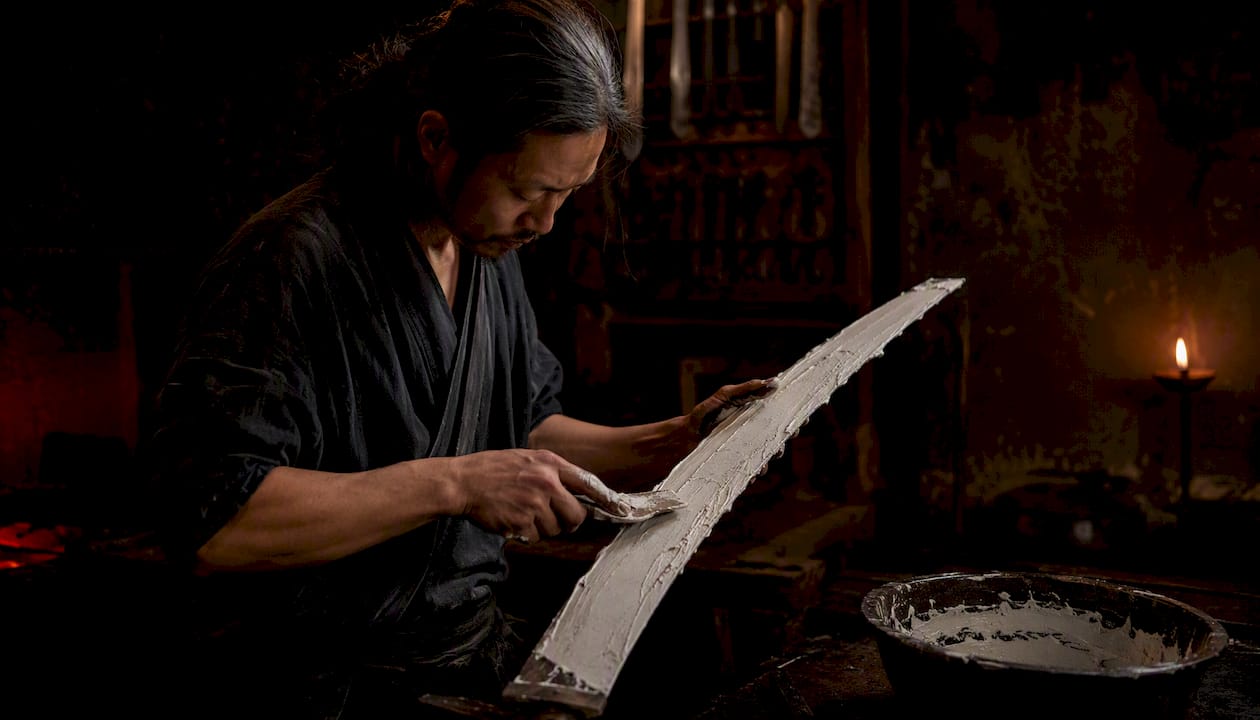
Differential (clay) tempering is the hallmark of a serious functional blade. A smith applies clay to the spine before quenching, insulating it so the spine cools slowly and stays tough while the edge hardens rapidly. The result is a visible temper line (hamon) and a blade that resists both breaking and bending under hard use. A blade without a hamon has almost certainly been through a uniform quench, which is adequate for display but not ideal for cutting practice.
Tang construction and fittings
- Full-tang: The steel runs the full length of the handle, secured by a pin or peen through the pommel. This is the standard for any functional sword.
- Partial tang / rat-tail tang: A thin steel rod welded or threaded into the handle. Adequate for display; dangerous under real cutting stress.
- Guard (huba) and disc: Traditional Chinese guards range from simple oval iron discs to elaborate bronze or brass fittings. Inspect for casting quality and fit — a loose guard is both a safety issue and a sign of low-grade assembly.
- Pommel ring and scabbard: Peened construction (the tang end is hammered over a washer) is more secure than a threaded nut. Scabbard fit should be snug without requiring force.
Craftsmanship checklist before you buy:
- Request photos of the tang, including the pin or peen
- Ask for the tempering method (clay-tempered, oil-quenched, or decorative)
- Confirm the steel type and hardness (Rockwell C scale; functional blades typically fall in the 58–62 HRC range for the edge)
- Ask for the maker’s name and any documentation
- Check that blade geometry is consistent — no flat spots, no visible grind marks from machine finishing
Pro Tip: A performance/wushu blade flexes noticeably when you apply light lateral pressure near the tip. A heat-treated functional blade resists that flex firmly. If a seller markets a blade as “functional” but it springs like a fencing foil, walk away.
What sizes and specs should you expect for different Chinese sword types?
Size and balance are not just numbers — they determine whether a blade suits your body, your training style, and your intended use. Museum and archaeological records show consistent mid-range blade lengths of 70–100 cm for most historic one-handed swords, with notable exceptions for two-handed anti-cavalry blades reaching or exceeding 90–100 cm.
| Type | Primary Use |
|---|---|
| One-handed jian | Solo forms, partner drills, display |
| Liuyedao (one-handed dao) | Cutting practice, martial arts |
| Nandao (wushu) | Competition, choreography |
| Zhanmadao / miaodao | Two-handed cutting, anti-cavalry |
| Dadao | Heavy cutting, militia training |
| Butterfly swords (pair) | Southern martial arts, paired forms |
For most practitioners, a one-handed dao or jian with a blade of 70–80 cm and a total weight of 900–1,100 g offers a comfortable balance between control and cutting authority. Wushu competitors should note that IWUF competition specifications standardize length and weight for competition dao — verify current rules with your instructor or governing body, because competition swords differ technically from historical battle swords.
Pro Tip: Find the balance point by resting the blade flat across one finger, moving it until the sword balances horizontally. For most one-handed dao and jian, a balance point 3–5 cm ahead of the guard is comfortable for most practitioners. A balance point much further toward the tip makes the blade feel sluggish; too far back toward the handle reduces cutting authority.
How do you buy a Chinese sword in the United States without getting burned?
The U.S. market for traditional Chinese swords ranges from museum-quality hand-forged pieces to mass-produced wall decorations sold as “functional.” Knowing how to read a listing is the difference between a blade that lasts decades and one that fails on the first cut.
Step-by-step decision framework
- Define your use: Training and cutting demand full-tang, clay-tempered or oil-quenched high-carbon steel. Wushu competition requires a blade that meets IWUF specs. Display only? Construction matters less, but provenance and aesthetics matter more.
- Choose your construction tier: Decorative (stainless steel, partial tang) → entry-level functional (1060 carbon steel, full-tang, oil-quenched) → mid-range (1075 or T10, clay-tempered, documented maker) → master-forged (laminated steel, named bladesmith, museum-quality fittings).
- Verify maker credentials: A reputable seller provides the maker’s name, workshop location (Longquan is the historic center of Chinese blade production), and documentation of heat treatment. Anonymous “hand-forged” claims without documentation are a yellow flag.
Questions to ask every seller
- What is the steel type and Rockwell hardness of the edge?
- Is the blade clay-tempered, oil-quenched, or decorative (no heat treatment)?
- Can you provide photos of the full tang, including the pin or peen?
- Who is the maker, and where is the blade forged?
- What is the return policy if the blade does not match the description?
- Is shipping insured, and what is the declared value on the customs form?
Price ranges (approximate, USD)
- Decorative / wall display: $30–$150. Stainless steel, partial tang, no heat treatment. Not suitable for any cutting or training.
- Entry-level functional: $150–$400. High-carbon steel (1060 or 1075), full-tang, oil-quenched. Suitable for light cutting practice with proper supervision.
- Mid-range functional: $400–$900. T10 or laminated steel, clay-tempered, documented maker. Suitable for regular training and cutting.
- Master-forged / museum-quality: $900–$3,000+. Named bladesmith, laminated or folded steel, full provenance documentation, premium fittings. Collector and investment grade.
Red flags to avoid
- No tang photos available or seller refuses to provide them
- “Battle-ready” claims on a blade under $100
- Blade described as “hand-forged Damascus” with no maker name or workshop
- Inconsistent measurements between listing and product photos
- Overly flexible blade sold as a functional cutter
- Exaggerated historical provenance (“used by Ming dynasty soldiers”) without documentation
For a deeper look at selecting a dao for kung fu practice, the practical selection criteria are worth reviewing before committing to a purchase.
What are the U.S. legal and shipping rules for buying a Chinese sword?
Owning a traditional Chinese sword is legal in most U.S. states, but “most” is not “all,” and the details matter. State laws vary significantly on blade length, concealed carry, and transport rules. California, for example, restricts certain blade types and lengths under its weapons statutes. New York and Massachusetts have additional restrictions on edged weapons. Always check your state’s specific statutes before purchasing, and never transport a sword in a vehicle without confirming your state’s transport rules.
Practical shipping steps
- Carrier policies: UPS and FedEx both ship edged weapons domestically under specific conditions (adult signature required, proper packaging, declared as “edged weapon” or “collectible”). USPS prohibits shipping sharp weapons domestically in most cases. Confirm current policies directly with the carrier before shipping.
- Insurance and declared value: Always insure the shipment for full replacement value. Provide an accurate invoice to the carrier and customs.
- Adult signature delivery: Request this for any blade valued over $200. It protects both buyer and seller.
Airline and TSA rules
Blades are prohibited in carry-on baggage under TSA rules. For checked luggage, blades must be sheathed or wrapped to prevent injury to baggage handlers, and the airline must be notified. For international travel, check the departure country’s export rules and the destination country’s import rules separately — they are not always symmetrical.
Customs and import
When importing a Chinese sword from overseas, the customs declaration must accurately describe the item. “Collectible/decoration” is appropriate only when truthful. Heat-treated functional blades may attract additional scrutiny. Work with your seller to confirm the correct Harmonized System (HS) code for the item and ensure all documentation matches the declared value.
Pro Tip: Before placing an international order, ask the seller directly how many shipments they have successfully cleared through U.S. customs and what packaging they use for transit. A seller with documented export experience and double-walled, foam-padded packaging dramatically reduces the risk of damage or customs delays.
How do you keep a Chinese sword in good condition?
A well-maintained blade can last generations. Neglect one for a season in a humid garage, and you may be looking at pitting that no amount of polishing will fully reverse.
Routine care after every use
- Wipe the blade clean with a soft, lint-free cloth immediately after handling. Fingerprints are acidic and will begin surface oxidation within hours.
- Apply a thin, even coat of protective oil. Mineral oil is widely available and effective; choji oil (clove oil in mineral oil) is the traditional choice and carries a pleasant scent. Avoid heavy coats — excess oil attracts dust and can seep into wooden fittings.
- Inspect the handle pins or peening after every session of cutting practice. Vibration from cuts loosens fittings over time.
Sharpening and edge care
Most collectors sharpen a Chinese sword far less often than they think they should. For display pieces, sharpening is rarely necessary and risks removing original geometry. For training blades, a light touch with a ceramic rod or fine whetstone (1,000–3,000 grit) maintains the edge without removing significant material. Jian edges are typically ground at a shallower angle than dao edges, reflecting the jian’s emphasis on thrusting and fine cutting over heavy chopping. Never use a powered grinder on a hand-forged blade without professional guidance — the heat generated can draw the temper and ruin the hardness.
Storage and display
- Store blades horizontally or edge-down in the scabbard. Edge-up storage in a wooden scabbard can cause the edge to cut into the wood over time.
- Maintain relative humidity between 40–55% in the storage area. Humidity above 60% accelerates rust; below 30% can crack wooden handles and scabbards.
- For wall display, use mounts that support the blade at two points without stressing the fittings. Avoid direct sunlight, which fades lacquer and can heat the blade unevenly.
Pro Tip: If you find a rust spot, address it immediately with a few drops of oil and a soft cloth, rubbing in the direction of the grain. For deeper pitting, a professional sword restorer using a progression of polishing stones (nugui, uchigumori, hazuya) can recover the surface without compromising the temper. Do not use steel wool or abrasive pads — they leave micro-scratches that accelerate future oxidation.
How does Moonswords source and craft its Chinese-style jian and dao?
Moonswords partners with skilled bladesmiths in Longquan, the historic center of Chinese sword production, where the craft tradition of clay tempering, hand-forging, and laminated steel construction has been maintained across generations. Every blade in our Chinese collection is built to functional standards: full-tang construction, documented heat treatment, and clear specification listings that include steel type, blade geometry, and maker information.
What distinguishes a Moonswords piece from generic import stock is the documentation. We provide tang photographs on every product page, along with the forging method and, where applicable, the bladesmith’s name. Our Chinese Jian Hand-Forged Jia Gang is a representative example: a hand-forged jian with a visible hamon, full-tang construction, and a product page that shows the tang, the fittings, and the blade geometry in detail — exactly the kind of transparency a serious collector should demand from any seller.
For dao collectors and practitioners, our Dragon Soul Tang dynasty-style sword demonstrates the same approach: full-tang, hand-forged, with fittings appropriate to the historical period it references.
Trust signals to look for on any Moonswords product page:
- Maker name or workshop location (Longquan)
- Tang photographs showing pin or peen construction
- Steel type and Rockwell hardness where available
- Tempering method (clay-tempered or oil-quenched)
- Warranty terms and return policy
- International shipping support with insurance options
What most buyers get wrong about choosing a Chinese sword
The conventional advice in most buying guides boils down to “buy from a reputable seller and check the tang.” That is not wrong, but it misses the more consequential error most buyers make: they choose a sword based on aesthetics and then rationalize the construction afterward.
A beautifully lacquered scabbard and ornate brass fittings are easy to photograph and easy to sell. A properly clay-tempered blade with a documented hamon and a full-tang secured by a peened pin is harder to photograph and harder to explain in a product listing. The result is that decorative pieces consistently outsell functional ones in the online market, even when the buyer’s stated intent is training or cutting practice.
The second mistake is treating wushu performance swords as a middle ground. They are not. A nandao or wushu jian built to IWUF competition specs is engineered for flexibility, visual arc, and audible whoosh — not for edge retention or structural integrity under cutting stress. Using one for tameshigiri or heavy bag work is a safety risk, not a training shortcut.
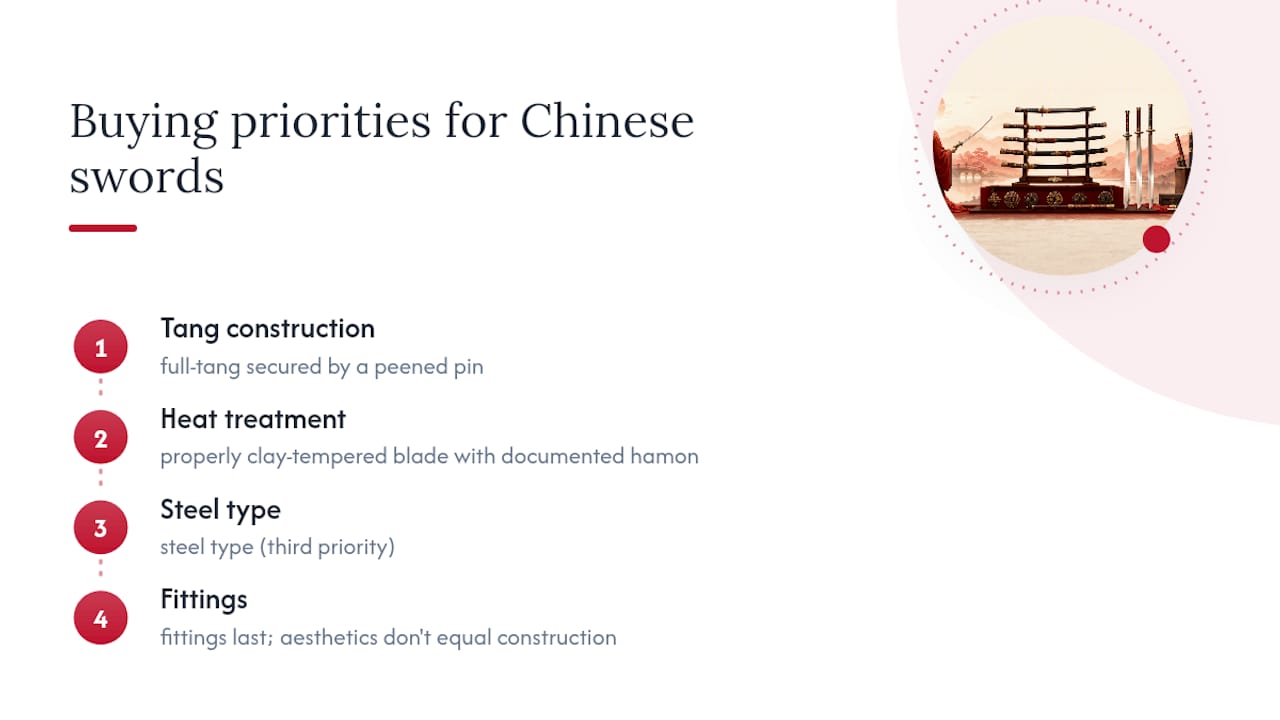
What actually matters, in order of priority: tang construction first, heat treatment second, steel type third, and fittings last. A plain iron guard on a properly clay-tempered full-tang blade is a better investment than an ornate bronze guard on a rat-tail tang. The techniques and philosophy behind Chinese swordsmanship reinforce this point — the sword is a tool for a practice, and the practice demands a tool built to withstand it.
One more thing the guides rarely say: the collector market for authentic antique Chinese swords is genuinely difficult to navigate without specialist knowledge. Andy Johnston’s identification guidance for collectors is one of the most honest treatments of the counterfeiting problem available in English. Read it before spending serious money on anything described as antique.
Moonswords carries handcrafted Chinese jian and dao built to functional standards
If you have worked through this guide and you know what you need — a heat-treated, full-tang dao for cutting practice, a museum-quality jian for your collection, or a custom commission for a specific historical period — Moonswords is where we would point you first. Our Chinese-style blades are hand-forged by Longquan artisans using clay tempering and full-tang construction, with product pages that show you the tang, the hamon, and the maker details before you commit to a purchase.
Browse the Moonswords Chinese dao collection for in-stock functional and display pieces, or contact our customer support team to discuss a custom commission. We ship internationally with full insurance and customs documentation support, and every purchase is backed by our warranty and return policy. If you are not sure which type fits your training or collecting goals, our team can walk you through the options — visit Moonswords to get started.
Sources
- Chinese sword
- The Chinese Broadsword (Dao): History, Form, and Fighting Spirit - Martial Journal
- Identifying Chinese Swords by Andy Johnston — Forde Military Antiques
- Swords in ancient Chinese warfare - World History Encyclopedia
This article is general information, not a substitute for advice from a qualified lawyer. Consult a qualified legal professional about your own circumstances before acting on anything here.
FAQ
What is a Chinese sword called?
The two main terms are jian (straight, double-edged sword) and dao (single-edged saber). Both are broad categories with many named subtypes, such as the liuyedao, niuweidao, and zhanmadao.
What is the most famous ancient Chinese sword?
The Sword of Goujian, a bronze jian dating to the Spring and Autumn period (c. 5th century BCE), is among the most celebrated. It was recovered from a Hubei tomb in near-perfect condition and is now housed in the Hubei Provincial Museum.
What is the classic Chinese sword used in martial arts?
The jian is traditionally associated with internal martial arts and scholarly practice, while the dao — particularly the liuyedao — is the standard weapon in many external kung fu systems. Modern wushu competition uses purpose-built nandao and wushu jian that differ technically from historical blades.
How much does a Chinese sword cost?
Prices vary widely, with decorative display pieces generally at the lower end of the market, functional blades at mid-tier prices, and master-forged, museum-quality pieces commanding higher costs, though exact figures depend on maker provenance and craftsmanship.
Are Chinese swords legal to own in the United States?
Ownership is legal in most U.S. states, but state laws vary on blade length, transport, and concealed carry. Always check your specific state’s statutes before purchasing, and confirm carrier policies before shipping.