

The four Moonswords handmade katanas worth your attention right now are the Tamahagane Steel Katana (serious collectors and display), the Atsu Katana “Ghost of Yōtei” in both Damascus and T10 variants (iaido and light training), the Black Dragon Katana (display and entry-level collection), and the Damascus Steel Nichirin Katana (high-end cutting and museum display). Your single most important decision before clicking “add to cart” is intended use: a blade built for tameshigiri cutting demands different steel, edge geometry, and tang construction than one destined for a wall mount or an iaido practice session.
Quick picks by use case:
- Collection/display: Tamahagane Steel Katana — traditional tamahagane, gold-gilded bronze fittings, clay-tempered full tang
- Iaido/light training: Atsu “Ghost of Yōtei” T10 — hand-forged, clay-tempered, full tang, balanced for movement
- Cutting/tameshigiri: Atsu “Ghost of Yōtei” Damascus — clay-tempered Damascus, full tang, hardened edge
- Display/entry collection: Black Dragon Katana — manganese steel, MoonSword Guild design, strong visual presence
- High-end cutting + display: Damascus Steel Nichirin Katana — Damascus, clay-tempered, silver and gold-gilded fittings
Before checkout on any model, confirm full-tang construction, steel specification, hamon visibility in product photos, and the seller’s stated shipping partner and warranty terms.
Table of Contents
- Featured Moonswords handmade katanas: specs and who each suits
- How to choose a handmade katana: the buying checklist
- What steel and forging method actually mean for your blade
- Battle-ready vs display: construction differences that matter
- Choosing blade length, weight, and balance for your use
- How to maintain a handmade katana
- U.S. legality, shipping, and transporting a katana
- How to verify authenticity and craftsmanship from product photos
- How Moonswords handles orders, custom options, and returns
- What price bands mean and what to expect at each level
- Our recommendation and your next step
- Key Takeaways
- Why these katanas represent what handmade should mean
- Moonswords: where to buy and how to request a custom order
- FAQ
Featured Moonswords handmade katanas: specs and who each suits
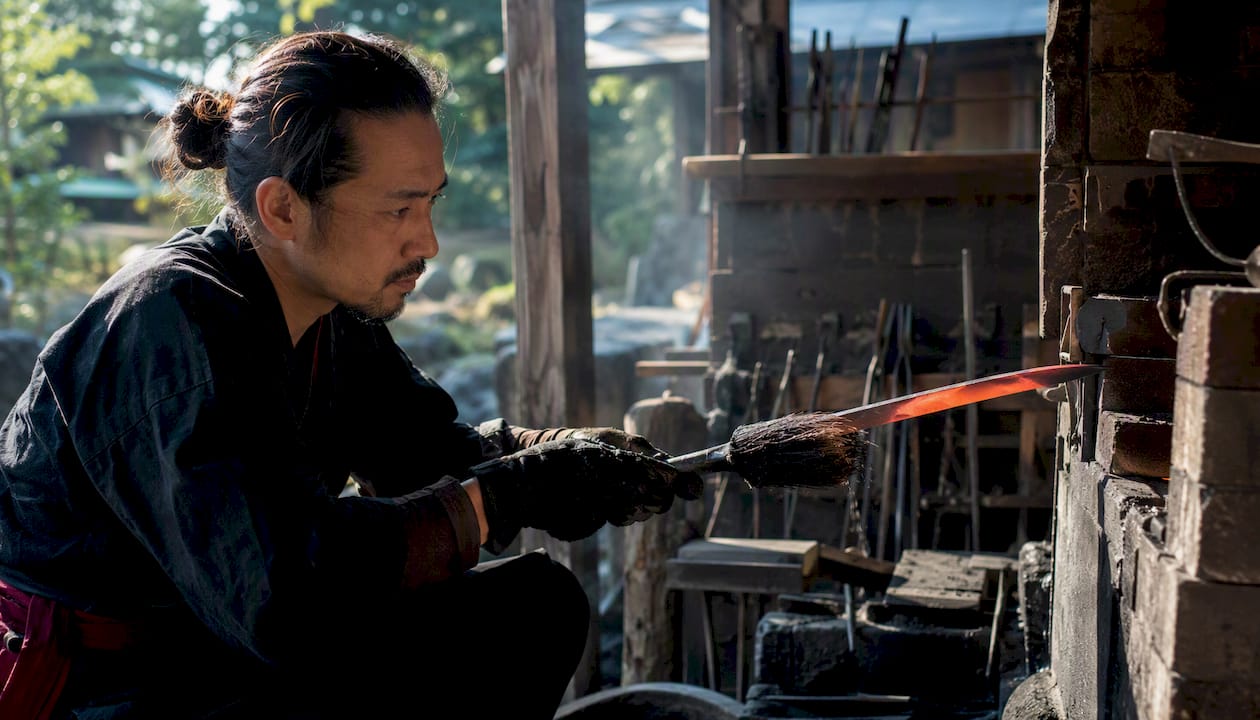
Each model below is hand-forged by master artisans using clay-tempering techniques that produce a genuine hamon — the visible temper line that separates the hard cutting edge from the tougher spine. That process is what distinguishes a true handcrafted Japanese sword from a machine-ground replica.
| Model | Steel / Forging | Tang | Best For | Fittings | Hamon |
|---|---|---|---|---|---|
| Tamahagane Steel Katana | Tamahagane, clay-tempered, hand-forged | Full tang | Collection / display | Gold-gilded bronze | Yes |
| Atsu “Ghost of Yōtei” T10 | T10 carbon steel, clay-tempered, hand-forged | Full tang | Iaido / light training | Traditional | Yes |
| Atsu “Ghost of Yōtei” Damascus | Damascus, clay-tempered, hand-forged | Full tang | Cutting / tameshigiri | Traditional | Yes |
| Black Dragon Katana | Manganese steel, full tang | Full tang | Display / entry collection | MoonSword Guild design | Varies |
| Damascus Steel Nichirin Katana | Damascus, clay-tempered, hand-forged | Full tang | High-end cutting + display | Silver and gold-gilded bronze | Yes |
Artisan attribution, customer ratings, warranty terms, and shipping details for each model live on the individual product pages linked above. We recommend reading those pages in full before ordering, particularly the shipping and returns sections.
How to choose a handmade katana: the buying checklist
The right katana selection starts with a single honest question: what will this blade actually do? Everything else follows from that answer.
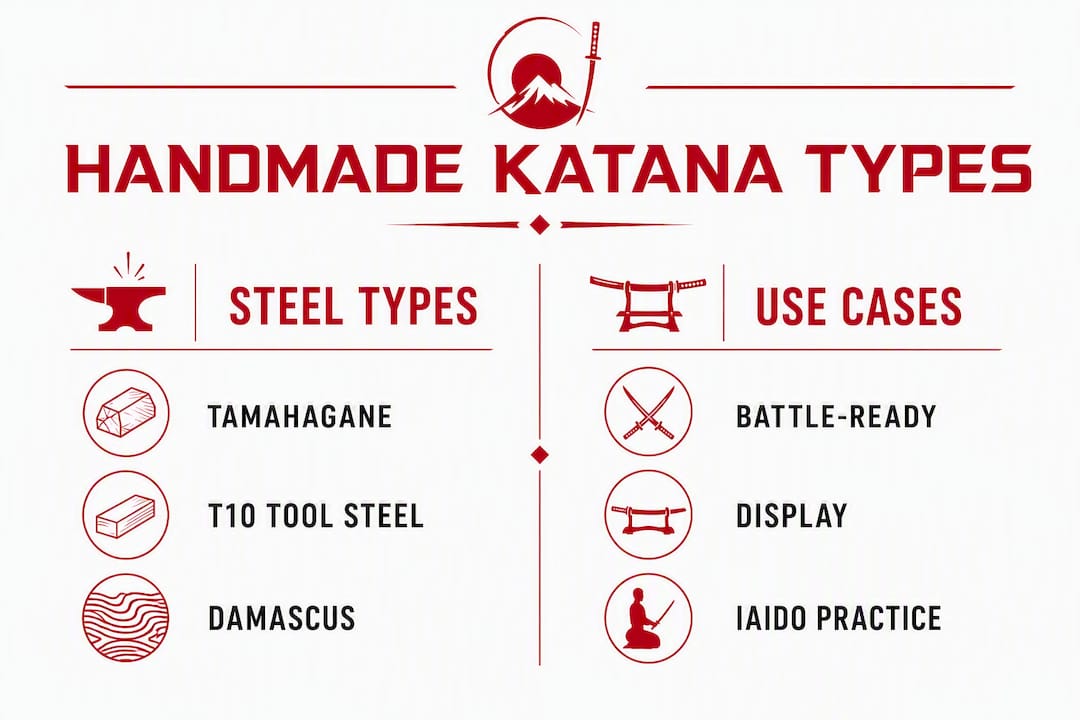
- Define intended use first. Cutting (tameshigiri) → battle-ready, full-tang, clay-tempered 1095/T10/Damascus with a hardened edge. Iaido/light training → prioritize balance, edge profile, and a polish suited to practice. Display/collection → focus on tamahagane, premium fittings, and artisan attribution.
- Verify steel and forging method. Look for a named steel grade (1095, T10, tamahagane, Damascus) and explicit “hand-forged” and “clay-tempered” language. Vague descriptions like “high-carbon steel” without a grade are a warning sign.
- Confirm full-tang construction. A full tang runs the blade’s steel the entire length of the handle. Partial or rat-tail tangs are structurally weaker and unsuitable for cutting or serious training.
- Check blade length against your body. A standard katana nagasa (blade length) runs roughly between medium lengths typical for katanas. For iaido, the blade tip should clear the saya cleanly when you draw; for display, proportion to the mounting matters more than personal fit.
- Assess fittings and finish. Tsuba, menuki, and kashira should be described with material specifics (bronze, iron, silver). Glued or plastic fittings on a “handmade” listing are a red flag.
- Set a realistic budget. Entry-level functional pieces start at lower price points; mid-range battle-ready swords occupy a moderate price band; tamahagane and museum-quality pieces are higher-end.
- Read the warranty and return policy before paying. Confirm coverage for damage on arrival and the seller’s process for resolving disputes.
Pro Tip: Request close-up photos of the nakago (tang) and mekugi holes before finalizing a custom order. The nakago’s condition, any artisan signature, and the cleanliness of the mekugi-ana (peg holes) tell you more about construction quality than any marketing description.
What steel and forging method actually mean for your blade
The steel specification on a product page is not marketing copy — it directly predicts how the blade will perform and age.
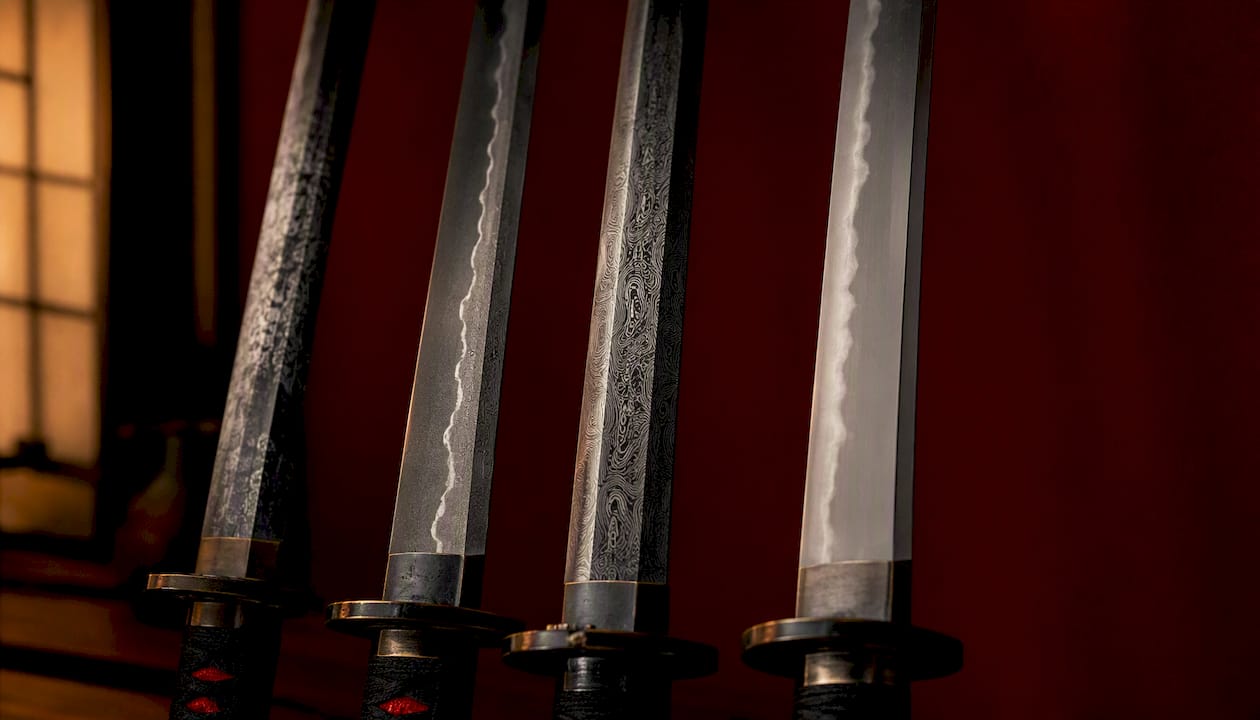
Tamahagane is the traditional Japanese steel smelted from iron sand in a tatara furnace. Its layered carbon structure produces the distinctive hada (grain pattern) visible on the blade’s surface. It is the most historically authentic material and commands the highest price, making it the natural choice for serious collectors who value provenance as much as performance.
1095 high-carbon steel is a reliable workhorse for battle-ready katanas. It holds an edge well, responds predictably to clay tempering, and is tough enough for tameshigiri. Most entry-level and mid-range functional swords use 1095 or its close relative T8. The Akitsu clay-tempered T8 katana is a practical example of what this steel delivers at a mid-range price.
T10 tool steel adds tungsten to the carbon-steel formula, which improves wear resistance and edge retention compared to standard 1095. Clay-tempered T10 blades like the Aka-Oni and the Atsu “Ghost of Yōtei” T10 variant are well-suited to iaido practitioners who draw and sheathe repeatedly, since the harder edge resists micro-chipping better than softer steels.
Damascus (pattern-welded) steel is forged by layering and folding two or more steel types, then acid-etching to reveal the flowing grain pattern. The result is visually striking and structurally sound, though the performance advantage over mono-steel T10 is modest for most users. Where Damascus excels is in combining cutting capability with display-worthy aesthetics — which is exactly why the Atsu Damascus and the Nichirin Katana occupy the upper end of our lineup.
Clay tempering is the process that creates the hamon. A smith applies a clay mixture to the blade before the final quench: thicker clay on the spine slows cooling there, leaving it tough and flexible, while the thinly coated edge cools fast and becomes hard. The resulting temper line (hamon) is functional proof of proper heat treatment, not decoration.
Pro Tip: If a seller claims “clay-tempered” but shows no hamon in product photos, ask for a close-up of the blade in raking light. A genuine hamon is always visible. No hamon photo means either the blade was not clay-tempered or the seller cannot document it.
Battle-ready vs display: construction differences that matter
Choosing the wrong construction type for your intended use is the most common and most expensive mistake buyers make.
Battle-ready construction:
- Full tang running the complete length of the handle, secured with mekugi (bamboo or wood pegs)
- Edge hardened through clay tempering and proper quench, capable of cutting
- Blade geometry optimized for draw and cut (shinogi-zukuri cross-section)
- Fittings fitted tightly without adhesive
Display/replica construction:
- Partial, rat-tail, or glued tang — adequate for wall mounting, not for use
- Edge may be unsharpened or only cosmetically finished
- Fittings sometimes glued or cast from zinc alloy
- Polish prioritizes visual appearance over functional geometry
Red flags on a product page that suggest display-only:
- Tang described as “stainless steel” (stainless does not hold a proper edge)
- No mekugi or mekugi-ana mentioned or shown
- Fittings listed as “zinc alloy” with no further detail
- Steel grade absent or listed only as “carbon steel” with no number
- Price under $80 for a claimed “hand-forged” blade
For iaido and light training, a battle-ready full-tang blade is the minimum. For tameshigiri, clay-tempered T10 or Damascus with a confirmed hardened edge is the standard.
Choosing blade length, weight, and balance for your use
A blade that fits your body and your practice style handles better and reduces fatigue. For iaido, the traditional fit test is simple: with the saya at your hip, the blade tip should clear the mouth of the scabbard cleanly on the draw without catching. Most practitioners find a medium nagasa comfortable; taller practitioners often prefer a slightly longer blade.
Weight and balance point matter differently depending on use. For iaido, a blade balanced moderately ahead of the tsuba allows controlled, fluid cuts without arm fatigue during extended practice. Cutting-focused swords can carry slightly more forward weight to add momentum through the target. Display pieces have no handling requirement, so balance is irrelevant — proportion and visual weight relative to the mounting are what count.
When reviewing product specs, look for overall length, nagasa (blade length), tsuka (handle) length, and weight in grams or ounces. A typical full-size katana weighs a moderate amount consistent with traditional Japanese swords. If a listing omits weight entirely, contact the seller before ordering — weight is a basic spec that any reputable maker can provide.
How to maintain a handmade katana
A hand-forged carbon-steel blade requires consistent care. Neglect for even a few weeks in a humid environment can produce rust that damages the polish and, eventually, the steel itself.
- Out-of-box inspection. Remove the blade from the saya slowly and check for shipping damage: nicks on the edge, loose fittings, or cracks in the lacquer. Photograph anything unusual immediately and contact the seller.
- Initial cleaning. Wipe the blade with a clean, lint-free cloth to remove the factory oil. Apply a thin, even coat of choji oil (clove-infused mineral oil) using a soft cloth or uchiko ball, working from the habaki toward the tip.
- Regular oiling. For display pieces, re-oil every 30–60 days. For blades handled or drawn regularly, oil after every session. Use choji oil or a food-grade mineral oil; avoid WD-40 and automotive oils, which leave residue that attracts dust.
- After cutting use. Clean the blade immediately after tameshigiri. Wipe away moisture and debris, then apply a fresh coat of oil before returning the blade to its saya.
- Storage. Store horizontally on a sword stand (katana-kake) with the edge facing upward. Avoid acrylic display cases that trap moisture against the blade. For transport, a padded sword bag is safer than a hard case that can transmit impact directly to the blade. Collector-grade storage and transport options are worth considering for high-value pieces.
- Sharpening. Carbon-steel katanas can be sharpened on Japanese water stones (starting at 400 grit and finishing at 2,000–3,000 grit). Do not use a mechanical grinder — it generates heat that destroys the temper. For tamahagane blades, professional polishing by a trained togishi is the correct approach.
U.S. legality, shipping, and transporting a katana
Possession of a katana is legal in the United States for adults in the vast majority of states. Carrying one in public is a different matter: most states prohibit carrying bladed weapons openly or concealed in public spaces, and local ordinances can be stricter than state law. California, New York, and a few other states have specific restrictions on blade length and carry method. Always verify your state and local rules before transporting a blade outside your home.
For shipping, reputable sellers declare the full value of the blade, package it in a rigid crate or padded hard case, and require a signature on delivery. Moonswords ships internationally; if you are ordering from outside the United States, request customs documentation from the seller before the package ships. Some countries classify katanas as regulated weapons and require import permits.
Pro Tip: Before placing an order, confirm the seller’s stated shipping carrier and whether the shipment includes insurance for the declared value. A $1,200 tamahagane blade shipped without insurance is an unnecessary risk. Ask for the tracking number and insurance certificate as part of your order confirmation.
How to verify authenticity and craftsmanship from product photos
A reputable seller of handcrafted Japanese swords will always provide detailed photos. If the listing shows only glamour shots, ask for the following before buying.
Photo checklist:
- Nakago (tang): visible in full, showing any artisan signature (mei), file marks, and the condition of the steel at the base
- Mekugi-ana: the peg holes through the tang and handle — should be clean and properly aligned
- Hamon: photographed in raking or natural light so the temper line is clearly visible along the full length of the blade
- Kissaki (tip): close-up showing polish quality and geometry
- Fittings: individual shots of tsuba, menuki, and kashira showing material and finish
Questions to ask the seller:
- Who forged this blade, and can you provide artisan attribution?
- What heat-treatment process was used, and can you show process photos?
- Does this blade have test-cutting records (for battle-ready models)?
- What is your return policy if the blade arrives damaged?
Vague answers to any of these questions, combined with inconsistent product photos, are the clearest signal that a “handmade” claim is overstated. Moonswords provides artisan attribution and process documentation on its product pages, which is the standard we recommend holding any seller to.
How Moonswords handles orders, custom options, and returns
The ordering process at Moonswords follows a clear sequence for both standard and custom pieces:
- Browse the storefront or high-end collection and select a model or submit a custom request.
- For custom orders: confirm design specifications, steel choice, fittings, and handle wrap with the Moonswords team before production begins.
- Pay deposit (custom) or full amount (standard stock pieces) at checkout.
- Production, quality control, and final inspection by the artisan team.
- Shipping with tracking and, for high-value pieces, insurance documentation.
| Order type | Typical lead time |
|---|---|
| Standard stock piece | 2–4 weeks (production + shipping) |
| Custom mid-range (T10/Damascus) | 6–10 weeks |
Warranty, return, and damage-on-arrival procedures are detailed on each product page. We recommend reading those terms before checkout. For buyers exploring the broader U.S. market, Moonswords also publishes guidance on alternatives and trusted sellers to help you make an informed comparison.
What price bands mean and what to expect at each level
Price is the clearest signal of what a handmade katana actually contains — and what corners were cut to hit a number.
Under $300: Functional entry-level pieces in 1045–1095 carbon steel, typically with a full tang and basic fittings. Clay tempering is possible at this price but less common; verify it explicitly. The Moonswords entry-level collection and the best functional katanas under $300 collection show what honest entry-level specs look like. Expect a serviceable blade for light training or casual display, not a collector piece.
$300–$1,000: The mid-range is where clay-tempered T10 and Damascus blades live, with better fittings, more consistent polish, and the option for customization. Most serious practitioners and beginning collectors shop here. Artisan attribution becomes more common, and warranty coverage is typically more detailed.
$1,000 and above: Tamahagane and museum-quality Damascus pieces with premium fittings (silver, gold-gilded bronze), full artisan documentation, and collector-grade polish. The Tamahagane Steel Katana and Damascus Steel Nichirin Katana sit in this tier. At this price, you are paying for material provenance, hours of hand-polishing, and the kind of craftsmanship that holds value over time.
Our recommendation and your next step
For most collectors and martial artists visiting Moonswords for the first time, the Atsu “Ghost of Yōtei” in T10 or Damascus is the right starting point: it covers both training and display needs, carries full-tang clay-tempered construction, and sits in the mid-range price band where quality-to-value is strongest. Serious collectors ready to invest in a centerpiece piece should go directly to the Tamahagane Steel Katana or the Damascus Steel Nichirin Katana.
View the full lineup at the Moonswords storefront, or contact the team to discuss a custom order tailored to your steel preference, handle length, and fittings.
Key Takeaways
A genuine handmade katana requires full-tang construction, a named steel grade, clay tempering confirmed by a visible hamon, and clear artisan attribution — verify all four before purchasing.
| Point | Details |
|---|---|
| Intended use drives every choice | Decide cutting, iaido, or display first; steel and construction follow from that decision. |
| Full tang is non-negotiable for use | Partial or rat-tail tangs are unsuitable for training or cutting — confirm full-tang construction in product specs. |
| Hamon confirms clay tempering | A genuine clay-tempered blade always shows a visible hamon; no hamon photo means no verified heat treatment. |
| Price bands signal real differences | Under $300 for entry-level functional; $300–$1,000 for battle-ready mid-range; $1,000+ for tamahagane and museum-quality. |
| Moonswords top picks by use case | Atsu T10/Damascus for training and cutting; Tamahagane and Nichirin Damascus for high-end collection and display. |
Why these katanas represent what handmade should mean
The most common mistake buyers make is treating “handmade” as a marketing adjective rather than a verifiable construction standard. After years of working with master artisans and reviewing what actually reaches collectors’ hands, the gap between a genuinely hand-forged blade and a machine-ground sword with decorative fittings is wider than most product listings suggest.
What separates the Moonswords lineup is specificity. The Tamahagane Steel Katana names its material, its tempering method, its tang construction, and its fittings — and backs those claims with process photos and artisan attribution. The Atsu “Ghost of Yōtei” variants offer the same transparency at a more accessible price point, which is why they suit practitioners who need a blade they can actually use without treating it as a museum artifact. The Damascus Steel Nichirin Katana sits at the intersection of functional cutting capability and display-worthy craftsmanship, a combination that is genuinely rare at any price.
Our sourcing standard at Moonswords is straightforward: every blade must be traceable to a named artisan, must show a documented heat-treatment process, and must pass a final quality inspection before it ships. That standard is what we hold ourselves to, and it is the same standard you should apply to any seller you consider.
Moonswords: where to buy and how to request a custom order
The sharpest reason to start your search at Moonswords rather than a general marketplace is documentation. Every piece in our catalog comes with artisan attribution, steel specification, and process photos — the three things that are hardest to fake and most often missing from listings that turn out to be disappointing on arrival.
Our high-end katana collection covers tamahagane and Damascus pieces with premium fittings, full-tang construction, and collector-grade polish. Custom orders are available across most models: choose your steel, handle length, tsuba style, and saya finish, and our team will confirm specifications before production begins. International shipping is available, and we provide customs documentation for all international orders. Warranty and return terms are listed on every product page.
To start, browse the Moonswords storefront or reach out directly to request close-up nakago and hamon photos for any custom piece before you commit.
FAQ
What makes a katana truly handmade?
A genuine handmade katana is hand-forged by a smith, clay-tempered to produce a visible hamon, and fitted with a full tang secured by mekugi pegs. Machine-ground blades with decorative fittings do not meet this standard regardless of how they are marketed.
Is it legal to own a katana in the United States?
Possession is legal for adults in nearly all U.S. states. Carrying a katana in public is restricted under most state and local laws, so check your specific state and municipal rules before transporting a blade outside your home.
How long does a custom Moonswords katana take to arrive?
Standard stock pieces typically ship within a few weeks. Custom mid-range orders in T10 or Damascus require several weeks, and high-end tamahagane commissions take multiple months from order confirmation to delivery.
What steel is best for iaido practice?
Clay-tempered T10 is the preferred choice for iaido: it holds an edge through repeated drawing and sheathing better than standard 1095, and the clay-tempered spine stays flexible enough to absorb the stresses of practice. The Atsu “Ghost of Yōtei” T10 variant is a strong option at the mid-range price point.
How do I spot a low-quality “handmade” katana listing?
Look for missing steel grades, no hamon photos, fittings described only as “zinc alloy,” and prices under $80 for claimed hand-forged construction. Any seller unwilling to provide nakago and hamon close-ups on request is a seller worth avoiding.