

The Dao sword is defined as the single-edged curved blade at the center of Chinese martial arts, serving both as a battlefield weapon and a training tool for over two millennia. When you select a Dao sword Kung Fu style, the choice shapes every aspect of your practice: the blade you carry, the techniques you drill, and the martial philosophy you internalize. Major styles range from traditional forms like the liuyedao (willow leaf saber) to modern competitive systems governed by International Wushu Federation (IWUF) standards. Getting this decision right from the start saves years of misdirected training.
What does selecting a Dao sword Kung Fu style actually mean?
Selecting a Dao sword Kung Fu style means matching a specific blade tradition, technical curriculum, and martial philosophy to your personal training goals. The Dao is not one weapon but a family of blades, each tied to a distinct fighting system. Traditional Dao variants) range from the infantry liuyedao to the two-handed changdao, while modern training splits between heavier traditional blades and contemporary performance swords. That split matters because the blade you train with shapes the body mechanics you develop.
The two broadest categories are traditional styles and contemporary wushu styles. Traditional styles prioritize power generation, whole-body coordination, and martial application. Contemporary wushu styles, governed by IWUF competition rules, prioritize choreographed routines, acrobatic difficulty, and timed performance. Knowing which category fits your goals is the first decision you make.
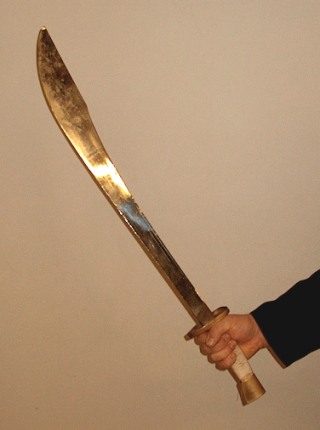
What are the main Dao sword styles in Kung Fu?
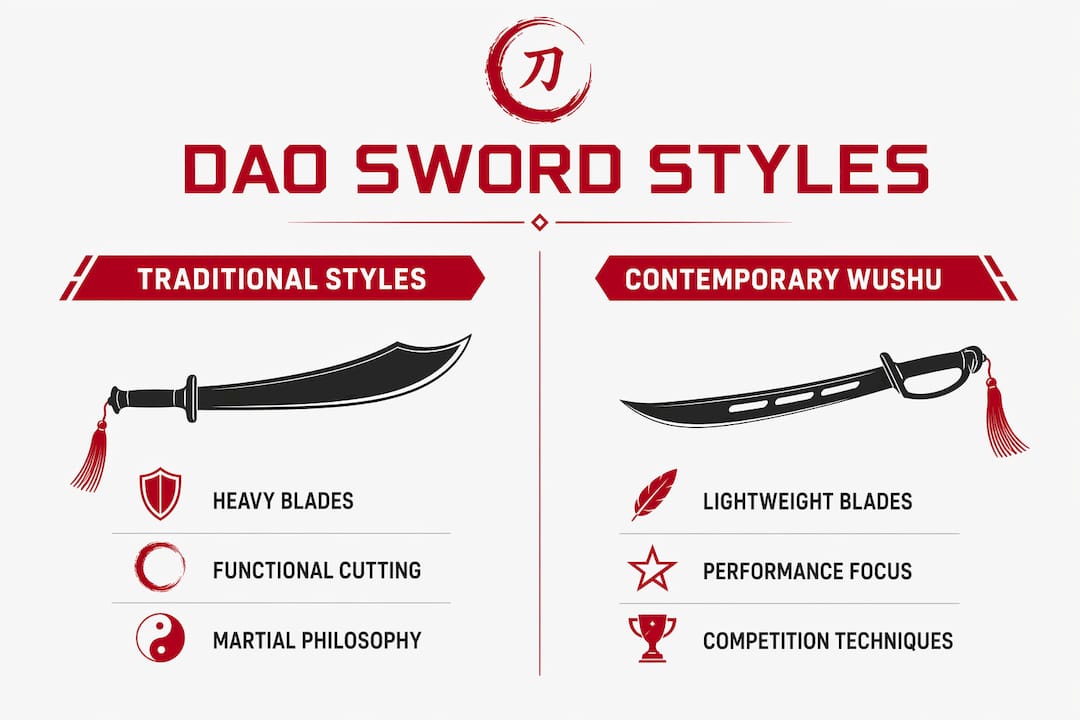
The major Dao sword styles each carry a distinct technical identity. Understanding their differences lets you make an informed choice rather than defaulting to whatever your first school happens to teach.
Traditional styles
- Liuyedao (willow leaf saber): The most widely practiced traditional Dao style. It features a moderately curved, single-edged blade suited to fast, continuous slashing combinations. Shaolin and Northern styles emphasize fast, powerful liuyedao techniques, prioritizing aggressive forward momentum and balance between the sword hand and the empty hand.
- Niuweidao (oxtail saber): Recognizable by its flared, fan-shaped tip. Some niuweidao designs) are more theatrical than practical for training, which can mislead beginners into developing habits that do not transfer to traditional forms.
- Changdao (long saber): A two-handed variant that demands greater strength and reach. It suits practitioners with a background in staff or spear work, since the body mechanics overlap significantly.
Modern competition styles
- Daoshu: The standard competition broadsword form under IWUF rules. It combines liuyedao techniques with acrobatic jumps and spins, demanding both power and flexibility.
- Nandao: A southern broadsword style officially ratified for wushu competition in 1999, featuring a unique blade shape and stance requirements drawn from southern Chinese martial traditions. Its footwork and guard positions differ visibly from northern Daoshu.
| Style | Primary focus | Blade type | Best for |
|---|---|---|---|
| Liuyedao | Traditional technique, speed | Moderately curved | Traditional training |
| Niuweidao | Display, theatrical forms | Flared tip | Collectors, demonstration |
| Daoshu | Competition performance | Flexible, lightweight | Wushu competitors |
| Nandao | Southern competition | Distinct southern profile | Competition, southern styles |
| Changdao | Power, reach | Long, two-handed | Advanced practitioners |
Pro Tip: Visit a school that trains multiple Dao styles before committing. Watching practitioners move with each blade tells you more than any written description.
How do you choose the right Dao style for your goals?
The right Dao style follows directly from your primary martial goal. Forcing a mismatch between your goal and your style wastes training time and builds the wrong physical habits.
-
Define your primary goal. Traditional skill development, wushu competition, or classical martial application each point to a different style. Competition practitioners need to study IWUF-regulated techniques including Gōng Bù (Bow Stance), Mǎ Bù (Horse Stance), and Guǒ Nǎo (Wrapping), since these are mandatory in judged routines.
-
Assess your physical profile. Heavier traditional blades reward practitioners with strong wrists and shoulders. Lightweight competition swords favor agility and flexibility. Be honest about where your body is now, not where you hope it will be in two years.
-
Match the technical curriculum to your current skill level. Competition routines for Daoshu and Nandao) must run between 80–95 seconds and include required techniques like Pī Dāo (chopping), Zhā Dāo (thrusting), and Guǒ Nǎo (wrapping). That technical density demands a solid foundation before you enter competition training.
-
Consider the martial philosophy behind the style. Shaolin philosophy frames the Dao as the weapon of the soldier, emphasizing aggressive continuous motion. Internal styles use the Dao for power development and whole-body coordination rather than aggressive attack patterns. These are genuinely different training experiences.
-
Evaluate your equipment budget. A quality practice Dao with correct weight and balance costs more than a cheap decorative piece. Authentic Chinese swordsmanship practice requires a blade with the correct weight and rigidity to build real body mechanics.
Pro Tip: Train with a heavier traditional blade for at least three months before switching to a lightweight competition sword. The strength and mechanics you build carry over. The reverse is rarely true.
How do you learn a Dao sword Kung Fu style step by step?
Learning a Dao sword style follows a clear progression. Skipping steps creates technical gaps that become harder to fix the longer they go unaddressed.
-
Master fundamental stances first. Gōng Bù and Mǎ Bù are the foundation of every Dao technique. Spend the first weeks drilling these without the sword until the positions are automatic.
-
Learn the basic grip and carry positions. The Dao grip differs from a jian grip. The thumb and index finger control the blade angle; the remaining fingers generate power. Practice transitions between carry and guard positions slowly before adding speed.
-
Drill core chopping and thrusting techniques in isolation. Pī Dāo (chop), Zhā Dāo (thrust), and Liāo Dāo (upward cut) each require a distinct body rotation. Practice each one as a standalone movement before linking them into combinations.
-
Add wrapping and circular techniques. Guǒ Nǎo (wrapping around the head) and Chán Tóu (winding around the body) are the techniques that separate Dao from straight-sword practice. They demand shoulder flexibility and precise blade control. Dao training develops both physical conditioning and a martial mindset of decisive, committed action, and these wrapping techniques are where that mindset becomes physical.
-
Integrate breathing and whole-body coordination. Each power technique should exhale on the strike. Breathing patterns are not decorative. They regulate tension, timing, and recovery between movements.
-
Build competition timing last. Once techniques are clean, practice full routines within the 80–95 second window. Timing pressure reveals weaknesses in transitions that slow practice hides.
“Balancing aesthetics and martial function in sword forms is key to true mastery, transcending performance to practical use.” The practitioner who trains only for visual effect builds a form that looks correct but breaks under pressure. The practitioner who trains only for power loses the precision that makes the Dao effective.
Common training mistakes to avoid:
- Gripping too tightly throughout the entire movement (power comes from a relaxed grip that tightens only at the moment of impact)
- Neglecting the empty hand, which should mirror and counterbalance the sword hand throughout every technique
- Rushing to learn forms before individual techniques are clean
- Training exclusively with a lightweight sword, which masks technical flaws that a heavier blade would immediately expose
How should you maintain a Dao sword for display and longevity?
Proper maintenance is not optional. A neglected blade becomes a safety hazard, and a damaged edge changes the balance and character of the blade. Sword maintenance directly affects both safety and performance in ways that practitioners often underestimate.
- Clean the blade after every handling. Fingerprints and skin oils accelerate rust on carbon steel. Wipe the blade with a clean cloth, then apply a light coat of oil (camellia or mineral oil both work) before storage.
- Inspect the handle and fittings regularly. A loose handle on a Dao is dangerous. Check that the handle collar (habaki equivalent in Chinese fittings) is seated firmly and that the handle wrap shows no fraying.
- Store the blade horizontally or edge-up in a rack. Storing edge-down on a hard surface rounds the edge over time. A wooden rack or padded stand protects both the edge and the finish.
- Treat traditional steel and performance blades differently. Traditional high-carbon steel Dao blades require more frequent oiling than stainless or spring-steel competition blades. Competition blades need regular inspection for flex fatigue, since repeated bending during routines can create micro-fractures near the tip.
- Sharpen only when necessary and only with the correct tools. A Dao kept for display and study does not need a razor edge, and forms practice belongs with an unsharpened practice blade. Over-sharpening thins the blade and shortens its life.
Pro Tip: Keep a small maintenance kit near your display: a clean cloth, a small bottle of oil, and a wooden dowel for handle checks. Two minutes of care after each handling prevents months of repair.
Key Takeaways
Selecting the right Dao sword Kung Fu style requires matching your martial goals, physical profile, and equipment to a specific blade tradition and technical curriculum before you begin serious training.
| Point | Details |
|---|---|
| Style defines training | Each Dao style carries a distinct blade type, philosophy, and technical curriculum that shapes your entire practice. |
| Competition has fixed rules | IWUF Daoshu and Nandao routines run 80–95 seconds and require specific techniques like Pī Dāo and Guǒ Nǎo. |
| Blade weight matters | Training with a heavier traditional blade builds real body mechanics that lightweight performance swords cannot replicate. |
| Learn techniques before forms | Drilling Pī Dāo, Zhā Dāo, and Guǒ Nǎo in isolation before linking them prevents deep-rooted technical errors. |
| Maintenance protects your investment | Regular cleaning, oiling, and handle inspection keep your Dao safe and performing correctly for years. |
What I’ve learned from years of watching practitioners choose the wrong style
The most common mistake I see is practitioners choosing a Dao style based on how it looks rather than what it demands. A Nandao routine filmed at a national wushu championship is visually spectacular. That spectacle draws people in, and they sign up for competition training without the foundational strength or technical base to support it. Six months later, they are frustrated and often injured.
The practitioners who progress fastest are the ones who spend their first year with a traditional liuyedao and a school that prioritizes martial arts and Chinese swordsmanship as a unified discipline rather than a performance art. They build the wrist strength, the stance depth, and the body rotation that every Dao style ultimately requires. When they eventually move to competition training or explore internal style Dao applications, the transition is clean.
Grandmaster Yang Zhen Duo’s observation that graceful sword form must carry underlying martial mechanics is the clearest statement of this principle I have encountered. The form is not the goal. The form is the container for the mechanics. When you select a style, select the one whose mechanics you are willing to build slowly and correctly, not the one whose form you most want to perform.
The Dao also teaches something that no other training tool replicates quite as directly: committed action. Every Dao technique requires you to commit your body weight and direction. Hesitation produces a weak, off-balance cut. That lesson transfers well beyond the training floor.
— Kenji Smith
Handcrafted Dao swords worthy of a serious collection
A serious appreciation of the Dao deserves a blade built to the same standard. At Moonswords, our hand-forged swords are crafted by master artisans using centuries-old techniques, including full tang construction and traditional forging methods that produce authentic, well-balanced collector pieces.

Whether you are exploring your first traditional style or building a collection inspired by Chinese martial heritage, an authentic hand-forged Dao brings that tradition to life. Browse the Moonswords sword collection to find handcrafted Dao and related blades made for collectors who appreciate the craft. We also carry maintenance accessories so your blade stays in peak condition for years to come.
FAQ
What is the best Dao sword style for beginners?
The liuyedao style is the best starting point for most beginners. Its moderate blade curve and emphasis on fundamental technique and stance work build the body mechanics that every other Dao style requires.
How long does a Daoshu competition routine last?
IWUF Daoshu competition routines must run between 80–95 seconds and include required techniques such as Pī Dāo, Zhā Dāo, and Guǒ Nǎo. Timing and technical completeness are both judged.
Is the niuweidao good for martial arts training?
The niuweidao is primarily a display and theatrical weapon. Its flared tip design suits theatrical forms, and beginners who train with it often develop habits that do not transfer to traditional Dao forms.
What blade weight should I train with?
Traditional training Dao blades are heavier than competition performance swords. Training with a heavier blade builds strength and correct body mechanics. Lightweight competition swords are appropriate only after that foundation is established.
How does Nandao differ from standard Daoshu?
Nandao is a southern Chinese broadsword style ratified for wushu competition in 1999. It features a distinct blade profile and southern-style stances that differ visibly from the northern-influenced Daoshu form.