

A decorative replica runs $50 to $300. An entry-level functional sword lands between $200 and $800. Quality production katanas sit at $800 to $3,000. Handmade, traditionally forged nihontō start around $5,000 and climb well past $20,000. Antique and museum-grade collector blades range from $3,000 to over $100,000, depending on the smith and condition.
That’s the honest map of where your money goes. We’ve spent years helping collectors and martial artists at Moonswords match budget to purpose, and the biggest mistake we see is a buyer expecting antique quality at replica prices, or dismissing a $250 practice sword because it isn’t “real” nihontō when it was never meant to be.
The price gap widens fast once provenance and certification enter the picture. A blade with NBTHK papers, a legible signed mei, and documented ownership history can be worth ten times more than a visually similar sword without paperwork.
- Decorative/replica: $50–$300
- Entry-level functional: $200–$800
- Quality production: $800–$3,000
- Handmade nihontō: $5,000–$20,000+
- Antique/collector: $3,000–$100,000+
Pro Tip: Before you shop, decide whether you want to display it, train with it, cut targets, or invest in it.
Key Takeaways
Katana prices track five distinct tiers, from $50 decorative replicas to $100,000-plus antiques, and provenance, certification, and maker reputation matter more than blade size or ornamentation in determining where any specific sword lands.
| Point | Details |
|---|---|
| Match price to purpose | Decide display, practice, cutting, or investment before shopping; each purpose has a realistic price floor. |
| Verify before paying | Request bare tang photos, NBTHK certificate numbers, and polish history for anything over a few hundred dollars. |
| Documentation drives resale | A signed mei with NBTHK papers can multiply resale value compared to an identical unpapered blade. |
| Budget beyond the purchase | Set aside funds for periodic polish, humidity-controlled storage, and insurance on higher-value blades. |
| Shop by tier at Moonswords | Moonswords’ entry-level, high-end, and custom commission collections map directly to the budget bands buyers actually shop in. |
Table of Contents
- Katana Price Range for Replicas and Decorative Swords
- What Do Entry-Level and Production Katanas Cost?
- Why Do Handmade Nihontō Cost So Much More?
- How Are Antique Katana Prices Determined?
- What Really Drives Katana Price?
- How Do You Verify a Katana’s Authenticity?
- Buying Checklist: Matching Budget to Purpose
- What Ongoing Costs Come With Owning a Katana?
- How Does MoonSwords Fit Across These Price Bands?
- Our Take: Buy for Purpose First, Not for the Story
- Ready to Buy? Here’s Where to Start
- Sources
- FAQ
Katana Price Range for Replicas and Decorative Swords
A replica katana usually costs $50 to $300, and at this level, “katana” is a loose description more than a construction standard. Most blades here are stamped stainless steel, often with a fixed or partially hollow tang, and fittings glued or pinned rather than properly peened.
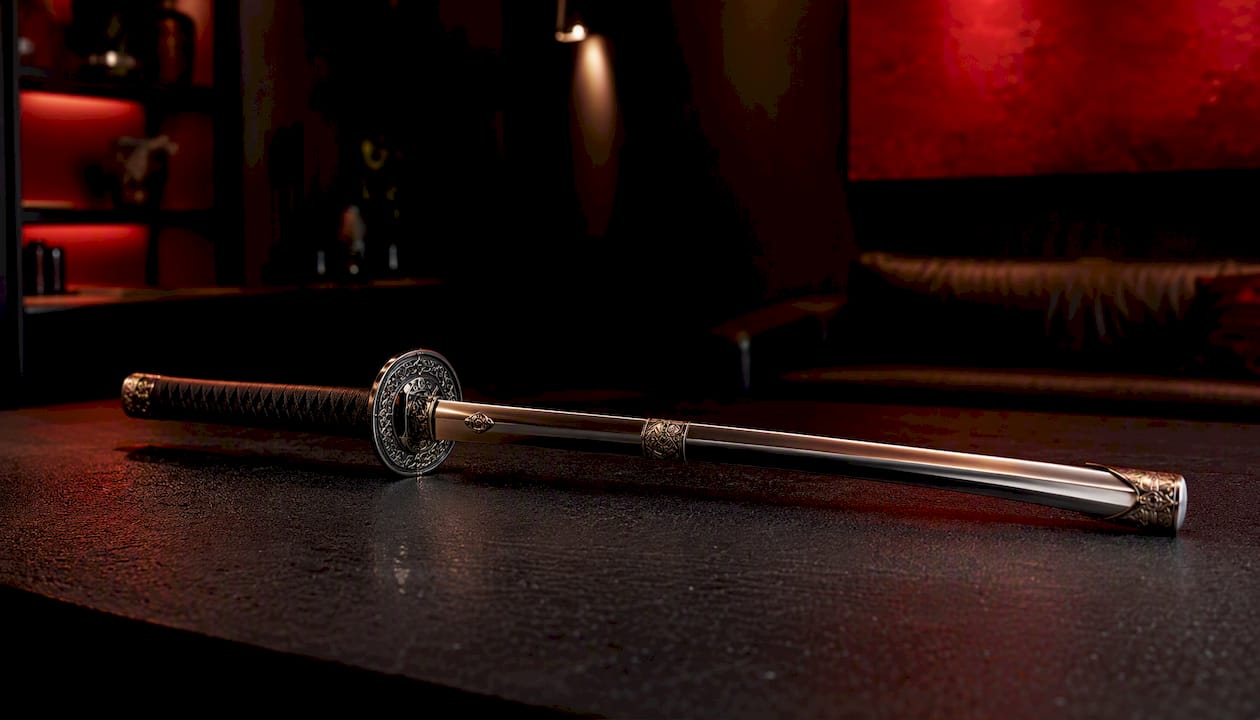
These swords are built to look good on a wall, not to hold an edge or absorb the shock of contact. Stainless steel is a poor choice for anything that flexes or strikes something firm. It’s harder and more brittle than the carbon steels used in functional blades, which means it tends to chip or even snap under stress instead of bending.
That said, not every sword in this price band is unusable. Some sub $300 pieces have a genuine full tang and decent stainless or low-carbon construction, which makes them acceptable for solo kata practice with no contact. The trouble is telling those apart from the ones that will fail during use, and at this price, sellers rarely disclose construction details clearly.
Watch for these red flags before buying anything in the replica tier:
- A tsuba (hand guard) that wobbles or spins freely on the blade
- Fittings held together with visible glue rather than mechanical fit
- A blade that flexes unevenly or shows pitting straight out of the box
- No mention of tang construction (full tang versus a welded rod) anywhere in the listing
- Praise like “battle ready” attached to a sword under $100, which is almost never accurate
If a listing can’t tell you what steel the blade is made from, treat it as decorative only, regardless of what the title says.
What Do Entry-Level and Production Katanas Cost?
Functional katanas suitable for practice generally fall within a moderate price range often categorized into entry-level and quality production tiers, distinguished mainly by materials and finish rather than shape.
At the entry-level end, expect a full tang (the blade’s steel extending the length of the handle, not a separate rod welded on), a basic but even polish, and steel like 1045 or 1060 carbon steel. These swords handle solo Iaido kata reasonably well. Some can survive light tameshigiri (test cutting) on soft targets like rolled tatami mat, though the fittings and edge geometry often aren’t refined enough for repeated cutting sessions.
Move into the $800 to $3,000 range and the construction tightens up noticeably. You’ll typically see:
- Higher carbon steels such as 1095 or T10, which hold an edge longer and resist chipping better
- A visible, sometimes genuine clay-tempered hamon rather than an acid-etched or sandblasted imitation
- Peened, fitted mounts (tsuba, habaki, and tsuka) instead of glued-on hardware
- A proper polish that reveals grain structure, not just a mirror shine
These swords are appropriate for regular tameshigiri, ongoing Iaido or Kenjutsu training, and light contact work. What they’re not appropriate for is heavy sparring against another blade edge to edge, which no production katana at any price is really built to survive without damage.
Pro Tip: If a seller can’t tell you the steel type and whether the tang is full length, walk away, even if the price looks reasonable. That single piece of information tells you more about durability than any photo.
Why Do Handmade Nihontō Cost So Much More?
Commissioned nihontō, traditionally forged by licensed Japanese smiths, typically command significantly higher prices that increase with the reputation of the smith and materials used. This isn’t a production process you can shortcut. A licensed smith spends weeks folding and forging tamahagane, the traditional smelted steel, then applies a clay coating unevenly along the blade before quenching it, which creates the differential hardness that produces a genuine hamon.
Several factors stack on top of the base price:
- Smith reputation: A recognized or awarded smith’s work commands a significant premium over an unknown maker
- Materials: Tamahagane costs more to produce than commercial carbon steel and requires more skill to work
- Ornamentation: Gold or silver fittings, elaborate saya (scabbard) lacquer work, and custom koshirae (the full mounting) add cost on top of the blade itself
- Polish: A traditional multi-stage hand polish by a togishi (polisher) can take weeks and cost thousands on its own
Lead times matter as much as price here. Master smiths often quote long waiting periods for a commission, sometimes a year or more, and buyers importing from Japan need to budget separately for export paperwork, shipping insurance, and customs handling on top of the sword’s price.
Documentation compounds the value over time. A nihontō with a clear paper trail, an NBTHK grading, and a known smith’s signed mei retains and often appreciates in value far more reliably than an undocumented blade of similar quality. Buyers who skip paperwork to save money at purchase frequently lose far more than they saved when they try to resell.
How Are Antique Katana Prices Determined?
Antique and collector katana prices vary widely, from moderate sums for modest unpapered blades to very high values for museum-grade pieces with famous signatures and documented provenance. Two visually similar swords may sell for very different amounts, primarily due to differences in documentation and historical provenance rather than external appearance alone.
NBTHK certification is the single biggest price lever in this tier. The organization grades submitted blades and issues papers that confirm authenticity, attribute the work to a specific smith or school, and sometimes flag historical importance. A blade with NBTHK papers routinely sells for multiples of what an unpapered but similar sword commands, because the paperwork removes the guesswork buyers otherwise have to price into their offer.
A legible, verified mei (signed inscription) matters just as much. Specialist dealers list individually authenticated antique swords with prices tied directly to the named smith, the era, and any recorded ownership history, sometimes running from several thousand dollars into seven figures for blades tied to famous historical figures or schools.
Condition and polish history decide the rest. A blade that’s been over polished by an unqualified hand loses metal and definition permanently, and that kind of damage depresses value even when the surface looks shiny and clean. Buyers should always ask when a sword was last polished, by whom, and how many times, because a blade that’s been “refreshed” repeatedly has less structural life left in it than one that’s been carefully maintained and left alone.
What Really Drives Katana Price?
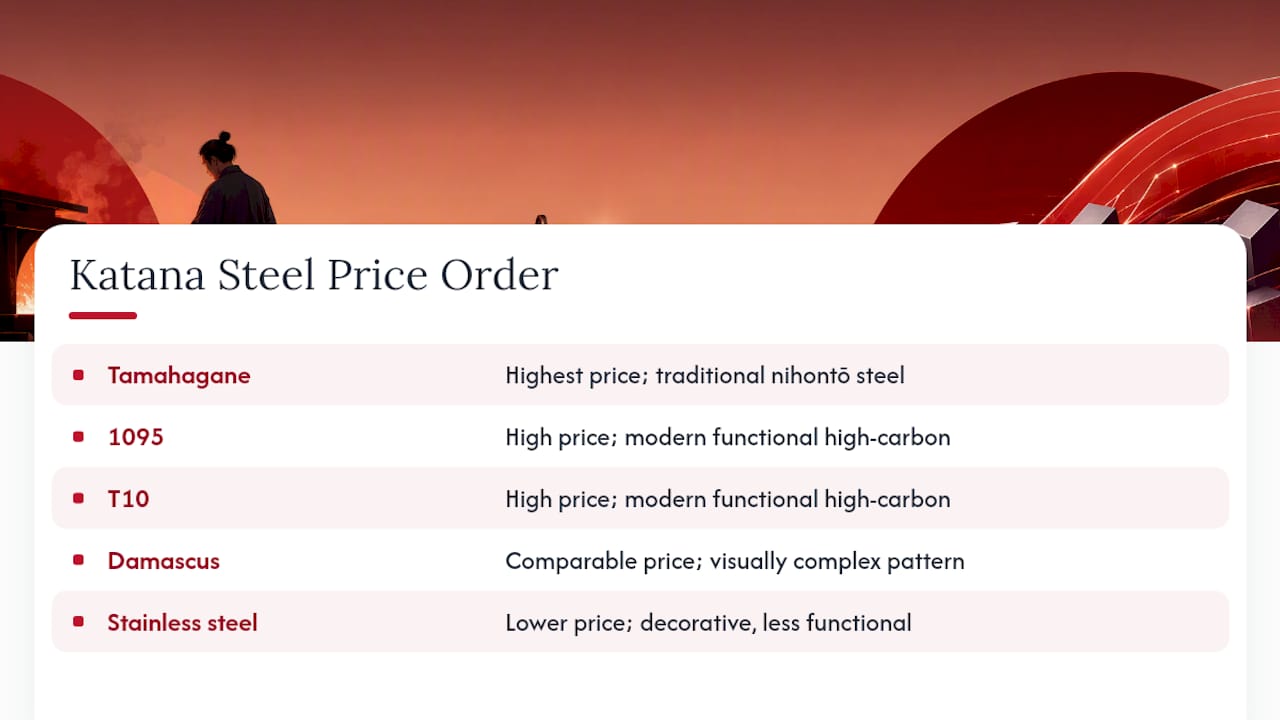
Several factors influence a sword’s price. The material is fundamental: traditional tamahagane folded steel is more costly and used by nihontō smiths, while modern functional swords often use high carbon steels like 1095 or T10. Damascus-pattern steel offers visual complexity in a comparable range. Stainless steel, often found in decorative swords, is less suitable for functional use and is generally less expensive.
Forging and tempering show up as visible signals you can actually check. A genuine clay temper produces a hamon with natural, irregular activity along the edge, distinct from the uniform, acid-etched lines on cheaper blades. Differential hardening, hard edge and softer spine, is what makes a blade both sharp and resistant to snapping.
Maker reputation and NBTHK grading compound everything else. A signed mei from a known smith, backed by NBTHK papers, can multiply a blade’s value several times over compared to an unsigned or undocumented equivalent.
A blade’s polish history often tells you more about its true condition than the blade itself. An over polished antique has permanently lost geometry no amount of paperwork can restore, while a well-preserved blade with an original or single careful polish holds its value far better over decades.
Mountings and restoration cut both ways. Elaborate koshirae raises price, but restoration only helps value when it’s done by a qualified togishi; amateur work almost always hurts resale.
How Do You Verify a Katana’s Authenticity?
Checking a sword’s paperwork and construction before you pay is the only reliable way to know if the price matches what you’re actually getting.
- Look up NBTHK status directly. If a listing claims NBTHK papers, ask for a copy or a certificate number, and treat vague claims like “certified authentic” without a document as a warning sign.
- Read the mei carefully. A signed inscription on the tang identifies the smith, but mei can be forged or added later, so cross reference the signature style and era claims against known reference examples where possible.
- Request tang and fitting photos. Sellers should be willing to show the nakago (tang) unmounted, since blade quality and file marks (yasurime) there tell you far more than a sheathed photo ever will.
- Get an independent appraisal for anything over a few thousand dollars. A qualified appraiser catches replaced fittings, hidden repairs, or overstated attribution before you commit real money.
- Check import and ownership rules for your situation. Legal guides on Japanese sword ownership outline registration and export requirements that vary by country, and it’s worth confirming these before you buy internationally rather than after.
Pro Tip: A seller who won’t photograph the bare tang almost certainly has something to hide. Legitimate dealers show this without hesitation because it’s the clearest way to build buyer trust.
Buying Checklist: Matching Budget to Purpose
Start with intended use, because it sets the minimum specs worth paying for.
- Display only: A decorative replica in the $50–$300 band is fine; skip anything claiming “battle ready” at this price.
- Iaido or solo kata practice: Look for full tang construction and 1045/1060 carbon steel, generally $200–$800.
- Regular tameshigiri or active training: Budget $800–$3,000 for 1095 or T10 steel with a real clay-tempered hamon.
- Collecting or investment: Prioritize NBTHK papers and documented provenance over blade size or ornamentation, generally $3,000 and up.
Before paying, ask every seller these questions:
- What steel is the blade made from, and is the tang full length?
- Can you photograph the bare, unmounted tang and any visible mei?
- Is there NBTHK paperwork, and can I see the certificate number?
- What is the polish history, and who performed the most recent polish?
- What shipping insurance and customs handling does the price include?
On inspection day or when reviewing photos, check tsuba fit (no wobble), even hamon activity along the full edge, and consistent fittings without visible glue. For anything over $1,000, confirm the seller insures the shipment and discloses who covers customs fees on international orders.
What Ongoing Costs Come With Owning a Katana?
The purchase price is only the starting number. A professional polish for a functional or antique blade typically costs several hundred dollars and up depending on length and condition, and it’s only worth doing when the blade genuinely needs it, since over polishing shortens a sword’s usable life permanently.
Storage matters more than most new owners expect. Humidity causes rust on carbon steel blades within days if left unchecked, so a proper stand, a dry storage environment, and regular light oiling with something like choji oil protect your investment far more cheaply than a repair ever will.
- Budget for periodic light oiling (inexpensive, do it yourself)
- Factor in insurance for anything valued over roughly $1,000 to $2,000
- Add customs and import handling fees when buying internationally, which vary by country and blade value
How Does MoonSwords Fit Across These Price Bands?
Moonswords built its collections to mirror the exact tiers buyers actually shop in, rather than forcing everyone into one price point. The entry-level katana collection covers functional swords with full tang construction for buyers starting out in Iaido or looking for their first serious blade. The high-end katana collection moves into tamahagane and clay-tempered construction, the same craftsmanship signals that separate quality production swords from decorative ones.
At the top, Moonswords’ master collection by bladesmith Zhao Peiyan represents the custom commission tier, where buyers can request specific fittings, steel type, and ornamentation the way a nihontō buyer would work with a licensed smith.
- Every tier discloses steel type and tang construction upfront, not buried in fine print
- Clay-tempered blades ship with a visible, genuine hamon you can inspect in product photos
- Custom commissions include direct communication about lead time and fittings before you commit
Pro Tip: Ask any seller, Moonswords included, for condition or construction photos before buying anything above $500. A seller confident in their product will never hesitate to provide them.
Our Take: Buy for Purpose First, Not for the Story
The katana market rewards patience and punishes assumption. Too many buyers walk in wanting an “authentic samurai sword” without defining what that word means to them, and they end up either overpaying for a production blade dressed up with marketing language, or underpaying for something and getting exactly what that price predicts: a wall hanger mistaken for a training tool.
The conventional advice, “spend as much as you can afford,” misses the point entirely. A serious Iaido practitioner gains nothing from a $10,000 nihontō they’re afraid to use, and a collector chasing investment value gains nothing from a $300 production sword no matter how nice the fittings look.
If there’s one thing worth prioritizing above all else, it’s documentation over decoration. A plain blade with real NBTHK papers will outperform an ornate, undocumented one in resale every time. The fittings are the part everyone notices first. The paperwork is the part that actually protects your money.
— Kenji Smith
Ready to Buy? Here’s Where to Start
Once you know your budget band, the next step is matching it to a real, inspectable product rather than guessing from a thumbnail. Moonswords is built around that exact problem: instead of one generic “katana” listing, you get separate collections for entry-level training swords, high-end handcrafted pieces, and fully custom commissions, each disclosing steel type, tang construction, and tempering method up front.
If you’re starting out, the entry-level katana collection gives you full tang construction and honest steel specs without paying for ornamentation you don’t need yet. Collectors and serious practitioners ready to move up should look at the Kyōjin premium clay-tempered tamahagane katana, which shows exactly the forging signals covered above: a genuine hamon, differential hardening, and documented materials. For a fully custom build, Moonswords’ team works directly with buyers on fittings, steel choice, and saya details, and can provide condition photos and construction documentation before you commit any money. Browse the current lineup at Moonswords and request build details or a custom quote before your next purchase.
Sources
- How Much Does A Samurai Sword Cost? Katana Prices Explained
- Authentic Japanese Sword / Katana
- Purchase a Katana - Yoshindo Yoshihara — TOKI
FAQ
How much does a katana cost?
Prices range from $50 to $300 for decorative replicas up to $100,000 or more for museum-grade antique or master-forged blades, with functional training swords typically falling between $200 and $3,000.
Can I legally own a katana?
Ownership rules vary significantly by country and sometimes by state or region, so check current import and registration guidance before buying, especially for antiques or international shipments.
How much does a custom katana cost?
A commissioned nihontō from a licensed traditional smith generally starts around $5,000 and often exceeds $20,000 depending on the smith’s reputation, materials like tamahagane, and fitting complexity; custom orders through production-quality makers like Moonswords typically cost less while still offering choice over steel and mounts.
How expensive is a good katana?
A “good” katana for regular training or test cutting usually costs $800 to $3,000, which buys full tang construction, higher carbon steel, and a genuine clay-tempered hamon rather than a cosmetic finish.