

For U.S. collectors and practitioners looking for katanaland.com alternatives, the most trustworthy options fall into two categories: specialty handcrafted retailers with documented smith attribution and clay-tempered construction, and curated specialist sellers with transparent specs, full tang photos, and clear U.S. shipping policies. Moonswords is one such option, offering detailed product pages, educational resources, and collections across multiple price tiers. Before you add anything to a cart, check for tang (nakago) photos, named steel type, and a visible returns policy. Those three signals alone will filter out the majority of unreliable sellers.
| Factor | What to look for |
|---|---|
| Best for | Collector display / functional use / training / budget functional |
| Typical price band | Entry level, mid level, and high-end price tiers offer increasing quality and craftsmanship |
| Authenticity signal | Named steel, clay temper claim, tang photo, smith attribution |
| U.S. shipping clarity | Declared origin, carrier named, estimated customs cost stated |
| Returns policy | Written policy page, timeframe stated, condition requirements listed |
The shortlist entries we cover below earned their place by meeting all five of these criteria, not just one or two.
- Clear material and construction specs on every product page (steel type, carbon content, forging method)
- Full-length photos of the blade tang (nakago) and mei (smith’s signature), plus close-ups of the hamon and polish
- Customer reviews backed by third-party forum reputation (r/Katanas, SBG Sword Forum)
- Transparent returns and warranty policy with stated timeframes
- Explicit U.S. shipping information, including declared origin and carrier
Pro Tip: Before clicking “buy,” open the product photos and look specifically for a nakago (tang) shot. If the seller has not photographed the tang, treat the listing as unverified, regardless of how polished the marketing copy looks.
Table of Contents
- Which katanaland.com alternatives are worth your time?
- How to choose the right online katana seller
- What makes a katana “authentic” and what do price tiers actually mean?
- How we vetted and selected the alternatives in this list
- Key Takeaways
- The part of katana buying most guides skip entirely
- Moonswords: a serious option for collectors and practitioners
- FAQ
- Sources and further reading
Which katanaland.com alternatives are worth your time?
A community-curated aggregator that ranks specialty sword retailers by visitor votes and internal metrics surfaces dozens of alternative stores, but the raw list mixes decorative replica sellers with legitimate functional-blade forges. We filtered that list down to the seller categories that consistently pass the authenticity checklist above.
Artisan hand-forged sellers (Moonswords, Hanbon Forge, Dynasty Forge)
These sellers commission or produce blades forged by named smiths using clay tempering, differential hardening, and full tang construction. Product pages typically include the steel type (T10, 1095, tamahagane), a description of the folding and heat-treatment process, and close-up photos of the hamon and nakago. Moonswords, for example, publishes a collector’s guide on katana metallurgy alongside each collection, so you can cross-reference material claims against independent educational content. Hanbon Forge and Dynasty Forge operate similarly, with custom-order options and build timelines communicated upfront.
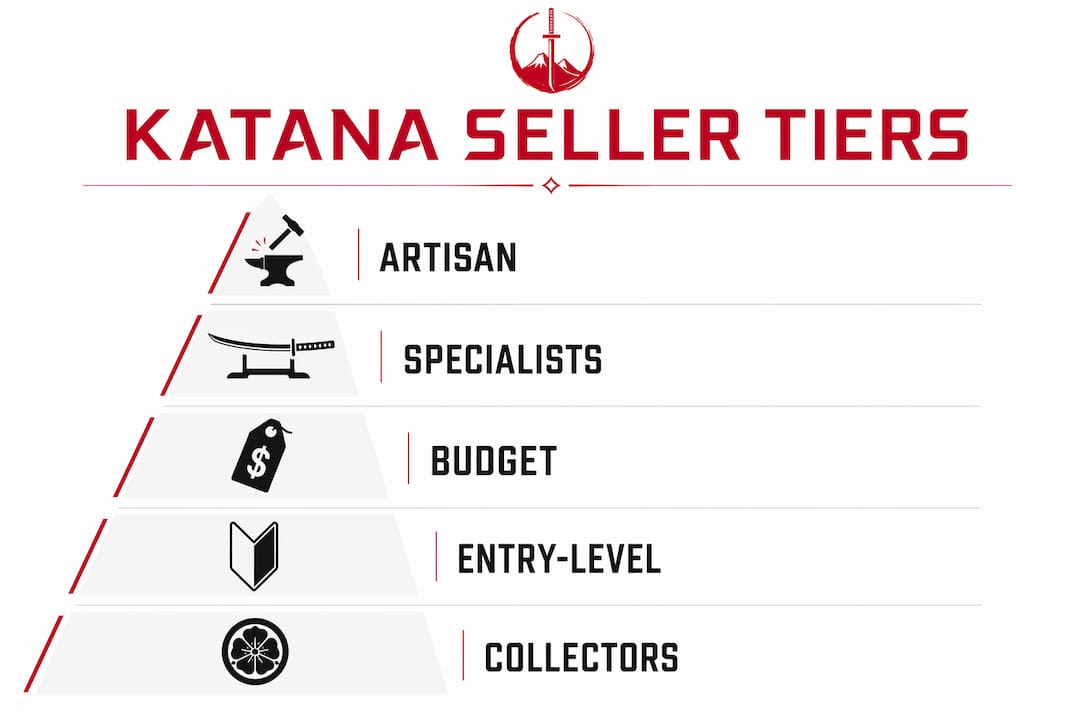
Best for: Collectors and practitioners who want a blade they can actually use, display with confidence, or pass on as an heirloom. Typical price range: moderate to high price range depending on customization and forging quality U.S. shipping: Ships internationally; customs declaration required; duties vary by declared value. Returns: Typically 30-day policy on stock items; custom orders non-refundable. Payment: Major credit cards, PayPal.
Curated specialist retailers (Kult of Athena, SwordNArmory)
Kult of Athena and SwordNArmory act as curated storefronts carrying blades from multiple forges, including Hanwei (Paul Chen) and Cold Steel. The advantage here is breadth: you can compare a Hanwei functional katana against a Cold Steel entry-level piece on the same platform, with consistent photography and policy language. Kult of Athena is particularly well-regarded on r/Katanas for its detailed product descriptions and responsive customer service. Cold Steel’s katanas are production-line pieces rather than hand-forged, but the steel specs and construction details are clearly stated, which is more than many budget sellers offer.
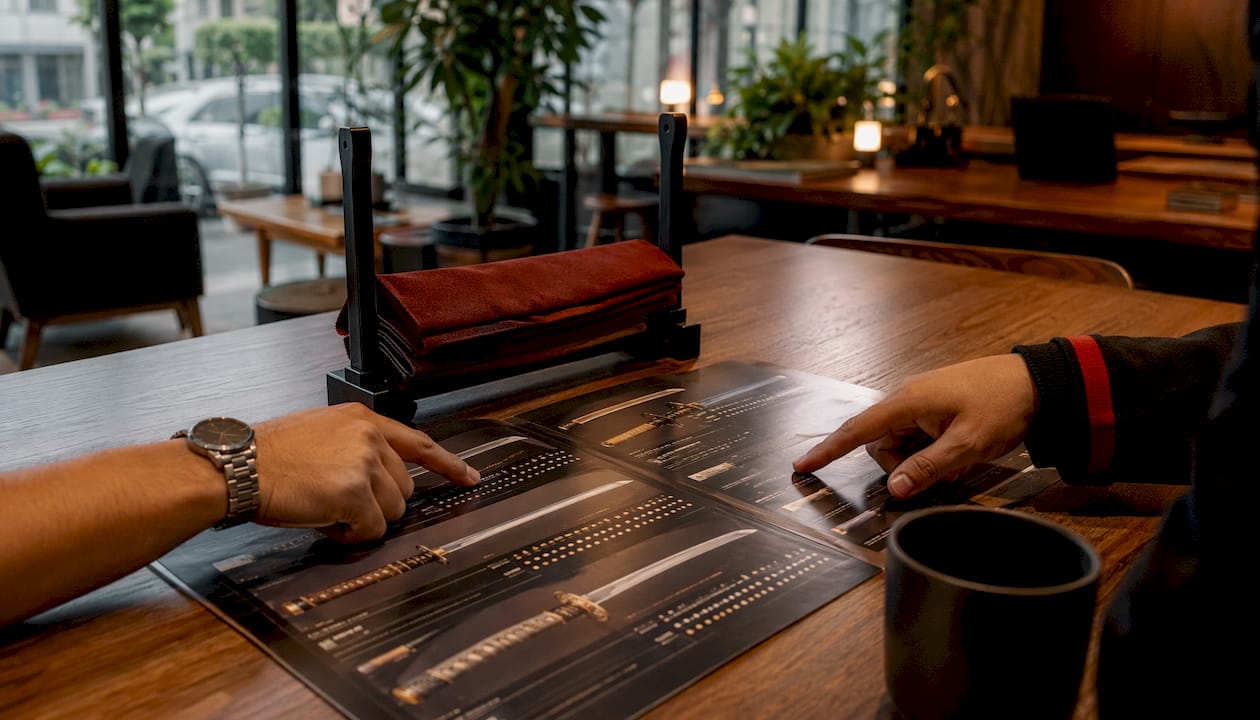
Best for: Buyers who want to compare multiple brands and price points without opening ten browser tabs. Typical price range: Range varies depending on forge and model U.S. shipping: Both ship domestically within the U.S.; no import paperwork needed for U.S.-based orders. Returns: Policy varies by product and forge; check individual listing pages. Payment: Credit card, PayPal, sometimes store credit.
Battle-ready budget collections (Musashi Swords, Hanwei entry-level)
Musashi Swords and Hanwei’s entry-level lines occupy the $80–$250 band. These are production-forged blades, not hand-finished pieces, but they use real carbon steel (typically 1045 or 1060), full tang construction, and heat treatment. Musashi Swords publishes a guide on buying authentic katanas online that is worth reading before you shop anywhere, including their own store. At this price tier, expect a functional blade suitable for light cutting practice (tameshigiri) or display, but not the refined hamon or hand-polished finish you get at higher tiers.
Best for: Beginners, martial arts students, or anyone who wants a real steel blade without a large upfront investment. Typical price range: entry level pricing suitable for beginners and budget buyers U.S. shipping: Domestic U.S. shipping available; fast fulfillment on in-stock items. Returns: Standard 30-day return window on most stock items. Payment: Credit card, PayPal.
| Price tier | Typical lead time | U.S. shipping window |
|---|---|---|
| Entry level | In stock, ships quickly | Standard domestic shipping times |
| Mid tier | Moderate lead times for semi-custom orders | Typical shipping times vary |
| High-end | Longer lead times for hand-forged customs | Extended shipping durations expected |
Pro Tip: For curated retailers carrying multiple brands, check whether the product page lists the specific forge, not just the retailer’s brand name. “Hanwei by Paul Chen” tells you exactly who made the blade; a generic “Japanese-style katana” label tells you nothing.
How to choose the right online katana seller
Evaluating a seller takes about ten minutes if you know what to check. Work through this list in order.
- Verify tang photos and mei. A reputable seller photographs the nakago (tang) from multiple angles. The mei (smith’s signature or forge mark) should be visible. No tang photo means no accountability.
- Confirm steel type and carbon content. Look for a named steel: T10, 1095, 1060, 1045, or tamahagane. “High-carbon steel” with no further specification is a red flag.
- Check clay temper and hamon claims. If the seller claims clay tempering, the product photos should show a visible hamon (temper line). A painted-on hamon is a common deception on cheap decorative blades.
- Confirm full tang construction. A full tang runs the entire length of the handle. Stick tang (a narrow rod) is structurally weaker and common on decorative pieces sold as functional.
- Read the returns and warranty page. The policy should state a timeframe (e.g., 30 days), acceptable return conditions, and who pays return shipping. Vague language like “returns considered case by case” is a warning sign.
- Check U.S. shipping details. The seller should name the carrier, state the declared origin, and give an estimated delivery window. For international shipments, customs duties are the buyer’s responsibility; a trustworthy seller will say so explicitly.
- Confirm payment method options. Credit card or PayPal gives you dispute resolution rights. Sellers who accept only wire transfer, cryptocurrency, or gift cards offer no recourse if the blade arrives damaged or not at all.
- Cross-check reviews on third-party forums. Search the seller’s name on r/Katanas or the SBG Sword Forum before purchasing. Community members post detailed photos and honest assessments that no curated review section can replicate.
Red flags to avoid:
- Vague material descriptions (“stainless steel,” “alloy steel,” no carbon content stated)
- No photos of the tang or hamon
- Price significantly below comparable pieces from known forges (a hand-forged clay-tempered katana for $60 is not possible)
- Review spikes: dozens of five-star reviews posted within a single week, with no critical feedback
- No visible returns or warranty policy page
Pro Tip: Run the product photos through Google Images reverse search. Sellers who reuse stock photos from other retailers or stock image libraries are not selling what they photograph. This takes thirty seconds and has saved collectors hundreds of dollars.
What makes a katana “authentic” and what do price tiers actually mean?
“Authentic” in the katana world covers a spectrum, and sellers use the word loosely. Here is what the construction terms actually mean in practice.
A named smith or forge is the strongest single authenticity signal. It means someone is accountable for the blade’s construction. Steel type matters because it determines hardness, edge retention, and flexibility: tamahagane (traditional Japanese iron sand steel) is the historical standard, while modern high-carbon steels like T10 and 1095 are widely used in quality production and hand-forged blades. Clay tempering (tsuchioki) creates the differential hardness that produces the hamon; without it, the blade is uniformly hardened and lacks the visual and functional character of a traditionally forged katana. Full tang construction means the steel extends through the entire handle, making the sword structurally sound for cutting practice. A stick tang is fine for display; it is not safe for use.
The aggregator listings confirm that the market spans decorative, training, and functional categories, and sellers do not always make that distinction clear. Here is what to expect at each tier:
- Decorative/replica: Stainless steel or low-carbon alloy, no clay temper, often stick tang. Suitable for display only. Do not attempt to cut with these.
- Entry-level functional: Real carbon steel with full tang and basic heat treatment. Suitable for light tameshigiri and kata practice. Hamon may be present but minimal.
- Mid-tier hand-finished: Higher carbon steel, clay tempered, hand-polished, visible hamon. Suitable for regular practice and collector display.
- High-end traditionally forged: Named smith, tamahagane or premium modern steel, full hand-forging, differential hardening, detailed mei. Museum-quality pieces suitable for serious collectors and advanced practitioners.
Regarding U.S. ownership: katana ownership is legal in most U.S. states, but transport rules and blade-length restrictions vary by state and municipality. Confirm your local laws before purchase, and check your shipping carrier’s policies on bladed weapons, as some carriers impose their own restrictions on blade length and packaging requirements.
Pro Tip: Ask the seller whether they can provide a photo of the blade’s hada (grain pattern visible in the steel). On a hand-forged piece, the hada is visible under good lighting. On a machine-ground blade, the surface is uniform. This one question separates hand-forged claims from production-line reality.
How we vetted and selected the alternatives in this list
We built this shortlist using explicit criteria, not general reputation. Every seller or seller category included here met all of the following:
- Transparent construction specs: Steel type, carbon content, forging method, and tang style stated on the product page.
- Photographic evidence: Tang (nakago) and hamon photos present on product listings, not just glamour shots of the finished blade.
- Documented warranty and returns: A written policy page with stated timeframes, not a “contact us” placeholder.
- U.S. shipping clarity: Carrier named, declared origin stated, estimated delivery window provided.
- Demonstrable brand or author expertise: Either bladesmith credentials, a named forge with community reputation, or published educational content on materials and maintenance.
We cross-referenced community-driven site listings and third-party forum threads (r/Katanas, SBG Sword Forum) to validate reputation. We also noted that general aggregators can surface false positives: one aggregator we reviewed listed digital software tools under a “Ka-tan” search, demonstrating how category mismatches happen when you rely on automated results without manual filtering. Always validate that an aggregator result is actually a sword retailer before treating it as a recommendation.
We excluded the following without stronger evidence:
- Anonymous marketplace listings with no seller profile or forge attribution
- Sellers lacking tang photos on any product page
- Marketplaces with no stated returns or warranty policy
- Sellers whose only reviews appeared on their own website with no third-party corroboration
Key Takeaways
The single most reliable way to identify a trustworthy katana seller is to require tang photos, named steel, and a written returns policy before you consider price.
| Point | Details |
|---|---|
| Tang photo first | No nakago photo means no accountability; skip any listing that lacks one. |
| Named steel type required | Insist on a specific steel grade (T10, 1095, tamahagane); “high-carbon” alone is insufficient. |
| Written returns policy | A stated timeframe and condition requirements protect you if the blade arrives damaged. |
| U.S. shipping and customs | Confirm carrier, declared origin, and who covers customs duties before ordering internationally. |
| Moonswords as an option | Moonswords offers detailed product pages, tang photos, educational resources, and collections from entry-level to high-end tamahagane pieces. |
The part of katana buying most guides skip entirely
Most buying guides focus on steel grades and price tiers. Those matter, but the single biggest mistake collectors make is treating a seller’s marketing copy as a substitute for photographic evidence. A seller can write “hand-forged, clay-tempered, tamahagane” on any product page. The nakago photo is the one thing they cannot fake easily, because it shows the actual steel, the file work, the peening, and the mei. If those details are absent, the claim is unverifiable.
There is also a tendency in this community to over-index on price as a proxy for quality. A $400 blade from a seller with no tang photos and a vague returns policy is a worse purchase than a $150 blade from a seller who photographs every component and publishes a clear 30-day return window. The documentation is the product, in a sense. It tells you what you are actually buying and what recourse you have if it is not what was described.
For U.S. buyers specifically, the customs and transport layer adds real complexity that most guides treat as a footnote. International shipments of blades require customs declarations, and duties are the buyer’s responsibility. Some carriers restrict blade length or require specific packaging. Confirming these details before you place an order is not paranoia; it is the difference between a blade that arrives legally and one that gets held at the border.
Moonswords: a serious option for collectors and practitioners
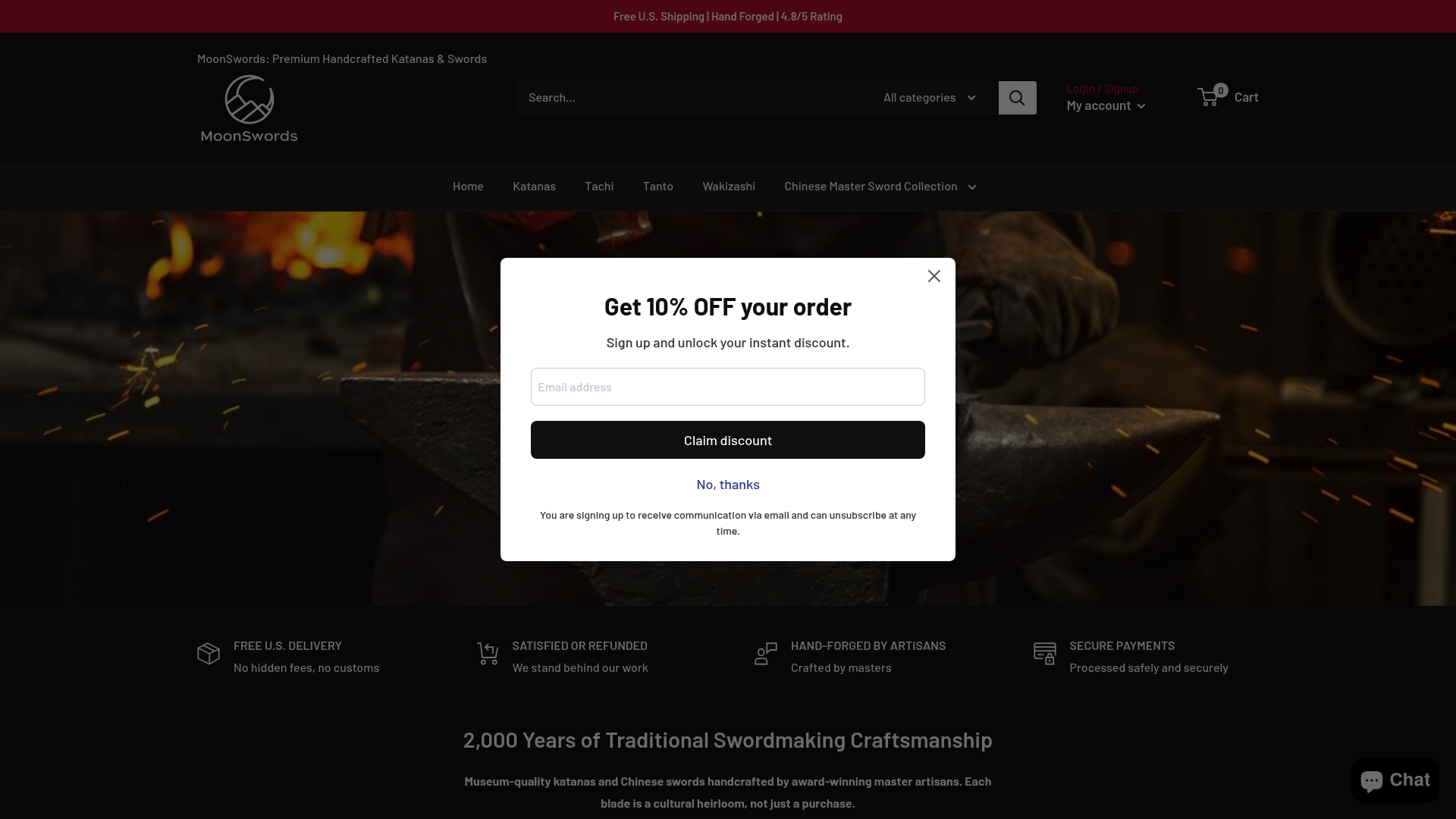
If you have worked through the checklist above and want a seller that passes every point without requiring you to dig through forum threads to verify it, Moonswords is worth a direct look. Product pages include named steel types, clay temper documentation, full tang construction details, and close-up photography of the nakago and hamon. The brand’s educational content on katana steel and maintenance is published openly, so you can use it to cross-check any seller’s material claims, not just Moonswords’s own.
For collectors at the entry tier, the entry-level katana collection covers functional carbon-steel pieces with full tang construction and clear specs. For serious collectors, the high-end collection includes tamahagane and clay-tempered pieces with smith attribution, including work from master bladesmith Zhao Peiyan. U.S. shipping information is visible on product pages, and the returns policy is documented. Browse the full catalog at Moonswords and use the tang photos as your first filter, just as you would with any seller on this list.
If you are also looking for samurai-themed art to complement a new blade, this traditional ink wash samurai poster from Tortuga Creations pairs well with a display piece.
FAQ
What is the best website to buy an authentic katana?
For U.S. buyers, the most consistently recommended sellers on community forums like r/Katanas are specialty retailers that provide tang photos, named steel types, and written returns policies. Moonswords, Kult of Athena, and Hanbon Forge are frequently cited for meeting these criteria.
Can you legally own a katana in the U.S.?
Katana ownership is legal in most U.S. states, but blade-length restrictions and transport rules vary by state and municipality. Confirm your local laws and your shipping carrier’s policies before placing an order, particularly for blades over a certain length.
How do I verify a katana seller is legitimate?
Check for tang (nakago) photos on product listings, a named steel type with carbon content, a written returns policy with a stated timeframe, and third-party reviews on forums like r/Katanas or the SBG Sword Forum. Sellers who lack any of these should be treated with caution.
What should I expect to pay for a functional katana?
Entry-level functional katanas in real carbon steel typically fall within a budget-friendly range, mid-tier clay-tempered pieces with visible hamon cost more, and hand-forged, smith-attributed pieces are at the higher end of the pricing spectrum.
Do katanas shipped internationally to the U.S. require customs paperwork?
Yes. International blade shipments require customs declarations, and import duties are the buyer’s responsibility. Some carriers also impose their own restrictions on blade length and packaging. Confirm these details with the seller before ordering.
Sources and further reading
The following sources informed this article’s shortlist and selection criteria. We recommend using them directly to verify seller claims before purchase.
- Sites like katana-land.de (Top Alternatives) — use this aggregator to discover additional specialty retailers, then manually verify each result against the tang photo and policy checklist above. Do not treat aggregator rankings as endorsements.
- Where to Buy Authentic Katanas Online (And What to Avoid) — a practical guide from Musashi Swords covering red flags and construction terminology; useful for cross-referencing seller claims.
- r/Katanas community thread on trustworthy websites — real collector experiences with named sellers; search the thread for any seller you are considering before purchasing.
- SBG Sword Forum — detailed community discussion on budget functional options; the forum’s search function is useful for verifying forge reputation.
- Moonswords collector’s guide on authentic katanas — use this to understand material terminology (hamon, hada, tamahagane, nakago) so you can evaluate any seller’s product descriptions with confidence.
Before purchasing from any seller on this list or discovered through an aggregator: pull up the product’s tang photo, read the returns policy in full, and run the seller’s name through the r/Katanas and SBG Sword Forum search. That sequence takes under fifteen minutes and protects you from the most common pitfalls in online katana buying.