

A horizontal katanakake with controlled side lighting is the single most consistent way to showcase the three traits that define a premium katana: a vivid, natural hamon (the temper line), a readable hada (blade grain), and a mirror-quality polish. Those three elements, combined with refined koshirae (the sword’s furniture — tsuba, ito wrap, samegawa, and saya finish), separate a collectible piece from a decorative prop.
Here is how display types map to the traits they reveal best:
- Horizontal katanakake: Polish clarity, hamon definition, and full nagasa (blade length) visibility
- Enclosed glass or acrylic case: Fittings, saya lacquer finish, and overall koshirae presentation
- Wall mount: Dramatic silhouette and tsuka detail at eye level
- Vertical stand: Space-efficient fittings display, though hamon visibility is reduced
Three Moonswords models illustrate the full range of premium display aesthetics: the Kyōjin (clay-tempered tamahagane, flagship polish), the Atsu Katana from the Ghost of Yōtei series (Damascus steel, ornate koshirae), and the Black Dragon Katana (manganese steel, bold dark fittings). Each rewards a different display approach, as we detail below.
On arrival, inspect these three things first:
- Hamon clarity: hold the blade at 45° to a soft light source and look for the transition zone between hard edge and soft spine
- Hada visibility: rotate slowly under a single light to catch the grain pattern in the steel
- Fit and finish: check tsuba tightness, ito wrap tension, and saya lacquer for chips or gaps
Pro Tip: Tilt a horizontal stand so the blade angles 10°–15° downward toward the viewer. That slight drop brings the hamon into the light plane and makes the temper line read three to four times more clearly than a perfectly flat display.
Table of Contents
- What visual features actually make a katana look premium?
- How do horizontal stands, wall mounts, and cases compare for display?
- How do you display a premium blade without damaging it?
- What does a premium display setup actually cost?
- Three Moonswords display setups that show what premium looks like
- Which display should you choose based on what you want to show?
- Key Takeaways
- The display is where the craft finally speaks
- Moonswords’ premium katanas, matched to the right display
- Useful sources and further reading
- FAQ
What visual features actually make a katana look premium?
The hamon is the most immediately legible signal of quality in any premium display katana. A natural hamon, produced by clay tempering and differential heat treatment, shows a complex, organic transition zone — nie (bright crystalline particles) and nioi (a misty, fine-grained boundary) visible along the edge. Collectors and reviewers consistently prioritize visible, natural hamon and high-quality polish on clay-tempered carbon blades over etched hamon on stainless decorative swords, because a real hamon carries genuine metallurgical information about how the blade was made.
Hada, the grain pattern in the steel, is the second layer of visual complexity. Folded steel develops distinct grain structures: itame (wood-grain burl), mokume (wood-eye), konuka (fine rice-bran), and nashiji (pear-skin). These patterns only become visible under raking light at the right angle, which is why lighting setup matters as much as the blade itself. A tight, even konuka hada on a well-polished blade looks almost alive when light crosses it obliquely.
Polish is what makes both hamon and hada legible. Reviewers use specific polish terminology — sashikomi (a high-contrast finger-stone polish that maximizes hamon definition), keisho (a softer, more reflective finish), and tri-tone polishes that create distinct visual zones along the blade geometry. Sashikomi is the choice for display pieces where hamon visibility is the priority. Keisho suits blades where overall reflectivity and the geometry of the shinogi (ridge line) are the focal points.
Koshirae is where a sword becomes a complete aesthetic object. Historically, decorative mountings carried by high-ranking nobles used maki-e (lacquer with sprinkled gold or silver powder), raden (mother-of-pearl inlay), nashiji lacquer finishes, rayskin-covered hilts, and elaborate metal fittings. Even at production-grade price points, the quality of samegawa (rayskin under the ito wrap), the tightness and pattern of the ito itself, and the material and finish of the tsuba all communicate craft level at a glance. A well-fitted tsuba with no play, a clean habaki (blade collar), and a saya with consistent lacquer depth are the details that distinguish a serious piece from a shelf decoration.
Provenance and maker credentials add a layer of value that photographs cannot fully convey but that serious collectors factor into every acquisition. Blades forged by named bladesmiths using traditional techniques — clay tempering, full-tang construction, hand-forged tamahagane or high-carbon steel — carry a traceable craft lineage. Moonswords’ master collection, overseen by bladesmith Zhao Peiyan, represents exactly this kind of documented provenance. The craft of a skilled swordsmith shapes every visual detail, from the geometry of the kissaki (tip) to the depth of the bo-hi (fuller groove).
Collector note: Fine polish work — sashikomi, keisho, and custom tri-tone finishes — is labor-intensive. Small investments in professional polishing and matched lighting greatly increase perceived display value for any piece you intend to show prominently.
How do horizontal stands, wall mounts, and cases compare for display?
Each format makes a different trade-off between visibility and protection. The table below maps the main options against the dimensions that matter most for a premium display katanas aesthetic comparison.
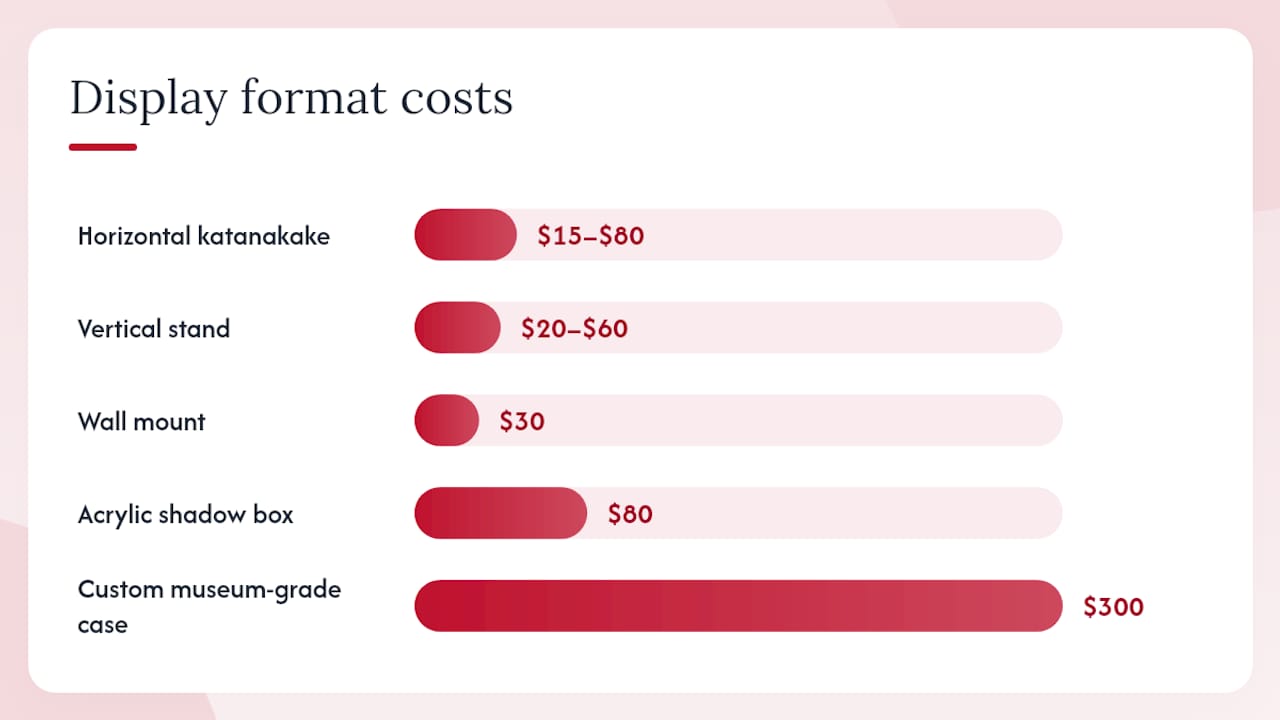
| Display Format | Best visual qualities highlighted | Hamon & hada visibility | Security & preservation | Cost / complexity | Space footprint | Sheathed vs unsheathed |
|---|---|---|---|---|---|---|
| Horizontal katanakake | Polish, hamon, full blade geometry | Excellent with side lighting | Low (open air, dust exposure) | $15–$80 / simple | Moderate shelf space | Unsheathed preferred |
| Vertical stand | Tsuka detail, tsuba, overall silhouette | Moderate | Low (open air) | $20–$60 / simple | Minimal floor/shelf | Either works |
| Wall mount | Dramatic silhouette, eye-level tsuka | Good if lit from below | Moderate (secured, elevated) | $30 / moderate | Wall space only | Sheathed or unsheathed |
| Acrylic shadow box | Full koshirae, saya finish, fittings | Good with internal LED | Good (dust, some UV) | $80 / moderate | Wall or shelf | Sheathed preferred |
| Custom museum-grade case | Complete presentation, all elements | Excellent with integrated lighting | Excellent (UV, humidity, dust) | $300 / complex | Dedicated furniture | Either, with rotation |
The core trade-off is simple: open displays maximize hamon and polish visibility but expose the blade to dust, humidity fluctuations, and handling risk. Enclosed cases protect the steel and lacquer but require thoughtful internal lighting to prevent the glass from washing out the hamon.
When to choose each format:
- Choose a horizontal katanakake when hamon and polish are the blade’s strongest traits and you have controlled indoor humidity
- Choose an enclosed acrylic or glass case when koshirae quality (saya, fittings, ito) is the focal point, or when the display space has variable humidity or direct light
- Choose a wall mount when floor and shelf space are limited and the sword’s silhouette and tsuka are visually strong
- Choose a custom museum-grade case for tamahagane or master-collection pieces where long-term preservation is as important as presentation
One cultural detail worth observing: traditional Japanese display etiquette places the blade with the edge (ha) facing upward on a horizontal stand and the nagasa pointing to the left when viewed from the front. This orientation signals respect and is immediately recognizable to knowledgeable collectors. Reversing it is not catastrophic, but it reads as an oversight to anyone familiar with the convention.
How do you display a premium blade without damaging it?
An enclosed case or a sheathed horizontal display with active humidity control is the best preservation practice for any premium carbon-steel blade shown prominently. Open, unsheathed display is visually ideal but demands consistent environmental management.
Carbon steel begins to oxidize when relative humidity exceeds roughly 50–55% for extended periods. In much of the continental United States, summer humidity regularly reaches that threshold indoors without climate control. The target range for displayed carbon blades is 40–50% relative humidity and a stable temperature between 60–75°F. UV exposure accelerates oxidation on the blade surface and degrades lacquer on the saya and wooden fittings over time. A museum-grade display case addresses all three risks simultaneously: UV-filter glazing, inert mount materials, and integrated low-heat LED lighting protect the blade while keeping it fully visible.
Secure mounting prevents the kind of slow physical damage that is easy to overlook. On a horizontal katanakake, check that the mekugi (bamboo peg securing the blade to the handle) is intact before display. Wall mounts should use hardware rated for at least three times the sword’s weight and be anchored into studs or masonry, not drywall alone. Tamper-proof fasteners on enclosed cases are worth the small additional cost in households with children or high-traffic display areas.
Maintenance checklist for displayed swords:
- Wipe the blade with a clean, lint-free cloth every 4–6 weeks to remove dust and fingerprint oils
- Apply a thin coat of choji oil (clove-infused mineral oil) every 3–4 months on unsheathed carbon blades
- Inspect the mekugi and tsuba fit at each cleaning; replace a cracked mekugi immediately
- Never use abrasive cloths, steel wool, or commercial metal polish on a hand-polished blade
- If rust spots appear, consult a professional polisher — amateur abrasive work destroys hamon definition permanently
Emergency handling steps:
- If the blade is dropped, do not catch it; let it fall and inspect for edge damage before handling
- If moisture contact occurs, dry immediately with a soft cloth, then apply choji oil within the hour
- If the saya is cracked, remove the blade and store separately until the saya is repaired
What does a premium display setup actually cost?
Budget planning for a display should account for both the stand or case and any lighting or humidity-control additions. The table below reflects typical U.S. market price bands for ready-made and custom options.
| Display option | Typical price range (USD) | Typical lead time |
|---|---|---|
| Off-the-shelf horizontal katanakake | $15–$80 | In stock / 3–7 days |
| Handcrafted hardwood katanakake | $80 | 2–4 weeks |
| Wall-mount hardware kit | $30 | In stock / 3–10 days |
| Acrylic shadow box (single sword) | $80 | 1–3 weeks |
| Custom museum-grade case (UV glass, humidity control) | $300 | 4–12 weeks |
Material choices drive cost more than size. Hardwoods like walnut, cherry, and black lacquered oak carry a price premium over pine or MDF, but they also read as premium in the display itself. UV-filter acrylic costs roughly 30–50% less than museum-grade borosilicate glass but offers meaningful UV protection for most home environments. Humidity-control inserts (silica gel cassettes or electronic units) add $20–$80 to any enclosed case and are worth the investment for carbon-steel blades in humid climates. Integrated LED lighting adds $30–$150 depending on whether you use a simple strip or a dimmable accent fixture.
Budget planning guidance:
- For blades under $300, a quality hardwood katanakake and a dimmable LED strip deliver the best visual return per dollar
- For blades in the $300–$800 range, an acrylic shadow box with UV filtering and a humidity insert is the right step up
- For master-collection or tamahagane pieces above $800, commission a custom case with museum glass, inert mounts, and integrated lighting — the case cost is a fraction of the blade’s value and protects it accordingly
- DIY shadow boxes are viable for sheathed display but rarely achieve the fit and UV protection of purpose-built cases
Three Moonswords display setups that show what premium looks like
Kyōjin: horizontal polished showcase
The Kyōjin is Moonswords’ flagship clay-tempered tamahagane katana, and its defining aesthetic is the hamon. Clay tempering creates a natural, complex temper line with visible nie and a distinct transition zone that rewards close inspection. The ideal display is unsheathed on a handcrafted hardwood horizontal katanakake, positioned at eye level with a single warm-white LED (2700–3000K) angled from the left at roughly 40° above horizontal. A matte dark background, charcoal or deep navy, pulls the hamon’s silver-white tones forward dramatically.
Preservation note: because the Kyōjin is displayed unsheathed, humidity control is non-negotiable. A silica gel cassette placed inside the display cabinet or nearby keeps relative humidity in the 40–50% range. Wipe and oil every 6–8 weeks.
Atsu Katana (Ghost of Yōtei): accent-lit enclosed case
The Atsu Katana from the Ghost of Yōtei series features Damascus steel construction and ornate koshirae — the fittings, ito wrap, and saya finish are as much the story as the blade itself. An enclosed acrylic or glass case with internal LED accent lighting at two angles (one for the blade, one for the saya) lets both elements read simultaneously. The Damascus pattern in the steel, with its layered visual texture, benefits from a slightly cooler light (3500–4000K) that sharpens the contrast between layers.
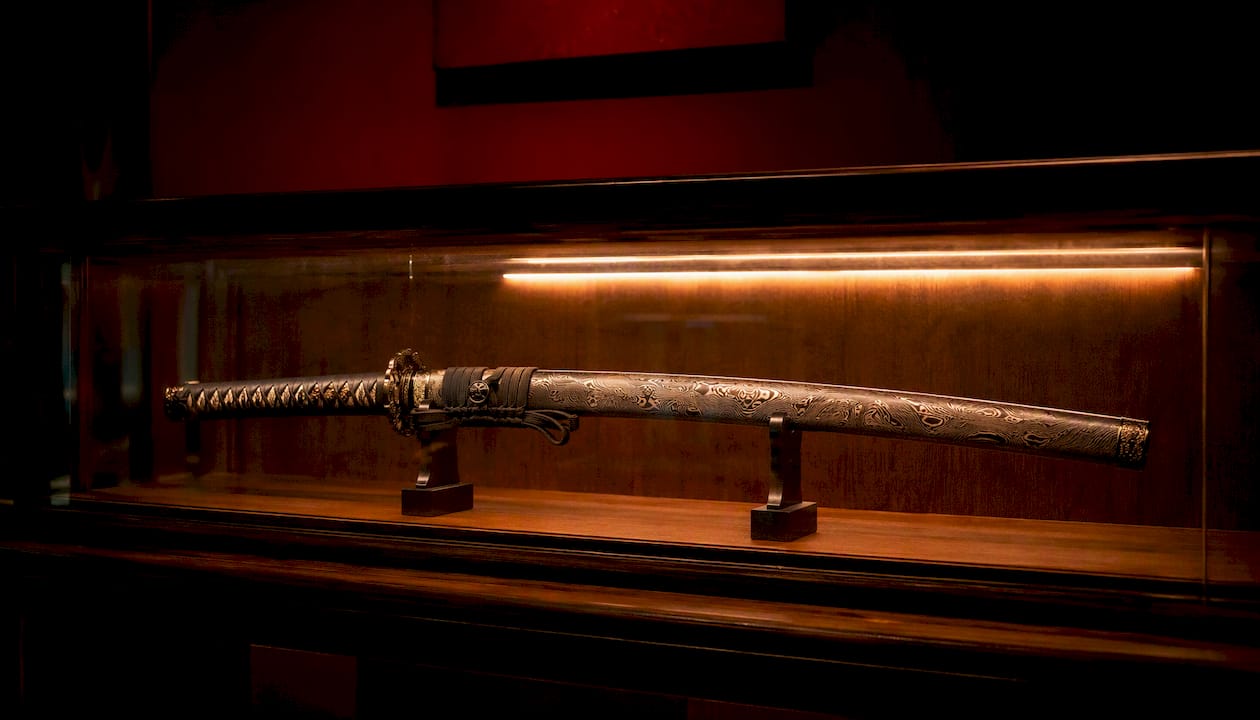
This model’s koshirae quality makes a sheathed display genuinely compelling. Displaying it sheathed in a case protects the Damascus surface from humidity while keeping the full aesthetic composition visible. Rotate to an unsheathed horizontal stand periodically for detailed hamon inspection.
Black Dragon Katana: wall-mounted silhouette display
The Black Dragon Katana is built around bold visual contrast: dark fittings, a dramatic profile, and a finish that reads powerfully at a distance. A wall mount at eye level, with a single upward-angled spot from below, creates a striking silhouette that emphasizes the blade’s geometry and the dark tsuba and tsuka against a light wall. This is the model where wall display outperforms a horizontal stand, because the visual impact is in the overall composition rather than fine hamon detail.
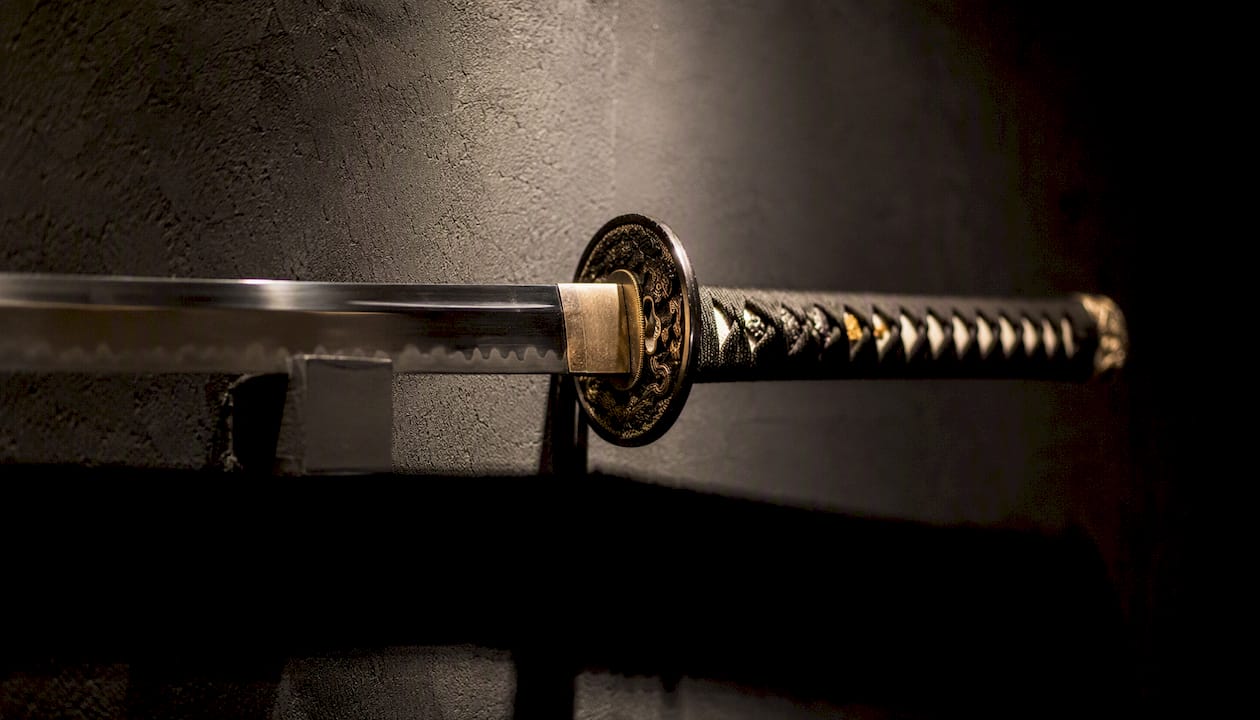
Security is straightforward: use a two-point wall mount anchored into studs, with the blade sheathed for daily display and removed for periodic inspection.
Visual payoff summary:
- Kyōjin on a horizontal stand: maximum hamon and polish visibility, museum-level blade presentation
- Atsu Katana in an enclosed case: full koshirae composition, Damascus texture, protected long-term
- Black Dragon on a wall mount: bold silhouette impact, space-efficient, strong visual presence from across the room
- For limited spaces, any of these three works sheathed in a compact acrylic shadow box without losing the essential aesthetic character
Which display should you choose based on what you want to show?
Three collector goals, three clear answers:
- Show hamon and polish: Unsheathed horizontal katanakake, warm-white side lighting, matte dark background, humidity-controlled environment
- Show fittings and saya finish: Enclosed case (acrylic or glass), dual-angle internal LED, sheathed display, UV-filter glazing
- Prioritize preservation above all: Custom museum-grade case with UV glass, inert mounts, humidity control, and low-heat integrated lighting — blade can be sheathed or unsheathed
Quick-pick checklist:
- My blade’s strongest trait is the hamon → horizontal katanakake, unsheathed, side-lit
- My blade’s strongest trait is the koshirae/saya → enclosed case, sheathed, dual-lit
- My display space is a wall only → wall mount, sheathed or unsheathed, upward accent light
- My display space is very limited → vertical stand or compact shadow box, sheathed
- I want maximum long-term protection → custom museum-grade case, any orientation
A hybrid approach works well for serious collectors: keep the blade sheathed in a glass case for daily display, then schedule monthly unsheathed sessions on a horizontal stand for detailed inspection and photography. This rotation gives you the preservation benefits of an enclosed display and the full visual access of an open one, without compromising either. For a deeper look at how minimalist and traditional display styles compare, this collector’s guide to display styles covers the aesthetic trade-offs in detail.
Key Takeaways
A horizontal katanakake with warm-white side lighting remains the most effective single setup for revealing the hamon, hada, and polish that define a premium display katana.
| Point | Details |
|---|---|
| Hamon is the primary quality signal | A natural, clay-tempered hamon reads far richer visually than an etched one and rewards close display lighting. |
| Polish type determines what lighting reveals | Sashikomi polish maximizes hamon contrast; keisho suits geometry and reflectivity; match your lighting to your polish. |
| Display format follows the blade’s strongest trait | Horizontal stand for hamon/polish; enclosed case for koshirae/saya; wall mount for silhouette impact. |
| Humidity control is non-negotiable for carbon steel | Keep displayed carbon blades at 40–50% relative humidity to prevent oxidation and lacquer degradation. |
| Moonswords flagship models map to distinct display types | Kyōjin suits a horizontal polished showcase; Atsu Katana rewards an enclosed accent-lit case; Black Dragon excels on a wall mount. |
The display is where the craft finally speaks
Most collectors spend months choosing a blade and an afternoon choosing a display. That imbalance costs them more than they realize. A poorly lit horizontal stand with a glossy white wall behind it can make a $900 tamahagane blade look like a $90 wall decoration. The reverse is also true: a thoughtfully lit, humidity-controlled case with a matte backdrop can make a mid-range piece look like a museum acquisition.
What we find consistently, working with collectors across a range of budgets, is that the biggest gains come not from spending more on the display hardware but from understanding what the blade’s specific aesthetic strengths actually are. A blade with a spectacular hamon needs raking light and an open stand. A blade with extraordinary koshirae needs a case that frames the full composition. Treating every sword the same way, regardless of its individual character, is the single most common display mistake we see.
The cultural dimension matters too. Displaying a blade with the ha upward and the nagasa pointing left is not just etiquette; it signals to other collectors that you understand what you own. That kind of informed presentation is part of what separates a collection from an accumulation. The enduring value of artisanal craftsmanship in any medium comes down to exactly this: the maker’s intention made visible, and the owner’s knowledge making it legible.
Moonswords’ premium katanas, matched to the right display
Moonswords gives you the blade and the knowledge to display it correctly. The Kyōjin’s clay-tempered tamahagane hamon is built for a horizontal polished showcase. The Atsu Katana’s Damascus koshirae belongs in an accent-lit enclosed case. The Black Dragon’s bold geometry commands a wall mount.

Every Moonswords piece ships with detailed maker credentials, finish specifications, and care guidance so you know exactly what you own and how to show it. Our high-end katana collection covers the full range from entry-level display pieces to master-collection tamahagane blades. Browse the collection at Moonswords and find the piece that fits both your display space and your aesthetic priorities. Each product page includes the finish details and steel specifications you need to choose the right display format before the blade arrives.
Useful sources and further reading
- [The Beauty of Japanese Swords] Decorative Sword Mounting | OCTOBER 2024 | HIGHLIGHTING Japan
- Feilong Swords Four Gourds Katana Review – Cottontail Customs
- Z-Sey Tuoyuan Katana – Cottontail Customs
- Kaze Katana review | Sword Buyers Guide
- Dragon Sword S7 Katana review | SBG Sword Forum
- Overview of Popular Decorative Sword Styles | Battle-Merchant ⚔
- Katana — Wikipedia
- What Is a Katana Display Case? A Collector’s Guide
FAQ
What is a katana display stand called?
The traditional horizontal stand is called a katanakake. A single-sword version holds the blade on two padded arms; multi-sword versions stack two or three blades and are called katana-kake or katana-tate depending on orientation.
Are display katanas sharp?
It depends entirely on the piece. Moonswords’ premium display katanas, including the Kyōjin and Atsu Katana, are fully sharpened, hand-forged blades. Decorative wall-hanger swords sold at low price points are typically unsharpened stainless steel and are not functional.
Which katana is considered the most visually striking for display?
Clay-tempered blades with a visible natural hamon, such as the Moonswords Kyōjin, are consistently rated highest by collectors for display aesthetics because the temper line carries genuine visual complexity that etched or stainless blades cannot replicate.
How do you display a katana correctly by tradition?
The blade faces edge-up (ha upward) on a horizontal stand, with the nagasa pointing to the left when viewed from the front. This orientation reflects traditional Japanese display etiquette and is the standard among informed collectors.
How do you protect a displayed katana from rust?
Keep relative humidity between 40–50%, apply a thin coat of choji oil every 3–4 months on unsheathed carbon blades, and wipe the blade with a clean lint-free cloth every 4–6 weeks. For high-humidity environments, an enclosed case with UV-filter glazing and a silica gel humidity insert provides the most reliable protection.