

The sword tsuba is defined as the handguard mounted between a Japanese sword’s blade and handle, serving both as a protective barrier and one of the most sophisticated art forms in Japanese metalwork history. The role of sword tsuba as art object is inseparable from its function. A tsuba stopped the hand from sliding onto the blade during combat, balanced the sword’s weight distribution, and simultaneously announced the wearer’s rank, taste, and identity to anyone who looked. These two purposes never competed. They merged into a single object that collectors, museums, and artists still study with genuine reverence today.
What practical purposes did the tsuba serve in samurai sword use?
The tsuba’s primary job was hand protection and sword balance. Tsuba are thin guards mounted between the handle and blade, commonly 2–3mm thick, often made from iron, copper alloys, or lacquered leather. That thinness tells you something important: this was not armor.
A 2–3mm iron disc stops a hand from sliding forward onto a razor edge. It does not absorb a direct sword strike from an opponent. The design prioritized ergonomic comfort and sword feel over battlefield fortification. Samurai needed to grip and draw quickly, and a bulky guard would have slowed both.
Historical evidence shows that many tsuba were made from lacquered leather, a material entirely unsuited for heavy defensive use. This points directly to a design philosophy centered on comfort and status signaling rather than pure protection. The lacquered surface could be decorated, colored, and shaped to reflect the wearer’s aesthetic preferences.
Here is what the tsuba actually did in practice:
- Hand stop: Prevented the grip hand from slipping forward onto the blade during a thrust or parry.
- Weight balance: Shifted the sword’s center of gravity toward the handle, improving control and reducing fatigue during extended use.
- Status marker: Signaled the wearer’s rank and taste through material choice and decorative complexity.
- Ergonomic fit: Shaped to sit comfortably against the hand without restricting movement or draw speed.
Pro Tip: When examining a tsuba, check its thickness and material first. A very thin or leather guard tells you the piece was made for peace-era display and social signaling, not battlefield use. That context changes how you read every design choice on its surface.
How did tsuba evolve into objects of artistic and cultural expression?
The shift from utility to art happened gradually across Japan’s historical periods, accelerating during the Edo period (1603–1868) when prolonged peace reduced battlefield demand and elevated the sword’s role as a social object. Artisans responded by treating the tsuba as a canvas.
Artisans used various metals and techniques to create motifs reflecting the wearer’s social status and aesthetic sensibilities. Iron remained common, but skilled craftsmen began inlaying gold, silver, and shakudo (a Japanese copper-gold alloy) to achieve color contrast and visual depth impossible with a single material. The result was a disc roughly the size of your palm that functioned as a miniature sculpture.
The artistic development of tsuba followed a recognizable progression:
- Early utilitarian guards: Simple iron or leather discs with minimal decoration, focused entirely on hand protection and balance.
- Clan and crest motifs: Artisans began incorporating family mon (crests) and regional symbols, turning the tsuba into a portable identity marker.
- Nature and mythology themes: Motifs expanded to include cherry blossoms, cranes, dragons, and scenes from Japanese folklore, each carrying specific cultural meaning.
- Precious metal inlay: Master craftsmen introduced techniques like nunome-zogan (fabric-pattern inlay) and kebori (hairline engraving) to achieve painterly detail in metal.
- Signed masterworks: By the late Edo period, renowned schools such as the Goto and Nara schools produced tsuba signed by their makers, establishing individual artistic identity and collector value.
“Great tsuba art facilitates an ongoing dialogue rather than fixed interpretation. The interaction between observer and tsuba engages a dynamic process of continuous re-evaluation, elevating the tsuba beyond static art objects.” — Metal artist Ford Hallam, as cited in research on tsuba as art
The specific design and quality of the tsuba signaled different social standings, from high-ranking warriors to merchants who adopted sword-wearing customs during the Edo period. A merchant’s tsuba might display commercial motifs or seasonal flowers. A daimyo’s guard would feature gold inlay and mythological scenes of power. The object spoke before its owner did.
What cultural meanings and symbolism are embedded in sword tsuba designs?
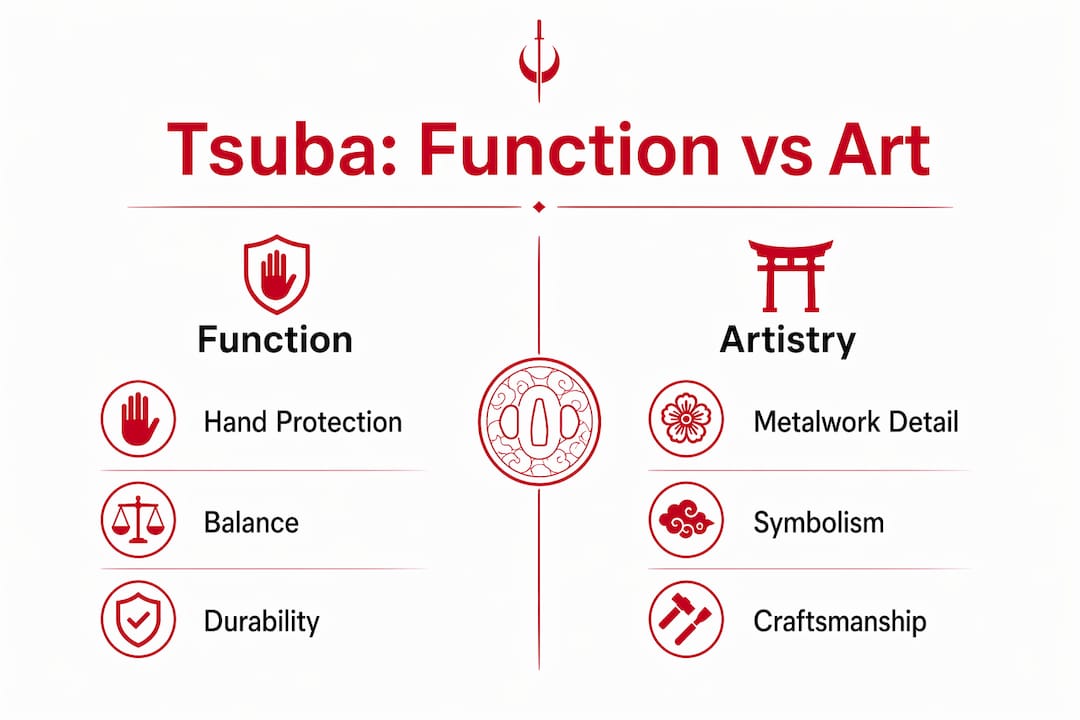
Tsuba designs function as visual narratives. Motifs such as dragons, floral patterns, and mythological scenes are common, conveying meaning well beyond decoration. Each image carried a specific cultural weight that any educated viewer in Edo-period Japan would have read immediately.
The symbolism embedded in tsuba design covers several distinct categories:
- Family lineage: Mon (family crests) identified the wearer’s clan and allegiance. A tsuba bearing a specific mon was as clear as a name badge in samurai society.
- Spiritual protection: Buddhist and Shinto imagery, including lotus flowers, torii gates, and temple motifs, invited divine favor and protection for the sword’s owner.
- Seasonal and natural cycles: Cherry blossoms represented the fleeting beauty of life, a concept central to samurai philosophy. Pine trees signaled endurance. Cranes indicated longevity.
- Mythological power: Dragons conveyed strength and authority. The phoenix represented renewal. These were not decorative choices. They were deliberate statements about the wearer’s character and aspirations.
- Martial virtue: Crossed swords, arrows, and armor motifs on tsuba reinforced the wearer’s identity as a warrior, even during peacetime when actual combat was rare.
Understanding sword fittings’ cultural symbolism transforms how you look at any tsuba in a collection. What appears to be a decorative flower is often a precise statement about mortality, honor, or clan identity. The tsuba was the samurai’s most personal public statement, worn at the hip and visible to everyone in a room.
The sword itself carried enormous symbolic weight in Japanese culture. Swords symbolize honor in Japan through centuries of tradition connecting the blade to the soul of its owner. The tsuba, as the most visible and decorated fitting, absorbed that symbolic weight and amplified it through art.
How are sword tsuba appreciated and displayed as art objects in modern times?
Contemporary collectors and museums recognize tsuba as valuable art objects, with exhibitions worldwide and renewed interest in their design. Major institutions including the Metropolitan Museum of Art in New York and the Tokyo National Museum hold significant tsuba collections, displaying them as standalone art objects rather than sword components.

Collectors focus on craftsmanship, material rarity, historical provenance, and cultural significance when valuing pieces. Auctions and exhibitions emphasize artistic complexity and authenticity to determine collectible worth. A signed piece from the Goto school commands a fundamentally different price than an unsigned provincial guard, even if both are visually similar to an untrained eye.
| Display factor | Why it matters for collectors |
|---|---|
| Lighting angle | Raking light reveals engraving depth and inlay texture invisible under flat illumination |
| Mounting method | Museum-quality acrylic stands show both faces without contact damage |
| Provenance documentation | Signed pieces or auction records increase authentication confidence |
| Storage environment | Controlled humidity prevents iron oxidation and lacquer cracking |
| Framing context | Displaying alongside period sword fittings adds historical narrative |
Proper lighting for sword display is the single most underrated factor in tsuba appreciation. A piece that looks flat under overhead lighting reveals extraordinary detail under a directed light source placed at a low angle. The shadows created by engraved lines and raised inlay work make the design three-dimensional.
Modern tsuba influence jewelry designers and manga artists, demonstrating an artistic legacy that extends far beyond historical use. Contemporary jewelry collections regularly reference tsuba geometry and motifs. Manga and anime series use tsuba designs as character identity markers, introducing the art form to global audiences who may never visit a museum.
Pro Tip: When buying your first tsuba for display, prioritize pieces with clear provenance over purely visual appeal. A well-documented piece from a known school or region tells a story that a beautiful but anonymous guard cannot. Provenance is the difference between a decoration and a conversation.
Key takeaways
The tsuba’s artistic value is not separate from its function. It grew directly from the object’s role as a personal, public statement worn by its owner every day.
| Point | Details |
|---|---|
| Function shaped art | The tsuba’s thin, ergonomic design freed artisans to prioritize decoration over armor-grade protection. |
| Status signaling was central | Design quality and motif choice communicated rank, clan, and personality to every observer. |
| Symbolism runs deep | Every motif, from dragons to cherry blossoms, carried specific cultural meaning readable by period audiences. |
| Modern value is multidimensional | Collectors assess provenance, material rarity, school attribution, and artistic complexity together. |
| Display technique matters | Lighting angle and mounting method determine how much artistic detail a tsuba actually reveals. |
Why tsuba are the most underrated art form I know
I have spent years handling Japanese sword fittings, and the tsuba consistently surprises collectors who come to it expecting a simple metal disc. The first thing most people notice is the size. A tsuba fits in your palm. The second thing they notice, usually after a minute of looking, is that they cannot stop looking.
That experience is not accidental. The artistic value of tsuba emerges through active engagement and interpretation by observers over time, not from a single glance. The best pieces reward sustained attention. A dragon that looks simple from three feet away reveals individual scale textures, inlaid silver claws, and a subtly asymmetric composition when you look closely. That layered revelation is what separates great tsuba from decorative metalwork.
What I find most compelling is the constraint the artisan worked within. The object had to function as a handguard. It had to fit a specific sword. It had to survive handling. Within those fixed requirements, the best craftsmen produced work that holds its own against any miniature sculpture in any tradition. That tension between constraint and expression is what makes tsuba genuinely interesting as art, not just as historical artifact.
My honest advice to collectors: do not buy tsuba based on photographs alone. The surface texture, the weight, and the way light moves across an engraved surface are all lost in images. Handle pieces whenever you can. The Japanese sword making tradition that produced great tsuba was fundamentally tactile, and appreciating it fully requires the same engagement.
— Kenji Smith
Authentic katanas with traditional tsuba artistry, from Moonswords
Owning a katana with a well-crafted tsuba is the most direct way to understand what all of this means in practice. Reading about nunome-zogan inlay is useful. Holding a sword where the tsuba catches the light and reveals its detail is something else entirely.

Moonswords offers a curated selection of hand-forged Japanese katanas built by master artisans using clay tempering, full tang construction, and traditional fitting techniques. Each sword includes a tsuba selected for both historical accuracy and visual quality. For collectors seeking the highest level of craftsmanship, the high-end katana collection features pieces where the tsuba, habaki, and fuchi-kashira are treated with the same care as the blade itself. These are not decorations. They are complete artistic statements, made the way they always were.
FAQ
What is the primary role of sword tsuba as an art object?
The tsuba serves as both a practical handguard and a miniature art object, with its decorative metalwork communicating the wearer’s rank, beliefs, and aesthetic identity. Its artistic value grew directly from its daily use as a personal, visible accessory in samurai society.
What materials were used in historical tsuba craftsmanship?
Artisans used iron, copper alloys, shakudo (a copper-gold alloy), lacquered leather, and inlays of gold and silver. Material choice reflected both the intended use and the owner’s social standing.
How do collectors determine the value of a tsuba?
Collectors assess craftsmanship complexity, material rarity, school attribution, and historical provenance. Auctions and exhibitions use artistic authenticity as the primary measure of collectible worth.
Why are tsuba considered important in art history?
Tsuba represent a rare convergence of practical design and fine art, produced within strict physical constraints by craftsmen who treated metalwork as a narrative medium. Their influence extends to contemporary jewelry design and visual media including manga and anime.
How should a tsuba be displayed for best aesthetic appreciation?
Mount the tsuba on an acrylic stand that shows both faces, and use a directed light source at a low angle to reveal engraving depth and inlay texture. Proper display technique makes the difference between seeing a metal disc and seeing the full artistic intent of its maker.