

The role of iron age in sword evolution is defined by a single, decisive shift: iron replaced bronze as the dominant blade material, and that change reshaped warfare, society, and craftsmanship for millennia. Iron swords began replacing bronze in Southern Europe as early as the 12th century BC, with widespread adoption complete by around 500–475 BC. Cultures like the Hallstatt and La Tène drove this transformation, introducing forging techniques and blade geometries that no bronze caster could match. The result was not just a better sword. It was a fundamentally different relationship between a soldier, his weapon, and the society that armed him.
How did the Iron Age change sword design and manufacturing?
Iron changed sword manufacturing at the most basic level: the process moved from casting to hammering. Bronze blades were poured into molds, which limited their length and cross-section. Iron Age swordsmiths adopted hammering rather than casting, which allowed them to forge longer, thinner, and more versatile blades. That single shift in technique opened up design possibilities that bronze simply could not support.

The hammering process also introduced work hardening. When a smith repeatedly strikes iron, the grain structure of the metal compresses and tightens, increasing surface hardness. Early Iron Age blades relied entirely on this method, producing swords with strength comparable to late bronze weapons. The advantage was not yet in superior metallurgy. It was in the scale and speed of production.
Carbon steel development changed everything. As smiths learned to control the amount of carbon absorbed during smelting, they produced steel rather than pure iron. Steel holds an edge better, resists deformation under impact, and can be shaped more finely. The evolution of iron swords from soft, work-hardened bars into high-carbon steel blades took centuries of accumulated knowledge.
Key manufacturing advances during this period included:
- Work hardening: Repeated hammering compressed iron grain structure, improving surface hardness without heat treatment.
- Carburization: Heating iron in contact with charcoal introduced carbon, converting iron to steel over time.
- Pattern welding: Smiths twisted and folded layers of iron and steel together, creating blades with both a hard edge and a flexible core.
- Quench and temper: Plunging a heated blade into water or oil locked in hardness; reheating at lower temperatures (tempering) reduced brittleness.
Pro Tip: If you study Iron Age blade finds in museum collections, look closely at the cross-section. A lenticular (lens-shaped) profile indicates early work-hardened iron. A flat, wide profile with a pronounced midrib typically signals a later, more refined steel composition.
What does the archaeological timeline of iron sword evolution look like?
The development of swords during the Iron Age did not happen uniformly. Different regions adopted iron at different rates, and the blade forms they produced reflected local fighting styles, available ore, and cultural priorities.
| Period | Culture | Sword Type | Key Feature |
|---|---|---|---|
| ~800 BC | Hallstatt | Leaf-shaped iron sword | Transitional form, still resembled bronze predecessors |
| ~500 BC | La Tène | Long slashing sword | Longer blade optimized for cavalry and infantry slashing |
| ~400–200 BC | Roman | Gladius | Short, double-edged thrusting sword derived from Iberian iron blades |
| ~500–300 BC | Greek | Xiphos | Double-edged leaf-shaped blade, iron replacing bronze versions |
| ~300 BC onward | Celtic | Celtic longsword | Extended reach, thin profile, suited to open-field combat |
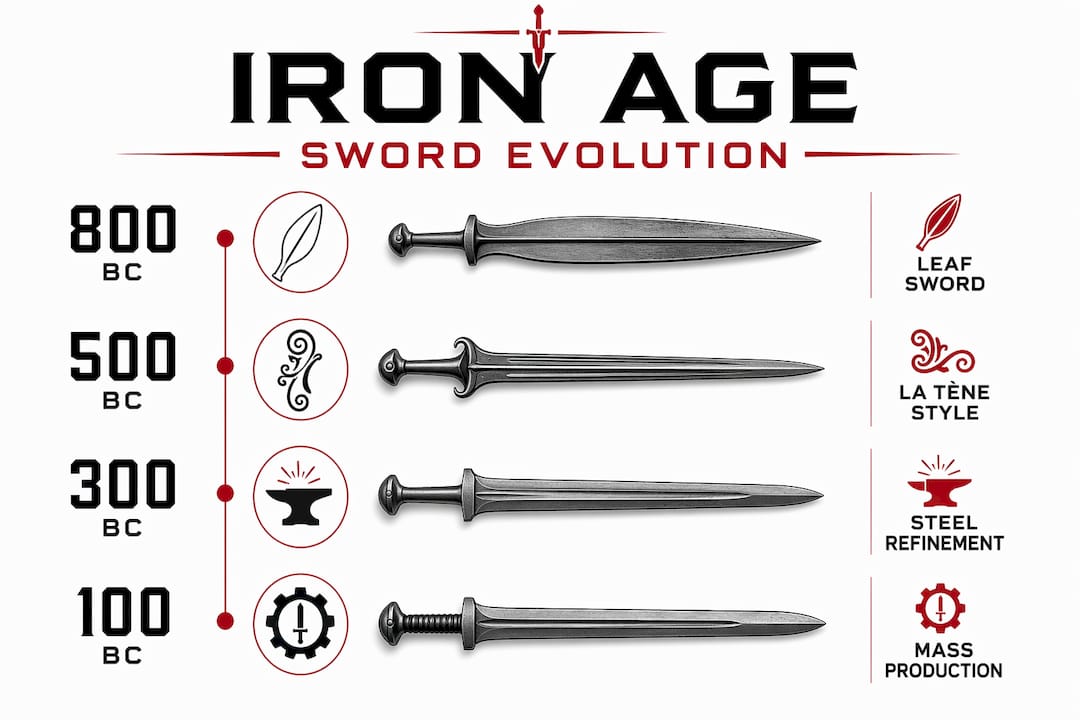
The Celtic Hallstatt culture produced swords in both bronze and iron around 800 BC. That coexistence of materials is significant. It shows the transition was gradual, not sudden. Smiths worked in both metals simultaneously, and the iron versions slowly proved their worth through battlefield performance and lower production cost.
La Tène culture, which flourished from roughly 500 BC onward, took iron sword design further. La Tène swords evolved into longer slashing blades that directly influenced Roman and Germanic sword types. The Roman gladius, one of the most studied swords in military history, traces its geometry back through Iberian iron sword traditions that were themselves shaped by La Tène contact. Archaeological finds across France, Switzerland, and the British Isles show consistent blade elongation and thinning over this period, confirming a clear design trajectory driven by iron’s properties.
How did iron swords change social structures and access to weapons?
The impact of iron age on weaponry extended well beyond the forge. Iron ore is abundant across Europe, the Middle East, and Asia. Tin, the critical ingredient for bronze, was scarce and required long-distance trade networks. The Iron Age began partly because the collapse of bronze-dependent palatial economies disrupted tin supply routes, forcing societies to work with what they had locally. Iron was everywhere. That abundance had profound social consequences.
“Iron’s spread equalized military access by providing cheap, abundant swords to common soldiers, shifting power dynamics and warfare scale significantly. Regions using iron weaponry showed more egalitarian wealth distribution compared to bronze-dependent regions, with the Gini coefficient decreasing by 0.07–0.10 in areas that transitioned to iron arms.”
The numbers behind that quote are striking. A Gini coefficient decrease of 0.07–0.10 represents a measurable reduction in wealth inequality. That is not a minor statistical fluctuation. It reflects a genuine redistribution of military power from elite bronze-armed warriors to broader infantry forces equipped with affordable iron swords.
The social effects of this shift included:
- Mass infantry arming: Commanders could equip large numbers of soldiers without the expense of bronze procurement and casting.
- Decline of warrior elites: When a sword no longer required rare imported tin, the exclusivity of being armed dissolved.
- New military formations: Larger, uniformly armed infantry units became viable, changing battlefield tactics across Greece, Rome, and the Celtic world.
- Persistent bronze prestige: Some regions, including Luristan and Han dynasty China, continued high-end bronze sword production for ceremonial and prestige purposes even as iron dominated everyday warfare.
Pro Tip: When examining ancient swords in museum catalogs, the material alone tells you something about the owner’s status. A bronze sword from 400 BC is almost certainly a prestige or ceremonial piece. An iron sword of the same date was likely carried into actual combat.
The social status of swords did not disappear with iron’s democratization. It transformed. The sword remained a symbol of power, but the power it represented shifted from inherited wealth to martial skill and military rank.
What metallurgical challenges did Iron Age smiths face, and how did they solve them?
Early iron blades had a serious flaw: they bent. Many early swords bent during use because tempering was not well understood initially. Work-hardened iron is harder than annealed iron, but it lacks the combination of hardness and toughness that makes a blade reliable in combat. A sword that bends under a heavy blow is worse than useless. It is dangerous to its owner.
The path from bent iron bars to reliable steel blades followed a clear progression:
- Work hardening (early Iron Age): Smiths hammered iron repeatedly to increase surface hardness. Blades were serviceable but prone to bending under lateral stress.
- Carburization: Heating iron in a charcoal-rich environment allowed carbon to diffuse into the surface, creating a harder outer layer over a softer core. This improved edge retention significantly.
- Quenching: Plunging a heated blade rapidly into water or oil locked the hardened crystalline structure in place. The result was a much harder blade, but also a brittle one.
- Tempering: Reheating a quenched blade to a lower temperature reduced internal stress and brittleness without sacrificing too much hardness. Quenching and tempering allowed swords to be strong yet flexible, reducing breakage in combat.
- Pattern welding: Smiths twisted and forge-welded alternating layers of high-carbon and low-carbon steel. The result was a blade with a hard, sharp edge and a tough, flexible spine. This technique is the direct ancestor of Damascus steel and, much later, the differential tempering used in Japanese sword production.
- Differential hardening: By applying clay to the spine before quenching, smiths could harden only the edge while keeping the spine flexible. This technique appears in both late Iron Age European blades and, centuries later, in the Japanese tradition of hamon formation.
Tempering was often not mastered until centuries after iron adoption. That gap between iron adoption and reliable steel production explains why early Iron Age swords are often found bent or broken in archaeological contexts. The science of differential tempering that modern collectors admire in Japanese katanas traces its conceptual roots directly to these Iron Age experiments. The Samurai sword making traditions that Moonswords draws on today are, in a real sense, the culmination of a metallurgical process that began in Iron Age forges across Europe and the Near East.
Key Takeaways
The Iron Age transformed sword evolution by replacing bronze with iron, enabling mass production, longer blade designs, and eventually the steel metallurgy that defines fine swords to this day.
| Point | Details |
|---|---|
| Iron replaced bronze by ~500 BC | Widespread iron sword adoption across Europe was complete by 500–475 BC, driven by ore abundance. |
| Hammering enabled longer blades | Forging rather than casting allowed smiths to produce longer, thinner, and more versatile sword designs. |
| Iron democratized armament | The Gini coefficient dropped by 0.07–0.10 in regions that shifted to iron, reflecting broader access to weapons. |
| Tempering took centuries to master | Early iron blades bent under stress; reliable quench-and-temper steel only became consistent long after iron adoption. |
| Iron Age laid the foundation for modern steel | Pattern welding and differential hardening developed during this era directly inform techniques used in fine swords today. |
The Iron Age was a logistics revolution, not just a materials upgrade
Most discussions of the Iron Age frame it as a story of better metal. That framing misses the deeper point. The real transformation was logistical. Bronze required tin, and tin came from a handful of sources connected by fragile trade networks. When those networks collapsed around 1200 BC, the entire bronze-based military economy collapsed with them. Iron did not win because it was obviously superior. It won because it was there.
I find this distinction important when thinking about sword history. The early iron swords were not better than the best late bronze swords. Historians note that sophisticated bronze traditions coexisted with iron swords over extended periods, indicating a gradual and culturally complex transition. The Greek xiphos and the Celtic longsword did not emerge because iron was suddenly recognized as the superior material. They emerged because iron was available, affordable, and scalable in ways bronze never could be again.
The socioeconomic angle is the one that most collectors and enthusiasts overlook. The Gini coefficient data is not just an academic curiosity. It tells us that the sword, for the first time in history, became a tool of the common soldier rather than the exclusive property of an elite warrior class. That shift changed how armies were organized, how battles were fought, and ultimately how states were built.
What I respect most about the Iron Age smiths is that they worked through enormous metallurgical uncertainty with no formal theory to guide them. Every advance in carburization, quenching, and tempering was earned through observation, failure, and accumulated craft knowledge. The pattern-welded blades they eventually produced are, by any measure, works of applied science as much as art. That tradition of disciplined experimentation is exactly what we see carried forward in the best modern sword forging today.
— Kenji Smith
Swords forged with the same respect for metallurgical history
The Iron Age established the principles that still define exceptional sword craft: material integrity, heat treatment discipline, and the balance between hardness and flexibility. At Moonswords, every blade in our collection reflects that same commitment to metallurgical honesty.

Our master artisans apply clay tempering, full tang construction, and hand-forging techniques that trace a direct line back to the innovations of Iron Age and medieval smiths. Whether you are drawn to the Damascus steel craftsmanship of pattern-welded blades or the refined geometry of our premium katana collection, you will find pieces built on the same principles that transformed sword design thousands of years ago. These are not decorative approximations. They are full-tang, hand-forged expressions of a metallurgical tradition that the Iron Age made possible.
FAQ
What was the role of the Iron Age in sword evolution?
The Iron Age shifted sword production from bronze casting to iron forging, enabling longer, stronger, and more affordable blades. This transition, complete across much of Europe by 500–475 BC, laid the metallurgical foundation for all subsequent sword development.
Why did iron replace bronze for sword making?
Iron ore is far more abundant than tin, which is required for bronze. When long-distance tin trade routes collapsed around 1200 BC, societies shifted to locally available iron, making sword production cheaper and more scalable.
Were early iron swords better than bronze swords?
Not immediately. Early iron swords were work-hardened and comparable in durability to late bronze blades. Reliable steel quality through quenching and tempering only became consistent centuries after iron adoption began.
How did the Hallstatt and La Tène cultures influence sword design?
The Hallstatt culture produced transitional leaf-shaped iron swords around 800 BC, while La Tène culture developed longer slashing blades by 500 BC that directly influenced Roman, Germanic, and Celtic sword forms.
What Iron Age techniques are still used in modern sword making?
Pattern welding, differential hardening, and quench-and-temper processes all originated during the Iron Age and remain central to fine sword production today, including the clay tempering methods used in Japanese katana forging.