

A shinken (真剣) is a real, sharpened Japanese-style sword forged from steel and intended for actual cutting — not a training substitute. Unlike the wooden bokken, the bamboo shinai, or the unsharpened alloy iaitō, a shinken carries a live edge and demands the respect that comes with it. Practitioners of iaidō, battōdō, and tameshigiri rely on shinken when their training requires genuine steel, and collectors prize them as the authentic expression of the nihontō tradition.
Pro Tip: If someone hands you a sword and calls it a shinken, run your eye to the edge before anything else. A true shinken has a sharpened blade — not a blunted practice edge.
- A shinken is a forged, sharpened Japanese-style sword used in cutting practice and advanced martial arts.
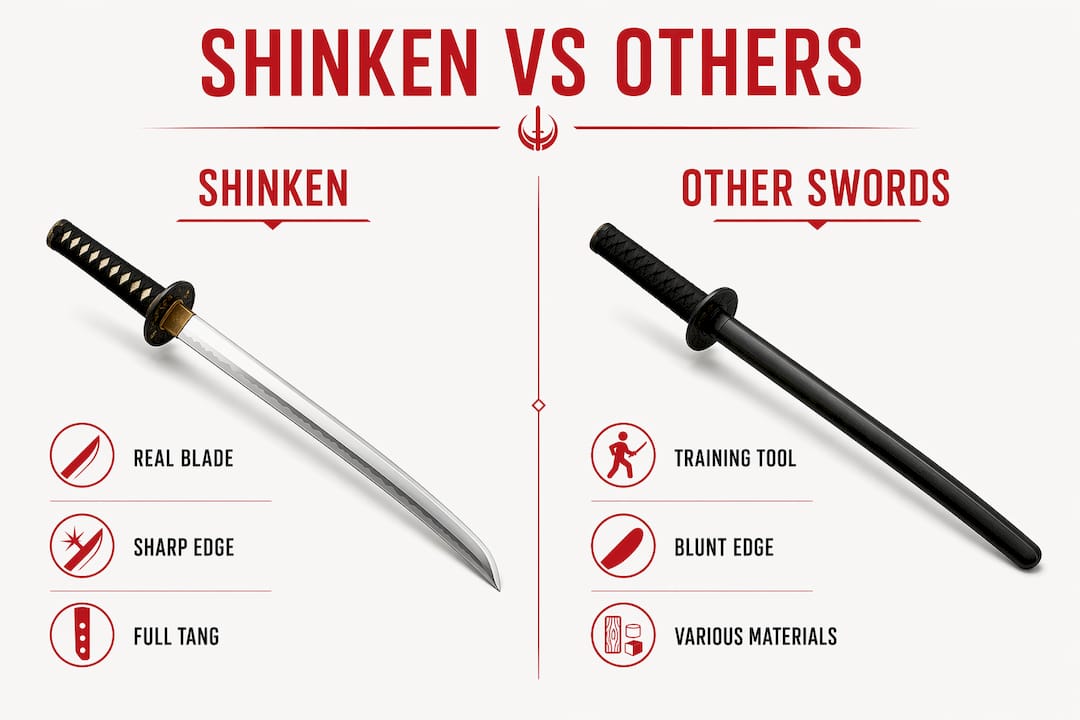
- It contrasts directly with bokken (wood), shinai (bamboo), and iaitō (unsharpened alloy).
- The term covers both traditional nihontō made in Japan and modern production blades made elsewhere.
- Primary uses include iaidō, battōdō, tameshigiri, and formal demonstrations.
Table of Contents
- What does “shinken” actually mean?
- How does a shinken differ from a katana, iaitō, bokken, and shinai?
- What makes a shinken’s construction different from other blades?
- Nihontō vs. production shinken: what buyers need to know
- How are shinken used in martial arts?
- What are the U.S. legal and safety rules for owning a shinken?
- How do you choose the right shinken to buy?
- How do you care for and maintain a shinken?
- Key Takeaways
- The shinken market rewards the informed buyer
- Moonswords shinken: hand-forged blades for practitioners and collectors
- Useful sources and further reading
- FAQ
What does “shinken” actually mean?
The kanji 真剣 breaks down simply: 真 (shin) means “real” or “true,” and 剣 (ken) means “sword.” Together, the literal meaning is “real sword” — a direct contrast to wooden or bamboo training tools. What makes the term richer is its second life in everyday Japanese. As documented in the Wiktionary entry for 真剣, the word also carries the meaning “serious” or “earnest” — as in shinken ni kangaeru, “to think seriously.” That double meaning is not coincidental. Picking up a live blade has always implied a shift in mental state, and the language reflects it.
Historically, every sword a samurai carried was a shinken by definition — there was no other kind. The distinction only became necessary once martial arts schools began developing safer training tools. Bokken appeared for kata practice, shinai for sparring, and iaitō for drawing-and-sheathing drills. Once those alternatives existed, “shinken” became the word that separated the live blade from its stand-ins.
The modern marketplace adds another layer. Today, “shinken” appears on product listings ranging from hand-forged nihontō made by registered Japanese swordsmiths to mass-produced sharp blades assembled overseas. Understanding that range is the first step toward buying or training with the right sword for your purpose.
How does a shinken differ from a katana, iaitō, bokken, and shinai?
This is where most buyers get confused, and the confusion is worth clearing up directly.
| Sword type | Material | Edge | Primary use |
|---|---|---|---|
| Shinken | Forged steel | Sharpened (live edge) | Cutting practice, advanced iaidō, tameshigiri, display |
| Iaitō | Aluminum-zinc alloy | Unsharpened | Beginner-to-intermediate iaidō drawing practice |
| Bokken | Hardwood (usually oak or red oak) | None | Kata, partner drills, basic forms |
| Shinai | Split bamboo | None | Kendo sparring |
| Katana | Forged steel | Sharpened | General term for a curved, single-edged Japanese sword |
The katana point deserves special attention. “Katana” describes a form — a curved, single-edged Japanese sword worn edge-up — while “shinken” describes a condition: a real, sharpened blade. Most shinken used in Japanese sword arts are katana in form, but the terms are not interchangeable. A katana can be an iaitō (unsharpened) or a shinken (sharpened). When a seller lists something as a “shinken katana,” they mean a sharpened katana — a live blade.
- Choose an iaitō if you are learning iaidō and your instructor has not yet cleared you for live steel. Alloy iaitō are safe for thousands of repetitions and do not require the same storage care.
- Choose a bokken for partner kata, warm-up, and beginner forms. No edge risk, no maintenance burden.
- Choose a shinken when your practice requires actual cutting — tameshigiri targets, advanced iaidō kata, or battōdō. Also the right choice for serious collectors and display.
For a deeper look at iaidō training sword options, the distinctions between these tools become even clearer in a practice context.
What makes a shinken’s construction different from other blades?
The quality of a shinken lives in its steel, its geometry, and the care taken during forging and tempering. Here is what separates a well-made blade from a decorative wall-hanger that happens to have an edge.
Steel and full tang
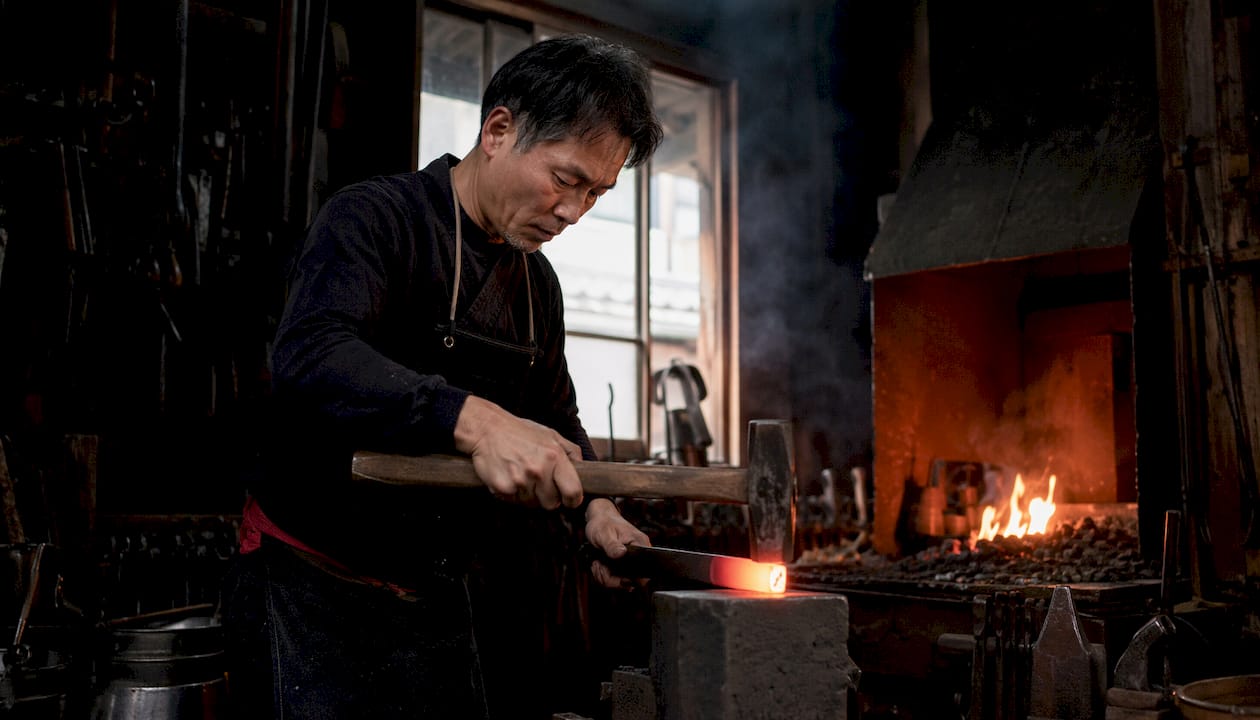
Most functional shinken use high-carbon steel — commonly 1045, 1060, 1075, or 1095 carbon steel, with higher carbon content generally producing a harder, more capable edge. Traditional nihontō use tamahagane, a steel smelted from iron sand in a tatara furnace, prized for its layered grain structure. Full tang construction (where the blade’s steel runs the full length of the handle, secured by a mekugi peg through the tsuka) is non-negotiable for a sword that will be used for cutting. A rat-tail tang or threaded bolt assembly is a safety failure waiting to happen.
Clay tempering and the hamon
The hamon — that visible wavy or straight line running along the blade’s edge — is the signature of differential hardening. A swordsmith coats the spine of the blade in clay before the final quench, which causes the edge to cool faster and harden to a higher Rockwell hardness than the spine. The result is an edge that holds sharpness while the spine stays tough enough to absorb impact without snapping. You can see this process reflected in blades like the Kyōjin 狂刃 Katana, which uses clay tempering to achieve that characteristic temper line.
Pro Tip: A genuine hamon has subtle activity — nie (crystalline particles) and nioi (misty areas) visible under magnification or good lighting. A painted or etched “hamon” on a cheap blade looks flat and uniform. Learn to tell the difference before you buy.
Quality markers to inspect
- Nakago (tang): Look for a mei (smith’s signature) on authentic nihontō. The nakago should show controlled oxidation (rust), not be polished clean.
- Hada (grain pattern): Traditional folded steel shows a visible grain — itame (wood grain), mokume (burl), or masame (straight). Absence of grain suggests mono-steel or pattern-welded construction.
- Polish: A proper sword polish (togi) brings out the hamon and hada. A mirror-polished blade with no visible temper line has likely been machine-buffed.
- Balance: Hold the sword at the tsuba. A well-made shinken should feel balanced, not tip-heavy or handle-heavy.
- Fittings: Tsuba, fuchi, kashira, and menuki should fit snugly with no rattle. Loose fittings indicate poor assembly.
For a thorough grounding in samurai sword making traditions, the forging techniques behind these quality markers go back centuries.
Nihontō vs. production shinken: what buyers need to know
This distinction shapes every buying decision, so we want to be direct about it.
A nihontō is a sword made in Japan by a registered swordsmith following traditional methods. Approximately 250 swordsmiths currently work in Japan, and each is legally limited to producing no more than 24 swords per year. That production cap, combined with the cost of tamahagane and years of apprenticeship, means nihontō blades commonly start at around US$6,000 for the blade alone — and prices climb steeply from there for recognized smiths.
A production shinken is a sharp Japanese-style sword made outside Japan, typically in China or Taiwan, using modern carbon steels and a mix of hand and machine processes. These blades can be suitable for iaidō practice and tameshigiri when made with care, but they do not carry the historical lineage, resale value, or cultural certification of a nihontō.
The market complicates this further. “Shinken” is used colloquially for any sharp Japanese-style sword, but strict collectors reserve the term for authentic nihontō. Knowing which definition a seller is using matters.
Buyer-intent checklist:
- Tameshigiri and regular cutting practice: A well-made production shinken in 1060–1095 carbon steel is the practical choice. You want a blade you can sharpen, use hard, and not feel sick about if it chips.
- Iaidō performance and dojo training: A production shinken with proper geometry, full tang, and a functional hamon serves most practitioners well. Match the blade’s weight and balance to your school’s requirements.
- Historical authenticity and investment: Only a certified nihontō satisfies this intent. Budget accordingly and verify provenance documentation.
- Display and collection: Either category works, but production shinken offer far more variety at accessible price points.
| Buyer intent | Recommended type | Typical price range |
|---|---|---|
| Regular cutting / tameshigiri | Production shinken | Sub-$1,000 blades are available and functional for regular practice |
| Iaidō training | Production shinken | $1,000–$3,000 |
| Premium display / high-end collection | High-end production or nihontō-style | $6,000 and up |
| Certified nihontō | Authentic Japanese-made | US$6,000+ (blade alone) |
How are shinken used in martial arts?
Shinken are used in battōdō, iaidō, iaijutsu, and tameshigiri — each discipline placing different demands on the blade and the practitioner.
Iaidō centers on the draw, cut, and resheathing of the sword in a single fluid motion. Most iaidō practitioners begin with an iaitō and transition to a shinken only after their instructor confirms they have the control and awareness to handle live steel safely. The shinken adds weight, feedback, and the psychological weight of a real edge — all of which change how a kata feels and is performed.
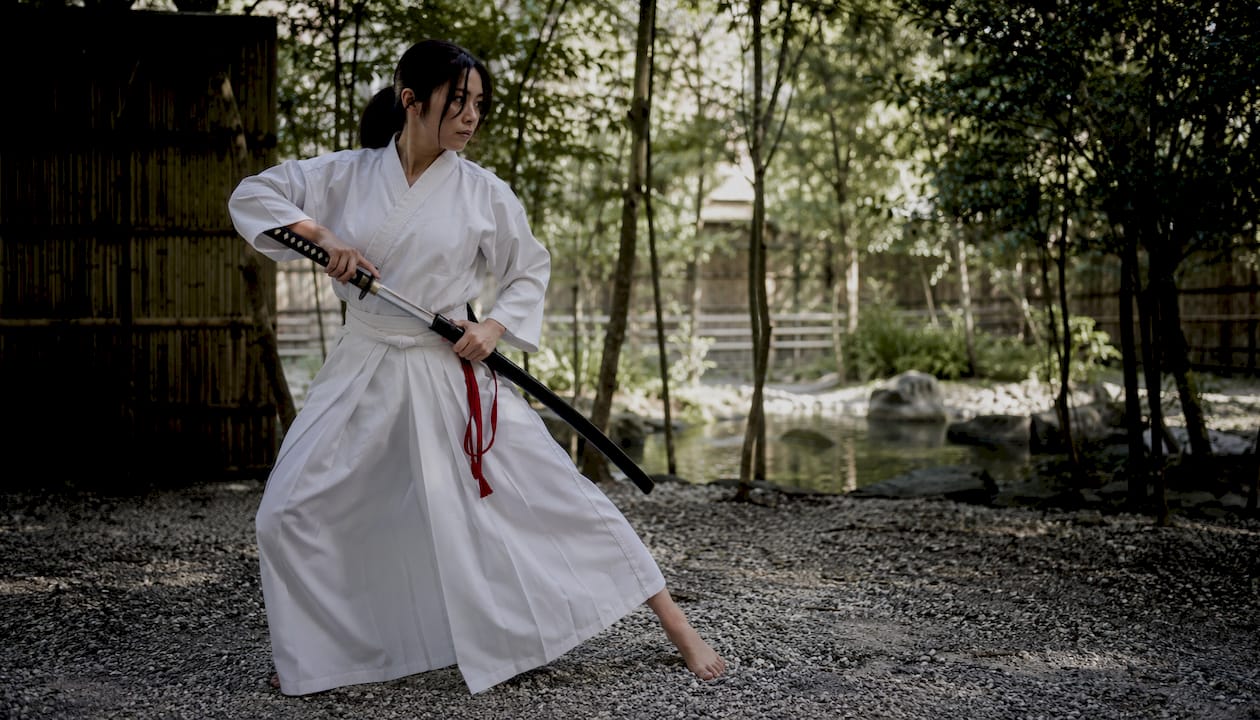
Battōdō (also called battōjutsu) focuses on drawing and cutting in a single motion, often against targets. A shinken is required for any meaningful cutting work in this art.
Tameshigiri is test-cutting, traditionally performed on rolled tatami mats soaked in water (which approximate the resistance of human tissue). Practitioners typically avoid using their most expensive or historically significant blades for tameshigiri, preferring durable production shinken that can take repeated use and resharpening without concern for damaging an irreplaceable piece.
For guidance on using Japanese swords in modern martial arts, the practical considerations around dojo use and safety are worth reviewing before you commit to a blade.
Dojo and demonstration etiquette:
- Never draw a shinken without your instructor’s permission in a group setting.
- Announce “shinken” clearly when carrying a live blade so others can adjust their proximity.
- Keep the edge oriented away from people when moving through a space.
- Never point a shinken at another person, even in jest.
What are the U.S. legal and safety rules for owning a shinken?
Owning a shinken is legal under federal law in the United States for adults. Swords are not regulated at the federal level the way firearms are, and there is no federal licensing requirement for purchase or ownership. That said, state and local laws vary considerably, and a few specific situations carry real legal risk.
Key points to verify before you buy or transport:
- California: Swords with blades over a certain length may be subject to concealed carry restrictions; check current California Penal Code provisions for your specific blade.
- New York City: Carries some of the strictest blade laws in the country. Carrying any sword in public is effectively prohibited.
- Other states: Most states permit ownership and home storage without restriction, but public carry of a sheathed sword is regulated differently in each jurisdiction.
Pro Tip: Always transport a shinken in a locked, hard-sided case in the trunk of your vehicle — not the passenger compartment. This is the safest practice regardless of your state’s specific rules, and it demonstrates responsible ownership if you are ever stopped.
Shipping and transport:
- Most major carriers (UPS, FedEx) permit shipping of swords within the United States when properly declared and packaged. Check current carrier policies before shipping.
- International import of swords into the U.S. is generally permitted but may require customs declaration. Antique blades (over 100 years old) may have additional documentation requirements.
- Always ship in a rigid case or tube with the blade wrapped and secured to prevent movement.
Safe storage at home:
- Store in a sword bag (sword bag/koshirae bag) or on a sword stand (katana-kake) in a low-humidity environment.
- Keep out of reach of children and unsupervised visitors.
- Apply a light coat of choji oil before storage to prevent rust.
How do you choose the right shinken to buy?
Buying a shinken without a clear intent is the most common mistake we see. Work through this framework before you spend anything.
- Define your primary use. Cutting practice, iaidō training, display, or investment? Each intent points to a different price range and specification.
- Set a realistic budget. Production shinken suitable for practice can start below $1,000; examples of functional sharp katana exist under $1,000 for practitioners needing a working blade without the nihontō price tag. Certified nihontō typically start at US$6,000 for the blade alone.
- Inspect construction markers. Full tang, high-carbon steel (1060 or higher for cutting use), clay-tempered hamon, and tight fittings are the baseline for a functional shinken.
- Verify seller credentials. Look for sellers who disclose the steel type, forging method, and country of manufacture. Vague listings (“high-quality steel,” no further detail) are a warning sign.
-
Ask specific questions before purchasing:
- What steel is used, and what is the carbon content?
- Is the tang full and pegged, or rat-tail?
- Is the hamon clay-tempered or acid-etched?
- Does the blade come with a certificate or documentation?
- What is the return and warranty policy?
- Match blade geometry to your art. Iaidō schools often specify blade length, curvature (sori), and weight. Confirm your school’s requirements before ordering.
| Price range | What you typically get |
|---|---|
| Under $1,000 | Entry-level sharp katana; functional for light practice, limited durability for heavy cutting |
| $1,000–$3,000 | Mid-range production shinken; 1060–1095 steel, clay temper, full tang; suitable for regular tameshigiri |
| $6,000 and up | High-end production or artisan-made; premium fittings, hand-polished, collector quality |
| US$6,000+ | Certified nihontō; tamahagane steel, registered Japanese smith, full provenance documentation |
For buyers interested in Japanese sword making historical eras, understanding the period context of a blade adds real depth to any collection decision.
How do you care for and maintain a shinken?
A shinken that is not maintained will rust, dull, and eventually become unsafe. The good news is that routine care is straightforward and takes only a few minutes after each use.
- Clean after every use. Wipe the blade with a soft, lint-free cloth (uchiko powder ball optional for light polishing) to remove fingerprints, moisture, and debris. Always wipe from the spine toward the edge, never across it.
- Apply choji oil. A thin, even coat of choji oil (traditional clove-scented mineral oil) protects the blade from oxidation. Apply with a soft cloth, then buff lightly. Too much oil attracts dust and can damage the saya (scabbard) lacquer.
- Inspect the fittings. Check the mekugi peg and tsuka wrap after every cutting session. A loose mekugi is a safety hazard.
- Store correctly. A sword bag or katana-kake in a stable, low-humidity environment is ideal. Avoid basements with moisture fluctuations. For display options that protect the blade while showing it off, minimalist vs. traditional sword displays covers the trade-offs well.
- Sharpen with care. Light touch-up sharpening with a fine whetstone is within reach for most owners. Major resharpening or full polishing should go to a professional togishi (sword polisher). Amateur polishing with power tools or coarse stones can destroy the hamon and hada permanently — damage that no amount of money will fully undo.
Pro Tip: Never use WD-40 or general-purpose machine oil on a shinken. These products leave residues that can damage the steel’s surface over time. Choji oil or a purpose-made sword oil is the correct choice.
Amateur polishing is the single most common way collectors destroy value in a blade. A togishi’s work is expensive precisely because it requires years of training to read the steel and preserve the temper line. If your blade needs more than light maintenance, find a qualified polisher rather than reaching for sandpaper.
Key Takeaways
A shinken is a real, sharpened Japanese-style sword — and choosing, using, and maintaining one correctly requires matching the blade’s type, steel, and construction to your specific intent, whether that is cutting practice, iaidō training, or serious collecting.
| Point | Details |
|---|---|
| Shinken definition | A forged, sharpened Japanese-style sword used for cutting practice, advanced iaidō, and display. |
| Nihontō vs. production | Certified nihontō start at US$6,000; production shinken can be found under $1,000 and are suitable for most training needs. |
| Buyer intent first | Define your use (cutting, iaidō, display, investment) before selecting steel grade or price range. |
| Maintenance is non-negotiable | Clean and oil after every use; send blades needing full polish to a professional togishi. |
| Moonswords | Moonswords offers hand-forged shinken-style katana from entry-level to high-end, with clay tempering and full tang construction. |
The shinken market rewards the informed buyer
Most buyers come to shinken through one of two doors: they have been practicing iaidō long enough that their instructor cleared them for live steel, or they have fallen in love with the craft and want a piece of it on their wall. Both are legitimate. What gets people into trouble is treating “shinken” as a single category when it actually spans a range from a $200 sharp wall-hanger to a $20,000 certified nihontō.
The conventional wisdom says: “buy the best you can afford.” We think that is the wrong frame. Buy the best blade for what you are actually going to do with it. A practitioner who cuts tatami three times a week needs a tough, serviceable production shinken in 1075 or 1095 steel — not a museum-quality nihontō that will suffer every time it meets a mat. A collector who wants a centerpiece for a dedicated display space has entirely different needs, and spending more on fittings, polish, and provenance makes complete sense there.
What we find underappreciated is the middle ground: the high-end production shinken made by skilled artisans outside Japan, using traditional techniques like clay tempering and hand-polishing, at a fraction of nihontō prices. These blades will not carry a Japanese smith’s mei or a board of education registration certificate, but they can be genuinely beautiful, historically informed objects that perform well in practice. Dismissing them because they are not nihontō misses what they actually are.
The other thing worth saying plainly: the shinken market has its share of misleading listings. “Hand-forged,” “clay-tempered,” and “tamahagane-style” are phrases that appear on blades ranging from the exceptional to the genuinely unsafe. Asking direct questions about steel type, tang construction, and forging method before you buy is not being difficult — it is being responsible.
Moonswords shinken: hand-forged blades for practitioners and collectors
For buyers ready to move from research to ownership, Moonswords offers a range of hand-forged katana built around the same principles this article covers: full tang construction, clay tempering, high-carbon steel, and fittings assembled to hold up under real use.
The entry-level katana collection is the right starting point for practitioners who need a functional shinken-style blade for iaidō training or tameshigiri without the premium price. For collectors and serious practitioners who want something closer to a display-worthy centerpiece, the high-end hand-forged collection includes blades with hand-polished finishes, premium fittings, and clay-tempered hamon that show genuine activity under light. Custom builds are also available for buyers with specific geometry, steel, or aesthetic requirements. Browse the full range at Moonswords and reach out directly if you have questions about which blade fits your practice or collection.
Useful sources and further reading
These are the primary sources cited in this article, along with recommendations for deeper research.
| Source | What it covers |
|---|---|
| Shinken — Wikipedia | Definition, production limits for nihontō, price context, and market usage of the term |
| 真剣 — Wiktionary | Linguistic roots, kanji breakdown, and dual meaning (real sword / serious) |
| 真剣 — Jepang.org | Secondary meaning (“serious/earnest”) and colloquial Japanese usage |
| Shinken — Stenudd.com | Practical guidance on production shinken for iaidō and tameshigiri; price examples |
| Moonswords — Shunshō Katana | Example of clay-tempered, 1095 steel construction with educational product detail |
For deeper research:
- Nihontō scholarship: The Society for the Preservation of Japanese Art Swords (NBTHK) publishes authentication standards and maintains records of registered smiths. Their documentation is the gold standard for verifying a nihontō’s provenance.
- Togishi (polishers): Finding a qualified sword polisher in the United States requires referrals through established martial arts organizations or collector communities. The American Federation of Judo and related sword arts organizations can point you toward vetted practitioners.
- Verifying seller credentials: Ask for the steel specification sheet, the smith’s name or workshop, and any registration papers (for nihontō). A mei (signature) on the nakago should be verifiable against known smith records. If a seller cannot provide these details, treat the blade as an unverified production piece regardless of how it is marketed.
FAQ
What is the difference between a katana and a shinken?
“Katana” describes the form of the sword — curved, single-edged, worn edge-up. “Shinken” describes its condition: a real, sharpened blade. A katana can be either a shinken (sharpened) or an iaitō (unsharpened), so the terms overlap but are not synonymous.
What does “shinken” mean in English?
Shinken (真剣) literally translates as “real sword” in Japanese. The same word also carries the meaning “serious” or “earnest” in everyday Japanese usage, reflecting the gravity associated with handling a live blade.
Is it legal to own a shinken in the United States?
Federal law does not prohibit adults from owning swords. State and local laws vary, however, and public carry of a sheathed sword is restricted in many jurisdictions. Always verify current rules in your specific state and city before purchasing or transporting a shinken.
How do you identify a real shinken versus a replica or fake?
Check for full tang construction (a mekugi peg through the tsuka), a genuine clay-tempered hamon with visible activity (nie or nioi), high-carbon steel specification from the seller, and tight, rattle-free fittings. A decorative replica typically has a rat-tail tang, a flat etched “hamon,” and stainless or low-carbon steel.
Why did Japan restrict katana production?
Japan’s post-World War II regulations limited sword production to preserve the craft as a cultural art form rather than a weapons industry. Registered swordsmiths are currently capped at 24 swords per year each, which keeps nihontō scarce, expensive, and traceable to specific smiths.