

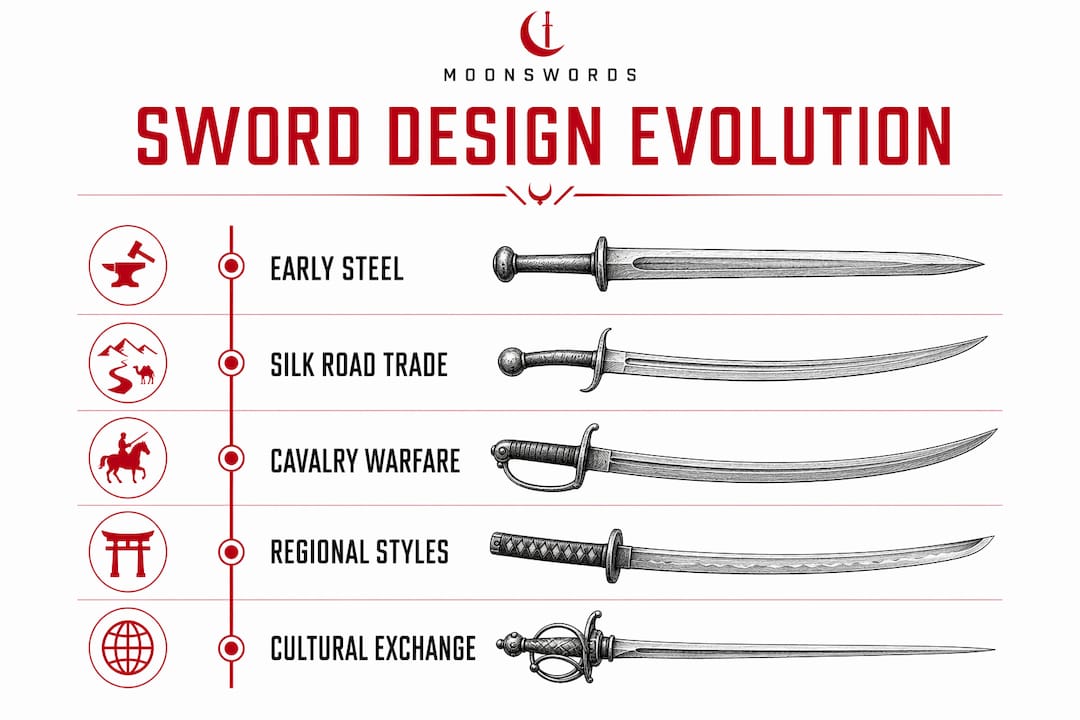
The Silk Road reshaped sword design by moving superior metals and crucible-steel techniques across Eurasia, spreading cavalry tactics that favored curved blades, and placing exotic foreign swords in elite hands where local smiths were commissioned to copy them. Three mechanisms drove nearly every major design shift you can trace from Persia to China to northern Europe: material and metallurgical transmission, tactical adoption from mounted steppe warfare, and elite patronage and aesthetic imitation. Understanding these vectors explains not just why the Persian shamshir curves the way it does, or why the Chinese dao displaced the straight jian as standard military issue, but also how a collector today can read a blade’s layered heritage in its fittings, geometry, and steel.
The primary channels of influence:
- Metallurgy and materials: Crucible steel (often called “Damascus” or wootz in popular writing) and the technical knowledge to produce it traveled as ingots, finished blades, and itinerant smiths along trade corridors from Central Asian workshops at Merv and Akhsiket outward to Persia, India, and eventually northern Europe.
- Cavalry tactics and steppe warfare: Turkic, Tungusic, and Mongol mounted warriors demonstrated the cutting efficiency of curved sabers across centuries of conflict and trade contact, driving adoption from the steppes into Persian, Indian, Chinese, and European military arsenals.
- Elite patronage and imitation: Rulers and aristocrats collected foreign blades as status objects and commissioned court smiths to replicate both the form and decorative language of those imports, institutionalizing foreign design features generation after generation.
Table of Contents
- How did the Silk Road transmit crucible steel and change blademaking?
- Why did cavalry warfare spread the curved saber across Eurasia?
- Regional case studies: what changed, when, and where?
- Which design features actually traveled along trade routes?
- How do historians and metallurgists reconstruct these transmission routes?
- Key Takeaways
- The deeper lesson swords carry about cultural exchange
- Historically inspired blades for collectors who care about the craft
- Useful sources for further reading
- FAQ
How did the Silk Road transmit crucible steel and change blademaking?
The single most consequential material that moved along Silk Road corridors was high-carbon crucible steel, the category that popular writing collapses under the label “Damascus steel.” Understanding why it mattered requires a brief technical distinction. Bloomery iron, the dominant pre-crucible process, produces a spongy, heterogeneous bloom that smiths must repeatedly fold and work to consolidate. Crucible steel, by contrast, melts the charge fully in a sealed clay vessel, allowing carbon to distribute evenly and producing a homogeneous high-carbon ingot. The result is a blade capable of holding a thinner, harder edge while retaining enough toughness to resist shattering — a combination that bloomery-worked iron rarely matched.
Archaeological crucible finds at Merv (Turkmenistan), Akhsiket, and Pap (Uzbekistan) date to the early Islamic period, the 9th–10th centuries AD, confirming sustained regional manufacture rather than isolated experiments. The scale of production at these sites suggests they functioned as distribution nodes, supplying finished blades and raw ingots to smiths across the Islamic world and beyond.
Trade mechanics worked on several levels simultaneously. Ingots of crucible steel traveled as raw material that local smiths could rework into blades suited to regional taste and combat style. Finished prestige blades moved as diplomatic gifts and luxury trade goods. And itinerant smiths, along with written treatises on metallurgical practice, carried the technical knowledge itself. A smith in Persia who acquired a Central Asian ingot did not simply copy the source blade; he adapted the material to local hilt forms, blade geometry, and heat-treatment traditions.
One persistent misconception deserves direct correction: the popular assumption that “Damascus steel” originated exclusively in India (as wootz) or was made in the Syrian city of Damascus. Central Asia produced crucible steel independently and, in many documented cases, earlier than Indian production centers. Central Asian and Indian crucible methods also differed materially in crucible shape, clay composition, and firing practice. The mottled surface pattern that collectors associate with “Damascus” depends on precise carbon segregation and controlled slow cooling — a process that was not uniform across regions and cannot be attributed to a single origin point.
Why did cavalry warfare spread the curved saber across Eurasia?
The curved saber’s spread is, at its core, a story about physics and horses. A straight double-edged sword like the Chinese jian or the European spatha is optimized for thrusting and controlled cuts delivered from a stable stance. On horseback at speed, the geometry changes entirely. A rider striking downward and forward needs a blade that draws through the target rather than stopping in it. Curvature shifts the center of percussion toward the tip, concentrates the cutting force along the belly of the blade, and allows the draw-cut mechanics that make a mounted slash genuinely lethal rather than a glancing blow.
Turkic, Tungusic, and Mongol steppe peoples had refined this logic into a weapon family by at least the 8th century. The Silk Road carried the curved saber westward and eastward from steppe origins, and that curved form became the template for the Persian shamshir, the Indian talwar, and eventually European cavalry sabers. The lineage is traceable:
- Turko-Mongol steppe saber (8th century onward): The ancestral form, characterized by a single-edged blade with pronounced curvature and a simple cross-guard suited to mounted use.
- Mongol saber (13th century): Refined through the Mongol conquests, which carried the form into Persia, China, and Eastern Europe simultaneously.
- Persian shamshir: Adopted and refined the extreme curvature for Persian cavalry, with a hilt style that became one of the most imitated forms in the Islamic world.
- Indian talwar: A direct descendant of the shamshir lineage, modified with a disc pommel and a slightly less extreme curve suited to both mounted and dismounted use.
- Chinese dao and peidao variants: Curved sabers adopted in China after the Mongol invasions; by the mid-Ming period, dao variants had replaced the straight jian as standard military issue.
The Mongol conquests of the 13th century acted as an accelerant rather than an origin point. Designs that had been spreading gradually through trade contact were suddenly imposed across vast territories through military occupation, and the administrative apparatus of the Mongol Empire then sustained those design preferences through court patronage and military standardization.
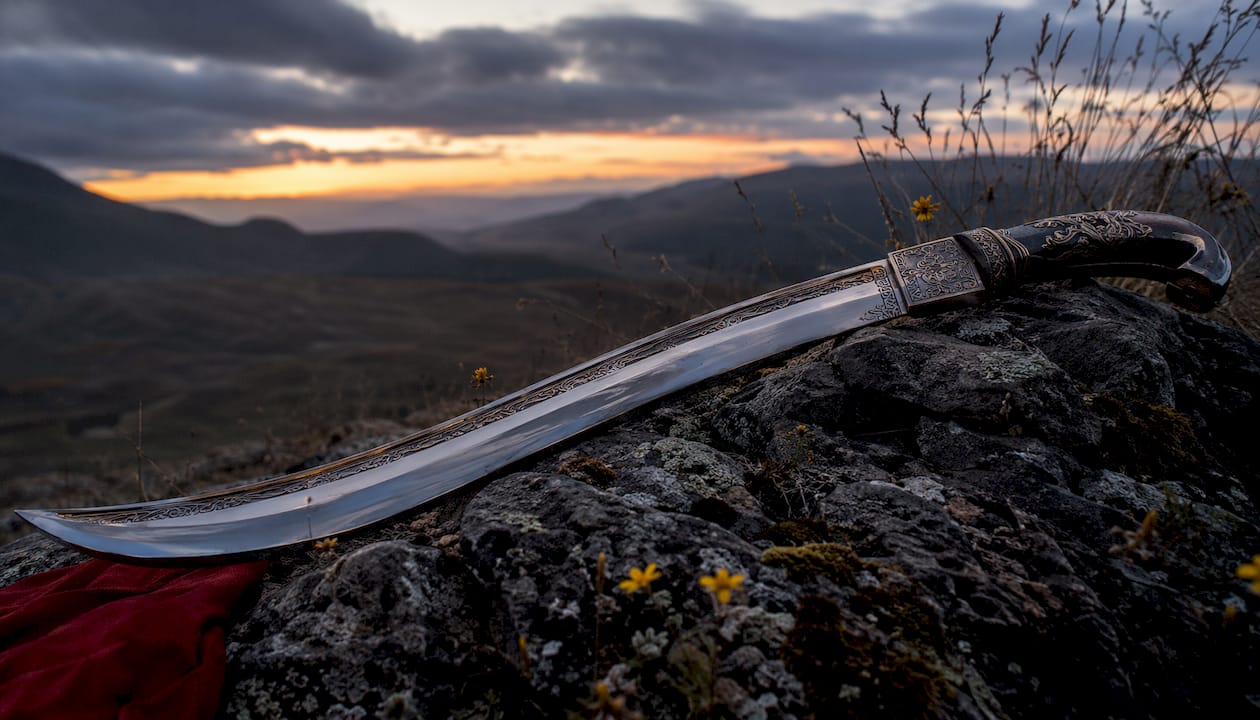
For collectors, the physical signals of steppe ancestry are readable. A tunkou (a metal collar reinforcing the blade-to-hilt junction) on a Chinese dao often indicates a design lineage that passed through Mongol military standardization. Hilt shapes with a slight pistol-grip curve, disk pommels, and single-edged blades with a pronounced distal taper all point toward the steppe saber family rather than indigenous straight-blade traditions.
Regional case studies: what changed, when, and where?
The table below maps the pre-Silk-Road dominant blade type, the specific influence that arrived via trade and conflict corridors, and a dated representative example for each major region.
| Region | Pre-Silk-Road dominant type | Silk Road influence | Dated representative example |
|---|---|---|---|
| Persia & India | Straight and slightly curved single-edge swords | Central Asian crucible steel ingots; Mongol curved-saber form; elite blade refitting | Shamshir (fully developed by 13th–14th c.); Mughal-era talwar with imported blade, local hilt |
| China | Straight double-edged jian | Mongol/Yuan curved-saber adoption; Persian decorative motifs via Tang-era trade | Peidao/dao as Ming military standard (mid-Ming); Tang-era paired-animal pommel swords |
| Europe | Spatha-derived straight swords | High-carbon crucible steel via eastern trade routes; curved falchion influence from eastern contact | Viking-period Ulfberht swords (9th–10th c.); medieval falchion forms (13th–14th c.) |
Persia and India. The shamshir and talwar carry complex layered provenances: blades, hilts, and fittings frequently come from different regions entirely, reflecting both trade acquisition and deliberate refitting by new owners. A Mughal-era talwar might carry a blade forged in Persia or Central Asia, mounted in an Indian hilt with local decorative conventions. This is not a sign of inferior craftsmanship; it reflects a sophisticated market in which the best blades were treated as raw material worth preserving across generations.
China. The Tang Dynasty (7th–8th centuries CE) brought Persian metalwork and textiles into China at scale, carried largely by Sogdian merchants who served as cultural intermediaries. Paired-animal roundels, a Persian artistic tradition, appeared on Chinese sword pommels during this period precisely because Persian textiles featuring those motifs were fashionable in aristocratic circles, and court smiths adapted the motif to sword fittings. Then the Mongol Yuan Dynasty (13th–14th centuries) imposed the curved saber as a military form. The Ming Dynasty that followed inherited both the Mongol blade geometry and the paired-animal decorative tradition, applying the latter to large disc-shaped handguards as symbols of imperial authority.
Europe. Some Viking-period Ulfberht swords carry metallurgical signatures consistent with imported high-carbon crucible steel traceable to eastern trade networks. Critically, production of these high-quality blades declines when eastern trade routes closed, a pattern that points directly to supply-chain dependence rather than independent European development. Later, trade and plunder carried eastern curved-blade designs into Europe, influencing medieval falchion forms and the cavalry saber traditions that would dominate European military use through the 18th century.
Which design features actually traveled along trade routes?
Blade geometry and steel quality were the most consequential things that moved, but they were not the only things. A range of decorative and functional features traveled as well, and they are often more visible to a collector examining a blade today.
- Tunkou (blade collar): A metal ferrule at the base of the blade, reinforcing the junction with the hilt. Its presence on Chinese dao variants signals Mongol-era standardization and steppe design ancestry.
- Paired animal roundels: Persian in origin, transmitted to China via Sogdian merchants during the Tang Dynasty, and later institutionalized as imperial symbols on Ming and Qing handguards.
- Disc pommels: Characteristic of the talwar and related Islamic sword families; adopted in modified form across regions where Persian military influence was felt.
- Knuckle-guard forms: Traveled from Islamic sword traditions into European cavalry saber design, particularly in the 17th–18th centuries.
- Inscriptions and calligraphy: Quranic inscriptions on blades destined for Islamic markets, Chinese reign-mark inscriptions on court swords, and Sanskrit or Persian verses on Indian blades all reflect the religious and symbolic frameworks of their respective trade networks.
Some features were adopted essentially unchanged because they functioned as status markers. Owning a sword with Persian-style fittings in Tang-era China signaled cosmopolitan taste and access to luxury trade goods. Other features were hybridized to fit local ergonomics or ritual requirements. The paired-animal motif, for instance, was simplified when applied to the small ring-shaped pommels of early Tang swords, then expanded to full complexity when Ming craftsmen had the larger disc-shaped handguard to work with.
Pro Tip: When evaluating a blade’s provenance, look for mismatched fittings: a blade with Central Asian or Persian geometry mounted in a hilt with local decorative conventions often indicates deliberate refitting rather than manufacture in a single workshop. Reading the fittings carefully — tunkou remnants, stylistic incongruities between blade and guard, and evidence of re-hilting — can reveal a sword’s full trade history more reliably than blade shape alone.
The role of religious symbolism deserves particular attention. Buddhist iconography, Islamic geometric patterns, and imperial Chinese symbols all traveled along the same corridors as the blades themselves, and they shaped ornamentation far more than they shaped blade geometry. A blade’s cutting edge follows tactical logic; its decoration follows the symbolic vocabulary of whoever commissioned or owned it. That distinction matters for attribution: decorative motifs can be added or changed at any point in a blade’s life, while the steel’s microstructure and the blade’s fundamental geometry are fixed at the forge.
How do historians and metallurgists reconstruct these transmission routes?
The claims made in this article rest on several distinct categories of evidence, each with different strengths and limitations.
Archaeometallurgy is the most direct. Metallographic analysis of blade cross-sections reveals microstructure: the distribution of carbides, the presence of crucible-steel signatures (banded cementite, for instance), and the carbon content that distinguishes crucible steel from bloomery iron. When a Viking-period sword in Scandinavia shows the same microstructural signature as crucible steel produced at Merv, the inference of trade connection is grounded in physical chemistry, not stylistic resemblance.
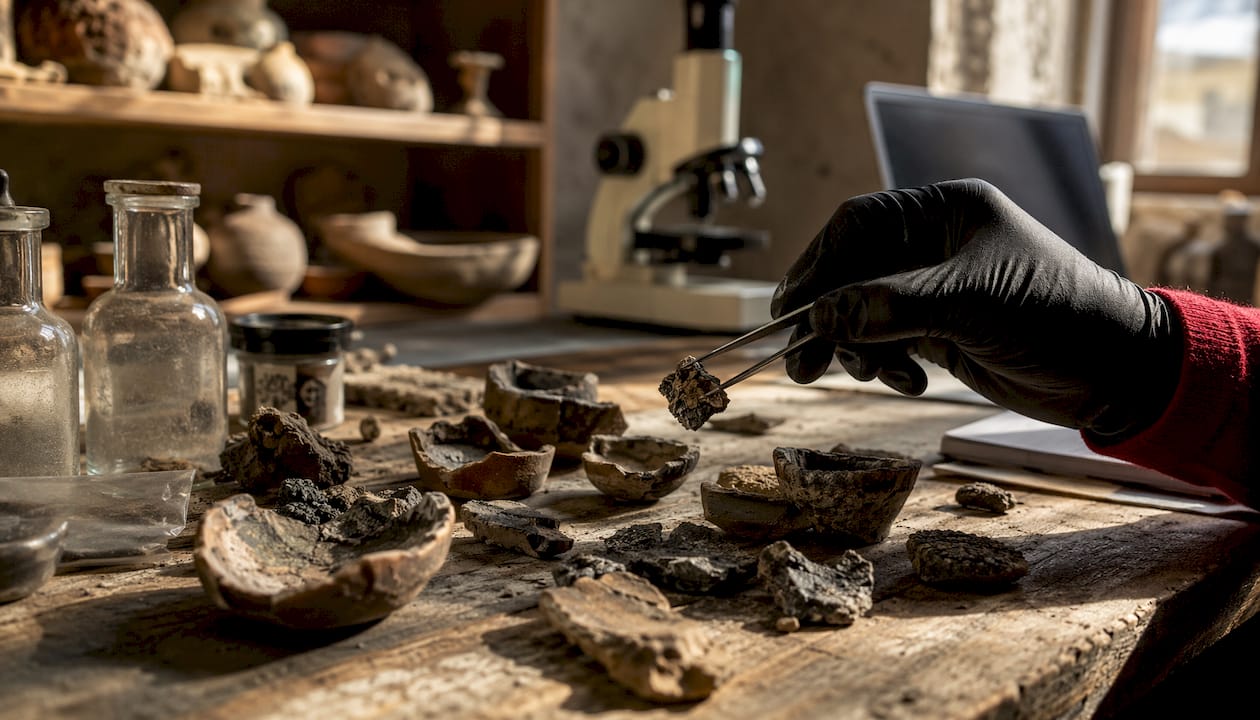
Workshop archaeology provides the production side. Crucible fragments, slag, and furnace remains at Merv, Akhsiket, and Pap in Uzbekistan confirm not just that crucible steel was made there, but the scale and continuity of production. The crucible steel workshops at Merv and Akhsiket dated to the 9th–10th centuries represent the best-documented transmission nodes currently known.
Typological and stratigraphic dating from hoards and burials establishes chronology. When a curved saber appears in a burial context dated to the 8th century in the Eurasian steppe and similar forms appear in Persian and Chinese contexts two centuries later, the sequence supports transmission rather than independent invention. Contemporaneous texts, including Persian and Chinese court records, trade inventories, and military manuals, provide additional corroboration.
For readers who want to go deeper, the peer-reviewed literature on archaeometallurgy is the most reliable starting point. The PhD thesis Crucible Steel in Central Asia: Production, Use, and Origins (available via Academia.edu) is the most thorough treatment of Central Asian production. The American Society of Arms Collectors bulletin on Damascus and crucible steel in Central Asia provides an accessible synthesis. For the China case, the Colorado Asian Studies Journal (2024) article on paired-animal motifs on Chinese swords is a well-sourced recent study.
At Moonswords, our bladesmith Zhao Peiyan draws on these documented traditions in the construction of our historically inspired pieces, particularly in the forging and heat-treatment approaches applied to our Chinese dao and jian collections. That practical knowledge informs how we read historical blades as much as the scholarly literature does.
Key Takeaways
The Silk Road reshaped sword design through three interlocking forces: the movement of crucible steel and smithing knowledge, the spread of cavalry tactics that favored curved blades, and elite patronage that institutionalized foreign forms in local workshops.
| Point | Details |
|---|---|
| Crucible steel was the key material | Central Asian workshops at Merv and Akhsiket produced crucible steel starting in the early Islamic period, supplying blades and ingots across Eurasia. |
| Cavalry tactics drove curvature | Curved sabers spread from Turkic and Mongol steppe peoples because draw-cut mechanics on horseback favored curved blades over straight ones. |
| Elite patronage locked in foreign forms | Rulers collected exotic blades and commissioned court smiths to replicate both form and decoration, making foreign design features permanent in local traditions. |
| Regional outcomes are traceable | China’s dao displaced the jian after Mongol influence; some Viking-period European swords show crucible-steel signatures consistent with eastern trade route connections. |
| Moonswords collections reflect these traditions | The Chinese dao collection and jian collection at Moonswords are inspired by historical techniques associated with master bladesmith Zhao Peiyan. |
The deeper lesson swords carry about cultural exchange
Swords are technology carriers as much as weapons, and the Silk Road’s influence on their design is one of the clearest demonstrations of how material culture actually moves between civilizations. Not through sudden invention or wholesale copying, but through incremental adoption driven by performance, status, and access. A Persian smith who acquired a Central Asian crucible-steel ingot was not imitating a foreign culture; he was solving a practical problem with the best available material. A Chinese court that commissioned swords with Persian-style paired-animal pommels was not abandoning Chinese tradition; it was incorporating a prestige vocabulary signaling cosmopolitan authority.
For collectors and museums, this history has a direct practical implication. A blade’s provenance is rarely a single point of origin. The steel, the geometry, the hilt, and the decoration may each carry a different cultural signature, and understanding those layers requires both metallurgical literacy and art-historical context. Attributing a sword to a single culture based on its most visible feature, usually the hilt, routinely misrepresents what the object actually is. The ethical dimension follows from that: a blade acquired without documented provenance loses the very layering that makes it historically significant. Collectors who invest in understanding how swords accumulated status across cultures are better equipped to evaluate what they own and to resist the market in decontextualized pieces.
The continuity argument also deserves emphasis. The transition from straight to curved swords across Eurasia took centuries, not decades. It was not a revolution but an accumulation of small tactical and aesthetic decisions, each one grounded in the specific conditions of a particular time and place. That is precisely what makes the Silk Road’s influence so durable: it worked through the grain of existing traditions rather than against them.
Historically inspired blades for collectors who care about the craft
The history covered in this article is not just academic. If you collect Chinese dao or jian, or if you are drawn to the curved saber traditions that traveled from the Central Asian steppes into Persian, Indian, and Chinese arsenals, the design lineages described here are alive in the blades Moonswords produces today.
Moonswords’ Chinese dao collection is forged by master bladesmith Zhao Peiyan using clay tempering and full-tang construction, the same foundational techniques that defined historically significant dao production. The Chinese jian collection offers the straight double-edged form that predates Mongol influence, giving collectors a direct comparison point for the design shift this article traces. These are purchase options for collectors who want museum-quality pieces grounded in documented historical traditions, not decorative reproductions. Browse the full range at Moonswords and find the blade that fits your collection.
Useful sources for further reading
| Source | Type | What it contributes |
|---|---|---|
| Crucible Steel in Central Asia: Production, Use, and Origins (Academia.edu PhD thesis) | Archaeometallurgy / primary research | Most thorough treatment of Central Asian crucible steel; includes laboratory analyses of Merv workshop remains and numerous blade examinations. |
| American Society of Arms Collectors: Damascus Steel and Crucible Steel in Central Asia | Synthesis / accessible scholarship | Corrects the India-origin myth; documents Merv and Akhsiket workshops; good entry point for non-specialists. |
| Williams, Crucible Steel in Medieval European Contexts (Penn Digital Scholarship) | Metallurgical chapter | Documents Ulfberht-type sword signatures and the correlation between eastern trade-route closure and decline in high-quality European blades. |
| Moshtagh Khorasani (2025), The Evolution of Curved Swords: A Comparative Study of China and Iran (Parseh Journal of Archaeological Studies) | Peer-reviewed comparative study | Traces the curved-saber lineage from steppe origins through Persian and Chinese adoption; most current scholarly treatment available. |
| Swords That Tell Stories: Plunder and Trade from India to Europe (Curationist) | Editorial / museum-facing | Illustrates layered provenance in Indian and Persian swords; accessible for collectors. |
| Colorado Asian Studies Journal (2024): paired-animal motifs on Chinese swords | Peer-reviewed art history | Documents Persian influence on Tang-era Chinese sword decoration via Sogdian merchants; well-sourced primary analysis. |
| Wikipedia: Mongol Sword | Reference overview | Useful lineage summary for the Turko-Mongol saber family; good starting point for chronology. |
FAQ
How did the Silk Road influence sword design?
The Silk Road moved crucible steel, smithing techniques, and curved-saber forms across Eurasia through trade, military contact, and elite patronage. Central Asian workshops at Merv produced high-carbon crucible steel from the 9th–10th centuries, supplying blades and ingots that reached Persia, India, and eventually northern Europe.
What is the role of swords in Chinese culture?
Swords in Chinese culture carried both martial and symbolic weight. The straight jian was associated with scholarly and aristocratic identity, while the curved dao became the military standard after Mongol influence during the Yuan Dynasty, a shift that reflects the Silk Road’s direct impact on Chinese weapon design.
What did the Silk Road transmit beyond trade goods?
The Silk Road transmitted combat concepts, metallurgical techniques, decorative motifs, and religious symbolism alongside physical goods. Curved-saber tactics from steppe cavalry, Persian paired-animal decorative traditions, and crucible-steel production methods all traveled as ideas and practices, not just as objects.
What did the Silk Road symbolize for sword collectors today?
For collectors, the Silk Road represents the layered provenance that makes historical blades genuinely complex objects. A single sword may carry steel from Central Asia, a blade geometry from the Mongol steppe tradition, and decorative fittings from a Persian or Indian workshop, each layer traceable through metallurgical analysis and typology.
Why did curved swords spread so widely across Eurasia?
Curved blades are more effective for draw-cut strikes from horseback, concentrating force along the blade’s belly and allowing the blade to pull through the target. As mounted cavalry became the dominant military force across Eurasia from the 8th century onward, the curved saber’s tactical advantages drove adoption from the steppes into Persian, Indian, Chinese, and European arsenals.