

Swords appear on Japanese family crests, known as kamon (family emblems) or mon, as direct symbols of samurai martial prowess, honor, and the sworn duty to protect one’s lord and family. These crests are not decorative accidents. The sword motifs embedded in kamon designs carry centuries of feudal meaning, clan identity, and social hierarchy. Understanding why swords appear on Japanese crests means understanding the warrior class that shaped Japan’s entire cultural identity from the Heian period through the Edo era and beyond.
Why swords appear on Japanese crests: the historical origins
The integration of sword imagery into Japanese family crests did not happen overnight. It developed across several distinct historical periods, each adding new layers of meaning to the practice.
-
Heian period (794–1185): The earliest kamon designs were plant and geometric patterns used by court nobility. Swords were not yet central motifs, but the rising samurai class was beginning to assert its identity through visual symbols on armor and banners.
-
Kamakura and Muromachi periods (1185–1573): As samurai clans consolidated military power, sword crests emerged on armor and battlefield flags to identify warriors at a glance. With over 2,000 variations of Japanese family crests existing today, many trace their sword-bearing designs directly to this era of intense clan warfare.
-
Sengoku period (1467–1615): Japan’s “Warring States” era accelerated the need for clear battlefield identification. Sword motifs became more prominent and stylized, fused with plant symbols to communicate both martial readiness and family prosperity. The Maru ni Ken Katabami crest, which combines a wood sorrel plant with sword motifs, became one of the most recognized designs of this period.
-
Edo period (1603–1868): Under the Tokugawa shogunate, Japan entered a long peace. Crests shifted from battlefield tools to social markers of status and lineage. Sword imagery in kamon now signaled a family’s warrior heritage even in peacetime.
-
Post-1875 expansion: The 1875 Commoner Surname Obligation Order required all Japanese citizens to adopt family names, triggering a surge in kamon adoption among commoners. Many chose sword-bearing crests to project status and longevity, further spreading designs like Maru ni Ken Katabami across the population.
Pro Tip: If you are researching your own Japanese family crest, the presence of a sword motif is a strong indicator of samurai lineage or a deliberate claim to warrior-class prestige adopted after 1875.
The sword’s journey from battlefield banner to family emblem mirrors Japan’s own transition from a war-driven feudal state to a structured, hierarchical society. The history of swords in Japanese symbols is inseparable from the history of the samurai class itself.
What do swords symbolize in Japanese crests?
The meanings of sword symbols in Japan go far deeper than simple weaponry. When a samurai clan placed a sword on its kamon, it was making a layered statement about identity, duty, and values.
-
Martial discipline and defender roles: Swords in Japanese crests symbolize martial discipline and the defender’s role rather than aggression. This reflects the samurai’s core duty to uphold justice and protect their lord and family. A sword on a crest says “we are guardians,” not “we are conquerors.”
-
Psychological warfare: Sword symbols served as signals of constant vigilance and readiness to strike. Displaying a sword crest on armor or a battle flag communicated to both allies and enemies that this clan was prepared, disciplined, and dangerous. The visual impact was intentional and calculated.
-
Honor and loyalty: The sword in Japanese culture is the physical embodiment of bushido, the warrior’s code. Placing it on a family crest bound the entire clan to those values across generations. The crest became a permanent declaration of the family’s commitment to honor.
-
Fusion with natural motifs: Swords rarely appear alone in kamon designs. The combination of sword imagery with plants like katabami (wood sorrel) was a strategic design evolution that fused prosperity symbolism with martial readiness. The plant represents resilience and abundance; the sword adds the warrior ethos that protects it.
-
Social status signaling: The cultural importance of swords in Japan meant that wearing a sword crest announced your family’s place in the social order. During the Edo period especially, sword motifs in kamon communicated proximity to the shogunate and samurai class standing.
“The sword in Japanese heraldry is not a weapon frozen in stone. It is a living declaration of a family’s values, duties, and place in the world.”
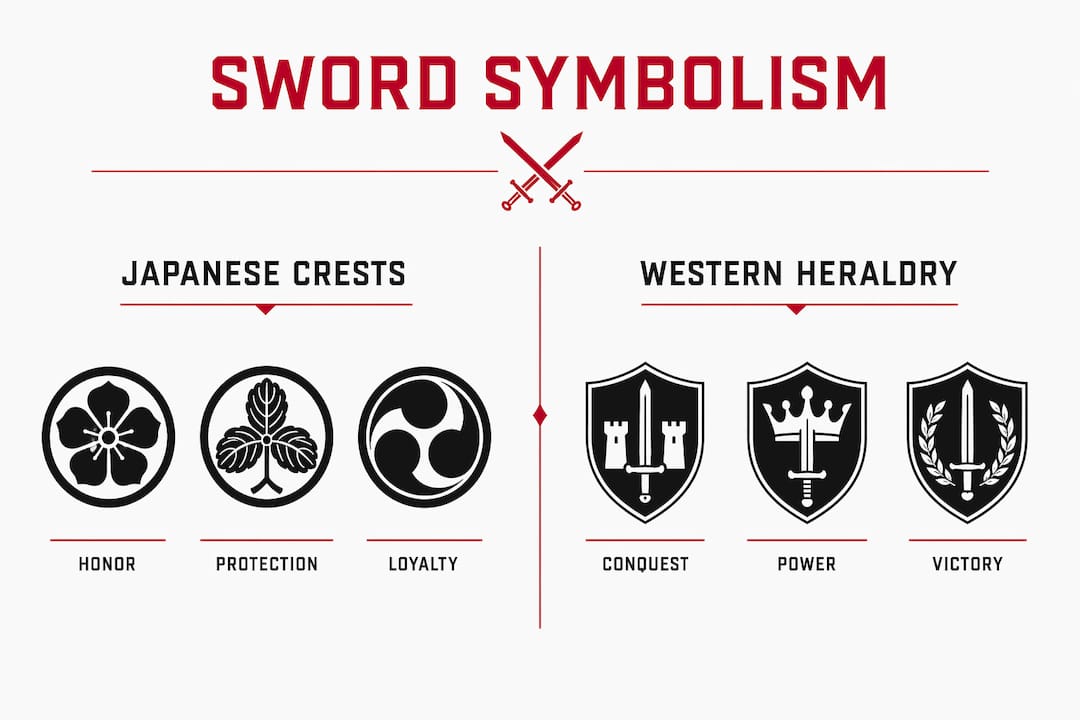
The contrast with Western heraldic traditions is striking. European sword symbolism typically emphasizes conquest, military victory, or royal authority granted through force. Japanese sword symbolism in kamon emphasizes the samurai’s defensive and honorable role, a distinction that reflects fundamentally different cultural relationships with the blade.
Notable examples of sword crests across clans and regions
The diversity of Japanese crests with swords reveals how different clans adapted the motif to their own identities and regional contexts.
| Crest Name | Key Features | Primary Symbolism |
|---|---|---|
| Maru ni Ken Katabami | Circle enclosing wood sorrel with sword points | Prosperity, martial prowess, longevity |
| Ken-Kikyō | Sword-pointed bellflower design | Purity, loyalty, martial valor, five classical elements |
| Ken Hanabishi | Sword motifs within diamond flower pattern | Warrior refinement, clan distinction |
| Crests without swords | Pure plant, animal, or geometric designs | Court nobility, merchant class, non-warrior lineage |
The Maru ni Ken Katabami stands as one of Japan’s most widespread family crests, and its popularity tells a clear story about what sword imagery meant to Japanese families. The katabami plant was already admired for its rapid spread and resilience. Adding sword points transformed it into a statement of martial readiness layered over natural abundance.
The Ken-Kikyō crest uses sword-like points to balance purity, loyalty, and martial valor, with the design symbolizing harmony of five classical elements relevant to governance and defense. This crest was favored by clans that saw themselves as both administrators and warriors, reflecting the dual nature of samurai leadership.
Regional distribution matters too. Sword-bearing crests appear with higher frequency in western Japan, particularly in regions with strong samurai clan histories such as Choshu (modern Yamaguchi Prefecture) and Satsuma (modern Kagoshima Prefecture). These areas produced many of the samurai who drove the Meiji Restoration, and their kamon traditions reflect generations of warrior culture.
Pro Tip: The number and placement of sword motifs within a crest carry specific meaning. A single central sword often indicates direct martial lineage, while multiple swords arranged symmetrically suggest a clan that valued collective defense over individual valor.
How sword crests shaped samurai identity and social dynamics
The significance of swords in Japanese heraldry extended well beyond visual identification. Sword crests were active tools of social communication within the rigid hierarchy of feudal Japan.
-
Psychological statements to allies and enemies: A clan’s kamon appeared on everything from armor and helmets to household goods and temple donations. Seeing a sword crest meant encountering a family that had publicly committed to warrior values. This created a constant, ambient pressure to live up to the symbol.
-
Unwritten rules of adoption: Social norms guided samurai families to modify sword crests to avoid conflicts and show hierarchical respect. If a powerful clan used a specific sword design, lesser clans would alter the number of swords, their angle, or the surrounding motif to differentiate themselves while still signaling warrior status. This system prevented visual conflicts that could imply false claims of lineage.
-
Shogunate and imperial grants: The most prestigious sword crests were granted directly by the shogun or emperor. Receiving a kamon featuring a sword from the Tokugawa shogunate, for example, was a formal recognition of loyalty and service. These granted crests carried legal and social weight that self-adopted crests did not.
-
Stylized abstraction as rank signal: Swords in crests use strict geometric forms called ken or tsurugi to comply with Japanese heraldic rules. The level of abstraction itself signals rank. Highly stylized, almost unrecognizable sword forms appear in crests of clans with deep, established lineages, while more literal sword depictions often indicate newer warrior families asserting their status.
Understanding why samurai carried swords as both functional weapons and identity markers helps explain why sword imagery became so central to kamon design. The blade was never just a tool. It was the samurai’s soul made physical, and placing it on a family crest extended that meaning across generations.
Key takeaways
Swords appear on Japanese family crests because they encode the samurai’s core identity: martial discipline, protective duty, clan loyalty, and social standing within Japan’s feudal hierarchy.
| Point | Details |
|---|---|
| Swords signal warrior lineage | Sword motifs in kamon identify families with samurai heritage or deliberate claims to warrior-class prestige. |
| Symbolism goes beyond combat | Sword imagery represents honor, loyalty, and the defender’s role rather than aggression or conquest. |
| Design details carry rank | The number, placement, and abstraction level of sword motifs reflect a clan’s position in the social hierarchy. |
| Regional patterns exist | Sword-bearing crests concentrate in western Japan, particularly in historically strong samurai regions. |
| Adoption expanded after 1875 | The Commoner Surname Obligation Order spread sword crests beyond the samurai class to the general population. |
The blade as a family’s permanent declaration
I have spent years studying Japanese sword culture, and the thing that strikes me most about sword crests is how deliberately they resist simplicity. A Western observer might look at a Maru ni Ken Katabami and see a decorative flower with pointed edges. A Japanese samurai family saw a complete philosophical statement about who they were and what they owed the world.
What I find genuinely underappreciated is the tension built into these designs. The katabami plant spreads aggressively and is nearly impossible to eradicate. Pair that with sword points, and you have a family saying: we grow, we endure, and we are armed. That is not decoration. That is a worldview compressed into a two-inch circle of lacquered wood or embroidered silk.
The contrast with Western heraldry also deserves more attention than it typically gets. European coats of arms often celebrate conquest and dominion. Japanese kamon with swords tend to emphasize guardianship and duty. The sword in a Japanese crest faces inward as much as outward. It protects the family’s values as much as it threatens enemies. That distinction reflects something profound about how Japanese warrior culture understood the relationship between power and responsibility.
For collectors and enthusiasts today, sword crests are not historical curiosities. They are compressed archives of how a family chose to define itself across centuries. When you hold a katana forged in the tradition of those families, you are holding the physical counterpart to what those crests declared. The blade and the emblem are two expressions of the same commitment.
— Kenji Smith
Explore the swords behind the symbols at Moonswords

The kamon traditions described in this article were built around real blades, forged by real craftsmen who understood that a sword was never just a weapon. At Moonswords, we carry that same understanding into every piece we offer. Our hand-forged Japanese katanas are crafted by master artisans using clay tempering, full tang construction, and centuries-old folding techniques that produce the hamon and hada patterns that made Japanese swords legendary. Whether you are a collector drawn to samurai heritage, a martial artist seeking an authentic training blade, or an enthusiast who wants to own a piece of the tradition behind those kamon designs, Moonswords has a blade worthy of the legacy. Browse our full katana collection and find the sword that speaks to your connection with this history.
FAQ
What does a sword on a Japanese family crest mean?
A sword on a Japanese family crest (kamon) symbolizes martial discipline, honor, loyalty, and the protective duty of the samurai class. It signals warrior lineage and a family’s commitment to bushido values across generations.
What is the most famous Japanese crest with a sword?
The Maru ni Ken Katabami is one of Japan’s most widespread family crests, combining wood sorrel with sword motifs to represent both prosperity and martial prowess. Its popularity surged after the 1875 Commoner Surname Obligation Order.
How are swords depicted differently in Japanese versus Western heraldry?
Japanese sword symbols in kamon emphasize the defender’s role and honorable duty, while Western heraldic swords typically represent conquest or royal military authority. The cultural meaning of the blade differs fundamentally between the two traditions.
Did only samurai families use sword crests?
Originally yes, but after the 1875 Commoner Surname Obligation Order required all Japanese citizens to adopt family names, commoners began adopting sword-bearing crests to project status and warrior-class prestige.
What do the ken and tsurugi terms mean in crest design?
Ken and tsurugi are the stylized, geometric sword forms used in kamon design to comply with Japanese heraldic conventions. The number and placement of these forms within a crest reflect the clan’s rank and proximity to the shogunate.