

Differential tempering is a targeted heat treatment method that gives a sword a hard cutting edge and a softer, tougher spine within a single blade. Understanding why swords are differentially tempered requires grasping a core metallurgical conflict: the same steel properties that make an edge sharp and hard also make it brittle. Without tempering, even high-quality steel shatters under impact. Differential tempering solves this by applying heat selectively after full hardening, producing a microstructural gradient across the blade. The result is a weapon that cuts cleanly and survives the shock of contact, a balance that uniform tempering cannot achieve.
Why swords are differentially tempered: the metallurgical case
Differential tempering works by re-heating specific zones of an already hardened blade to reduce brittleness where toughness matters most. The spine of a sword absorbs shock. The edge must hold a keen line. A blade tempered uniformly compromises both: either the edge is too soft to hold sharpness, or the spine is too hard to flex without cracking.
The process targets the spine directly. A smith heats the back of the blade using a heated block, pipe, or torch, then watches the steel surface carefully. Temper colors appear as thin oxide layers form on the steel, progressing from pale straw through gold, purple, and blue as temperature rises. Each color corresponds to an approximate temperature range and a predictable drop in hardness. The smith stops heating when the desired color reaches close to the edge, preserving edge hardness while softening the spine.
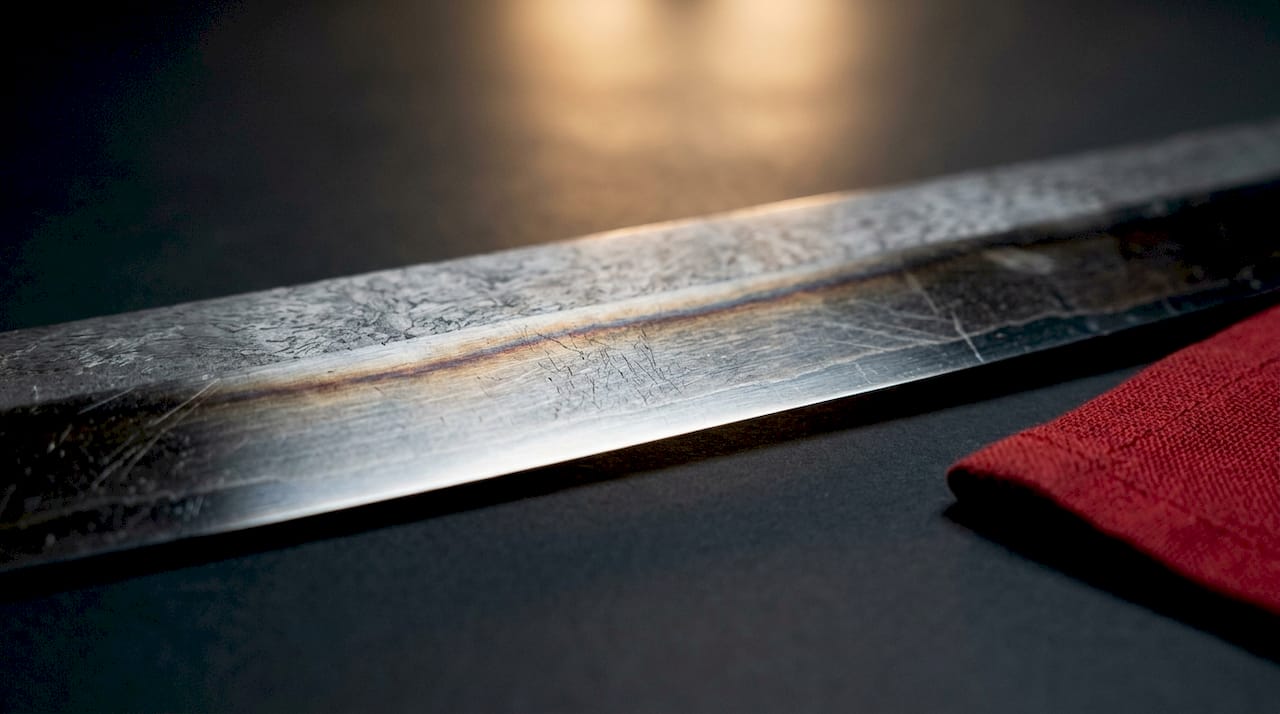
The microstructures involved are martensite and pearlite. Martensite forms during rapid quenching and is extremely hard but brittle. Tempering converts some martensite into tempered martensite, which retains significant hardness while gaining ductility. The spine, heated more aggressively, may develop pearlitic or bainitic structures that absorb energy without fracturing. This gradient, hard at the edge and tough at the spine, is the engineering goal of every differential tempering cycle.
How hardness zones map across a blade
The table below shows typical hardness values and microstructures across a differentially tempered blade.
| Zone | Typical hardness (HV) | Dominant microstructure |
|---|---|---|
| Cutting edge | 600–750 | Martensite |
| Mid-blade | 450–600 | Tempered martensite |
| Spine | 300–450 | Tempered martensite / pearlite |
These gradients are not accidental. They reflect deliberate control of heat, time, and cooling rate across each zone of the blade.
Pro Tip: Watch the temper color at the edge, not the spine. The color you see at the spine tells you where you are; the color creeping toward the edge tells you when to stop.
How does differential tempering differ from differential hardening?
Differential tempering and differential hardening both create hardness gradients, but they use opposite approaches to get there. Knowing the difference matters for understanding why sword design varies so dramatically between European and Japanese traditions.
Differential hardening uses clay coating applied to the spine before quenching. The clay insulates the spine, slowing its cooling rate so it transforms into tough pearlite or bainite rather than brittle martensite. The uncoated edge cools rapidly, reaching martensite hardness of HV 700 or above. The spine cools slowly to around HV 300. This single quench creates both zones simultaneously. The boundary between them becomes the hamon, the visible temper line prized on Japanese katanas.
Differential tempering takes the opposite path. The blade is first hardened uniformly through quenching, then selectively re-heated at the spine to reduce hardness there. This technique) is predominantly European and applies after full hardening rather than during it. The edge retains its quench hardness; the spine is drawn back to a tougher state through controlled reheating.
Key distinctions between the two methods:
- Clay tempering (differential hardening): Single quench process; clay controls cooling rate; produces hamon line; dominant in Japanese katana tradition; relies on tamahagane or high-carbon steel.
- Differential tempering: Post-hardening process; heat applied selectively to spine; no hamon produced; dominant in European swordmaking; compatible with a wider range of carbon steels.
- Steel selection: High-carbon steels like T10 and 1095 respond well to both methods; stainless and highly alloyed steels present challenges for differential tempering due to color inconsistency.
- Visual result: Clay tempering leaves a visible hamon; differential tempering leaves no such surface marker.
The thermal contraction difference between martensite and pearlite during clay tempering also generates the katana’s characteristic upward curvature, called sori. Martensitic contraction at the edge differs from pearlitic behavior at the spine, creating internal stresses that curve the blade naturally after quenching. Differential tempering does not produce this effect because the blade is already shaped before re-heating begins.
What does recent science say about carbon content and clay thickness?
A 2026 MDPI Crystals study quantified what master smiths have known intuitively for centuries: carbon content and clay thickness are the two most powerful variables in differential heat treatment. The findings give collectors and metallurgists a precise framework for understanding blade performance.
The study compared two steel grades under clay tempering conditions. L02 steel at 0.98% carbon showed a hardness range of 425 to 1,050 HV across the blade. L01 steel at 0.69% carbon ranged from 550 to 846 HV. Higher carbon content produced both a harder edge and a greater spread between edge and spine hardness, meaning a more pronounced gradient and a sharper performance difference between zones.
Clay layer thickness directly controls the proportion of martensite formed during quenching. Thick clay slows cooling at the spine, favoring tough pearlitic structures. Thin or absent clay allows rapid cooling, driving full martensitic transformation at the edge. Adjusting thickness is how a smith tunes the hardness gradient without changing the steel itself.
The same study found that carbon content affects corrosion rates as well as hardness. Higher carbon steels with greater microstructural heterogeneity showed different corrosion behavior across zones. This matters for collectors who store blades long-term: the edge and spine of a high-carbon blade may corrode at different rates, requiring zone-specific maintenance.
Controlling cooling rates through clay thickness is more critical than steel grade alone for achieving the hardness-toughness balance. A mediocre steel with expert clay application outperforms a premium steel with careless heat treatment. This finding reinforces why craftsmanship, not just material selection, defines blade quality.
What techniques do modern swordsmiths use for differential tempering?
Modern swordsmiths apply differential tempering through several methods, each with distinct advantages depending on blade geometry and steel type.
- Heated blocks or bars: A steel block is heated to the target temperature and pressed against the spine. This delivers even, controlled heat across a wide surface area and suits longer blades well.
- Heated pipes: A hollow pipe heated to temperature slides over the spine. The curved contact surface distributes heat uniformly along the back edge without touching the sides.
- Torch application: A propane or oxy-acetylene torch directed at the spine gives the smith direct control over heat placement. It requires more skill but allows precise targeting of specific zones.
- Water baths: The edge is submerged in water while the spine is heated from above. The water acts as a heat sink, protecting edge hardness while the spine draws back.
Temper colors remain the primary monitoring tool regardless of method. A pale straw color indicates approximately 200°C (392°F) and preserves high hardness. A blue color signals approximately 300°C (572°F) and a significant hardness reduction. The smith watches the color migrate from spine toward edge and removes heat at the right moment.
Stainless and highly alloyed steels present a specific problem: they do not show reliable temper colors. The oxide layer that produces color forms inconsistently on these steels, making visual timing unreliable. Smiths working with these materials must rely on calibrated temperature measurement tools or extensive experience with the specific alloy’s behavior.
Multiple tempering cycles improve uniformity. A single pass rarely distributes heat evenly across the full spine length. Running two or three cycles, allowing the blade to cool between each, produces a more consistent gradient and reduces the risk of localized over-tempering.
Pro Tip: Always clean the blade surface before differential tempering. Oil, scale, or oxidation on the steel surface distorts temper colors and leads to misreading the temperature, which can ruin an otherwise well-hardened blade.
For collectors interested in how clay tempering fits into the broader heat treatment picture, understanding both processes together gives a complete view of how traditional blades achieve their performance characteristics.
Key Takeaways
Differential tempering is the most direct method for creating a blade that cuts hard and survives impact, because it produces a controlled hardness gradient from edge to spine within a single piece of steel.
| Point | Details |
|---|---|
| Core purpose | Differential tempering creates a hard edge and tough spine by selectively re-heating the spine after full hardening. |
| European vs. Japanese methods | Differential tempering dominates European traditions; clay tempering (differential hardening) defines Japanese katana production. |
| Carbon content matters | Higher carbon steels produce wider hardness gradients, with edge-to-spine ranges exceeding 600 HV in controlled studies. |
| Clay thickness as a control variable | Adjusting clay layer thickness tunes the hardness gradient without changing the steel grade. |
| Temper color monitoring | Visual temper colors remain the primary real-time tool for controlling differential tempering, except on stainless steels. |
The craft behind the science
By Kenji Smith
After years of studying blade metallurgy and handling hundreds of swords, the thing that still impresses me most about differential tempering is not the science. It is the fact that smiths were solving a genuine engineering problem centuries before anyone had the vocabulary to describe martensite or pearlite.
The hardness-toughness conflict in steel is real and unforgiving. You cannot have both at maximum in the same zone. What differential tempering and clay hardening both represent is a practical engineering workaround: accept the tradeoff, but control where it falls spatially across the blade. That is sophisticated thinking by any standard.
What I find underappreciated is how much skill the visual monitoring step demands. Reading temper colors accurately under forge lighting, on a blade that is changing temperature every second, requires genuine expertise. Modern pyrometers and controlled ovens help, but they do not replace the judgment call of watching color creep toward an edge and knowing exactly when to pull the heat. That moment is where craft and science meet.
My honest view is that collectors who understand this process appreciate their blades differently. A hamon line is not decoration. It is a record of a thermal event, a visible map of where the steel transformed and where it did not. Knowing that changes how you look at a blade. I encourage every serious enthusiast to learn the forging traditions behind the pieces they collect. The science makes the artistry more impressive, not less.
— Kenji Smith
Moonswords and the art of differential heat treatment
Moonswords applies both differential tempering and clay tempering across its blade collections, working with master artisans who treat heat treatment as a craft discipline, not a production step.

Every blade in the Moonswords catalog reflects a deliberate choice about steel grade, tempering method, and hardness gradient. The Kyōjin 狂刃 Katana uses premium clay tempered tamahagane construction, producing a genuine hamon and the hardness gradient that defines authentic Japanese blade performance. For collectors who want to see differential heat treatment expressed across a range of styles and steel grades, the full Moonswords collection offers pieces from entry-level to master-crafted, each built with the metallurgical principles covered here applied by hand.
FAQ
What is differential tempering in swordmaking?
Differential tempering is a post-hardening heat treatment that selectively re-heats the spine of a fully hardened blade to reduce brittleness there while preserving edge hardness. The result is a blade with a hard cutting edge and a tougher, more flexible spine.
How does differential tempering differ from clay tempering?
Clay tempering (differential hardening) applies clay to the spine before quenching so the spine cools slowly and stays tough, while the edge cools fast and becomes hard. Differential tempering re-heats the spine after the entire blade has been hardened uniformly.
Why do temper colors matter during differential tempering?
Temper colors are oxide layers that form on steel as temperature rises, progressing from pale straw through gold and blue. Each color signals a specific temperature range and corresponding hardness level, giving the smith real-time feedback on when to stop heating.
What steels work best for differential tempering?
High-carbon steels like 1095 and T10 respond well to differential tempering because they show clear temper colors and produce strong hardness gradients. Stainless and highly alloyed steels are more difficult because their oxide layers form inconsistently, making visual color monitoring unreliable.
Does carbon content affect the hardness gradient in differentially treated blades?
Higher carbon content produces a wider hardness range across the blade. A 2026 MDPI Crystals study found that 0.98% carbon steel achieved an edge-to-spine hardness spread of 425 to 1,050 HV, compared to a narrower range in lower-carbon steel at the same treatment conditions.