

A battle-ready sword is one built to withstand real cutting forces without failing — meaning it has a full tang, appropriate high-carbon steel, proper heat treatment to a functional hardness range in the typical range for most Japanese-style blades, and geometry designed for actual use rather than display. Collins English Dictionary defines “combat-ready” as sufficiently equipped or constructed to engage in combat, and that structural framing translates directly to swords: the blade must be built for the job, not just look the part.
The contrast with a decorative sword is immediate and practical. A battle-ready blade lets you perform cutting practice on tatami or rolled straw, controlled reenactment, or HEMA training without risking catastrophic failure. A display sword — typically made from stainless steel or low-carbon alloys with a partial or rat-tail tang — is built to hang on a wall and look beautiful, and it should stay there.
Key Takeaways
A battle-ready sword is defined by verifiable construction specs — full tang, high-carbon steel, documented heat treatment, and functional hardness — not by the label a seller applies.
| Point | Details |
|---|---|
| Core definition | “Battle ready” means structurally and metallurgically fit for real cutting use, not a marketing phrase. |
| Non-negotiable specs | Full tang, high-carbon steel (1060–tamahagane), HRC 58–62 at the edge, documented heat treatment. |
| Red flag to avoid | Any listing using “battle ready” with no steel grade, no HRC value, and no tang specification. |
| Safe testing approach | Request maker HRC documentation and cutting-test footage rather than performing destructive tests yourself. |
| Moonswords standard | Moonswords documents steel grade, HRC, tang type, and heat treatment on every functional blade, with test footage available on request. |
Table of Contents
- What Does “Battle Ready” Mean in Practice for Swords?
- What Technical Features Actually Make a Sword Battle-Ready?
- How Sellers Use “Battle Ready” and What to Watch For
- How to Check a Sword’s Battle-Readiness Before You Buy
- Keeping a Battle-Ready Sword in Fighting Condition
- What Does “Battle Ready” Cost, and How Is It Labeled?
- Legal and Safety Considerations for Owning a Functional Sword
- What a Responsible Maker Documents for a Battle-Ready Blade
- Why the Battle-Ready Distinction Matters More Than Most Buyers Realize
- Moonswords’ Approach to Battle-Ready Craftsmanship
- Sources
- FAQ
What Does “Battle Ready” Mean in Practice for Swords?
The phrase itself borrows from military language. Dictionary as sufficiently equipped, trained, and numerically strong to engage an enemy. For swords, the training and doctrine elements drop away; what remains is the equipment side: construction integrity and metallurgical fitness for purpose.
In sword retail, HEMA circles, and reenactment communities, “battle ready” typically signals three things: the blade won’t snap under controlled cutting stress, the handle won’t separate from the blade, and the steel is hard enough to hold an edge but tough enough not to shatter. It does not mean the sword has passed any military certification, carries a government safety rating, or is guaranteed indestructible. Those claims don’t exist in the civilian sword market.
The phrase also drifts across hobby communities in ways that can confuse buyers. Warhammer Community uses “Battle Ready” to describe a minimum painting standard for tabletop miniatures, which has a completely different meaning unrelated to structural readiness. That semantic drift is a real buyer hazard: the same phrase can mean “minimum acceptable standard” in one niche and “structurally sound for cutting” in another.
A minimum seller checklist for a sword marketed as battle-ready:
- Tang type stated explicitly (full tang, peened, or hidden tang with dimensions)
- Steel grade named (e.g., T10, 1095, spring steel, tamahagane)
- Heat treatment described (quench medium, tempering temperature range)
- Hardness value given in HRC
- Intended use stated (light cutting practice, reenactment, display only)
Pro Tip: If a listing uses “battle ready” but omits all five of the above, treat it as decorative until the seller provides documentation.
What Technical Features Actually Make a Sword Battle-Ready?
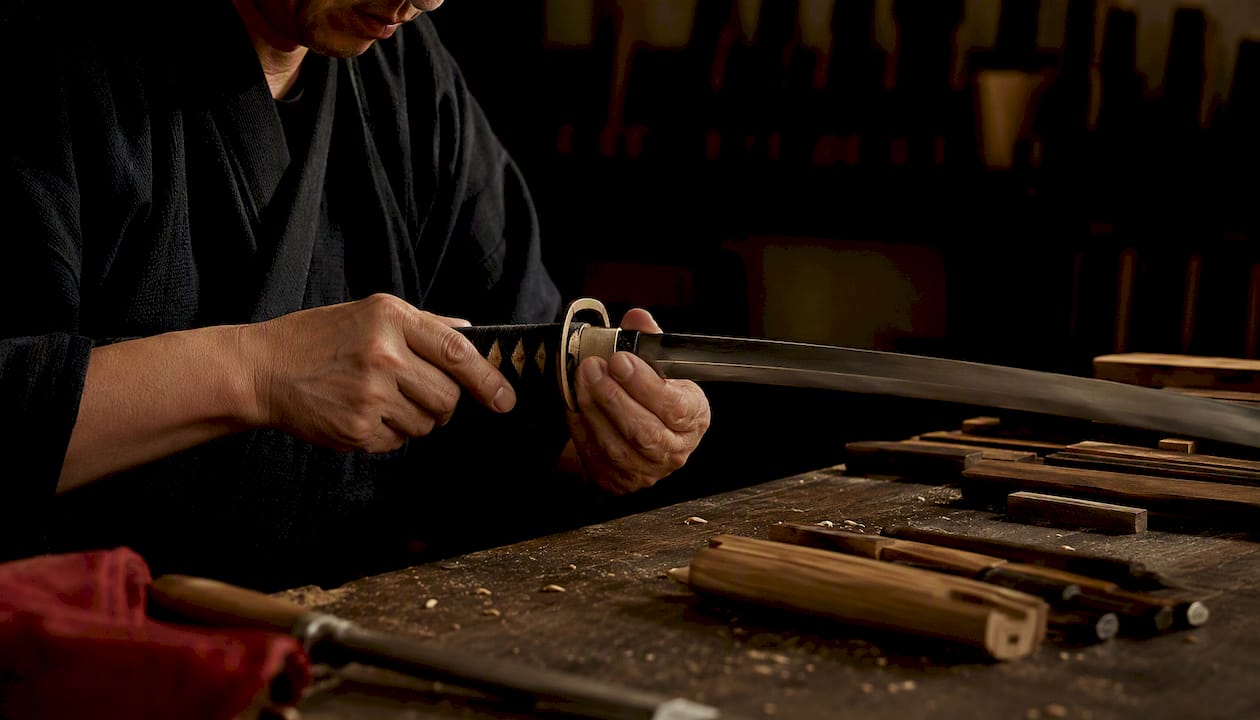
Construction is where battle-readiness starts. A full tang — where the steel of the blade extends the full length of the handle — is the single most important structural indicator. Partial tangs (also called rat-tail tangs) concentrate stress at the handle junction and can fail under lateral force. A properly peened or pinned full tang, with tight fittings (tsuba, habaki, seppa on a katana; crossguard and pommel on a European blade), distributes impact across the whole assembly.
Steel family matters almost as much. High-carbon steels — 1060, 1075, 1095, T10, and spring steels like 5160 — are the standard for functional blades. Stainless steels (400-series) are too brittle at the hardness needed to hold an edge and are a reliable red flag for decorative construction. Tamahagane, the traditional Japanese steel made from iron sand, is used in the most authentic Japanese blades and produces the characteristic hada (grain pattern) and hamon (temper line) that experienced collectors recognize immediately.
Heat treatment determines whether a blade is tough enough to flex without snapping and hard enough to hold an edge. Differential hardening — clay tempering in Japanese tradition — produces a harder edge (typically 60–62 HRC) and a softer spine (around 40–45 HRC), giving the blade both cutting performance and shock absorption. A blade hardened uniformly through the full cross-section is more prone to brittleness under lateral stress.
| Feature | Functional / Battle-Ready | Display Grade |
|---|---|---|
| Tang | Full tang, peened or pinned | Partial or rat-tail tang |
| Steel | High-carbon (1060–1095, T10, tamahagane) | Stainless or low-carbon alloy |
| Hardness (HRC) | 58–62 (edge), 40–45 (spine, if differentially hardened) | Often untested or uniform low hardness |
| Heat treatment | Documented quench and temper, clay tempering optional | Minimal or absent |
| Edge geometry | Convex or flat grind suited to cutting | Rolled or blunt edge, cosmetic only |
| Fittings | Tight, functional, secured | Decorative, often glued or press-fit |
Pro Tip: Ask the seller for the HRC test method used — a Rockwell hardness test on the edge and spine separately is the standard for differentially hardened blades. A single number for the whole blade usually means uniform hardening.
Spine thickness also matters. A katana spine in a moderate functional thickness range near the habaki tapering thinner toward the tip is common for functional blades; blades outside this range may be too flexible for controlled cuts or too rigid to absorb impact safely.
How Sellers Use “Battle Ready” and What to Watch For
The Cambridge Thesaurus entry for “battle-ready” lists synonyms including “combat-ready,” “battleworthy,” “fighting fit,” and “prepared for combat.” Sellers cycle through all of these, and none of them carry technical weight unless backed by documented specs. “Battleworthy,” for example, is defined by Collins as “capable of engaging in combat; ready for battle” — a useful concept, but still just a word without a spec sheet behind it.
Red flags in a listing:
- No steel grade named, or “stainless steel” listed for a “battle-ready” blade
- Vague phrases like “suitable for use” or “combat-quality” with no HRC or tang details
- Decorative fittings described as “ornamental” alongside a functional claim
- Price under $80 for a “hand-forged battle-ready” sword (genuine functional blades cost more to produce)
- No maker name, bladesmith credential, or country of forge listed
Trust signals worth paying for:
- Explicit HRC number with test method stated
- Named bladesmith or forge with verifiable reputation
- Documented cutting test results (tatami, rolled straw, standardized targets) or video footage
- Warranty that covers functional use, not display only
- Return policy that acknowledges the sword is sold as a cutting tool
The phrase “battle-ready replica” deserves special attention. A replica can be structurally sound and fully functional — or it can be a display piece shaped like a historical weapon. The word “replica” tells you nothing about construction. Only the spec sheet does.
How to Check a Sword’s Battle-Readiness Before You Buy
- Inspect the tang. On a katana, the nakago (tang) should be visible when the handle is removed. Check its length, width, and whether it is peened at the pommel end. A full tang running the handle’s full length is non-negotiable for functional use.
- Check handle tightness. Grip the handle firmly and apply lateral pressure. Any wobble between handle and blade indicates loose fittings — a safety risk under real cutting stress.
- Examine blade straightness. Sight down the spine from the tip. A functional blade should be straight or carry only the intentional curvature of its design (sori on a katana). Warping or twist indicates poor heat treatment.
- Assess edge geometry. A battle-ready edge should be ground to a consistent bevel with no rolled or blunt sections. You can check this visually; a properly sharpened edge reflects light uniformly along its length.
- Look for the hamon. On a differentially hardened Japanese blade, the hamon (temper line) is visible as a cloudy or wavy line running along the blade. Its absence on a claimed “clay-tempered” katana is a red flag.
- Request hardness documentation. Ask the seller for Rockwell hardness test results. Reputable makers test edge and spine separately and provide the numbers.
For cutting tests, rolled tatami mats and bundled straw are the standard media used by makers and reviewers to demonstrate that a blade can perform controlled cuts without deforming or chipping. These tests are destructive in the sense that they require a sharp, functional blade and a safe cutting setup. If you are not trained in cutting practice, ask the maker for documented test footage rather than attempting cuts yourself.
Safety note: Never perform flex tests beyond a gentle controlled bend, and never strike metal objects, concrete, or hard surfaces with a functional blade. Proper maintenance directly affects whether a sword remains safe to use — a blade that has been improperly stored or neglected can fail unpredictably even if it was originally battle-ready.
Portable Leeb hardness testers are available for collectors who want to verify HRC values without sending a blade to a lab. They are not as precise as a bench Rockwell tester, but they provide a useful field check when a seller’s stated hardness seems implausible.
Keeping a Battle-Ready Sword in Fighting Condition
A sword built for use requires ongoing care that a display piece does not. High-carbon steel — the material that makes a blade functional — oxidizes readily. Without regular maintenance, a battle-ready blade can develop rust that compromises both its appearance and its structural integrity.
Routine care checklist:
- After every use: wipe the blade clean with a soft cloth, apply a thin coat of choji oil (traditional) or a food-grade mineral oil along the full length of the blade
- Weekly (if stored): inspect for surface rust, check handle tightness, verify fittings are secure
- Monthly: remove the handle if possible, inspect the nakago for corrosion, re-oil the full blade
- Annually: have the edge professionally sharpened if used regularly; inspect for micro-cracks or deformation near the edge
Appropriate use matters as much as maintenance. Battle-ready swords are suited to cutting practice on tatami, rolled straw, or foam targets; controlled reenactment with appropriate protective gear; and HEMA training where the curriculum calls for sharp blades. They are not suited to striking metal armor, hard wooden posts, or other swords in uncontrolled contact — those uses accelerate wear and risk catastrophic failure regardless of construction quality.
The fittings are often the first components to show wear. On a katana, the habaki (blade collar) and seppa (spacers) can loosen with repeated use. Check them before every cutting session. A loose habaki is not just an annoyance; it affects how force transfers from blade to handle and can cause the blade to shift unpredictably.
Pro Tip: Store a functional high-carbon blade horizontally or edge-up in a wooden saya (scabbard). Storing edge-down concentrates oil at the edge and can cause uneven oxidation along the spine over time. Learn more about maintaining a high-carbon steel blade to protect your investment.
What Does “Battle Ready” Cost, and How Is It Labeled?
Price is a rough but useful filter. Genuine battle-ready construction — proper steel, documented heat treatment, full tang, tight fittings — has a real production cost that sets a floor on what honest sellers can charge.
- Entry-level functional ($150–$400): Production blades in 1060 or 1075 high-carbon steel, full tang, basic heat treatment, minimal documentation. Suitable for beginner cutting practice. Moonswords’ entry-level katana collection and functional katanas under $300 fall in this range and include steel grade and tang information.
- Mid-tier maker ($400–$1,200): Named forge or bladesmith, 1095 or T10 steel, documented HRC, differential hardening, tighter fittings. Often includes a warranty for functional use and some cutting test documentation.
- Custom or hand-forged ($1,200 and up): Tamahagane or premium high-carbon steel, clay tempering, master bladesmith credentials, full documentation of heat treatment and test results, often with video. These are investment pieces that are also genuinely functional.
Labeling cues that indicate a real functional blade: the steel name is spelled out (not just “carbon steel”), an HRC number appears in the specs, “full tang” is stated explicitly, and the warranty language covers cutting use. When a listing says “decorative only” or “not for use,” that is the seller being honest — take it at face value.
Price alone is not a guarantee. A $900 sword with no documentation and a vague “battle-ready” label is a worse buy than a $350 blade from a maker who publishes HRC results and cutting test footage.
Legal and Safety Considerations for Owning a Functional Sword
Safe handling and storage:
- Store functional swords in a locked cabinet or secured rack, out of reach of children
- Always use a blade cover (saya or scabbard) when transporting
- Never draw or handle a sharp blade in a public space without explicit permission from the venue
- Wear appropriate protective gear during cutting practice (cut-resistant gloves, eye protection)
- Train with a qualified instructor before attempting cutting practice with a live blade
Legal restrictions on bladed weapons vary significantly by state, county, and city in the United States. Carrying a sword in public — even in a scabbard — is restricted or prohibited in many jurisdictions. Some states regulate blade length; others restrict concealed carry of any bladed weapon. Transporting a sword in a vehicle may require it to be unloaded (unsheathed and inaccessible) or stored in a locked case, depending on local law.
This article provides general information only, not legal advice. Check your local and state laws before transporting or using a functional sword in any public or semi-public setting, and consult a qualified attorney for jurisdiction-specific questions. For a parallel on how safety and certification standards apply to functional weapons in retail contexts, Blvista’s review of custom weapons illustrates how documented specs and maker credentials matter across functional weapon categories.
What a Responsible Maker Documents for a Battle-Ready Blade
Experienced collectors and bladesmiths expect a specific set of documented claims when a sword is sold as battle-ready. The table below shows typical maker-stated values for a functional Japanese-style blade using generic construction tiers.
| Specification | Entry-Level Functional | Mid-Tier Maker | Master / Custom |
|---|---|---|---|
| Steel family | 1060 or 1075 high-carbon | 1095 or T10 high-carbon | Tamahagane or premium high-carbon |
| Edge hardness (HRC) | 54 | 58 | 60 |
| Spine hardness (HRC) | Uniform (untested separately) | 40–45 (differentially hardened) | 40–45 (clay-tempered) |
| Tang type | Full tang, basic peen | Full tang, peened or pinned | Full tang, hand-fitted, peened |
| Cutting test | Not documented | Tatami or rolled straw, results stated | Video-documented, multiple media |
| Warranty | Display or limited use | Functional use covered | Full functional warranty, custom terms |
A responsible maker documents the heat-treatment process (quench medium, tempering temperature), the HRC test method (bench Rockwell or portable Leeb, location on blade), and the cutting-test protocol (media used, number of cuts, blade condition before and after). At Moonswords, our master bladesmith Zhao Peiyan applies these standards to every piece in the master collection, and test documentation is available on request for custom commissions.
Pro Tip: Before purchasing any sword marketed as battle-ready, ask the seller: “Can you provide the HRC test result and a description of your heat-treatment process?” A maker who cannot answer that question is selling you a label, not a specification.
Why the Battle-Ready Distinction Matters More Than Most Buyers Realize
Most collectors who ask about battle-ready meaning are not planning to fight anyone. What they are really asking is: “Will this sword hold up to what I want to do with it, and is it worth the price?” That is a completely reasonable question, and the answer depends entirely on construction quality, not marketing language.
The gap between a display sword and a functional one is not just about cutting performance. It is about safety. A decorative blade with a rat-tail tang can fail under lateral stress and send a sharp fragment in an unpredictable direction. That risk is not hypothetical; it is why experienced HEMA practitioners and reenactors are specific about construction requirements, and why display sword care is a genuinely different discipline from functional blade maintenance.
For beginners, a mid-tier functional blade with documented specs is almost always the better starting point than either a cheap “battle-ready” label or an expensive display piece. HEMA practitioners need a blade their instructor has approved for the curriculum. Reenactors need to check event rules, which often specify construction standards. Collectors who want both display quality and functional integrity should look for makers who document both — because those two goals are not mutually exclusive when the craftsmanship is genuine.
Moonswords’ Approach to Battle-Ready Craftsmanship
Every Moonswords blade sold as functional comes with documented steel grade, HRC disclosure, full-tang construction, and a warranty that covers cutting use. Our master collection, forged by Zhao Peiyan using clay-tempering and traditional folding techniques, includes pieces like the Kyōjin tamahagane katana — where the heat-treatment process, hamon characteristics, and hardness values are stated on the product page, not buried in fine print.
For collectors who want a blade that is both a display piece and a genuine cutting instrument, our high-end katana collection covers the full range from entry-level functional to master-forged custom commissions. If you have specific construction requirements — a particular steel, hardness target, or cutting-test documentation — contact us directly. We can connect you with the right blade or discuss a custom build with Zhao Peiyan’s forge. Browse the full collection at Moonswords and request maker documentation for any piece that interests you.
Sources
The following sources informed this article and are worth consulting for deeper technical detail:
- COMBAT-READY definition in American English | Collins English Dictionary
- Dictionary
- Citadel Colour: just what is Battle Ready? | Warhammer Community
- battle-ready - Cambridge Thesaurus
FAQ
What does “battle ready” mean for a sword?
A battle-ready sword is one built with a full tang, high-carbon steel, and proper heat treatment — typically 58–62 HRC at the edge — making it structurally sound for cutting practice, reenactment, or HEMA training rather than display only.
What is another word for “battle-ready” in sword listings?
Sellers use synonyms including “combat-ready,” “battleworthy,” “fighting fit,” and “prepared for combat,” as listed in the Cambridge Thesaurus. None of these terms carry technical weight without accompanying specs.
How does a battle-ready sword differ from a decorative one?
A battle-ready blade has a full tang, high-carbon steel, and documented heat treatment; a decorative sword typically uses stainless or low-carbon steel with a partial tang and is not designed to withstand cutting stress. Using a display sword for cutting practice risks handle failure and potential injury.
What should I ask a seller before buying a “battle-ready” sword?
Ask for the steel grade, HRC hardness value with test method, tang type and dimensions, and any cutting-test documentation or video. A seller who cannot provide these details is selling a label rather than a verified specification.
Does Moonswords sell genuinely battle-ready swords?
Yes. Moonswords documents steel grade, HRC, full-tang construction, and heat-treatment process on every functional blade, with cutting-test footage available on request for custom commissions and master-collection pieces.