

If you want a hand-forged custom katana, start by choosing your blade steel and setting a realistic budget. We can tell you upfront: MoonSwords builds bespoke katanas with a transparent ordering process, and most custom commissions run within a range depending on materials, with production taking several weeks. Your core decisions come down to a short list.
- Blade steel and hamon style
- Fittings (tsuba, tsuka, ito, saya)
- Functional versus display balance
- Length and handedness for your grip
TL;DR:
- Steel choice significantly impacts the katana’s performance, with tamahagane offering the highest authenticity and cost, while T10 provides affordability and reliability.
- Full tang construction is crucial for durability and resisting breakage, especially for practice or functional blades, surpassing partial tang designs.
- Customization of fittings, hamon style, and polish level allows for personalized aesthetics, but choosing standard fittings and a working polish can reduce overall expense.
- Lead times for bespoke katanas vary from several weeks to months, depending on steel complexity, fittings, and the artisan’s process, with deposits of 30 to 50 percent typical.
- Buyers should verify local laws regarding ownership, carry, and display in their state or city, as regulations differ and can impact how the katana is stored or transported.
Table of Contents
- What Parts of a Custom Katana Design Can You Choose?
- What Steel and Forging Methods Shape a Custom Katana?
- How Does the Custom Katana Ordering Process Work?
- How Much Does a Custom Katana Cost?
- Is It Legal to Own a Katana in the United States?
- How Do You Maintain and Display a Custom Katana?
- Why Choose MoonSwords for a Hand-Forged Custom Build
- When Does a Custom Katana Actually Make Sense?
- Start Your Custom Katana With Artisans Who Show Their Work
- Key Takeaways
- Sources
- FAQ
What Parts of a Custom Katana Design Can You Choose?
Every katana breaks down into components a bladesmith can adjust individually, and knowing them changes how you talk to a maker. This is the checklist we walk collectors through before any forge work begins.
The blade itself drives weight, balance, and how the sword behaves in the hand. A thinner, more distally tapered blade swings faster and feels livelier; a thicker blade holds up better to repeated cutting but adds heft near the tip. Curvature (sori) also shifts the balance point, and a deeper curve favors draw cuts over thrusting.
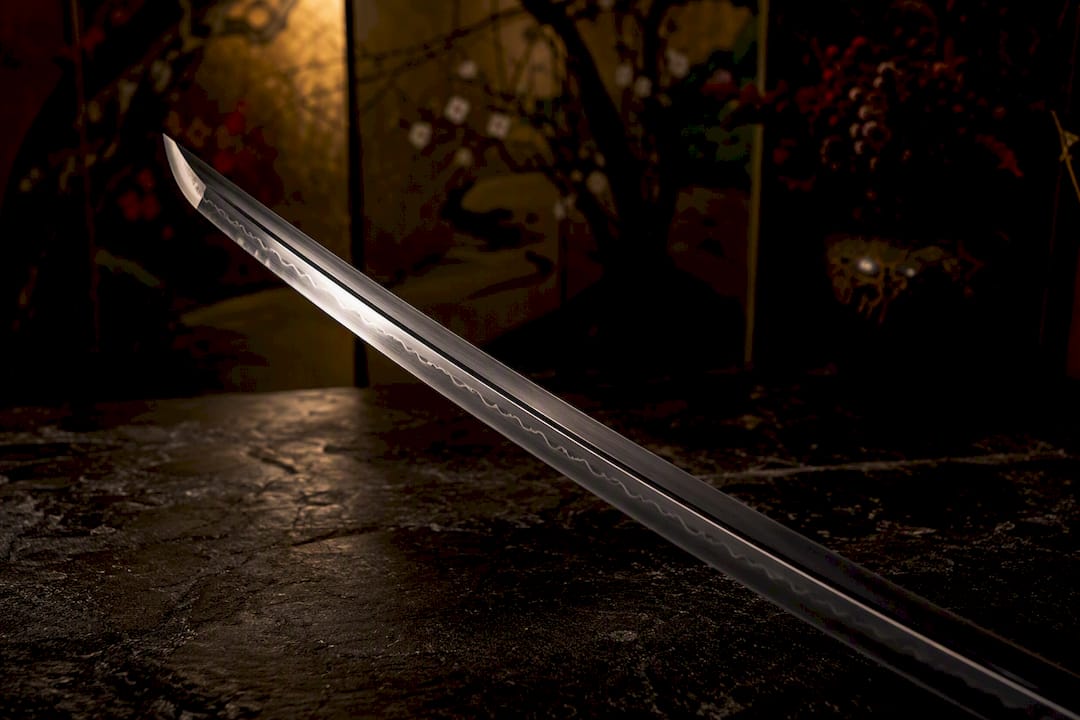
The hamon, the wavy temper line along the edge, is both decoration and a record of how the blade was heat treated. Polishers can accentuate a straight hamon (suguha) for a clean, formal look, or a wilder pattern like gunome and choji for something closer to antique koto-period blades. Polish level matters too. A working polish shows the steel’s grain (hada) without the mirror finish that a full art polish demands.
Fittings offer the widest room for personalization:
- Tsuka (handle) core wood, wrap material, and same-panel or split panel construction
- Ito (wrap cord) color, material (silk, cotton, synthetic), and wrap pattern
- Menuki (grip ornaments) theme, from dragons to family crests
- Fuchi/kashira (collar and pommel) metal type and motif
- Tsuba (guard) shape, metal, and engraving
- Saya (scabbard) lacquer color, wood, and finish (matte, glossy, textured ray skin wrap)
Pro Tip: If you plan to use your katana for light cutting practice, prioritize full tang construction and a slightly thicker blade profile over ornate fittings. A sword that flexes or chips under stress isn’t a design flaw you can polish away later.
Display-only builds can push further into decorative territory since they’ll never meet resistance, while a katana meant for iaido or tameshigiri practice needs geometry and tang strength that hold up to repeated motion.
What Steel and Forging Methods Shape a Custom Katana?
Steel choice determines how your blade performs and ages, and it’s the single biggest factor in both price and authenticity claims. Here’s what separates the common options.
Tamahagane, the traditional smelted steel made from iron sand in a tatara furnace, remains the gold standard for purists. It’s labor intensive, inconsistent by nature, and expensive, which is why true tamahagane builds sit at the top of most price lists. Folded and laminated steel construction, where a smith combines a hard outer jacket with a softer core, mimics traditional Japanese methods and improves toughness without the tamahagane price tag. Damascus steel, folded to create a visible layered pattern, delivers striking aesthetics and solid performance, though the pattern itself doesn’t guarantee superior edge quality. Modern high-carbon steels like T10 offer excellent edge retention and consistency at a lower cost than traditional methods, making them a practical choice for buyers who want performance without the premium price of hand-smelted steel.
- Tamahagane: traditional, expensive, prized for authenticity
- Folded/laminated steel: strong toughness-to-cost ratio
- Damascus: distinctive pattern, good all-around performance
- T10 high-carbon: reliable edge retention, budget-friendly
Clay tempering, where a smith applies clay unevenly along the blade before quenching, creates the hamon and produces a genuinely harder edge with a softer, more shock-absorbent spine. This isn’t cosmetic. It’s a functional heat-treatment technique with roots stretching back through centuries of Japanese swordmaking, refined during periods when battlefield demands shaped blade geometry, a lineage that traces back as far as the Heian period.
“Hand-forged” and “full tang” are the two phrases that matter most for longevity. A full tang blade, where the steel extends the complete length of the handle, resists breaking at the joint under stress far better than a partial tang. Fittings made from bronze, shakudo, or gilded metal add resale value and visual weight, but they also demand more careful handling since soft metals scratch and tarnish faster than steel.
How Does the Custom Katana Ordering Process Work?
Ordering a bespoke katana follows a fairly predictable rhythm across most reputable makers, even when the artistic details vary wildly.
- Select your components — blade steel, hamon style, fittings, and saya finish
- Confirm measurements — blade length, handle length, and your dominant hand
- Approve mockups — sketches or renderings before any steel is cut
- Pay a deposit — typically required before forging begins
- Forging and heat treatment — the longest single phase
- Polishing and fitting assembly — where the visual character emerges
- Final approval — photos or video before shipping
- Shipping — insured, often with signature confirmation
Give your maker precise numbers: blade length in inches, your height and arm length if you want proportional balance, and whether you’re left or right handed for wrap direction. Lead times vary because forging and polishing are hand skills, not assembly-line steps. A premium collection piece with intricate fittings simply takes longer than a straightforward T10 build. Expect deposits of 30 to 50 percent, with the balance due before shipping, and confirm return policies before you commit since custom work is rarely eligible for a full refund once forging starts.
How Much Does a Custom Katana Cost?
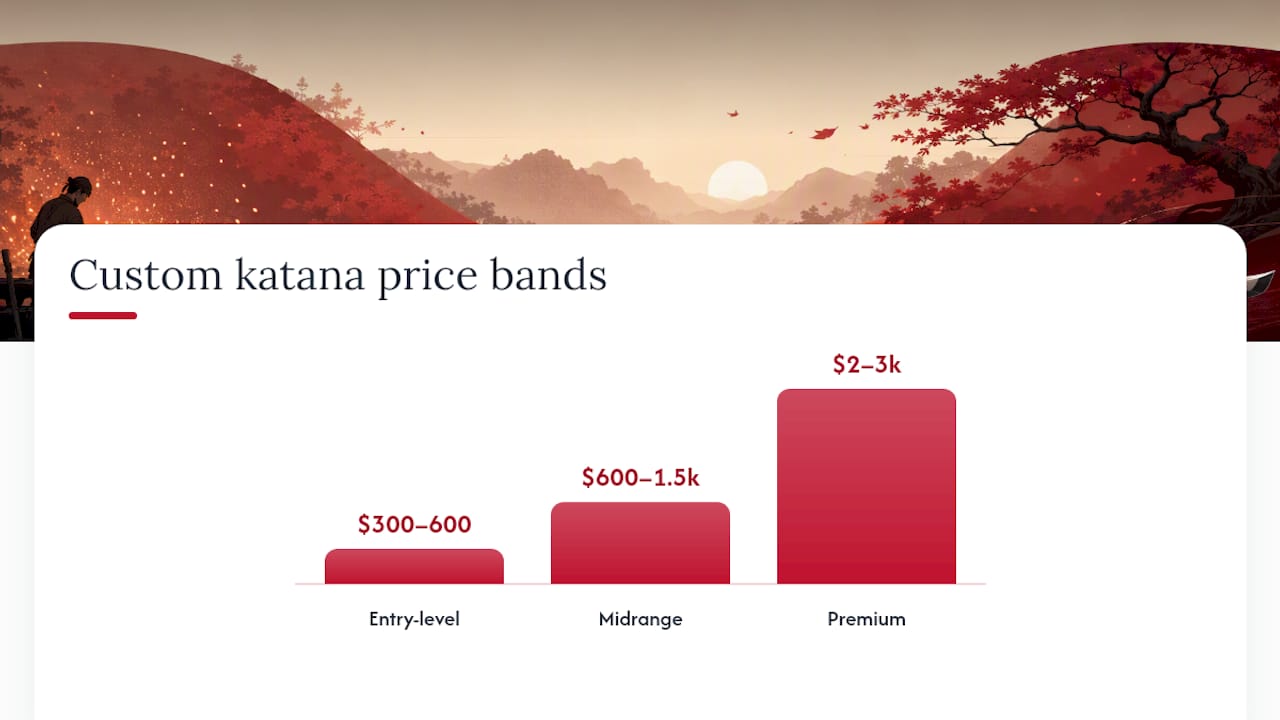
Price bands break down fairly cleanly once you understand what drives each tier. Entry-level custom builds using T10 steel with standard fittings typically start around $300 to $600. Midrange hand-forged katanas with folded steel or Damascus patterns, plus upgraded fittings, land between $600 and $1,500. Premium and museum-quality pieces featuring tamahagane steel and gilded bronze fittings can run $2,000 to $3,000 or more.
The features that push price up fastest:
- True tamahagane steel over folded alternatives
- Custom inlay work or gold gilding on fittings
- Bespoke tsuba engraving or menuki commissions
- A named master artisan’s involvement
To manage cost without sacrificing what matters, choose standard fittings over custom inlay, opt for a working polish instead of a full art polish, and consider pre-made mounting components where the design allows it. Budget beyond the sword itself too: shipping, any applicable taxes, a display stand or case, and a basic maintenance kit all add up.
Is It Legal to Own a Katana in the United States?
Owning a katana is generally lawful across the United States, but the details around carrying, displaying, or transporting one vary by state and even by municipality. Most restrictions target concealed carry or brandishing in public rather than ownership itself, so a katana mounted on your wall or stored in a case rarely raises legal questions.
Before you order, it still pays to check your specific situation:
- Review your state’s weapons statutes for any sword-specific language
- Call your local police non-emergency line if local rules aren’t clear online
- When shipping, declare the item accurately and use a carrier that accepts edged weapons
- Store the blade secured and out of easy reach, particularly in households with children
Pro Tip: Municipal codes sometimes differ sharply from state law, especially in dense cities. A five-minute call to your local precinct’s non-emergency line beats guessing.
Transport across state lines rarely triggers issues for personal collection pieces, but airlines treat swords as checked-baggage-only items at minimum, so never pack one in a carry-on.
How Do You Maintain and Display a Custom Katana?
A hand-forged blade rewards a little routine care with decades of stable finish and function. The maintenance steps most collectors follow are simple once they become habit.
- Wipe the blade with a clean microfiber cloth after any handling to remove oils and moisture
- Apply uchiko powder occasionally and buff with rice paper to lift old oil and polish residue
- Coat the blade lightly with choji oil before long-term storage to prevent rust
- Store in a climate-controlled space away from direct sunlight and humidity swings
A blade left unoiled in a humid closet can develop surface rust within weeks. The habit of oiling before storage isn’t ceremonial. It’s the difference between a katana that looks the same in ten years and one that doesn’t.
For display, a proper case with UV-filtering glass and secure mounts beats an open wall hanger, especially in rooms with fluctuating temperature. If you notice pitting, a dull edge that oil won’t restore, or a loose fitting, it’s time to send the blade to a professional polisher rather than attempt a fix yourself.
Why Choose MoonSwords for a Hand-Forged Custom Build
We built our custom program around the same standards that define our master collections, including pieces associated with renowned bladesmith Zhao Peiyan. Every commission starts with the same component-by-component approach covered above: steel, hamon, fittings, and finish, all confirmed before forging begins.
What a MoonSwords commission includes:
- Detailed product pages showing steel type, tang construction, and fitting materials upfront
- Blog resources covering history, display options, and maintenance
- Direct communication during mockup approval before any steel is cut
- Documented craftsmanship rather than vague “handmade” claims
Pro Tip: When evaluating any custom katana maker, ask to see progress photos during forging, not just a finished product shot. A maker confident in their process will show you the work in stages.
We built our reputation on being straightforward about what a blade is made of and how long it takes to build, not just what it looks like in a listing photo.
When Does a Custom Katana Actually Make Sense?
Not every collector needs a bespoke commission. If you’re building a first collection or want something to display without deep personal meaning attached, a well-made stock piece from a reputable maker often delivers 90 percent of the satisfaction at a fraction of the wait and cost. Custom forging earns its price when you have a specific use case, a family or cultural connection you want reflected in the fittings, or simply the patience to wait weeks for something no one else owns.
Our advice: decide function first, aesthetics second, and resale value a distant third unless you’re buying from a documented master. Start by listing your must-haves, then find a maker willing to show you their process before you send a deposit.
— Kenji Smith
Start Your Custom Katana With Artisans Who Show Their Work
Choosing a custom katana maker often means comparing vague “handcrafted” claims with no way to verify them. MoonSwords closes that gap with detailed product pages showing exact steel type, tang construction, and fitting materials before you ever commit to a build, plus artisan collections tied to named bladesmiths like Zhao Peiyan rather than anonymous production runs.
If you already know you want a tamahagane build with clay-tempered hamon, the Kyōjin katana shows what a premium commission looks like in finished form. Prefer Damascus patterning instead? The Ghost of Yōtei Damascus build gives you a concrete reference point for pricing and finish quality. Browse the full high-end collection to compare options side by side, then reach out with your measurements and design preferences to start your own commission.
Key Takeaways
A custom katana’s price, durability, and authenticity all trace back to three linked decisions: steel type, tang construction, and hamon treatment.
| Point | Details |
|---|---|
| Choose steel first | Tamahagane, folded steel, Damascus, and T10 each trade cost against authenticity and edge performance. |
| Full tang matters most | A full tang blade resists breaking at the handle joint far better than a partial tang design. |
| Budget realistically | Custom builds range from roughly $300 for entry-level T10 to $3,000+ for tamahagane with gilded fittings. |
| Confirm legality locally | Katana ownership is generally lawful in the US, but carry and display rules vary by state and city. |
| MoonSwords offers transparent commissions | MoonSwords publishes exact materials, tang type, and forging details before you commit to a custom build. |
FAQ
How much does a custom katana cost?
Custom katanas typically range from $300 for entry-level T10 steel builds to $3,000 or more for tamahagane steel with gilded bronze fittings and intricate customization.
Can you legally own a katana in the US?
Yes, owning a katana is generally lawful across the United States, though some states and cities restrict carrying or public display, so check local statutes before ordering.
Which website is best for custom katana design?
MoonSwords offers detailed product pages disclosing steel type and construction, along with a transparent ordering workflow that includes mockup approval before forging begins.
What information do I need to provide to order a custom katana?
Provide your desired blade length, your height for proportional balance, your dominant hand for wrap direction, and whether the sword is for display or light practice use.
How long does a custom katana take to make?
Production timelines typically run several weeks depending on steel complexity, fitting customization, and whether the maker requires mockup approval before forging.