

Every sword tells a story, but the blade itself is only the beginning. To truly decode sword fittings cultural symbolism, you need to look at the pommel, the guard, the scabbard mounts, and the silk wrapping on the grip. These components are not decorative afterthoughts. They are coded messages about identity, spiritual belief, social rank, and the values a warrior’s culture held most dear. This guide will walk you through the methods scholars use to read those messages, with detailed examples drawn from Japanese, European, Chinese, and Viking traditions.
Table of Contents
- Key takeaways
- Understanding sword fittings and their symbolic roles
- How to decode sword fittings step by step
- Cultural case studies in sword fitting symbolism
- Common mistakes when decoding sword fittings
- Verifying your interpretations and deepening your knowledge
- My perspective on reading sword fittings honestly
- Explore culturally authentic sword fittings at Moonswords
- FAQ
Key takeaways
| Point | Details |
|---|---|
| Fittings carry layered meaning | Every component from tsuba to pommel communicates identity, status, and spiritual belief. |
| Function preceded symbolism | Structural necessity came first; cultural meaning was layered on afterward as traditions matured. |
| Context is everything | Wear patterns, burial context, and historical records all shape correct interpretation of fittings. |
| Cross-cultural pitfalls exist | Symbols migrated between cultures, so avoid reading any motif through a single cultural lens. |
| Verification requires multiple sources | Archaeological evidence, fencing manuals, and museum records together produce reliable conclusions. |
Understanding sword fittings and their symbolic roles
Before you can decode the symbolism, you need a firm grasp of what each fitting is and why it exists. Sword fittings are the non-blade components that make a sword functional, balanced, and identifiable. They include the pommel (the weighted cap at the base of the hilt), the guard (called a tsuba in Japanese tradition), the grip or hilt, the scabbard and its associated mounts, and decorative elements like tassels or inlaid metalwork.
Pommels served critical structural roles, counterbalancing the blade’s weight to make the weapon maneuverable and reducing fatigue in extended combat. The symbolism on pommels developed after their functional purpose was established. This sequence matters because it tells us that symbolism was layered atop function, not designed from the start with pure iconography in mind. The same applies to the tsuba, which primarily protected the hand before becoming a miniature canvas for lacquered artwork and inlaid clan crests.
Here is a comparison of major fitting types across four key sword cultures:
| Fitting | Japanese | European | Chinese | Viking/Migration |
|---|---|---|---|---|
| Guard | Tsuba (round, oval, or shaped) | Crossguard (cross-shaped) | Jian guard (rhomboid or winged) | Simple iron cross or lobed |
| Pommel | Kashira (cap-shaped, menuki under wrap) | Wheel, disc, or animal-head | Ring or disc pommel | Cocked-hat, brazil-nut, lobed |
| Scabbard fittings | Kurikata, kojiri, koiguchi | Chape, locket, throat | Scabbard rings and jade fittings | Gold or silver mounts |
| Grip decoration | Tsuka-ito silk wrapping, samegawa | Leather, wire, wood | Silk or cord wrapping | Wood with metal bands |
Pro Tip: When studying a fitting for the first time, photograph it from multiple angles before attempting interpretation. The reverse face often carries different symbols from the front, and the distinction can completely change the reading.
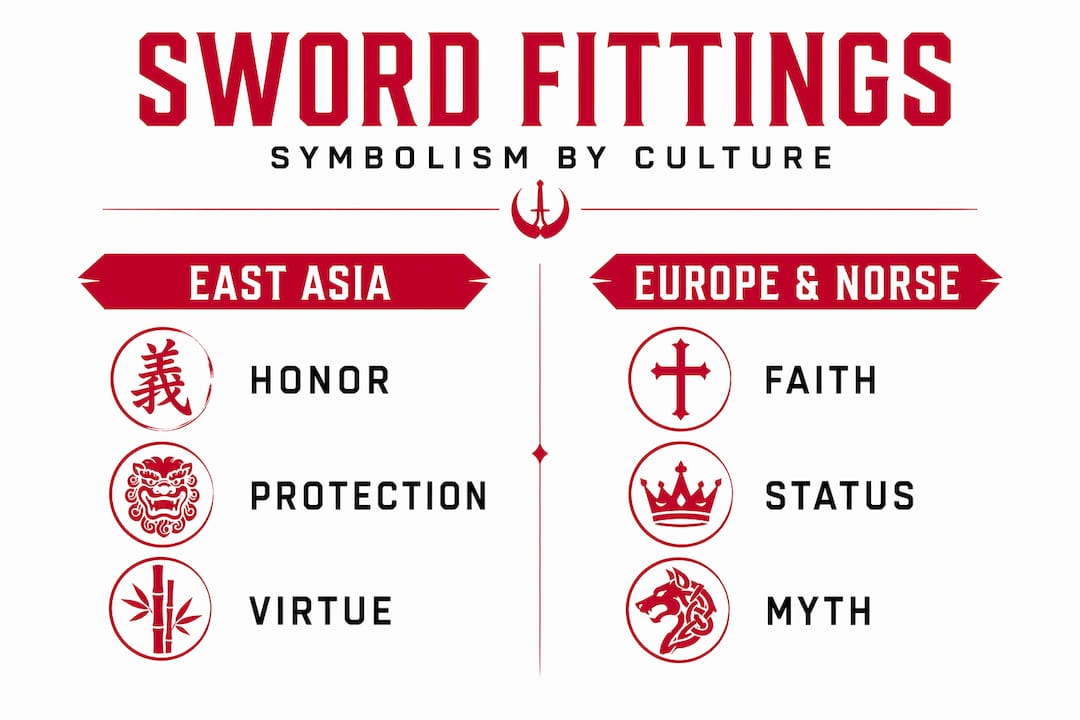
Notice how each cultural tradition expresses the same functional need through radically different visual vocabularies. The European crossguard echoes the Christian cross, while the tsuba echoes the disc of meditative completeness. These are not accidents. They reflect swords as symbols of authority and justice across completely separate civilizations.
How to decode sword fittings step by step
Decoding sword fittings meaning is a methodical process. Rushing toward a symbolic conclusion before gathering physical and historical evidence produces errors that are surprisingly common even in published scholarship. Follow these steps to build a reliable interpretation.
-
Identify the fitting type and period. Start with what the fitting is and when it was made. Pommel typology correlates design shape with historical period and culture, giving you an immediate interpretive framework. A brazil-nut pommel points toward 11th-century Europe. A round iron tsuba with pierced cutwork points toward Edo-period Japan.
-
Examine the materials. Gold signals wealth and political power in almost every culture. Iron signals martial practicality. Bronze in Chinese fittings often carried ritual connotations linked to ancestor veneration. Jade inserts on Chinese jian scabbard fittings communicated Confucian virtue and scholarly identity, not just luxury.
-
Catalog the motifs. Write down every recognizable image: animals, plants, geometric patterns, human figures, script. Do not interpret yet. Just record. Viking animal-head pommels featured dragons, wolves, and birds, each tied to specific mythological frameworks that only become clear once you have the full motif inventory.
-
Cross-reference cultural symbol dictionaries. Each motif carries culture-specific meaning. A dragon on a Japanese tsuba typically signifies power and protection. A dragon on a Viking pommel may represent chaos overcome or a warrior’s fearsome nature. The image alone is insufficient. Cultural context determines meaning.
-
Assess wear and use patterns. This step separates serious scholarship from surface-level analysis. Physical wear on fittings tells you whether the sword was actively used or purely ceremonial. A 1,500-year-old gold scabbard fitting from Norway showed visible wear consistent with real use, indicating the owner was a warrior chieftain, not a ritual figurehead.
-
Examine burial or archival context. Where was the sword found? Grave goods in Viking burials, temple donations in Japanese tradition, and royal inventories in European records all shape the symbolic reading. A sword buried with a warrior reads differently from one donated to a shrine.
Pro Tip: Consult museum catalog entries before academic papers when starting research. Museum conservators often record physical details, including repair marks and residue, that academic authors omit entirely. These details are gold for decoding historical sword fittings.
Cultural case studies in sword fitting symbolism
Japanese samurai fittings: honor, clan, and discipline
The tsuba is the most extensively studied sword fitting in any tradition, and for good reason. The tsuba evolved into miniature art objects with inlaid gold and clan symbols during the Edo period, when samurai were more administrators than battlefield warriors. The silk wrapping on the tsuka (grip), called tsuka-ito, carried clan identity through color: red, black, and indigo each signaled specific affiliations. You can explore Japanese sword making historical eras to understand how this symbolism shifted across the Kamakura, Muromachi, and Edo periods.
The menuki, small ornamental figures hidden beneath the silk grip wrap, were pressed against the palm during use. Their imagery, cranes for longevity, tigers for courage, chrysanthemums for imperial loyalty, was literally held by the warrior as he fought. This is symbolism in sword design taken to its most intimate form.
Medieval European pommels and guards: chivalry and faith
European swords of the 10th through 15th centuries show wide pommel variety, from the round disc associated with mounted knights to elaborate lobbed designs depicting heraldic animals. The crossguard’s cross shape was not incidental in a Christian Europe where the sword was blessed by a priest before a knight’s dubbing ceremony. The sword became an embodiment of divine justice and noble obligation simultaneously.
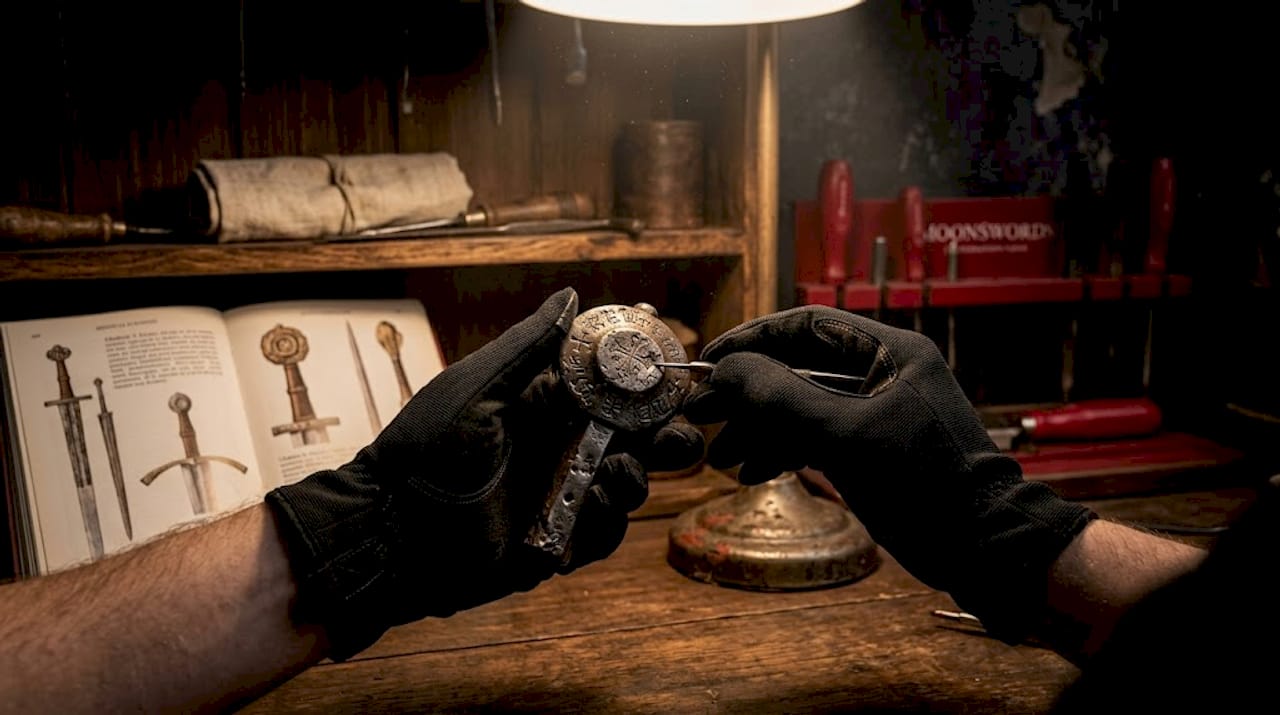
Historical fencing manuals from Hans Talhoffer (1467) and Joachim Meyer (1570) detail pommel striking techniques, reminding us that even the most ornate pommel was also a weapon in half-swording close combat. The warrior carried his beliefs and his practicality in the same hand.
Chinese jian fittings: wisdom and spiritual protection
The jian, China’s double-edged straight sword, carries symbolism distinct from both Japanese and European traditions. The jian represents wisdom and balance in Chinese culture, and its fittings reflect this through geometric precision rather than figurative imagery. The rhomboid guard shape echoes cosmological diagrams from Daoist tradition. Tassels on the grip, far from ornamental, were believed to distract opponents and channel the wielder’s qi.
Jade fittings on formal jian scabbards communicated Confucian virtue in material form, because jade in Chinese aesthetics represents the qualities of the ideal scholar-official: hardness, translucence, and cool temperament under pressure.
Viking and Migration Period fittings: status and mythic power
| Culture | Key fitting symbol | Meaning |
|---|---|---|
| Japanese | Gold clan crest on tsuba | Family lineage and battlefield identification |
| European | Cross-shaped guard | Christian faith and chivalric obligation |
| Chinese | Jade scabbard mounts | Confucian virtue and scholarly identity |
| Viking | Dragon or wolf pommel | Warrior ferocity and mythological protection |
The gold scabbard fitting dating to the 6th century C.E. found in Sandnes, Norway, was approximately two inches wide and buried as a likely sacrifice during the turbulent Migration Period. Its wear indicates a chieftain who actually used the sword, making it a symbol of active power, not inherited prestige. That distinction matters enormously when reading what the cultural significance of swords meant to those who carried them.
Common mistakes when decoding sword fittings
Even experienced researchers fall into predictable errors when working with historical sword fittings. Knowing these pitfalls in advance will save you significant time and prevent embarrassing misreadings.
- Treating decoration as purely aesthetic. This is the most widespread mistake. A geometric pattern on a tsuba is almost never purely decorative. It encodes cosmological, seasonal, or clan-specific meaning in a visual shorthand the original owner would have recognized immediately.
- Ignoring wear evidence. A pristine fitting on an ancient sword is not a sign of quality preservation. It may indicate a ceremonial piece never intended for combat, which completely changes its symbolic interpretation. Physical wear patterns are primary evidence, not secondary.
- Projecting one culture’s symbolism onto another. A lotus motif on a Japanese tsuba carries Buddhist connotations. The same lotus on a Chinese fitting may carry Confucian or Daoist associations instead. Cross-cultural migration of motifs was real and common, especially along Silk Road trade routes.
- Accepting dealer attributions uncritically. The collectibles market contains many fittings with reassigned cultural origins. Always verify attribution against physical evidence and published scholarship before treating a provenance claim as fact.
Pro Tip: When you encounter an unfamiliar motif, search museum collection databases before general internet searches. The Metropolitan Museum of Art, the Tokyo National Museum, and the British Museum all maintain searchable online catalogs with peer-reviewed object descriptions.
Verifying your interpretations and deepening your knowledge
Reaching a reliable symbolic interpretation requires checking your conclusions against multiple independent sources. Here is how to build that verification practice:
- Physical evidence first. Examine wear patterns, tool marks, repair history, and material composition. These are objective data points that either support or contradict symbolic theories.
- Cross-reference historical records. Estate inventories, battle chronicles, and temple donation records from the relevant period often describe swords by their fittings, giving direct textual evidence of what those fittings signified to contemporaries.
- Consult specialist publications. The Journal of the Society for Japanese Arts, the Arms and Armour Society journal, and equivalent Chinese antiquities publications carry peer-reviewed research that general books rarely match in precision.
- Engage scholarly and collector communities. Organizations like the Japanese Sword Society of the United States maintain active memberships of practitioners, collectors, and scholars who collectively hold interpretive knowledge no single book contains.
- Study sword craftsmanship traditions directly. Understanding why sword making became a sacred craft across cultures helps you understand why fittings were treated as meaning-bearing objects rather than hardware. Craft tradition and symbolic vocabulary developed together.
Collectors and martial artists today view culturally symbolic fittings as tangible connections to historical virtues like honor and discipline. That continuity is itself evidence that the symbolic vocabulary is alive and legible, not a dead language requiring purely archaeological recovery.
My perspective on reading sword fittings honestly
I’ve spent years studying sword fittings from Japan, China, and medieval Europe, and the lesson I keep relearning is this: the most dangerous interpreter is the one who already knows what a fitting means before examining it carefully. I’ve seen scholars confidently attribute Buddhist lotus symbolism to a tsuba that was, on closer examination, depicting water currents from a regional landscape tradition. The difference matters to the family whose ancestor carried it.
What changed my approach was handling a worn gold scabbard fitting from a Migration Period context and realizing that the wear told a completely different story than the iconography. The images suggested divine protection. The wear suggested a man who needed that protection to be real and immediate. Those two readings together are richer than either alone.
I’ve also found that the most rewarding moments in this work come from interdisciplinary study: reading a 15th-century fencing manual alongside an armorer’s guild record and a heraldic register from the same decade. The fitting becomes a nexus point where combat technique, social aspiration, and spiritual belief all converge. That convergence is what makes decoding sword symbolism genuinely exciting rather than merely academic.
If you are beginning this work, start methodically. Take the six steps above seriously, resist the pull toward fast conclusions, and treat every fitting with the respect it deserves as a physical record of someone’s cultural identity. The patience will reward you.
— Kenji Smith
Explore culturally authentic sword fittings at Moonswords
For collectors and scholars who want to hold history rather than just read about it, the quality of the fittings matters as much as the blade. At Moonswords, every katana in our Japanese sword collection is hand-forged by master artisans using clay tempering and full tang construction, with fittings that reflect authentic historical symbolism rather than decorative approximation.

Our high-end katana collection features tsuba with traditional motifs, silk tsuka-ito wrapping in historically accurate colors, and scabbard fittings finished to museum standards. Whether you are building a scholarly reference collection or seeking a piece that carries genuine cultural weight, you will find swords here that reward close study. Explore the full range at Moonswords and invest in a piece whose fittings have something real to say.
FAQ
What are sword fittings and why do they carry symbolism?
Sword fittings are the non-blade components including the pommel, guard, grip, and scabbard mounts. They carried symbolism because they were visible markers of identity, rank, and belief that observers could read at a glance before a sword was ever drawn.
How do I identify the cultural origin of a sword fitting?
Examine the fitting’s material, shape, and motifs, then cross-reference these against period-specific typologies. Pommel shape and guard design are the most reliable starting points because they correlate strongly with specific cultures and historical periods.
What does the tsuba symbolize on a Japanese katana?
The tsuba evolved from a hand guard into a miniature art object communicating clan identity, philosophical values, and aesthetic tradition. Motifs ranged from clan crests and seasonal imagery to Buddhist and Shinto iconography depending on the owner’s affiliation and period.
Can the same symbol mean different things across cultures?
Yes. Dragon imagery, for example, signifies power and protection in Japanese fittings but may represent chaos or warrior ferocity in Viking contexts. Always interpret motifs within their specific cultural and chronological framework rather than applying universal meanings.
How does physical wear help decode a sword fitting’s meaning?
Wear patterns reveal whether a sword was actively used in combat or reserved for ceremony. A gold fitting with visible use wear, like the 6th-century Norwegian example, indicates an active warrior elite, which shifts the symbolic reading from purely ritual to one combining prestige with genuine martial function.