

Few hobbies blend intellectual passion with tangible history the way sword collecting does. If you’re trying to pick a beginner sword as a history enthusiast, the sheer number of historical periods, sword types, and seller claims can feel genuinely overwhelming. Where does a Roman gladius fit compared to a Japanese katana? Is that affordable piece at a local fair authentic or decorative junk? This guide cuts through the noise. We’ll walk you through the foundational history of swords, identify beginner-friendly types, and give you practical steps to start collecting with confidence and genuine knowledge.
Table of Contents
- Key takeaways
- How to pick a beginner sword with historical roots
- Beginner-friendly sword types to start with
- Starting your sword collection as a beginner
- Evaluating swords for authenticity and collector value
- Common mistakes beginners make when picking swords
- My honest take on starting a sword collection
- Start your collection with Moonswords
- FAQ
Key takeaways
| Point | Details |
|---|---|
| History shapes selection | Understanding sword origins helps you choose pieces with real cultural and historical meaning. |
| Know your sword’s purpose | Distinguish decorative swords from battle-ready replicas before spending a single dollar. |
| Budget before you browse | Set a clear spending limit and invest in one quality piece rather than several poor ones. |
| Visual appeal is a trap | Beginners who buy on looks alone often overpay for replicas with no historical value. |
| Research is your best tool | Build a reference library and trusted dealer relationships before making any significant purchase. |
How to pick a beginner sword with historical roots
Swords are among the oldest purpose-built weapons in human history. Swords originated around 5,000 years ago during the Bronze Age, evolving from long daggers, with the earliest known specimens dating to roughly 3300 BCE at approximately 60 cm in length. Bronze limited blade length because the material became too flexible and prone to bending beyond that range. It was only with the adoption of iron, and eventually high-carbon steel, that longer, thinner, and more lethal blade profiles became possible.
What makes this history so fascinating is how directly metallurgical advances shaped sword design. The Roman spatha, the Viking ulfberht, the Japanese katana, the Chinese jian. Each one reflects the technology, warfare style, and social values of its culture and era. Sword styles evolved over centuries as transitions from the spatha to the longsword to the rapier tracked changes in armor, combat doctrine, and social hierarchy.
Swords as cultural symbols, not just weapons
One point beginners often miss is how deeply symbolic swords were. Recent Viking finds include blades with rare filigree work and octagonal hilts that signal elite social status rather than purely martial function. A 1,500-year-old gold sword ornament from Norway showed clear signs of active use, proving that even ornate, high-status swords were carried and wielded by leaders rather than locked away as purely ceremonial objects.
Here are the major sword categories every history enthusiast should know:
- Bronze Age swords (3300 BCE onward): Short, leaf-shaped blades used for thrusting and slashing
- Roman gladius and spatha (200 BCE to 400 CE): Infantry short swords and longer cavalry blades that shaped European sword design for centuries
- Viking swords (800 to 1100 CE): Double-edged, pattern-welded blades prized for both combat and social ceremony
- Medieval longswords (1200 to 1500 CE): Versatile two-handed weapons designed for armored combat
- Japanese katana (1300 CE onward): Curved, single-edged swords forged through clay tempering and differential hardening, producing the distinctive hamon (temper line)
- Chinese jian and dao (500 BCE onward): Double-edged straight sword (jian) and single-edged curved saber (dao), each with distinct fighting traditions
Pro Tip: When you start learning sword lore for beginners, focus on one cultural tradition first. Trying to absorb Japanese, European, and Chinese history simultaneously leads to confusion. Pick one lineage and build outward.
Beginner-friendly sword types to start with
Not every historically significant sword makes a good starting point for new collectors. The right choice depends on your budget, your interest area, and whether you want a display piece, a light training tool, or both.
| Sword Type | Historical Origin | Best For | Approx. Cost Range |
|---|---|---|---|
| Entry-level katana | Feudal Japan (1300s) | Display and light training | $150 to $400 |
| Viking sword replica | Scandinavia (800 to 1100 CE) | Display, historical study | $200 to $500 |
| Roman gladius replica | Ancient Rome | Display, introductory handling | $100 to $300 |
| Chinese jian replica | Ancient China (Han Dynasty) | Display, tai chi practice | $150 to $400 |
| Medieval arming sword | Medieval Europe (1200s) | Display, light sparring | $200 to $600 |
The katana is a particularly strong first choice for several reasons. The Japanese sword making tradition is exceptionally well documented, which means authenticity markers are easier to verify. The size and weight (typically 900 to 1100 grams for a full katana) are manageable for beginners. And the global collector community is large, which creates accessible resources and forums.
A common beginner mistake is purchasing a sword with a stainless steel blade because it looks clean and polished. Stainless steel is brittle under stress and unsuitable for anything beyond wall display. High-carbon steel (1060, 1095, or T10 grade) is what distinguishes a functional, battle-ready sword from decorative metalwork. Understanding sword folding techniques and construction methods will help you ask the right questions before buying.
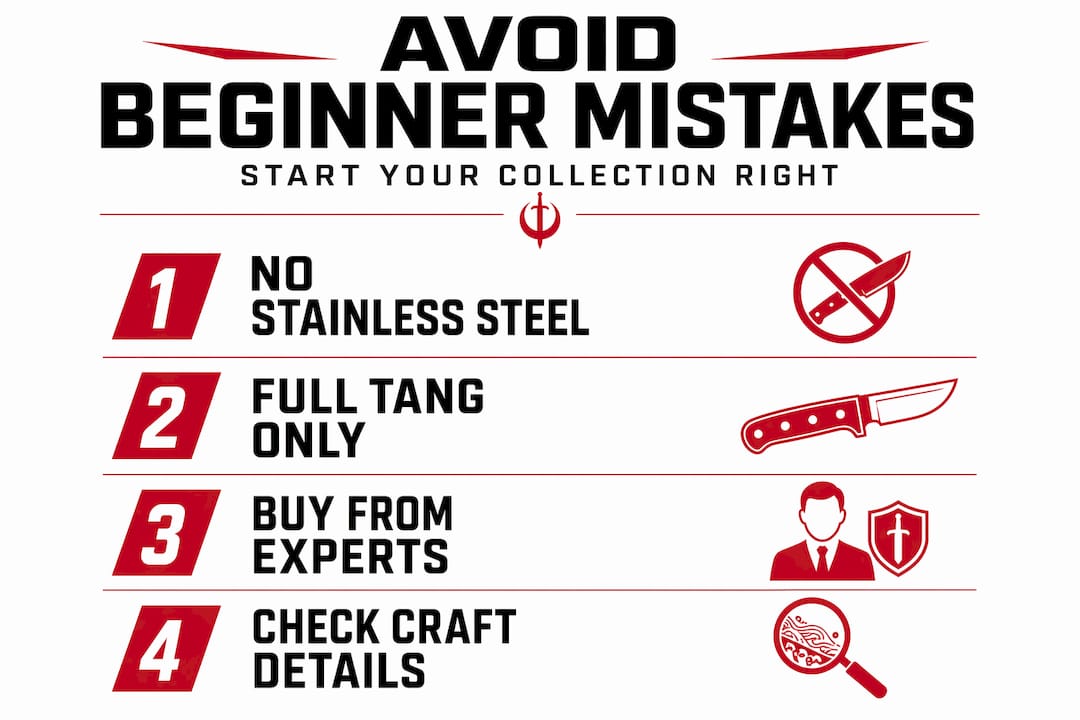
Pro Tip: Always check that a sword is full tang, meaning the blade steel extends through the entire handle. A sword with a partial or rat-tail tang can fail catastrophically during handling, regardless of how impressive it looks on a shelf.
Starting your sword collection as a beginner
Building a sword collection that holds both historical meaning and monetary value requires more than enthusiasm. It requires a system. Here are the steps we recommend following from the start:
- Set a clear budget. Investing in one high-quality piece beats buying five mediocre ones. A single well-forged entry-level katana at $250 to $400 will teach you more about craftsmanship than five $50 wall hangers combined.
- Define your purpose. Are you collecting for display, for historical study, for light martial arts practice, or for long-term investment? Each goal influences which sword type and quality level is right for you.
- Research before you reach for your wallet. Read at least one dedicated reference text on your chosen sword tradition. For Japanese swords, The Connoisseur’s Book of Japanese Swords by Kokan Nagayama is a starting benchmark.
- Build dealer relationships. Serious collectors develop trusted dealer relationships and reference libraries over time. Start by identifying two or three reputable sellers and asking them detailed questions. How they respond tells you a lot.
- Learn basic maintenance. A sword that is not properly maintained degrades in both safety and value. Understand how sword maintenance affects safety and performance before your first purchase arrives.
- Document everything. Keep records of where you bought each sword, what you paid, and any provenance information the seller provided. This becomes important as your collection grows.
Avoid the temptation to buy from online marketplaces with no verifiable history or product details. Scams targeting beginner collectors typically involve sellers using terms like “battle-ready antique” or “museum-quality rare find” without any supporting documentation.
Pro Tip: Ask any seller for the steel specification, blade geometry (length, width, and thickness at various points), and heat treatment method. Legitimate sellers know these details. Vague or dismissive answers are a red flag.
Evaluating swords for authenticity and collector value
Once you know what to look for, evaluating a sword becomes a skill you develop progressively. Beginners often buy on looks alone rather than on historical verifiability and provenance. This is the single most common and costly mistake in beginner sword collecting.
Here is what to examine when evaluating any sword for historical accuracy and value:
- Blade geometry: Authentic period swords have specific profiles. A katana should have a gentle curve (sori) and a clear yokote (transition line at the tip). A Viking sword should have a fuller (groove) running parallel to the spine.
- The hamon on Japanese swords: This visible temper line is created through clay tempering. A machine-made sword will have an etched, cosmetic hamon. A properly forged blade produces a hamon with natural variation and depth visible under direct light.
- Maker marks and tang inscriptions: On Japanese swords, the nakago (tang) often carries the smith’s signature (mei). On historical European swords, blade markings indicate workshop origin.
- Materials and construction: Traditional sword making used regionally specific materials. Tamahagane steel for Japanese swords, pattern-welded steel for Viking blades. Modern replicas using these methods command higher value.
- Recent archaeological finds: New discoveries like Merovingian-era blades continue to update our understanding of transitional sword designs. Staying current with archaeological news sharpens your eye for regional and period variation.
| Feature | Authentic Indicator | Red Flag |
|---|---|---|
| Hamon (Japanese) | Natural, variable temper line | Perfectly uniform etched line |
| Tang construction | Full tang with visible forging marks | Short or welded tang |
| Blade steel | High-carbon or pattern-welded steel | Stainless steel on a “functional” sword |
| Seller documentation | Steel spec, construction details, provenance | Vague descriptions, no technical details |
Pro Tip: Use a strong flashlight held at a low angle across the blade surface. On a properly forged sword, you will see the grain structure of the steel (called hada on Japanese blades). On a cast or machine-made blade, the surface will appear uniform and featureless.
Common mistakes beginners make when picking swords
Even well-intentioned beginners repeat the same errors. Recognizing them early saves money and frustration.
- Prioritizing aesthetics over authenticity: Real collector value lies in a sword’s dual role as a functional weapon and cultural artifact, not its decorative appeal alone.
- Ignoring cultural context: A sword without historical context is just metal. Understanding why a katana is curved, or why a Viking sword has a specific fuller depth, is what separates a collector from a buyer.
- Buying impulsively at events: Sword fairs and conventions can pressure beginners into fast decisions. Never buy a piece you have not researched beforehand.
- Neglecting maintenance: A poorly maintained sword becomes unsafe and loses value. Rust, loose fittings, and degraded handle wrapping (tsuka-ito) are signs of neglect that reduce both safety and resale price.
- Trusting pop culture portrayals: Media often mythologizes swords in ways that distort historical reality. Use primary historical sources and academic references, not movies or games, as your baseline.
My honest take on starting a sword collection
I’ve made most of these mistakes myself. The first sword I bought looked incredible on the wall and cost me $180 at a convention. It had a stainless blade, a rat-tail tang, and zero verifiable history. It taught me nothing except what not to do.
What I’ve learned after years of collecting is that patience is the single most undervalued skill in this hobby. The best pieces I own came from spending months researching a specific period, building a small reference library, and waiting for the right seller. None of them were impulse buys.
I’ve also found that specialization makes you a far better judge of quality. When I focused exclusively on Japanese sword history for a year, my ability to spot authentic sword forging traditions improved dramatically. Broad curiosity is wonderful, but depth is what protects your wallet.
The most important shift in perspective I can offer you is this: see each sword as a historical document, not just an object. When you hold a well-forged katana or study a quality Viking replica, you are holding a record of metallurgical knowledge, social hierarchy, and human conflict that spans centuries. That framing makes the research feel less like homework and more like the privilege it actually is.
— Kenji Smith
Start your collection with Moonswords

At Moonswords, we built our catalog specifically for collectors and enthusiasts who want craftsmanship they can trust. Our entry-level katana collection offers beginner-friendly options forged with high-carbon steel, full tang construction, and authentic clay tempering. Every blade is made by skilled artisans using traditional methods, so you are not just buying a sword. You are acquiring a piece of documented craft history. Beginners looking for an accessible starting point without sacrificing quality will find our functional katanas under $300 an excellent first step. Explore our full range at Moonswords and find the sword that matches both your historical interests and your budget.
FAQ
What is the best sword type for a beginner history enthusiast?
The entry-level katana is one of the best starting points because its history is well documented, its construction markers (hamon, nakago, hada) are verifiable, and a strong global collector community makes research accessible. Roman gladius and Viking sword replicas are also excellent beginner choices depending on your historical interests.
How do I know if a sword is battle-ready or decorative?
Check the blade steel specification. Decorative swords typically use stainless steel, which is brittle under stress. Battle-ready swords use high-carbon steel (1060, 1095, or T10 grade) and feature a full tang construction where the blade steel runs through the entire handle.
How much should a beginner spend on a first sword?
A beginner should expect to spend between $150 and $400 for a quality entry-level piece. Investing in one well-forged sword at this range teaches far more about craftsmanship and historical accuracy than purchasing multiple cheap replicas.
Why does sword provenance matter for collectors?
Provenance, meaning the documented history of where a sword came from and how it changed hands, directly affects both authenticity verification and resale value. Serious collectors maintain records for every piece because undocumented swords are harder to authenticate and sell.
Can ongoing archaeological discoveries change the value of sword replicas?
Yes. New finds like recently discovered Merovingian-era single-edged blades refine our understanding of transitional sword designs, which can make historically accurate replicas of rare types more desirable and valuable to collectors focused on specific periods.