

A functional, entry-level jian is often priced in the low hundreds of dollars. Mid-range hand-tempered blades fall in the mid-price range, and premium hand-forged or custom jian command higher prices depending on metallurgy and fittings. For most buyers, the mid-range band offers the best combination of real steel performance, secure construction, and price. That’s where a 1095 carbon or clay-tempered blade with a properly fitted full tang starts to make sense as both a display piece and a sword you could actually train with.
Before you spend a dollar, learn to spot the difference between a display jian and a battle-ready one:
- Blade flexibility and thickness. Taiji and Wushu jian are often thinner and more flexible, sometimes unsharpened, built for forms rather than contact.
- Tang construction disclosed on the page. A listing that specifies full tang construction and shows the assembly is signaling something a vague “decorative sword” listing won’t.
- Explicit “battle-ready” language. If a seller doesn’t use that phrase or something equivalent, assume the piece is for display until proven otherwise.
Quick take: the $400 to $900 range is where most serious buyers should start looking, because it’s the first price band where you consistently see disclosed steel grades and full tang construction rather than marketing language standing in for specs.
Key Takeaways
The right jian price depends less on the dollar figure itself and more on whether steel grade, tang construction, and heat treatment are clearly disclosed on the listing.
| Point | Details |
|---|---|
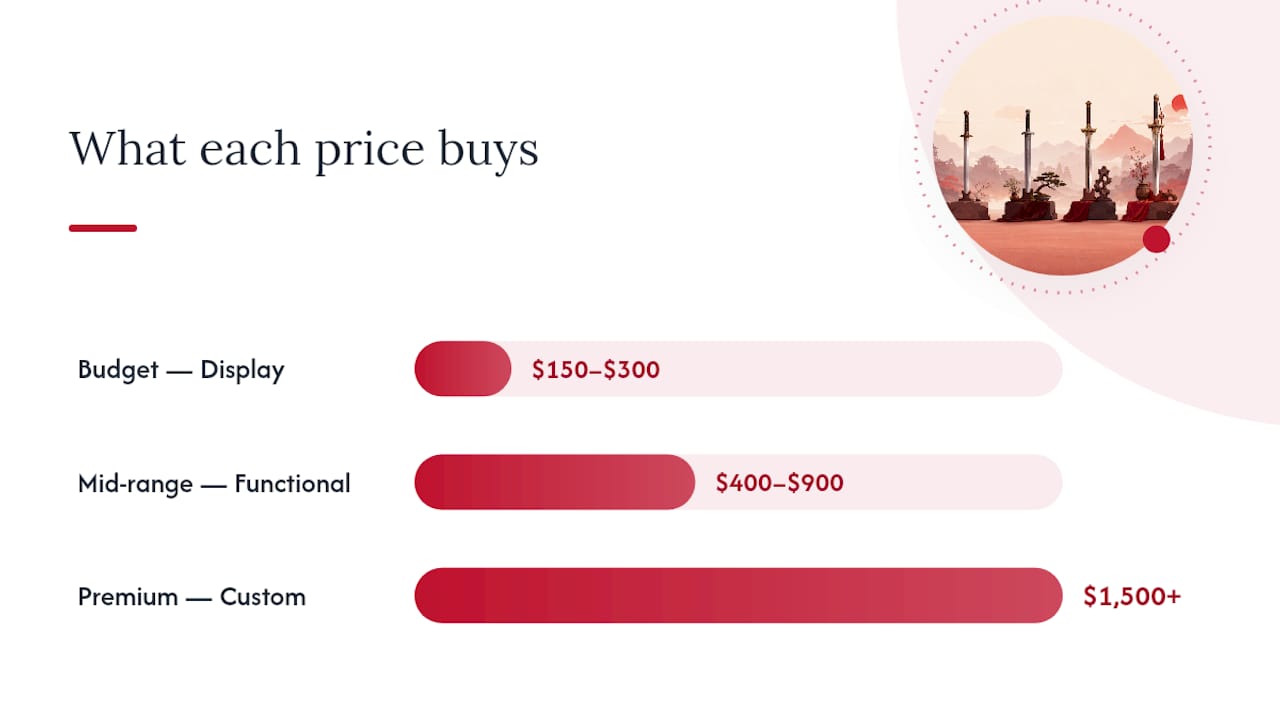
| Match price to use | Budget for display ($150–$300), mid-range for training or light cutting ($400–$900), premium for collecting or cutting ($1,500+). |
| Verify tang and steel grade | Never buy a jian without a stated tang type and a named steel grade, not a vague “carbon steel” label. |
| Confirm battle-ready status | Taiji and Wushu jian are often flexible or unsharpened; confirm “battle-ready” labeling if you need cutting capability. |
| Budget for upkeep | Oiling and periodic edge maintenance are recurring costs on any carbon steel jian, regardless of price band. |
| Start with MoonSwords’ collection | The Han Dynasty Replica Jian and Hand-Forged Jia Gang both disclose full specs, making them a reliable starting comparison point. |
Table of Contents
- What Each Jian Price Band Actually Buys You
- What Drives a Jian’s Price Up or Down?
- How Do You Vet a Jian Listing Before Buying?
- How Long Does It Take to Get a Jian, and What Does Shipping Add?
- Why Choose MoonSwords’ Chinese Jian Collection?
- What Craftsmen Wish Every Jian Buyer Knew
- Why We Price Jian the Way We Do
- Ready to Buy? What Moonswords Offers Jian Buyers
- Sources
- FAQ
What Each Jian Price Band Actually Buys You
Price bands aren’t arbitrary. Each one corresponds to a real jump in materials, labor, or both, and knowing what changes at each threshold keeps you from overpaying for a display sword or underpaying for something you plan to swing.
Budget and display ($150 to $300). These jian typically use mass-produced stainless or basic carbon alloys, machine-polished blades, and simpler fittings. They look good on a wall mount and cost little to acquire, but they’re rarely intended for any contact use. A typical example: a stainless-steel jian with a synthetic scabbard, decorative tassel, and no stated tang specification. Fine for décor. Not something to swing at a target.
Mid-range functional ($400 to $900). This is where blades start using 1095 high-carbon steel or folded steel, often with some form of heat treatment. Collectors and experienced buyers frequently point to this tier as the sweet spot where clay-tempered blades and better fittings appear without bespoke pricing. A representative listing here might describe a “folded steel, clay-tempered” jian with a wooden scabbard and brass fittings. That combination of terms is doing real work. It tells you the maker actually treated the steel rather than just shaping and sharpening it.
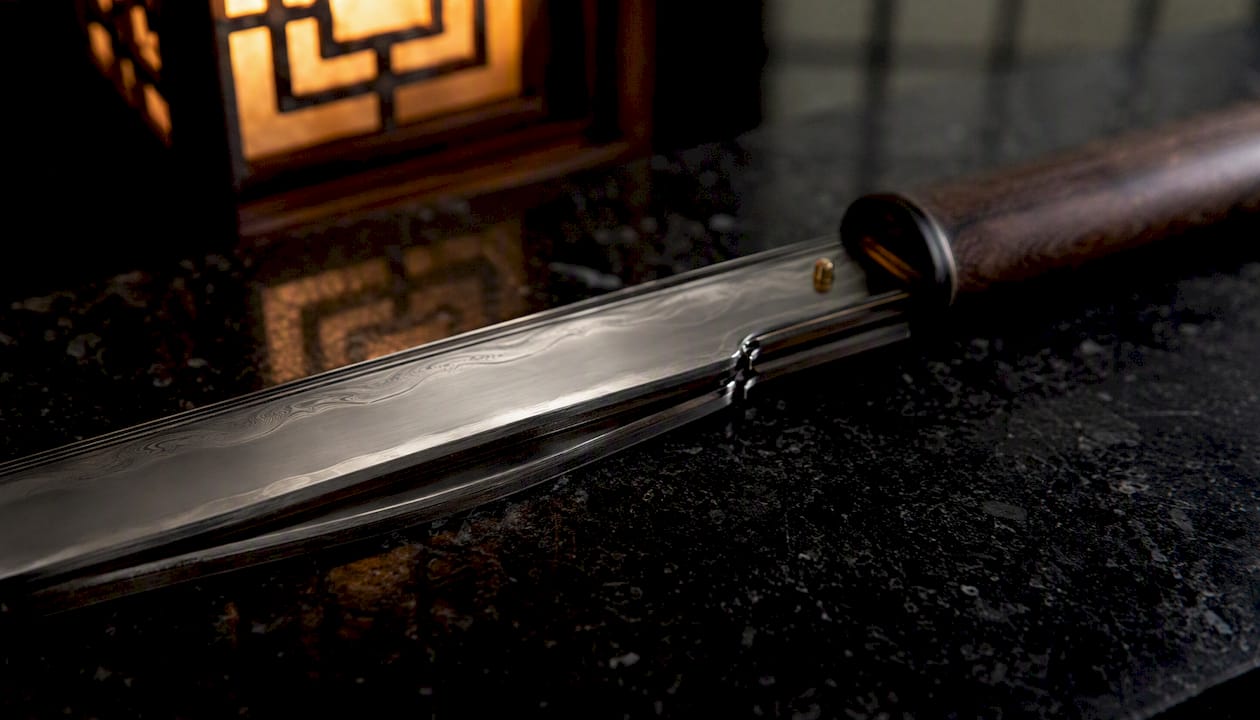
Premium, hand-forged, or custom ($1,500 and up). Here you’re paying for artisan labor as much as raw material. Expect named-smith attribution, forging photography, hand-polished hamon lines, and custom fittings in materials like brass or silver. Public retail catalogs show jian listings spanning from around $100 to well over $5,000 depending on exactly these variables, which is why “jian price” as a single number is close to meaningless without knowing the construction details behind it.
| Price Band | Intended Use | Typical Materials/Finish | Common Buyer Expectations |
|---|---|---|---|
| $150–$300 | Display, light forms | Stainless or basic carbon steel, machine finish | Basic warranty, standard shipping |
| $400–$900 | Taiji, training, light cutting | 1095 carbon or folded steel, clay tempering | Return window, tang specs disclosed |
| $1,500+ | Cutting, collecting, custom builds | Hand-forged high-carbon or pattern-welded steel, hand-finished fittings | Maker attribution, extended or lifetime warranty options |
If you’re weighing a jian purchase against a Japanese blade, the construction logic runs parallel. Our katana versus jian comparison breaks down how balance and geometry differences between the two traditions affect what you should expect to pay at each tier.
What Drives a Jian’s Price Up or Down?
Steel grade sits at the top of the list, but it’s rarely the only factor separating a $200 sword from a $2,000 one. Here’s what actually moves the number.
- Steel grade and metallurgy. Stainless steel is cheapest and least suited to hard use. High-carbon steel like 1095 costs more but holds an edge and flexes properly. Folded or pattern-welded steel (sometimes marketed loosely as “Damascus”) adds labor-intensive forging steps that push price higher still.
- Heat treatment. A simple oil quench is inexpensive. Clay tempering, the traditional method that creates a differentially hardened edge, takes more skill and time, and it shows up in price.
- Construction type. Full tang construction, where the blade’s steel extends the full length of the handle, costs more to produce correctly than a partial or rat-tail tang, but it’s also dramatically safer under stress.
- Fittings and scabbard materials. Brass, silver, or hand-carved wood fittings cost more than cast alloy or plastic substitutes.
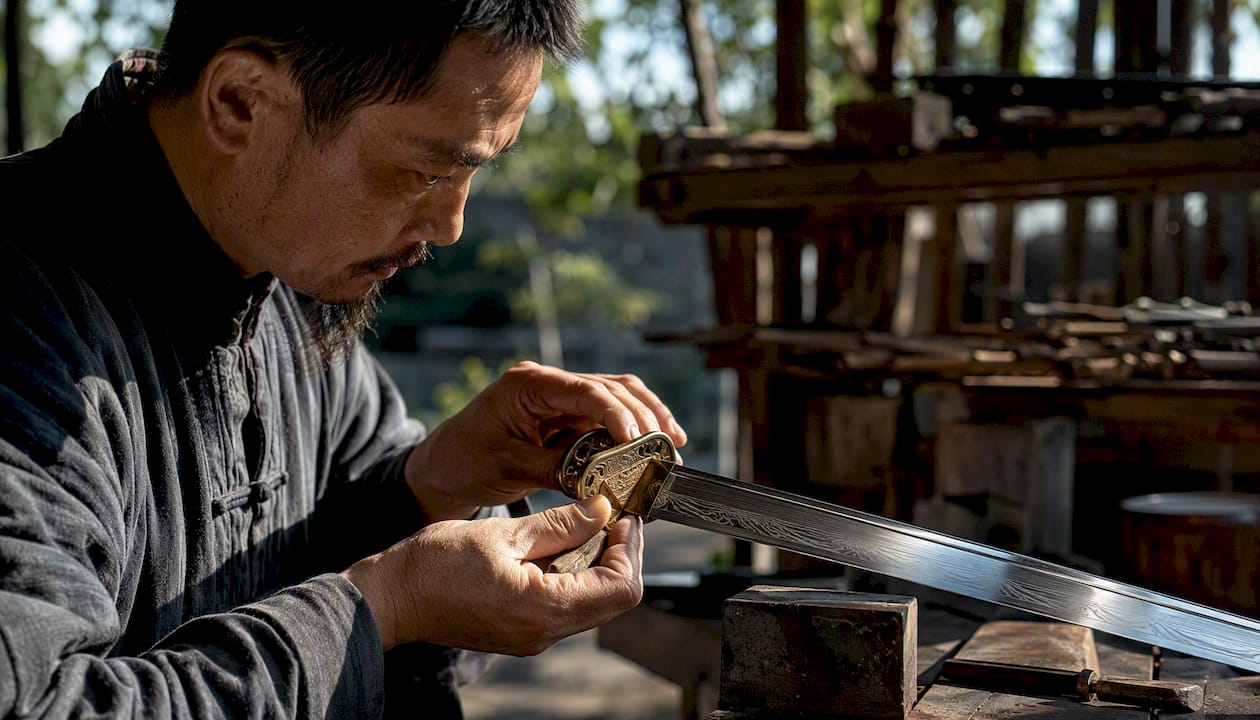
- Hand-finishing and artisan labor. Hand-polished blades and hand-fitted guards take hours a machine process skips entirely.
- Provenance and maker attribution. A named smith with documented forging photos commands a premium over an anonymous factory run.
A useful rule of thumb: a clay-tempered 1095 blade with a hand-polished hamon line will almost always land in the mid-to-high band, even before you factor in fittings, because both the steel and the tempering process require real skill to execute well.
Pro Tip: Search the listing for the word “tang.” If a product page never mentions tang type, construction, or full-length steel, assume it’s a partial tang built for looks, not contact. That single missing detail tells you more about true cost and safety than the price tag does.
Cheap doesn’t always mean bad, but it does mean something was skipped. Industry craftsmen consistently point out that price reflects labor-intensive fitting work and balance calibration as much as raw steel, and a sword with insecure fittings can loosen dangerously with repeated use. That’s the hidden cost of a rock-bottom price: not the steel itself, but the corners cut in assembly.
How Do You Vet a Jian Listing Before Buying?
Reading a product page correctly is a skill, and it’s the one that separates buyers who get exactly what they paid for from buyers who discover a loose pommel three weeks in. Start with the fields that actually matter: is the sword explicitly labeled “battle-ready,” or does the description hedge with words like “decorative” or “display only”? What steel grade is named, specifically, rather than a vague “carbon steel” with no number attached? Is the tang type stated, and does the listing mention overall length, blade thickness, and weight?
Beyond the spec sheet, look for trust signals that separate a serious maker from a drop-shipped import. Forging photographs, a named smith, and real customer photos showing the sword in hand all suggest a seller willing to stand behind their claims. Well-structured product pages that disclose steel grade, tang type, and maker attribution are themselves a strong signal. Their absence is a red flag you shouldn’t ignore.
A loose pommel, a tang that’s never mentioned, or “carbon steel” with no grade number attached are the three most common tells that a listing is cutting corners on construction, not just marketing. If a seller can’t answer a direct question about tang length or steel grade, that hesitation tells you more than any five-star review.
If a listing leaves those details out, don’t guess. Copy a version of this into your inquiry: “Can you confirm the tang type (full or partial), the specific steel grade, and whether this piece is rated battle-ready or intended for display?” A responsive, specific answer is a good sign. Silence or a vague reply is not.
Martial-arts publications consistently draw a hard line between Taiji or Wushu training jian, which are often lighter, more flexible, and sometimes deliberately unsharpened, and stiffer, heat-treated jian built for actual cutting. Confirm which category you’re looking at before you confuse a forms sword for a cutting one.
How Long Does It Take to Get a Jian, and What Does Shipping Add?
In-stock, mass-produced jian ship fastest, often within days, because they’re sitting in warehouse inventory rather than waiting on a smith’s schedule. Custom or hand-forged orders are a different timeline entirely. Because a named artisan is forging, tempering, and fitting a single piece rather than pulling one off a shelf, expect measurably longer lead times, and budget for that delay if you’re buying for a specific date like a competition or a gift.
- In-stock listings: typically ship within days of order confirmation.
- Custom or bespoke commissions: expect a materially longer wait, since the smith is starting the forging process from scratch rather than shipping existing inventory.
- International shipping: customs handling and insurance can add meaningfully to total cost, especially on premium pieces where declared value affects both.
Clear delivery windows matter more than most buyers realize until they’re three weeks into an unclear wait. Vendor information pages that publish specific delivery timelines by region, a defined return and exchange window, and a stated warranty period on workmanship give you something concrete to hold a seller to if something goes wrong.
Quick signal to check before ordering: does the seller publish an estimated ship date on the product page itself, separate from generic shipping policy boilerplate? If a listing only says “ships within 1 to 2 business days” with no mention of what happens for custom orders, ask directly before you pay. Backlogs at reputable forges are common during peak gift seasons, and a seller who’s upfront about a longer wait is more trustworthy than one who promises everything ships instantly.
Why Choose MoonSwords’ Chinese Jian Collection?
Moonswords’ Chinese Jian collection is built around the same principle that should guide any jian purchase: price should track real construction, not marketing language. Every piece in the lineup discloses steel grade, tang type, and finishing method up front, which is exactly what the evaluation framework above tells you to look for.
The MoonSwords Han Dynasty Replica Jian sits in the mid-range band, designed for buyers who want a historically grounded piece with real heat-treated steel rather than a purely decorative stand-in. It suits practitioners who want a jian that looks and handles like the originals it’s modeled on, without stepping up to full bespoke pricing.
The MoonSwords Chinese Jian Hand-Forged Jia Gang occupies the premium tier. This is a piece built around traditional forging methods, hand-finished fittings, and the kind of maker attribution collectors specifically look for when justifying a higher price. If you’re buying as an investment piece or a serious collector’s addition, this is the model to examine closely on its dedicated product page.
| Price Band / Best For | Intended Use | Steel & Tempering | Construction | Warranty & Shipping |
|---|---|---|---|---|
| Han Dynasty Replica Jian — mid-range functional | Display, light Taiji practice, historical study | Heat-treated carbon steel | Full tang construction | Standard warranty and shipping terms |
| Hand-Forged Jia Gang — premium collector | Cutting-capable, collecting, investment | Hand-forged high-carbon steel, clay-tempered | Full tang, hand-fitted mountings | Extended warranty options, artisan-order lead time |
Both models reflect a construction philosophy worth understanding before you buy anywhere: a sword’s long-term value as a collector’s piece depends heavily on provenance and metallurgy documented at the point of sale, not added after the fact.
What Craftsmen Wish Every Jian Buyer Knew
Fittings matter more than most first-time buyers expect. A loose pommel or an improperly seated guard isn’t just an aesthetic flaw. It’s a mechanical failure point that gets worse with use, and on a sword meant for any contact work, that’s a genuine safety issue, not a cosmetic one. Before your first swing, check that the guard doesn’t shift when you grip and twist the handle gently, and confirm the pommel is secured rather than simply pressed on.
Fittings are where cheap swords fail first, and it’s rarely obvious until the sword has already seen use. A tight, well-fitted guard and pommel on delivery is one of the clearest signs a maker understood what they were building, not just how to make it look finished in a photograph.
Maintenance is the ongoing cost buyers forget to budget for. A carbon steel jian needs periodic oiling to prevent corrosion, generally after handling and on a regular schedule in humid climates. Edge maintenance for a cutting-capable blade adds modest recurring cost over the sword’s life, and if a blade ever needs professional resharpening or a fitting repair, that service cost varies with the extent of the work. Budgeting a small annual amount for oil, cloth, and occasional professional attention keeps a quality jian performing the way it did on day one. Our guide on sword maintenance and safety covers the specific steps in more depth.
Pro Tip: The moment your jian arrives, before you do anything else, grip the handle and gently flex the guard and pommel by hand. Any detectable movement means the fittings need attention before the sword sees any active use, full stop.
Why We Price Jian the Way We Do
Craftsmanship has a cost, and pretending otherwise does buyers no favors. A jian that costs $150 and a jian that costs $1,500 aren’t the same object wearing different price tags. They’re built by different processes, with different labor hours, different steel, and different levels of accountability behind the maker’s name. When Moonswords prices a hand-forged Jia Gang well above an entry-level display piece, that gap isn’t margin for margin’s sake. It reflects the actual hours a smith spent folding steel, clay-tempering an edge, and hand-fitting mountings that a machine simply can’t replicate.
What frustrates me most about how jian are sold online is the flattening of that distinction. A listing that says “carbon steel” with no grade number is doing the same job, linguistically, as one that names 1095 and describes a clay temper. But those two swords aren’t remotely equivalent, and a buyer who doesn’t know to ask the difference ends up paying mid-range money for a budget sword, or budget money for a sword that will fail exactly where it matters most. Every price tier we offer exists because a specific combination of steel, tempering, and labor justifies it, not because a number felt right.
Ready to Buy? What Moonswords Offers Jian Buyers
Most online jian listings force you to choose between a cheap decorative piece with vague specs or a fully custom commission with a long wait and an unclear final price. Moonswords closes that gap. Every jian in the collection publishes steel grade, tang construction, and finishing method on the product page itself, so you’re comparing real specifications instead of guessing from a photo.
That transparency matters most if you’re choosing between the mid-range Han Dynasty Replica Jian and the premium Hand-Forged Jia Gang, since the right pick depends entirely on whether you want a historically grounded training piece or an investment-grade collector’s sword with named-smith attribution. If you want something outside either standard model, Moonswords also takes custom commissions built to your specific length, balance, and fitting preferences. Browse the full Chinese Jian collection now, compare the disclosed specs against the checklist in this guide, and reach out directly if you want a custom build quoted before you commit.
Sources
FAQ
How effective was the jian in actual combat?
Historically, the jian was prized for speed and precision rather than brute cutting power, making it effective in the hands of a skilled user against lightly armored opponents, though its double-edged design made it less suited to heavy armor than curved single-edged swords.
What does “jian” mean in Chinese?
“Jian” (剑) refers to the straight, double-edged sword native to China, distinct from the single-edged dao, and the term applies broadly to the entire family of straight Chinese swords regardless of era or specific style.
What kind of sword is a jian?
A jian is a straight, double-edged sword, typically lighter and more balanced for thrusting and quick directional changes than curved swords, and it ranges from flexible training versions to stiff, battle-capable blades depending on intended use.
What is the most famous Chinese sword?
Among historical jian, the swords attributed to the ancient state of Yue, discovered in archaeological finds and renowned for their preserved sharpness and metallurgy, are frequently cited as the most celebrated examples of the type.
Is a MoonSwords jian battle-ready or decorative?
Moonswords discloses tang construction, steel grade, and heat treatment on each product page, including the Han Dynasty Replica Jian and Hand-Forged Jia Gang, so buyers can confirm cutting capability before purchase rather than guessing from a photo.