

Katana engraving options fall into four broad camps: traditional hand carving, laser or precision etching, chemical or acid etching, and CNC or rotary work. Choose hand carving when authenticity and heirloom value matter most, laser or etch work for repeatable graphics and clean kanji, and skip engraving entirely on black-coated or painted blades, which rarely hold a mark well. For anything meant to last generations, commission the work from a specialist who understands blade steel, not a general engraver.
TL;DR:
- Hand carving offers unmatched authenticity and character but requires skilled artisans and is more expensive than modern methods.
- Laser etching and acid etching provide precise, repeatable designs suitable for logos, kanji, and text, but lack relief and tactile depth.
- Engraving placement is critical; the nakago safely holds signatures and dates, while the blade near the habaki is ideal for decorative motifs without risking blade integrity.
- Traditional techniques like Inkoku or jiniku-bori carry historical and spiritual significance, and using these methods authentically enhances a blade’s value.
- Proper kanji review and mockups are essential to avoid costly mistakes, and engraving should be planned before finalizing the blade to ensure longevity and quality.
Table of Contents
- Katana Engraving Options: A Quick Map of the Field
- Traditional Japanese Engraving Techniques and Their Features
- What Modern Engraving Methods Can and Can’t Do
- Where to Engrave and What Your Blade Will Accept
- Getting Kanji and Design Details Right
- How to Commission Custom Katana Engraving
- Caring for an Engraved Blade Long Term
- The Historical Weight Behind Katana Engravings
- What Collectors Get Wrong About Custom Engraving
- Custom Engraving Through Moonswords
- Sources
- FAQ
Katana Engraving Options: A Quick Map of the Field
Every engraving choice trades off authenticity, precision, cost, and permanence, and no single method wins on all four. Here’s the field as we see it, working with collectors and craftsmen at Moonswords:
- Traditional chiseling (horimono): hand cut with steel chisels, prized for authenticity and irregular, human character. Slow and expensive.
- Sukashi (openwork): the design is cut through the metal, not into it. Dramatic but limited to non-structural areas like fittings or tsuba.
- Intaglio-style carving: recessed line work similar to Inkoku, good for text and fine motifs.
- Laser etch: precise, shallow, and repeatable. Ideal for kanji and logos, weak for depth or dimension.
- Acid/chemical etch: produces a frosted, permanent contrast without removing much material.
- CNC/rotary engraving: machine controlled depth and repeatability, useful for production runs.
- Inlay or gilding: gold, silver, or brass set into the blade or fittings, historically reserved for high status swords.
Display pieces and heirlooms lean toward hand carving or inlay. Blades meant for light cutting practice do better with laser or etch work, since deep carving near the edge can weaken the temper.
Traditional Japanese Engraving Techniques and Their Features
Japan’s engraving vocabulary predates modern tooling by centuries, and the terms still matter to serious collectors because they describe how a mark was made, not just what it looks like.
Inkoku is a recessed line carving technique, often used for signatures and dates on the nakago. Ukibori raises the design in relief above the surrounding surface, giving figures a sculptural, three-dimensional quality. Jiniku-bori carves directly into the steel’s flesh with visible chisel texture left intact, prized for its raw, handmade look. Sukashi-bori cuts openwork designs straight through the metal, most often seen on tsuba and other fittings rather than the blade itself. Hitsunai-bori refers to carving done inside a bo-hi groove, a technique that demands precise control since the surrounding channel limits tool access.
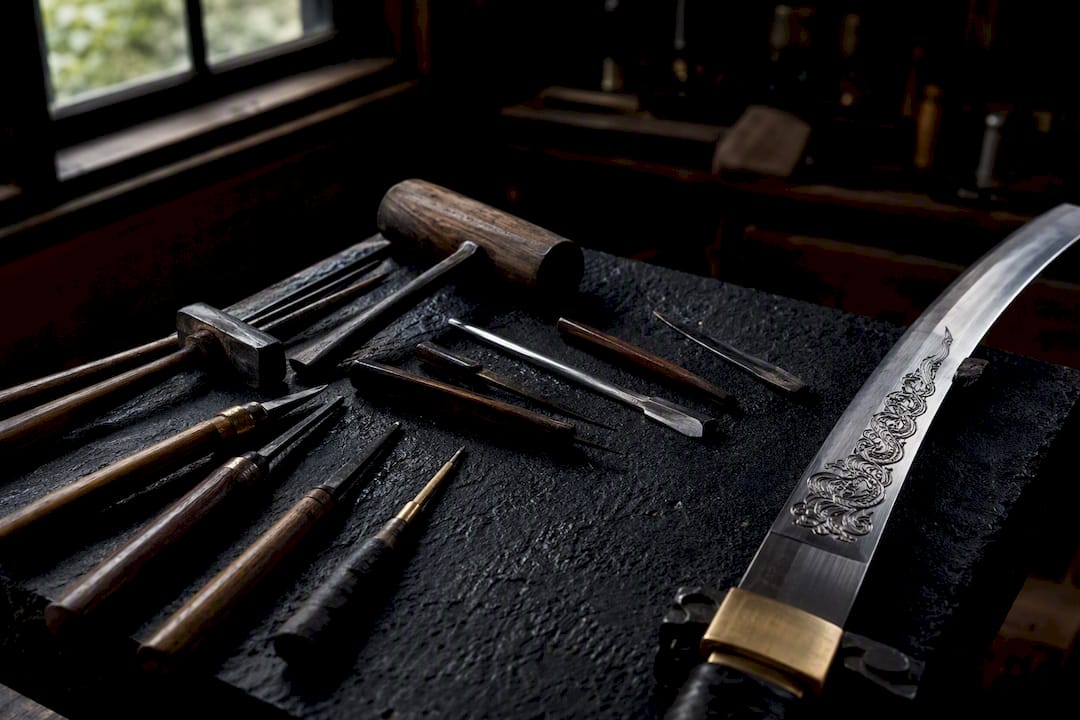
Each of these appears in the detailed technique breakdown that collectors reference when authenticating antique work. Historically, these styles clustered on the nakago for maker’s marks and dates, or on the blade’s flat near the habaki for decorative dragons, Buddhist figures, and sutra text.
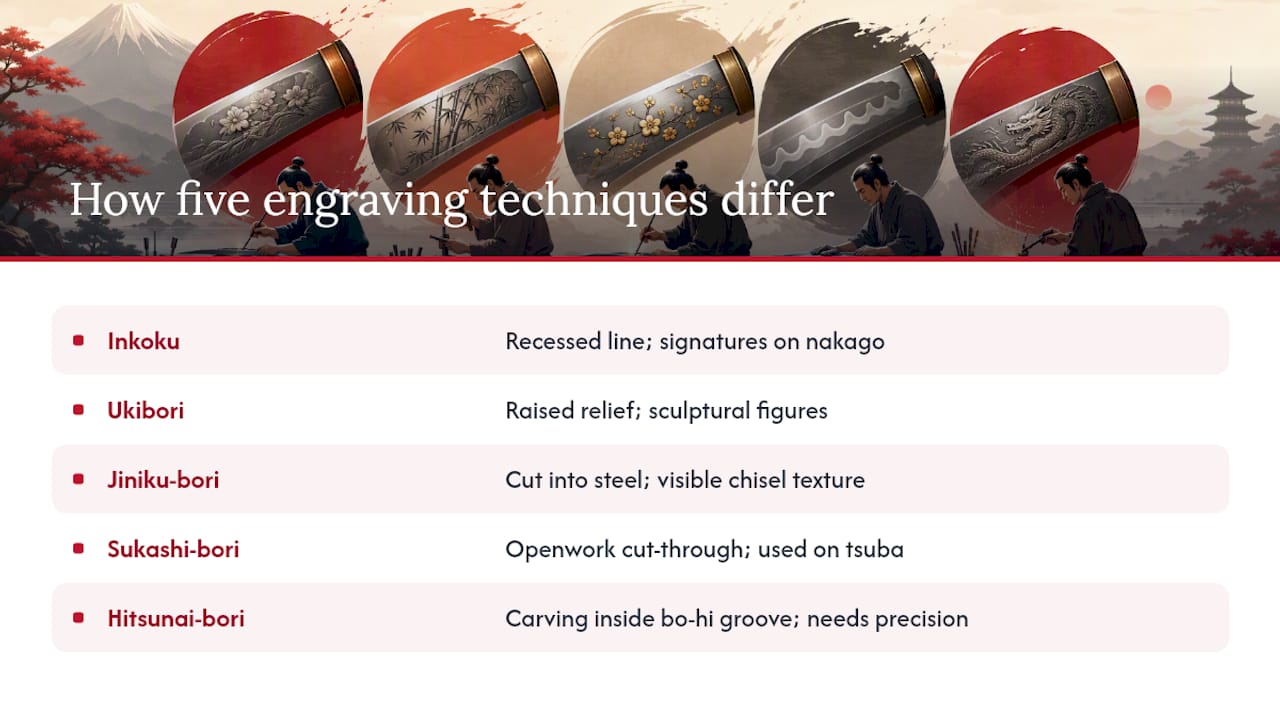
Hand carved work holds up remarkably well over centuries when the smith understood the temper line, since deep cuts too close to the hamon risk weakening the blade’s structural integrity.
Pro Tip: Ask any vendor offering “traditional” engraving which of these five techniques they actually use. If they can’t name one, they’re likely doing shallow modern etching dressed up with old terminology.
What Modern Engraving Methods Can and Can’t Do
Laser etching burns a shallow mark into the surface using focused light, and it’s become the default for kanji and graphic designs because it reproduces fine detail with no hand-to-hand variation. It won’t give you the raised relief of ukibori or the tactile depth of jiniku-bori, though, since the mark stays close to the surface by design.
Acid or chemical etching works differently: a resist mask protects everything except the design, and acid eats away exposed steel to leave a frosted, permanent contrast. It’s durable but flatter looking than carved work.
- Laser etch: best for kanji, logos, repeatable art; shallow and low risk to blade integrity.
- Acid/chemical etch: permanent, moderate cost, distinct matte finish.
- CNC/rotary: programmable depth, consistent across batches, suited to production pieces.
- Hand chiseling: highest cost and skill requirement, the only route to true relief or openwork.
None of these modern methods should touch a blade’s hardened edge or run deep grooves near the hamon. Reserve laser and etch work for the flat and the spine, and save CNC for fittings or nakago work where structural risk is minimal.
Where to Engrave and What Your Blade Will Accept
Placement decisions affect both looks and long-term value, so match the method to the location before you commit.
- Nakago (tang): the traditional home for signatures and dates, hidden under the handle wrap and safe from wear. Most collectors favor the nakago for authenticity even when they also want visible blade art.
- Blade near the habaki: the classic spot for horimono dragons, Buddhist deities, and inscriptions, visible when the sword is drawn.
- Along the shinogi or near the hamon: possible but risky. Engraving too close to the tempered edge can compromise the blade under stress.
- Saya (scabbard): the safest surface for elaborate art since it carries no structural load.
Black-coated, painted, or heavily lacquered blades often reject etching and laser work cleanly, leaving uneven or patchy marks. Bare steel, polished finishes, and traditional clay-tempered blades take engraving far more reliably.
Getting Kanji and Design Details Right
A beautiful engraving ruined by bad kanji is one of the most common regrets collectors report, and it’s entirely avoidable. Machine translation tools routinely produce grammatically broken or outright nonsensical kanji strings, and vendors who accept your text without questions rarely catch the error before it’s permanent.
- Have kanji reviewed by a native speaker or a recognized translation authority, not just translated once.
- Request a mockup on the actual material before final engraving, since stroke complexity that reads clearly on paper can blur at small scale.
- Match the calligraphy style to the sword’s era. Modern sans-serif kanji looks jarring on a traditionally styled blade.
- Avoid literal translations of English phrases. Idioms rarely carry over.
Reputable vendors ask you to supply and confirm kanji text before cutting anything, which cuts down on returns and disputes.
Pro Tip: Print your kanji mockup at actual engraving size and view it from three feet away. If it turns to mush, so will the real thing.
How to Commission Custom Katana Engraving
Send your engraver finalized artwork files, confirmed kanji text, exact placement instructions, and clear photos of your blade’s current finish before requesting a quote.
- Turnaround: laser and CNC work often ships in days to a couple of weeks; hand chiseling and inlay can take several weeks to a few months depending on complexity.
- Pricing: simple laser etching sits at the low end of custom work, hand-carved horimono and gilded inlay command significantly more due to the skill and hours involved.
- Red flags: no before-and-after gallery, refusal to confirm your kanji before cutting, or vague answers about which blade finishes they’ll work on.
Ask specifically whether they’ve engraved your steel type before. A vendor confident with laser work on bare carbon steel may still be guessing with a coated or Damascus-pattern blade.
Caring for an Engraved Blade Long Term
Oil the blade regularly with a light mineral or choji oil, keeping it away from humidity swings that promote corrosion inside carved lines where moisture collects easily.
- Avoid abrasive polishing compounds on shallow laser or acid-etched marks, since aggressive buffing can wear the design away entirely.
- Deep hand-carved work tolerates gentle cleaning better than surface etching does.
- Store engraved swords horizontally in a saya with a stable, moderate climate, away from direct sunlight that can fade contrast on etched finishes.
Nakago inscriptions need almost no maintenance since they sit under the handle wrap, untouched by handling or air exposure.
The Historical Weight Behind Katana Engravings
Engraving on a katana was never purely decorative. A smith’s Inkoku signature on the nakago served as a legal and professional record, the sword world’s equivalent of a maker’s stamp, and collectors today still use those marks to authenticate age and provenance. Horimono carvings near the habaki carried religious weight too. Dragons represented protective, water-associated power meant to guard the wielder, while depictions of Fudo Myo-o, a wrathful Buddhist guardian deity, were believed to grant courage and ward off evil.
Common motifs collectors still request include dragons (protection, power), bonji Sanskrit characters (Buddhist prayer script), rising suns, and clan mon (family crests) once used to mark ownership and allegiance. Sukashi openwork on tsuba often depicted seasonal plants, waves, or geometric patterns tied to the wearer’s personal taste or household symbolism.
Modern engraving on a mass-produced or replica katana carries none of that provenance weight, but it can still carry personal meaning. A name, a date, a family crest, or a line of poetry turns a factory-forged blade into something singular. The techniques haven’t changed as much as the purpose has: where a 16th-century smith carved to certify authorship and invoke protection, today’s collector engraves to mark identity. Famous historical blades like those attributed to storied smiths such as Masamune are remembered partly because their nakago inscriptions, when present, let scholars trace lineage across centuries. That traceability is the whole point of the tradition, and it’s worth remembering even on a decorative piece.
What Collectors Get Wrong About Custom Engraving
Most guides treat engraving as a purely aesthetic decision, a matter of picking a pretty design and finding someone to cut it. That undersells the problem. The real question is always whether the method matches the metal, and I’ve seen more disappointed collectors over bad technique matching than bad artwork.
Documenting engraving options at Moonswords means being upfront about where each method breaks down. Laser work looks stunning on bare carbon steel and disappoints almost every time on a black-coated blade. Hand carving delivers unmatched character but demands a craftsman who respects the temper line, not just someone skilled with a chisel. We combine traditional aesthetic references with the modern tooling precision that makes kanji legible at any size, because collectors deserve both the look and the longevity.
The pattern I’d push back on is treating engraving as an afterthought tacked onto a sword purchase. The best results come from planning placement and technique before the blade is even finished, not retrofitting a design onto a completed piece and hoping it holds.
— Kenji Smith
Custom Engraving Through Moonswords
Moonswords built its customization process around a simple idea: your engraving should last as long as the blade does. We support kanji text confirmation before cutting, placement guidance based on your blade’s finish, and a documented care guide so the detail you paid for doesn’t fade in five years.
Browse the high-end katana collection for models suited to hand-carved horimono, or start with a bare carbon steel blade like the Kyōjin clay-tempered katana if you want a canvas that takes etching cleanly. Handle and fitting choices matter too, and our guide on customizing a katana handle pairs well with any engraving plan. To start a custom order, send your kanji text and reference images through the main ordering page and our team will confirm technique compatibility before any cutting begins.
Sources
- The Art of Katana Engraving: History, Techniques and …
- Katana Engraving the EASY way
- Katana Customize – Japonalia
FAQ
What are some good katana engraving ideas?
Popular choices include clan mon crests, protective dragon motifs, bonji Sanskrit characters, personal names in verified kanji, and short poetry lines placed near the habaki or on the saya.
What are the different engraving styles for katanas?
The main traditional styles are Inkoku (recessed line carving), Ukibori (raised relief), Jiniku-bori (textured chisel work), Sukashi-bori (openwork), and Hitsunai-bori (carving inside a bo-hi groove), alongside modern laser, acid etch, and CNC methods.
Can you legally own a katana in the United States?
Yes, owning a katana is legal in the United States for most adults, though a handful of states and cities restrict carrying blades in public, so check local law before transporting one.
What are some cool things to engrave on a sword or knife?
Beyond names and dates, collectors often engrave family crests, guardian figures like dragons or Fudo Myo-o, meaningful quotes, or geometric patterns adapted from historic tsuba designs, and Moonswords supports custom kanji and motif requests during the ordering process.