

For U.S. collectors and practitioners who want museum-quality Japanese-style katanas, Moonswords delivers the best balance of traditional techniques, material transparency, and purchase support available outside Japan. These are handcrafted blades forged by master artisans using clay tempering, full tang construction, and documented steel types — not wall-hanger replicas.
Quick picks by use case:
- Display: Entry-Level Katana Collection — clean aesthetics, honest construction, accessible price point for first-time collectors
- Light training: Atsu Katana Sword, Ghost of Yōtei T10 Steel Full Tang — full tang, T10 high-carbon steel, built for occasional cutting practice
- Museum-quality: Kyōjin 狂刃 Katana, Premium Clay Tempered Tamahagane — clay-tempered Tamahagane with traditional fittings, collector-grade finish
Key Takeaways
Moonswords’ master-forged, clay-tempered katanas deliver museum-quality Japanese-style craftsmanship with full material transparency, making them the strongest option for U.S. collectors who want technique-driven blades without the Nihontō price point.
| Point | Details |
|---|---|
| Match blade to use case | T10 full tang for light training; Tamahagane or Damascus for display and collecting. |
| Verify construction on the page | Confirm clay tempering, full tang, and named steel type before purchasing. |
| Budget for customs and lead time | U.S. buyers should plan for production time plus international shipping and potential import duties. |
| Oil and store correctly | Apply choji oil every one to three months; store in saya, edge up, away from humidity. |
| Moonswords for museum-quality picks | The Kyōjin Tamahagane and Zhao Peiyan Master Collection are the top collector-grade options. |
Table of Contents
- What does “katana made in Japan” mean for this article?
- Which construction features actually matter in a Japanese-style katana?
- Which Moonswords katana fits your use case?
- How do you verify build quality from a product page?
- What should you expect when ordering, customizing, and shipping to the U.S.?
- How do you care for a handcrafted katana at home?
- What trust signals should you look for before buying?
- Moonswords: handcrafted Japanese-style katanas for serious U.S. collectors
- An artisan’s perspective on what “made in Japan” really means
- Sources
- FAQ
What does “katana made in Japan” mean for this article?
When collectors search for a katana made in Japan, they are usually expressing a desire for quality — the differential hardening, full tang construction, and material honesty that define serious Japanese sword craftsmanship. They are not always seeking an authentic Nihontō (a sword made in Japan by a licensed Japanese swordsmith using traditional tamahagane). That category is a separate subject with its own legal restrictions, price range, and availability constraints, and this article does not cover it.
What we cover here is Moonswords’ range of high-quality, Japanese-style katanas forged by master artisans outside Japan. These blades follow many of the same construction principles — clay tempering, traditional forging techniques, full tang nakago — while using modern high-carbon and specialty steels (T10, Damascus, manganese, and Tamahagane) to deliver museum-quality results at a fraction of authentic Nihontō prices. As sword-buyers-guide.com explains, authentic shinken undergo folding, laminating, and differential hardening that make them far more expensive than production-level approximations — Moonswords occupies the serious middle ground: artisan-forged, technique-driven, and priced for real collectors.
Which construction features actually matter in a Japanese-style katana?
Clay tempering, full tang construction, and documented steel type are the three features that separate a serious blade from decorative metalwork. Everything else is secondary.
Here is what to inspect on any Moonswords product page:
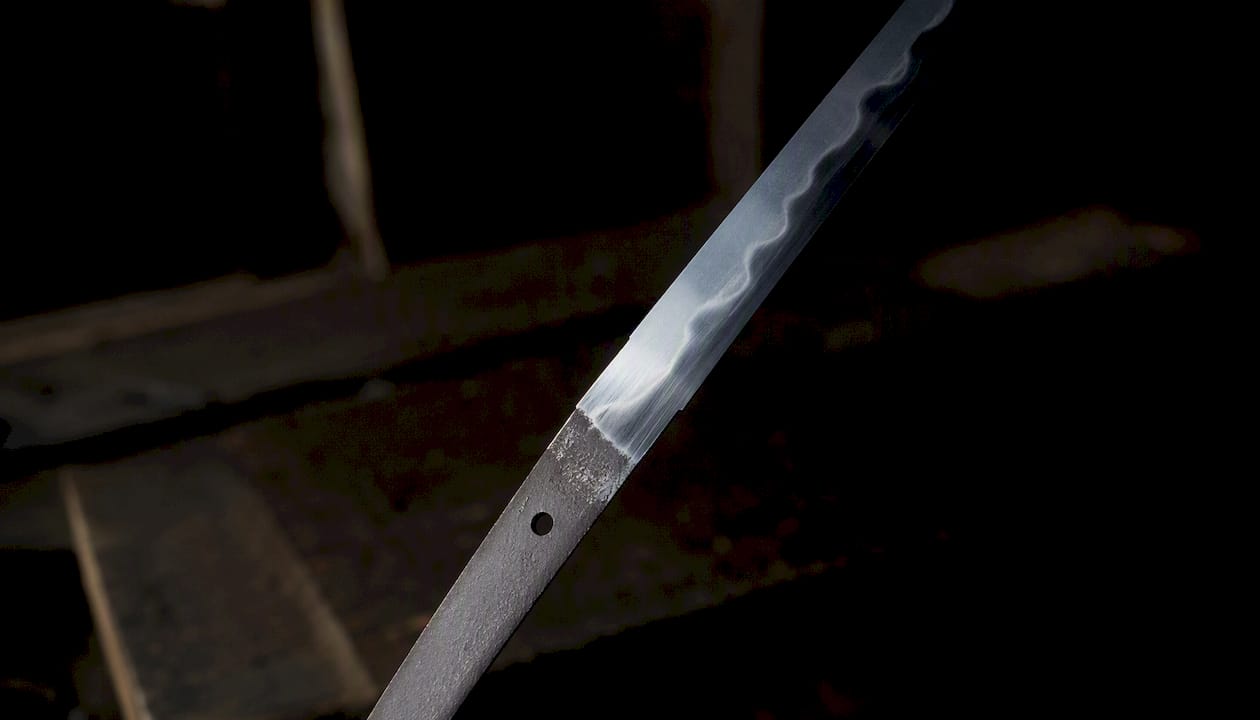
- Clay tempering (tsuchioki): Clay is applied differentially before quenching, creating a harder edge (ha) and softer spine (mune). The result is a visible hamon and a blade that resists shattering under stress.
- Full tang (nakago): The steel runs the full length of the handle. A partial or rat-tail tang is a structural weakness; full tang is non-negotiable for any blade intended for light use.
- Steel type transparency: T10 high-carbon steel, Damascus (folded or pattern-welded), manganese steel, and Tamahagane each have distinct hardness and flexibility profiles. A product page that names the steel type is a product page you can trust.
- Visible hamon with documented tempering: A hamon (the temper line along the edge) is visually striking, but its presence alone does not confirm quality. According to Absolute Anime’s guide to real vs. wall-hanger katanas, polish quality and clear construction details are more reliable indicators than the hamon by itself.
- Fittings quality: Tsuba (guard), menuki (handle ornaments), and habaki (blade collar) should be described by material — bronze, brass, or iron — not just labeled “decorative.”
- Polish level: A hand-polished blade shows consistent geometry along the shinogi (ridge line). Uneven polish or visible grind marks suggest rushed finishing.
Pro Tip: Request a close-up photo of the nakago (tang) before purchasing. A signed or stamped tang, or one with visible hand-forging marks, tells you far more about build quality than any marketing description.
For collectors, transparency about full tang construction and documented clay tempering carries more long-term value than vague phrases like “folded steel” used without context.
Which Moonswords katana fits your use case?
Your goal — display, light training, or museum-quality collecting — should drive your choice of steel and construction tier. The table below maps Moonswords’ main collections and products to those goals.
| Collection / Product | Best For | Standout Feature |
|---|---|---|
| Entry-Level Katana Collection | Display, beginners | Affordable, functional, honest construction |
| Black Dragon Katana | Display / light use | Bold aesthetic, manganese steel, clean fittings |
| Tamahagane Steel Katana | Collector display | Gold-gilded bronze fittings, clay tempered, full tang |
| Atsu Ghost of Yōtei, T10 Steel | Light training | T10 high-carbon, full tang, material-transparent page |
| Atsu Ghost of Yōtei, Damascus Steel | Display / collector | Clay-tempered Damascus, striking visual pattern |
| Kyōjin 狂刃 Katana | Museum-quality collecting | Clay-tempered Tamahagane, premium traditional fittings |
| Master Collection by Zhao Peiyan | Investment / museum-quality | Renowned bladesmith, certificate, limited availability |
Pro Tip: The Atsu T10 variant handles occasional test cutting well; the Damascus variant is better kept as a display piece — Damascus pattern-welded blades are visually stunning but the layered steel is more sensitive to lateral stress.
How do you verify build quality from a product page?
Product pages and close-up photos reveal enough to screen for quality — if you know what to look for. A well-documented listing is itself a trust signal.
- Steel type is named explicitly (T10, Damascus, Tamahagane, manganese — not just “high-carbon steel”)
- Construction method is stated (clay tempered, hand forged, full tang — all three, not just one)
- Hamon is visible in photos with a close-up shot showing the temper line clearly
- Tang photo is included showing the nakago, any signature, and the handle assembly
- Fittings are described by material, not just labeled “ornamental”
- Customer photos are present showing the blade in hand or on display — real buyers, real lighting
- Certificate or warranty language appears on the page or is offered on request
Detail photos — hamon close-ups, nakago shots, and fittings — plus explicit steel-type labeling are the most reliable buyer-side indicators of honest product claims.
Pro Tip: If a product page lacks a tang photo, contact Moonswords directly and ask for one before ordering. Any reputable artisan-forged blade has a nakago worth showing.
What should you expect when ordering, customizing, and shipping to the U.S.?
Moonswords offers customization on selected pieces — handle wrap color (ito), tsuba style, blade length, and saya finish are common options. Customization requests are made directly on the product page or through the site’s contact channel before checkout.
Typical ordering steps:
- Review the product page for steel type, construction details, and available customization options
- Contact Moonswords to confirm customization choices and request any additional photos
- Complete checkout; note the production lead time stated on the product page
- Receive order confirmation with expected production and ship date
- Track international shipment to your U.S. address
Made-to-order production typically adds lead time before shipping begins. International shipping from China to the U.S. adds further transit time on top of production. U.S. buyers should also account for potential customs duties and import taxes, which are assessed by U.S. Customs and Border Protection based on declared value and product category. These costs are not included in the listed product price and vary by order.
How do you care for a handcrafted katana at home?
Regular, simple care preserves a blade’s finish and prevents rust — the two most common causes of condition loss in display and light-use katanas.
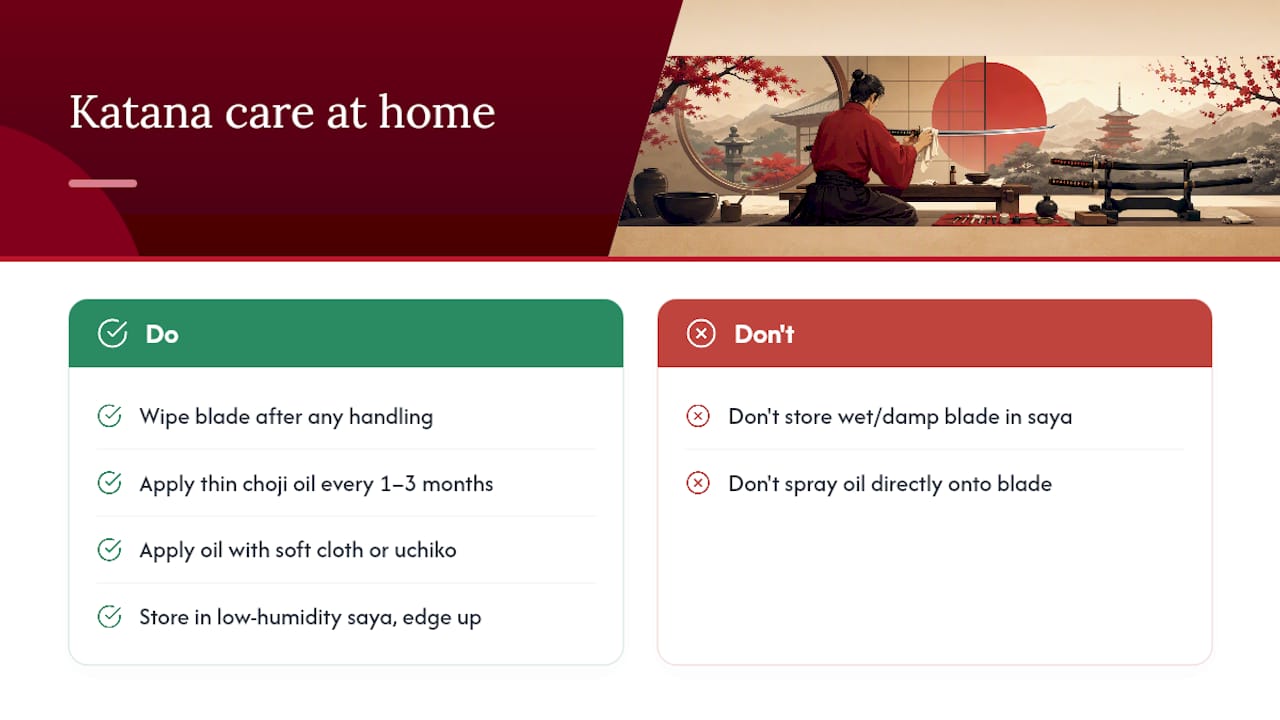
For display pieces, wipe the blade with a clean, lint-free cloth after any handling. Fingerprints leave acidic oils that etch the steel over time. Apply a thin coat of choji oil (clove oil mixed with mineral oil) every one to three months, depending on your home’s humidity. Store the blade in its saya (scabbard) horizontally or at a slight downward angle, edge up, in a low-humidity environment away from direct sunlight.
For light-use blades, clean the edge after every session. Remove any debris with a soft cloth, re-oil the blade, and inspect the habaki and handle for loosening. Never store a wet or damp blade in the saya.
Pro Tip: Apply choji oil with a soft cloth or a dedicated uchiko ball — never spray directly onto the blade. A thin, even coat protects without attracting dust or gumming the saya interior. Moonswords’ katana care guide walks through the full cleaning sequence step by step.
For long-term collector storage, consider a protective knife and blade storage solution that shields against moisture and dust without direct contact with the steel.
What trust signals should you look for before buying?
Specific trust signals increase buyer confidence more reliably than brand claims alone. Here is what to verify on any Moonswords product page:
- Master artisan name or photo associated with the piece (Zhao Peiyan’s Master Collection includes this explicitly)
- Clay tempering and full tang noted in the construction description, not just implied
- Steel type named (T10, Damascus, Tamahagane) with no vague substitutes
- Close-up photos of hamon, nakago, tsuba, and handle wrap
- Customer photos and reviews showing the actual product received
- Certificate or warranty language for premium and master-collection pieces
- Customization documentation confirming your chosen options before production begins
Moonswords’ High-End Katana Collection and the Zhao Peiyan Master Collection both meet this standard, with detailed pages, artisan credentials, and certificate options for buyers who want full documentation.
Moonswords: handcrafted Japanese-style katanas for serious U.S. collectors
When you want a Japanese-style katana built with real technique — clay tempering, full tang, documented steel, and a master artisan behind the blade — Moonswords is where U.S. collectors and practitioners shop. Every piece in the catalog comes with material transparency, close-up photography, and purchase support that generic importers simply do not offer.
Browse the full Japanese katana collection, go straight to the High-End Collection for museum-quality pieces, or start with the Entry-Level Collection if you are building your first display. Customization, certificates, and U.S.-friendly checkout are available across the catalog. Visit Moonswords to find the blade that fits your collection.
An artisan’s perspective on what “made in Japan” really means
The phrase “katana made in Japan” carries weight because it signals intention: a buyer who uses it wants something real, not a prop. We respect that. The techniques we apply — clay tempering, full tang forging, differential hardening — are the same principles that define serious Japanese sword craftsmanship, regardless of where the forge sits. What matters is whether the maker documents their work, names their steel, and stands behind the blade. We do all three. If you have a custom commission in mind or want to discuss a specific piece from the Zhao Peiyan Master Collection, reach out through the contact page. We answer every inquiry personally.
Sources
- Real Katana or Wall Hanger? How to Tell the Difference • Absolute Anime
- Demystifying the Authentic Samurai Sword
FAQ
What steel types does Moonswords use in its katanas?
Moonswords uses T10 high-carbon steel, Damascus (pattern-welded), manganese steel, and Tamahagane, with each product page naming the steel type explicitly so buyers know exactly what they are purchasing.
Are Moonswords katanas functional for light training?
Yes. Full tang models like the Atsu Ghost of Yōtei T10 are built for occasional cutting practice, while decorative variants such as the Damascus and Tamahagane pieces are better suited to display and collecting.
How long does it take to receive a Moonswords katana in the U.S.?
Total delivery time includes made-to-order production lead time plus international shipping transit; U.S. buyers should also allow additional time for customs clearance, which varies by shipment.
What is clay tempering, and why does it matter?
Clay tempering (tsuchioki) involves applying clay differentially to the blade before quenching, creating a harder cutting edge and a tougher spine — the same principle behind the visible hamon on traditionally forged Japanese swords.
Does a visible hamon guarantee a quality blade?
No. As noted in guides to identifying real katanas, a hamon is attractive but not proof of quality on its own; consistent polish, documented construction details, and named steel type are more reliable indicators.