

The most common sword training injuries are contusions, sprains, strains, subungual hematomas (nail-bed bruising from blade strikes), fractures, lacerations, and concussions, concentrated at the hands, fingers, wrists, shoulders, knees, and head. Three actions reduce your risk more than anything else: wear properly fitted PPE every session, train under a coach who enforces correct mechanics, and progress weapon weight and intensity gradually rather than jumping ahead.
If something goes wrong mid-session, do this now:
- Stop training immediately and secure your weapon.
- Check yourself and your partner for bleeding, deformity, or disorientation.
- Remove or stabilize PPE without moving a suspected fracture.
- Report the incident to your instructor before resuming any activity.
Table of Contents
- ## Common sword training injuries: types and where they show up
- Why these injuries happen: mechanics, load, equipment, and mindset
- PPE and equipment: what to buy, how to fit it, and when to retire it
- Technique, coaching, and training design that actually prevent injuries
- Immediate response and rehabilitation when an injury occurs
- Choosing training swords and tips: a practical selection guide
- What current HEMA research and safety testing shows
- Key Takeaways
- The detail most practitioners overlook
- Training-ready swords and gear guidance from Moonswords
- Useful sources and further reading
- FAQ
## Common sword training injuries: types and where they show up
Injury profile research on longsword HEMA gives us the clearest picture of what actually happens in sword training: 36.5% of acute injuries are sprains, 28.3% are strains, and 10.4% are fractures, with subungual hematomas (nail-bed bruising, sometimes called “swordsman’s thumb”) accounting for 40.6% of reported hand injuries. Head injuries are also documented, though less frequent.
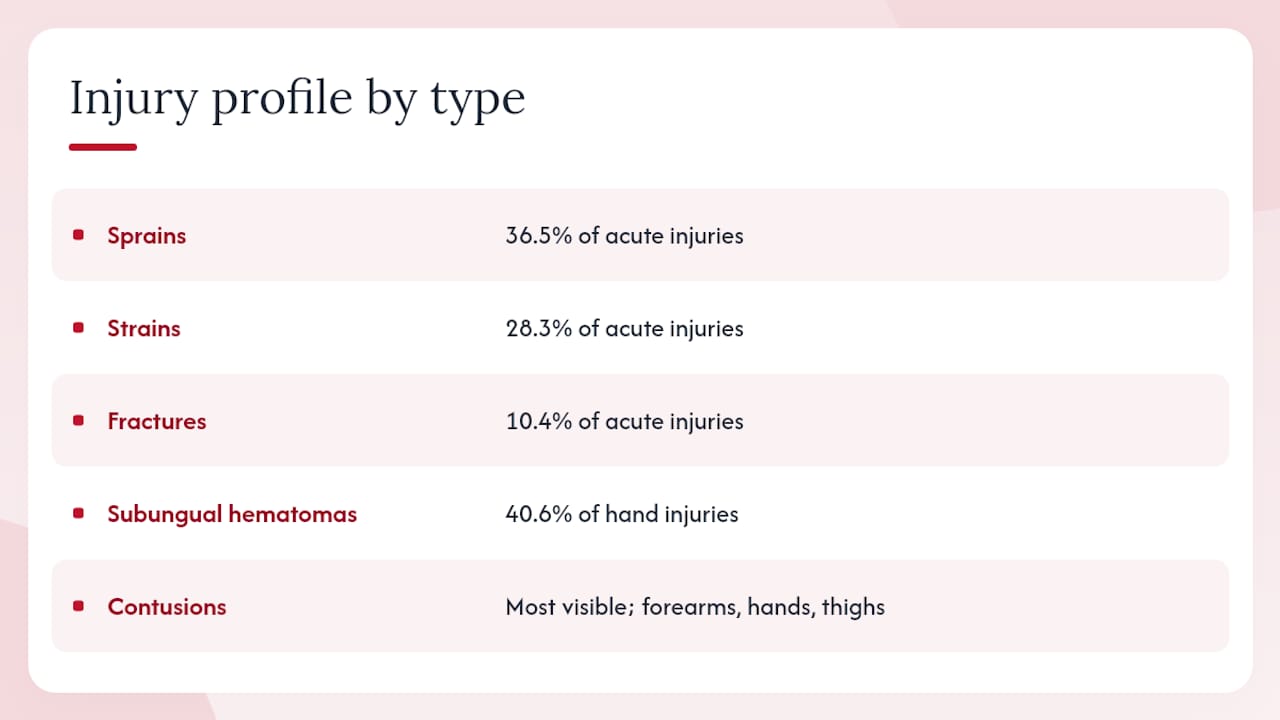
Contusions and bruises are the most visible everyday outcome of sword contact. They typically appear on the forearms, hands, and thighs, and most resolve within a few days. Persistent bruising over a joint, however, warrants closer attention.
Sprains and strains affect ligaments and muscles respectively. In sword training, the wrist, elbow, and shoulder are the most common sites, usually from repetitive impact, poor grip mechanics, or a sudden awkward parry. Tendinopathy (chronic tendon irritation) develops when these loads accumulate without adequate rest.
Fractures and dislocations are less common but serious. Finger fractures from direct blade contact and thumb dislocations from grip failure are the most frequently reported. Any suspected fracture requires immobilization and medical evaluation, not a “walk it off” approach.
Subungual hematomas deserve special mention because they are so specific to this discipline. A direct hit to the fingertip drives blood under the nail, causing intense pressure and pain. Heavy-duty gloves are the primary defense.
Lacerations occur when blades are sharp, tips fail, or protective gear gaps. Even training swords with worn or missing tips can produce cuts on exposed skin.
Crushing and jamming injuries happen when fingers are caught between blade and guard, or when a partner’s weapon lands on an unprotected hand. These can range from minor bruising to fractures.
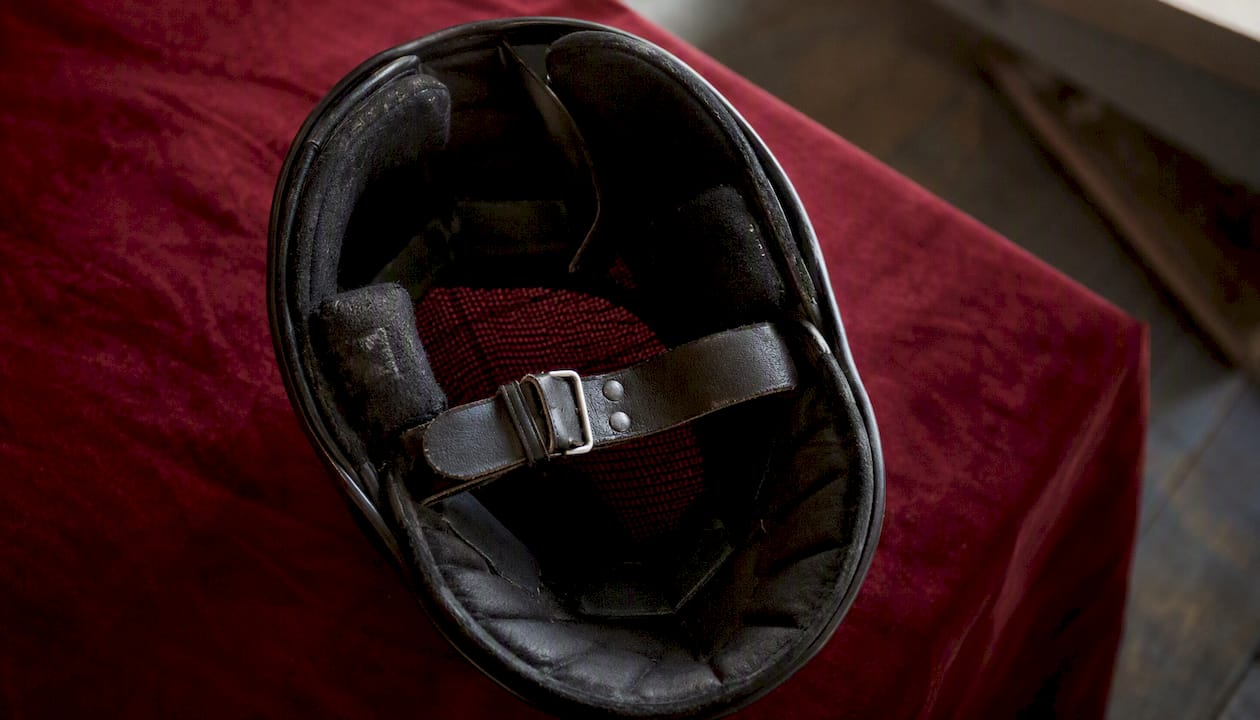
Concussions and head impacts are the highest-stakes injury category. Signs include disorientation, headache, nausea, vomiting, or any loss of consciousness. A mask that fits poorly or has degraded padding transfers far more force to the skull than one properly maintained.
Why these injuries happen: mechanics, load, equipment, and mindset
Most sword training injuries are not accidents in the random sense. They follow predictable patterns rooted in technique faults, load mismanagement, equipment failure, and a psychological dynamic that deserves more attention than it usually gets.
Mechanical causes are the most correctable. A hyperextended wrist during a thrust loads the carpal ligaments far beyond their design tolerance. A stiff-arm strike, where the elbow locks out on impact, transfers shock directly into the joint rather than absorbing it through the shoulder and core. Poor footwork puts the knee in a valgus (inward-collapsing) position under load. Wrist and elbow problems from poor technique, and tripping on loose training uniforms like hakama-style pants, are well-documented at the club level. These are not beginner mistakes exclusively; experienced practitioners develop habitual faults that go uncorrected for years.
Training load mistakes follow a familiar pattern across combat sports. Sudden increases in session frequency, duration, or sparring intensity without a corresponding adaptation period are a primary driver of overuse injuries. Military training data confirms that bone stress injuries and chronic joint pain are direct outcomes of poor load management, a finding that maps directly onto sword training programs that prioritize sparring volume over structured recovery.
Equipment causes include using a weapon that is too heavy for your current grip strength and conditioning, worn or missing blade tips, ill-fitting gloves that allow fingers to shift on impact, and masks with degraded padding. A glove that fits loosely is often worse than no glove at all because it creates a false sense of security while still allowing the finger to move into a dangerous position.
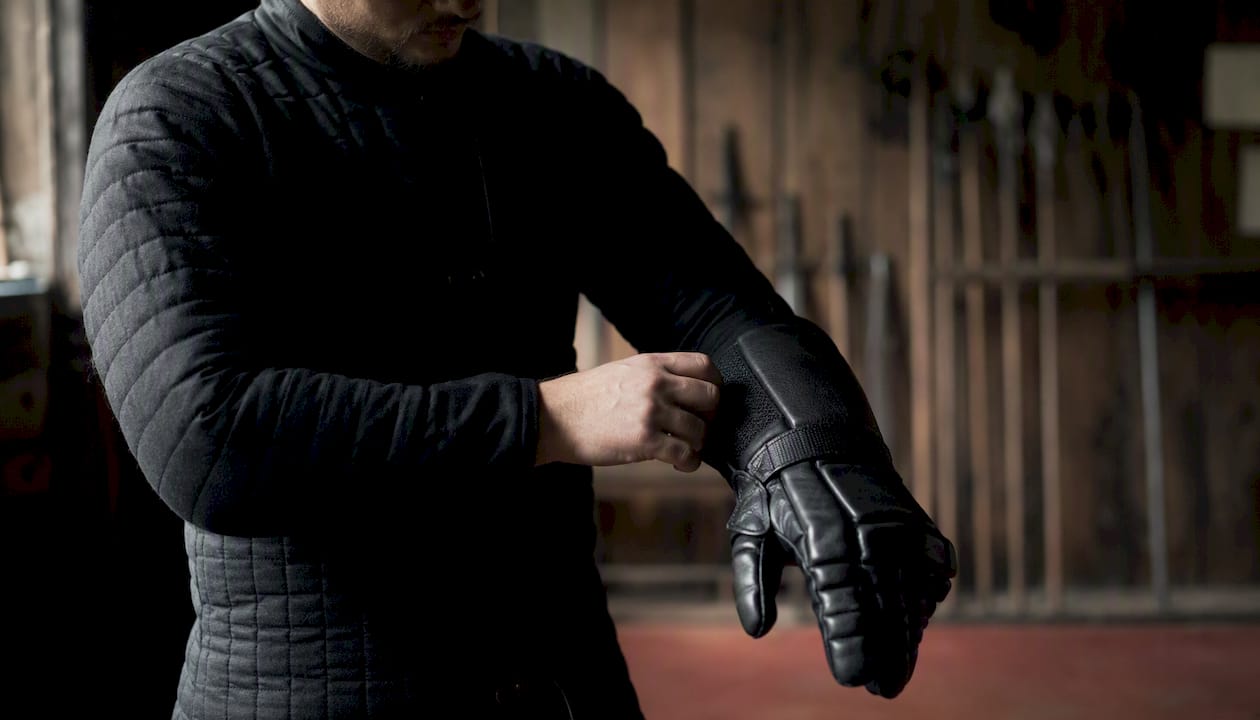
Risk compensation is the behavioral driver that practitioners rarely discuss openly. When you strap on a full set of HEMA gear, the psychological sense of protection can subtly increase the intensity and recklessness of your attacks. Research on the HEMA injury profile notes this dynamic explicitly: heavier PPE can lead to riskier behavior rather than safer practice. Instructors who enforce technique-focused rules and controlled contact are the primary check on this tendency.
Pro Tip: Delayed-onset muscle soreness (DOMS) typically peaks 24–48 hours after training and feels like diffuse muscular fatigue. Joint pain, sharp pain during movement, or pain that worsens over successive sessions is a different signal entirely. The first means you worked hard; the second means something in your mechanics or load needs to change before you train again.
PPE and equipment: what to buy, how to fit it, and when to retire it
Protective gear is a minimum standard, not a guarantee. The BFHS guidance on safety equipment in historical fencing is explicit: equipment can fail, and it is never a substitute for safe technique and instructor oversight. With that framing in mind, here is what the gear actually needs to do.
Tip selection: thermoplastic vs. rubber
This is one area where testing data has produced a clear answer. Safety Tips Phase 1 testing found that thermoplastic (hard plastic) tips significantly reduced puncture risk and did not increase mask-push force, while rubber tips performed poorly and increased the risk of pushing on masks. For tip-reliant weapons like rapiers and longswords, thermoplastic tips are the practical choice. Rolled or properly buttoned tips on blunted training swords remain standard for many HEMA disciplines, but they require regular inspection for deformation.
Pro Tip: To test a tip before training, press it firmly against your palm. A properly domed or thermoplastic tip should distribute pressure broadly. A tip that concentrates force to a point, or that wobbles and shifts, needs to be replaced before that session begins.
Equipment maintenance schedule
| Frequency | What to check |
|---|---|
| Before every session | Tip integrity, mask strap tension, glove seam condition, blade for burs or cracks |
| Weekly | Mask padding compression, gorget attachment, jacket seam and padding integrity |
| Monthly | Full structural check: mask frame, glove palm padding thickness, strap hardware, blade flex and tip security |
| As needed | Retire any item showing cracked frame, compressed padding, frayed load-bearing straps, or a blade with a bur that cannot be safely filed |
Routine kit checks for mask straps, glove seam integrity, and blade burs catch most equipment-related incidents before they cause injury. The five minutes before a session is the cheapest insurance available. For a deeper look at how blade care connects to safety, our guide on sword maintenance and safety covers the full routine.
Technique, coaching, and training design that actually prevent injuries
Equipment protects you from the consequences of an error. Coaching and training design prevent the error from happening.
Immediate response and rehabilitation when an injury occurs
Red flags requiring urgent care
Seek emergency medical care immediately if you observe: loss of consciousness (even briefly), disorientation or confusion after a head impact, vomiting following a blow to the head, an open fracture (bone visible through skin), severe limb deformity, uncontrolled bleeding after five minutes of direct pressure, or signs of compartment syndrome (intense pain, tightness, numbness, or pallor in a limb after a crushing injury). Do not drive yourself. Call 911 or have someone take you to an emergency department.
Concussion protocol: any suspected concussion means no return to training that day, regardless of how the practitioner feels twenty minutes later. Symptoms can be delayed. A physician should clear the practitioner before any contact training resumes.
Return-to-play for sprains and strains
Recognizing pain as an early-warning sign and resting 1–2 days for acute overload prevents progression to chronic injury. Beyond that initial rest, a graduated return works as follows: begin with pain-free range-of-motion exercises, progress to resistance work, then to solo drilling, then to controlled partner work, and finally to full sparring only when the injured area is fully pain-free under load. A physiotherapist referral is appropriate for any sprain that does not show clear improvement within two weeks, or for any injury involving joint instability.
For the mental side of recovery, which is often underestimated, the mental wellness tips for injury healing guide addresses rehab adherence and the psychological challenges of returning to contact training.
Choosing training swords and tips: a practical selection guide
The single most common equipment-related mistake in sword training is using a weapon that is too heavy for your current level of conditioning and skill. A heavier sword does not make you train harder in a useful sense; it makes your mechanics collapse under load, which teaches bad habits and accelerates joint wear.
Buyer checklist for a training sword
- Flexibility: a training sword should have enough flex to absorb impact safely. A rigid blade transfers all force directly to the hands and wrists. Our article on blade flexibility and sparring safety explains this in detail.
Progression path by skill and conditioning level
| Stage | Sword type | Key marker to progress |
|---|---|---|
| Beginner | Light training sword (blunted, flexible, appropriate tip) | Consistent mechanics under slow-speed drilling |
| Intermediate | Mid-weight training sword | Pain-free training, solid footwork, controlled sparring |
| Advanced | Full-weight sparring sword | Demonstrated conditioning, instructor sign-off |
| Sharp fencing | Only with experienced partner, strict protocols | Years of experience, formal skills assessment |
Sharp fencing sits in its own category. A practical guide to sharp fencing recommends a 30–40 cm safety buffer between practitioners, walking-pace execution, and a formal skills assessment before any sharp-blade work begins. This is not a milestone for most practitioners; it is a specialized practice with its own risk profile.
For readers choosing their first training sword, our beginner sword selection guide and martial arts weapons guide for beginners both walk through the weight-and-discipline matching process in practical terms.
What current HEMA research and safety testing shows
Two bodies of evidence stand out as directly relevant to practitioners making decisions about gear and training design.
The HEMA longsword injury profile study is the most cited quantitative source in this space. Its key findings:
- Acute injuries concentrate overwhelmingly at the hand, wrist, and fingers.
- Sprains account for 36.5% of acute injuries, strains for 28.3%, and fractures for 10.4%; subungual hematomas represent 40.6% of hand injuries specifically.
- Chronic injuries cluster at the shoulder, elbow, knee, and back, consistent with repetitive loading without adequate recovery.
- Equipment failure points most frequently cited by practitioners: heavy-duty gloves and masks are common points of equipment complaints.
- Risk compensation behavior was identified as a contributing factor: heavier PPE correlated with more aggressive training behavior in some practitioners.
Safety Tips Phase 1 testing addressed a specific and practical question: which tip type is safer for thrust-capable weapons?
- Thermoplastic tips reduced puncture risk in testing and did not increase the force transferred to the mask during a thrust.
- Rubber tips performed poorly on both measures and are not recommended for sparring use.
- The practical implication: for rapier and longsword work, thermoplastic tips are a low-cost, evidence-backed upgrade.
What both bodies of research agree on: PPE is a floor, not a ceiling. Always wearing a mask and hand protection for free-sparring, combined with pre-session kit checks and a clear training area, is the baseline that clubs should enforce without exception. Protective equipment reduces the severity of injuries when they occur; it does not prevent them when technique, load management, and training culture are poor.
Key Takeaways
Preventing sword training injuries requires fitted PPE, sound mechanics, and progressive loading, with immediate reporting and medical referral when pain or injury signals appear.
| Point | Details |
|---|---|
| Hands and wrists are highest risk | Acute injuries concentrate at fingers, wrist, and thumb; heavy-duty HEMA gloves are the primary defense. |
| Thermoplastic tips outperform rubber | Safety testing shows thermoplastic tips reduce puncture risk without increasing mask-push force. |
| Mechanics prevent more injuries than gear | A coach who enforces correct technique reduces injury risk more than any single piece of equipment. |
| Progressive loading is non-negotiable | Start with a lighter training sword and increase weight only when mechanics and conditioning support it. |
| Moonswords offers training-appropriate options | Moonswords carries training-capable swords across weight ranges, with guidance on matching blade weight and balance to your current skill level. |
This article is general educational information, not medical or professional advice. Consult a physician or qualified physiotherapist for any injury, and confirm current safety standards with your club instructor or a recognized governing body.
The detail most practitioners overlook
There is a tendency in sword training communities to treat injury prevention as a gear problem. Buy better gloves, upgrade the mask, fit a thermoplastic tip, and the risk is managed. The research does not support that framing.
The HEMA injury profile data is instructive precisely because it shows that gloves and masks are the most frequently cited equipment failure points, not because the gear is inherently bad, but because practitioners rely on it too heavily and inspect it too rarely. A glove with compressed padding that has never been replaced is worse than a new budget glove, because it carries the psychological weight of “good gear” without the protection.
The more uncomfortable truth is that most chronic injuries in sword training trace back to mechanics that were never corrected, loads that were never managed, and pain signals that were ignored because stopping felt like weakness. A practitioner who trains through wrist pain for six months does not build toughness; they build a tendinopathy that will sideline them for a year.
We think the most productive shift in how clubs approach this is to treat technique enforcement as the primary safety intervention, and PPE as the backup. That means instructors who stop a drill when mechanics collapse, not just when someone gets hurt. It means rest days that are scheduled, not improvised. And it means a culture where reporting pain early is respected, not stigmatized.
Training-ready swords and gear guidance from Moonswords
Practitioners who train seriously need swords built to handle repeated use, not display pieces that look the part but flex or loosen under load. Moonswords offers a range of training-capable swords across weight classes, from entry-level options suited to beginners building mechanics, to functional katanas under $300 that balance durability and appropriate weight for progressive training.
If you are unsure which weight or balance point suits your current conditioning level, our customer support team can help you match a sword to your training stage. Every blade we carry comes with full specifications on weight, balance point, and construction, so you are not guessing when it matters. Browse the collection and reach out with your discipline and experience level for a direct recommendation.
This is a product recommendation, not medical advice. Always train under qualified instruction and wear appropriate PPE.
Useful sources and further reading
- Injury profile of Longsword fencing in Historical European Martial Arts
- Guidance on the use of safety equipment in Historical Fencing and Western Martial Arts
- Recognising the early warning signs of pain for HEMA practitioners — Keith Farrell
- Common sword training injuries and how to prevent them
FAQ
What are the most common injuries in sword training?
Sprains, strains, contusions, and subungual hematomas (nail-bed bruising) are the most frequently reported injuries, concentrated at the hands, fingers, wrists, and shoulders. HEMA longsword research shows sprains alone account for 36.5% of acute injuries.
Which muscles should you train for sword fighting?
Prioritize the rotator cuff, forearm flexors and extensors, grip strength, core stabilizers, and hip and leg muscles. These are the primary load-bearing groups in sword mechanics, and conditioning them reduces both acute and chronic injury risk.
What are the five most effective ways to prevent sword training injuries?
Wear properly fitted PPE (mask, HEMA gloves, jacket) every session; train under a coach who enforces correct mechanics; progress weapon weight gradually; warm up with discipline-specific mobility work; and report pain early rather than training through it.
How long should you rest a sprained wrist from sword training?
Rest 1–2 days for mild acute overload, then begin pain-free range-of-motion work before returning to drilling. Any sprain that does not improve clearly within two weeks, or that involves joint instability, warrants a physiotherapy referral before resuming contact training.
Does more protective gear mean fewer injuries in sword training?
Not automatically. Research on HEMA injury profiles identifies risk compensation as a real factor: heavier PPE can lead some practitioners to train more aggressively, which offsets the protective benefit. Gear reduces injury severity when contact occurs; it does not replace sound technique and controlled training intensity.