

Oil your sword blade immediately after every practice session. That single habit does more to prevent rust than any storage solution, display case, or occasional deep clean. Sweat and skin oils contain corrosive salts that can begin attacking steel within hours of contact, settling into micro-scratches where oxidation takes hold fast. The fix is straightforward: wipe the blade clean, then apply a thin, even film of acid-free mineral oil before you put the sword away.
Here is what that looks like in practice:
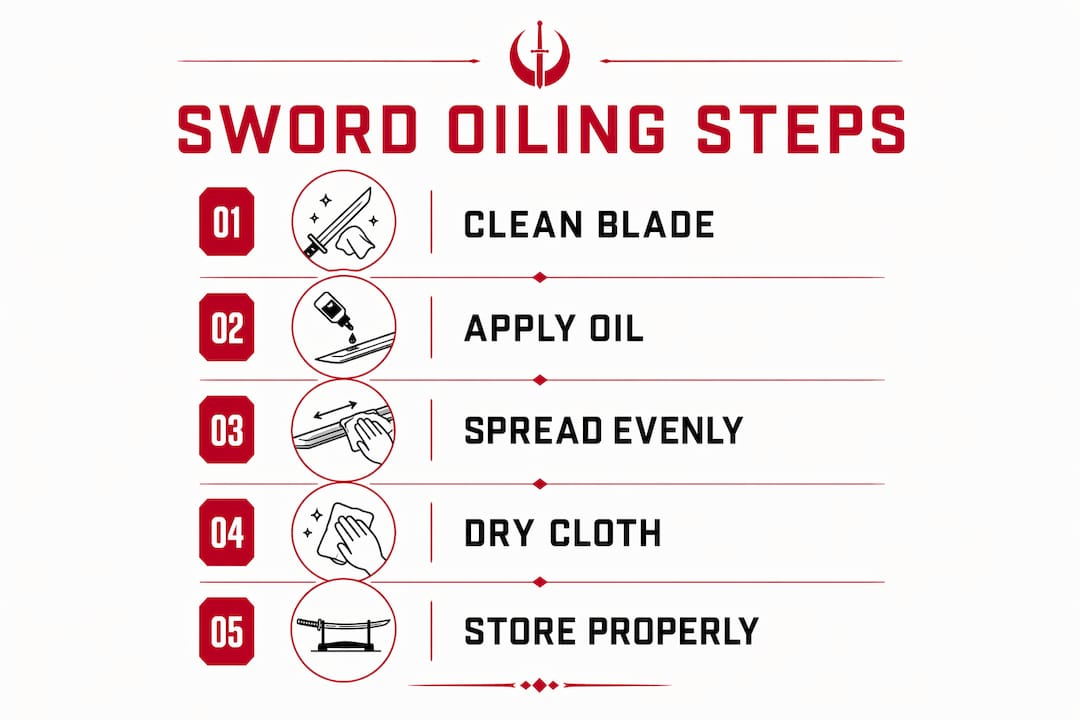
- Wipe the entire blade with a dry, lint-free microfiber cloth to remove sweat, fingerprints, and moisture.
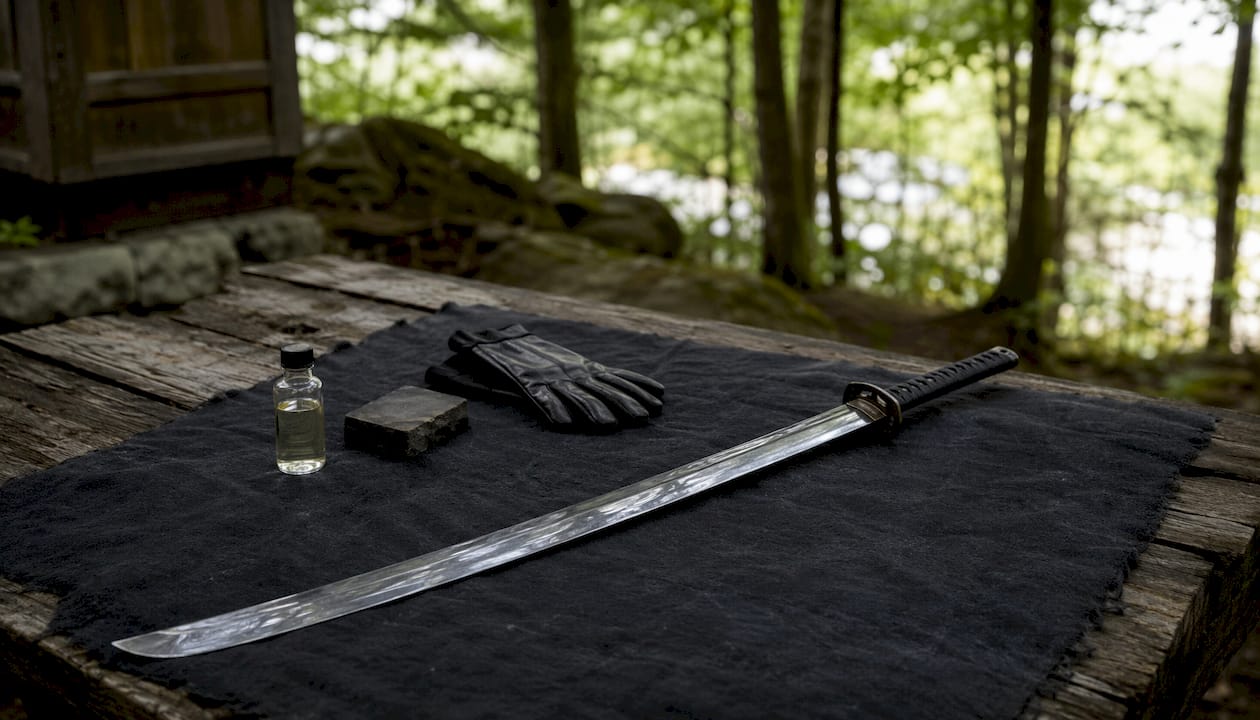
- Apply a small amount of oil (Ballistol, Choji oil, or sewing machine oil) to a clean cloth, not directly onto the blade.
- Spread the oil in long, even strokes from the base toward the tip, following the blade’s length.
- Aim for a light sheen, not a greasy coat. Avoid visible pooling of oil; the coating should be thin and even.
- Wipe down the guard (tsuba), habaki (blade collar), and any metal fittings to prevent corrosion on those components too.
- Store the sword unsheathed or in a breathable bag, never sealed in a leather scabbard.
This routine takes under five minutes. Done consistently, it is the most effective rust prevention method available to any practitioner.
Why you need to clean and oil the blade right after training
Sweat is the primary enemy of carbon steel. It is not just moisture; it is a saline solution that starts oxidation immediately when it contacts bare steel. The salts penetrate micro-scratches left by sparring contact, and once oxidation begins in those grooves, surface wiping alone cannot reverse it.
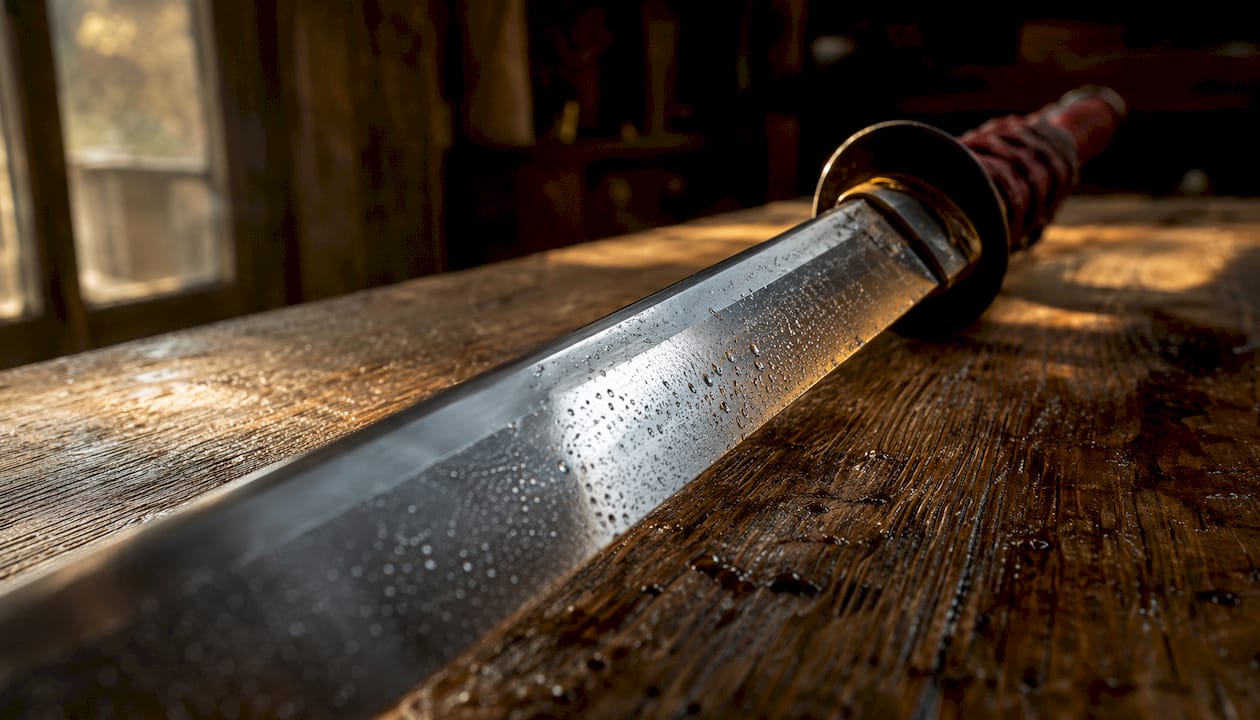
HEMA practitioners and Nihonto collectors share the same core consensus: missed oiling after handling causes more rust than poor storage. A sword sitting clean and dry in a rack will outlast one wiped but left unoiled after a sweaty session. The discipline of post-practice care is what separates blades that last decades from those that pit and corrode within a few years of regular use.
Rust does not wait. Even a single day of salt residue sitting on the metal can leave visible marks, according to fencing blade maintenance experts at Prieur USA. The oxidation process accelerates in humid training environments, where ambient moisture compounds what sweat leaves behind. Developing a consistent post-practice oiling routine is not optional for anyone training regularly with a carbon steel blade.
Step-by-step guide to cleaning and oiling your sword after training
Follow these steps in order every time you finish a session. Skipping steps or changing the sequence reduces effectiveness.
-
Unsheathe carefully and lay the blade flat. Place it on a clean, padded surface with the edge facing away from you. Never rest a bare blade on an unprotected surface.
-
Dry-wipe the entire blade. Using a dry microfiber cloth, wipe from the spine toward the edge in long, smooth strokes running from base to tip. This removes sweat, fingerprints, and loose particles. Avoid paper towels entirely; they leave microscopic scratches on polished steel.
-
Inspect the blade under good light. Hold it at an angle and look for pitting, rust spots, or micro-chips along the edge. Pay close attention to the area near the habaki, where moisture tends to collect and rust develops unseen.
-
Address any light rust before oiling. Apply a drop of oil to the affected spot, let it soak for a few minutes, then use a rust eraser block (such as a Garryflex extra-fine block) with gentle, circular motion. Never use a rust eraser dry; the block must be lubricated with oil or water to avoid damaging the blade finish.
-
Apply oil to the cloth, not the blade. Put 2–3 drops of your chosen oil onto a clean, lint-free microfiber cloth. Spread it across the cloth first so the application stays controlled and even.
-
Oil the blade in long, even strokes. Work from the ricasso (the unsharpened section near the guard) to the tip, covering the full surface on both sides and the spine. The goal is a thin, uniform film. The oil layer should be thin enough that it does not produce a mirror-like reflection on the blade.
-
Wipe fittings and guard. Use a lightly oiled cloth on the tsuba, habaki, and pommel. Metal fittings corrode too, and they are easy to overlook after a long session.
-
Remove excess oil. Run a fresh, dry cloth lightly over the blade to pick up any visible pooling. The final coat should be nearly invisible, with just a subtle sheen.
-
Store correctly. Do not resheathe immediately into a leather or wood scabbard. More on this in the storage section below.
Pro Tip: Apply oil to the cloth using an eye dropper for precise control. This prevents accidental over-oiling and keeps the application consistent every session.
What are the best oils to use for sword blade maintenance?
The oil you choose matters as much as the habit itself. Acid-free, mineral-based oils that displace moisture and resist evaporation are the standard recommendation across HEMA practitioners, Nihonto collectors, and sword conservators.
| Oil | Type | Best for | Notes |
|---|---|---|---|
| Ballistol | Mineral-based, multipurpose | All steel swords, HEMA blades | Displaces moisture, slow evaporation, widely available |
| Choji oil | Mineral oil with clove scent | Japanese swords (katana, wakizashi) | Traditional choice; used by Nihonto collectors for centuries |
| 3-in-1 oil | Light machine oil | General maintenance | Acceptable secondary option; not specialized for blades |
| Sewing machine oil | Mineral oil | Budget-friendly maintenance | Reliable and easy to find; works well for regular upkeep |
| Renaissance Wax | Microcrystalline wax | Display swords, long-term storage | Forms a hard protective barrier; used by museum conservators |
| WD-40 | Water-displacing solvent | Emergency rust loosening only | Evaporates quickly; leaves steel vulnerable; not a long-term protectant |
| Cooking oils | Organic fats | Not recommended | Go rancid over time and become acidic, accelerating corrosion |
Ballistol was originally developed for firearms care, and it translates exceptionally well to sword steel. It displaces moisture, protects against corrosion, and does not evaporate within a day or two the way WD-40 does. For practitioners who train frequently, it is the most practical choice.
Choji oil is the traditional option for Japanese blades. It has been used on katana and wakizashi for centuries, and Nihonto experts continue to recommend it for maintaining the hamon (temper line) and hada (grain pattern) without leaving a reactive residue. The faint clove scent is a hallmark of authentic Japanese sword care.
Renaissance Wax deserves a separate mention for display pieces. Developed by the British Museum for artifact conservation, it forms a hard, dry barrier that protects against dust and humidity without the mess of liquid oil. For a sword kept on display, wax is often the better long-term choice over repeated oil applications.
WD-40 comes up constantly in online discussions, and the answer from experienced practitioners is consistent: it works in a pinch to loosen surface rust, but it is a water-displacing solvent, not a protective oil. It evaporates quickly and leaves the steel under-protected shortly after application.
Common mistakes that damage your blade during post-practice care
Most blade damage from maintenance comes from a handful of repeated errors. Knowing them is half the fix.
-
Touching the blade with bare hands. Skin oils and salts transfer immediately on contact. Always handle the blade with a clean cloth or cotton gloves, especially after oiling.
-
Using too much oil. Excess oil migrates into leather grips, wooden handles, and scabbard linings, where it accelerates rot. It also attracts dust and grime, which then abrades the surface. A nearly invisible film is the target.
-
Reaching for WD-40 or cooking oil. WD-40 evaporates and leaves steel exposed. Cooking oils go rancid and become acidic over time, doing more harm than no oil at all.
-
Wiping with paper towels. Paper fibers are abrasive enough to leave micro-scratches on polished steel. Use lint-free microfiber or high-quality soft cotton only.
-
Leaving the sword sheathed after practice. Leather and wood scabbards trap moisture against the blade. A sword left sheathed and damp after training is being actively corroded, not protected.
-
Neglecting the habaki and guard. These areas collect moisture and are easy to skip. Rust that forms under the habaki is invisible until it has already done serious damage.
-
Over-cleaning between sessions. Wiping aggressively after every handling with cleaning products strips the protective oil layer and introduces micro-abrasions. A quick visual check and a light dry wipe is usually enough between scheduled maintenance sessions.
-
Using a dry rust eraser. Garryflex blocks and similar rust erasers must always be used wet with oil or water. Dry application on polished steel damages the finish and can create uneven surfaces.
Pro Tip: Keep your maintenance kit next to your training bag, not stored away. When the tools are immediately accessible, the post-practice routine actually happens.
How to store your sword correctly after oiling
Storage is where many practitioners undo good maintenance work. The right environment after oiling preserves the protective film you just applied; the wrong one strips it or traps moisture against the blade.
Do:
- Store in a cool, dry environment with low humidity. Climate-controlled spaces are ideal for carbon steel blades.
- Use a padded sword rack or a breathable sword bag made from non-acidic materials.
- Keep a thin coat of oil or Renaissance Wax on the blade before any extended storage period.
- Check the blade every 6–12 months, including under the habaki, where moisture collects and rust develops out of sight.
- Wrap the blade in a clean, dry cloth if storing without a rack.
Don’t:
- Store the sword sheathed in a leather or wood scabbard long-term. Untreated leather traps moisture against the blade and encourages rust rather than preventing it.
- Leave the sword in a closed training bag after practice. Bags trap heat and humidity.
- Store near a bathroom, damp basement, or any area with fluctuating moisture levels.
- Assume a freshly oiled blade needs no attention for months. In humid climates, re-oil more frequently than the standard monthly schedule.
- Store horizontally if the blade has a curve; edge-up vertical storage is the traditional and structurally sound approach for katana.
For long-term storage, a light coat of Renaissance Wax over a clean, dry blade, wrapped in a clean cloth in a cool and dry place, will serve the steel far better than any scabbard. Pooley Sword’s conservators recommend checking stored swords every few months, cleaning with a dry microfiber cloth, and reapplying the protective layer to maintain the barrier.
What HEMA and Nihonto experts say about sword care discipline
The most consistent message from experienced practitioners across both HEMA and Japanese sword traditions is that rust is a maintenance failure, not a storage failure. Swords rust because their owners skip the post-handling oil, not because the storage room was imperfect.
That framing matters. A sword is a tool that reflects the care of its user. Practitioners who treat post-practice oiling as part of the training ritual, as inseparable from bowing out or cleaning up the dojo, maintain blades that last decades without serious corrosion. Those who treat it as optional find themselves dealing with pitting and rust spots that require professional intervention.
The HEMA community specifically emphasizes the habaki as a blind spot. Moisture collects under the blade collar during training and is invisible at the surface. Thorough inspection and cleaning in that area every 6–12 months prevents the kind of deep rust that no amount of surface oiling can address after the fact.
Nihonto experts add another layer: the tools matter as much as the habit. A rust eraser used dry, or a cloth that leaves lint, can introduce damage during the very act of maintenance. Consistent, light-touch care with the right materials is always better than infrequent deep-cleaning sessions that carry a higher risk of accidental damage. For anyone maintaining a high-carbon steel blade, that principle applies whether the sword is a centuries-old Nihonto or a modern hand-forged katana.
Moonswords: blades worth maintaining

Every sword in the Moonswords collection is forged to be used and cared for, not left behind glass. Our master artisans use clay tempering, full tang construction, and high-carbon steel to build blades that reward consistent maintenance with decades of performance. Whether you train with a hand-forged katana or carry a Chinese dao into sparring, the post-practice care routine covered here applies directly to keeping that blade in peak condition.
Explore the full Moonswords collection at moonswords.com and find the blade that deserves this level of care.
Key Takeaways
Oiling your sword blade immediately after every practice session, using an acid-free mineral oil applied with a lint-free cloth, is the single most effective method for preventing rust and extending blade life.
| Point | Details |
|---|---|
| Oil immediately after practice | Sweat salts begin corroding steel within hours; oiling right after training neutralizes them before damage sets in. |
| Choose the right oil | Ballistol and Choji oil are the top recommendations; WD-40 and cooking oils cause more harm than good over time. |
| Apply a thin, even film | Two to three drops on a cloth is enough; visible pooling or grease means you have used too much. |
| Clean under the habaki | Moisture collects under the blade collar and causes hidden rust; inspect and clean this area every 6–12 months. |
| Store unsheathed | Leather and wood scabbards trap moisture; store blades in breathable bags or on padded racks in dry environments. |
FAQ
How often should you oil your sword?
Oil your sword after every practice session or handling, and at minimum once a month if it has not been used. In humid climates, oil more frequently to compensate for ambient moisture.
What is the best oil to use on a sword blade?
Ballistol and Choji oil are the most widely recommended options. Both are acid-free, mineral-based, and slow to evaporate, providing reliable corrosion protection for carbon steel blades.
Can you use WD-40 to oil a sword?
WD-40 can loosen light surface rust in a pinch, but it is not a protective oil. It evaporates quickly and leaves the steel under-protected, making it a poor choice for regular post-practice maintenance.
Should you oil a katana after every use?
Yes. Katana blades are typically high-carbon steel, which is especially prone to rust from sweat and skin contact. Oiling with Choji oil or Ballistol after every session is the standard practice among Nihonto collectors and HEMA practitioners alike.
What happens if you skip oiling after practice?
Sweat salts settle into micro-scratches on the blade and begin oxidizing the steel, sometimes within a single day. Skipping post-practice oiling consistently leads to pitting, rust spots, and eventually damage that requires professional restoration.