

A real hamon is a structural temper line, not a surface decoration, and you can catch most fakes with your own eyes before you ever send a blade to a metallurgist. Rotate the blade under grazing light: authentic hamon shifts intensity and shimmer as the angle changes, while etched or painted lines stay flat. Pull out a loupe and look for nioi, the sparkly granular texture that only differential clay tempering produces. If a seller won’t give you a rotating video or unedited close-up photos, treat that as a warning sign, not a technicality, especially when considering collectibles like the Kenshin Samurai X Resin Figurine by Nomnom Figures.
TL;DR:
- Authentic hamon displays a three-dimensional, shifting glow under grazing light, unlike flat, etched lines that stay static regardless of angle.
- Genuine nioi appears as a sparkly, granular texture made of tiny martensite crystals, which fake hamon cannot replicate or produce under magnification.
- Proper verification involves testing the blade’s response to light, inspecting the boshi’s natural flow, and requesting unedited videos and provenance details from the seller.
- Most fake hamon results from acid etching, sandblasting, wire brushing, or flame hardening, each leaving distinctive superficial or structural signatures.
- Buyers should focus on documented forge records and macro photos showing real grain textures, as high price or appearance alone does not guarantee authenticity.
Table of Contents
- What Real Hamon Vs Fake Comes Down To: Clay Tempering Explained
- Visual Features That Separate Genuine Hamon From a Copy
- Common Fake Hamon Techniques and How to Spot Them
- Your Step-by-Step Hamon Authenticity Test
- What Photos Hide When You’re Buying a Katana Online
- How Moonswords Verifies Every Clay-Tempered Hamon
- The Quick Verdict on Real Hamon vs Fake
- Myths About Hamon That Cost Collectors Money
- Why This Distinction Still Matters to Me
- See Moonswords’ Verified Clay-Tempered Katanas
- Sources
- FAQ
What Real Hamon Vs Fake Comes Down To: Clay Tempering Explained
A hamon marks the boundary where a swordsmith deliberately created two different types of steel in one blade. The edge needs to be hard enough to hold a keen edge; the spine needs to flex without snapping. Differential hardening solves both problems at once, and it’s the reason a real hamon vs fake distinction) even exists as a topic worth studying.
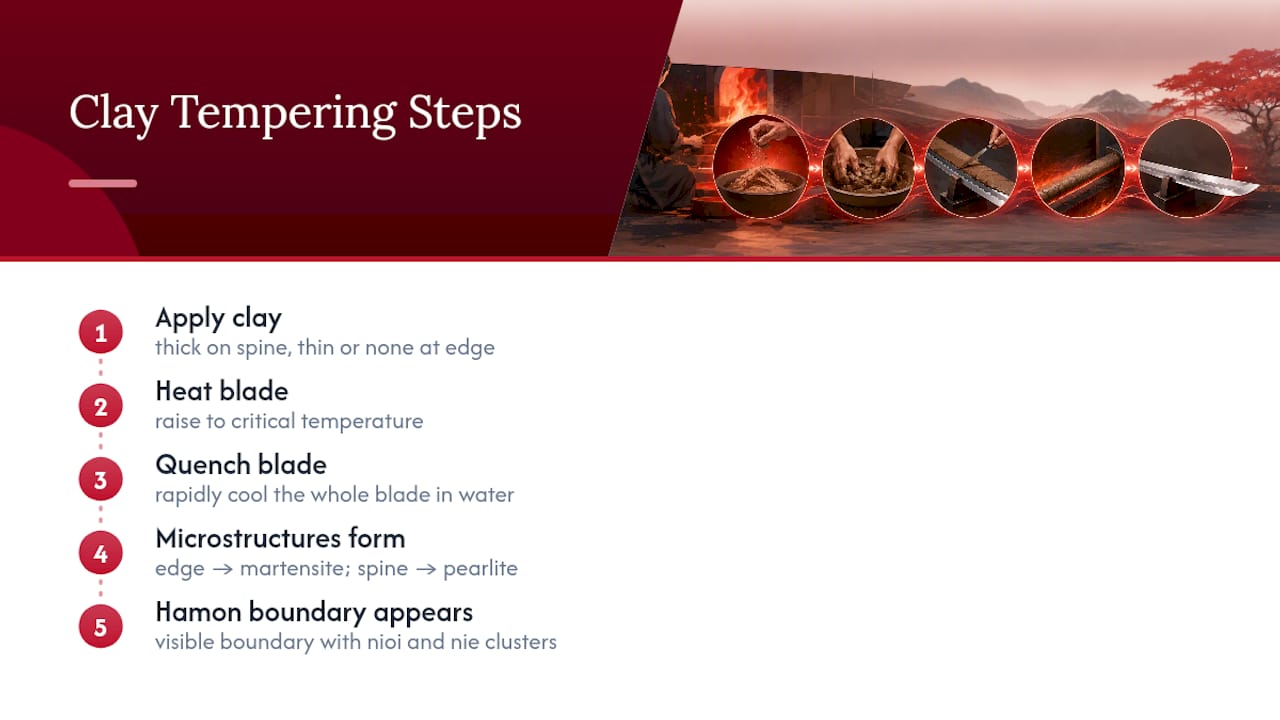
The traditional process starts with clay. The smith coats the spine and sides of the blade in a thick layer, leaves the edge bare or lightly coated, then heats the whole blade to a critical temperature before quenching it in water. The thin clay over the edge lets that section cool fast, forming martensite, a hard, brittle crystal structure. The thick clay over the spine slows the cooling there, producing softer pearlite or a mix of structures that stay flexible.
That boundary between martensite and pearlite is the hamon. Within it, you’ll find nioi and nie, clusters of martensite crystals that catch light differently than the surrounding steel. Martensite’s grain structure forms during the quench itself, at the molecular level, which is exactly why acid, sandblasting, or paint can’t replicate it. Those techniques change the surface. They don’t touch what’s underneath.
Visual Features That Separate Genuine Hamon From a Copy
The strongest tell is depth. A real hamon looks three-dimensional, almost like it’s floating slightly above or below the polished surface, and that effect changes as you tilt the blade. Etched hamon stays flat no matter how you angle it, because there’s no actual grain structure creating the visual depth. It’s ink on steel, not steel on steel.
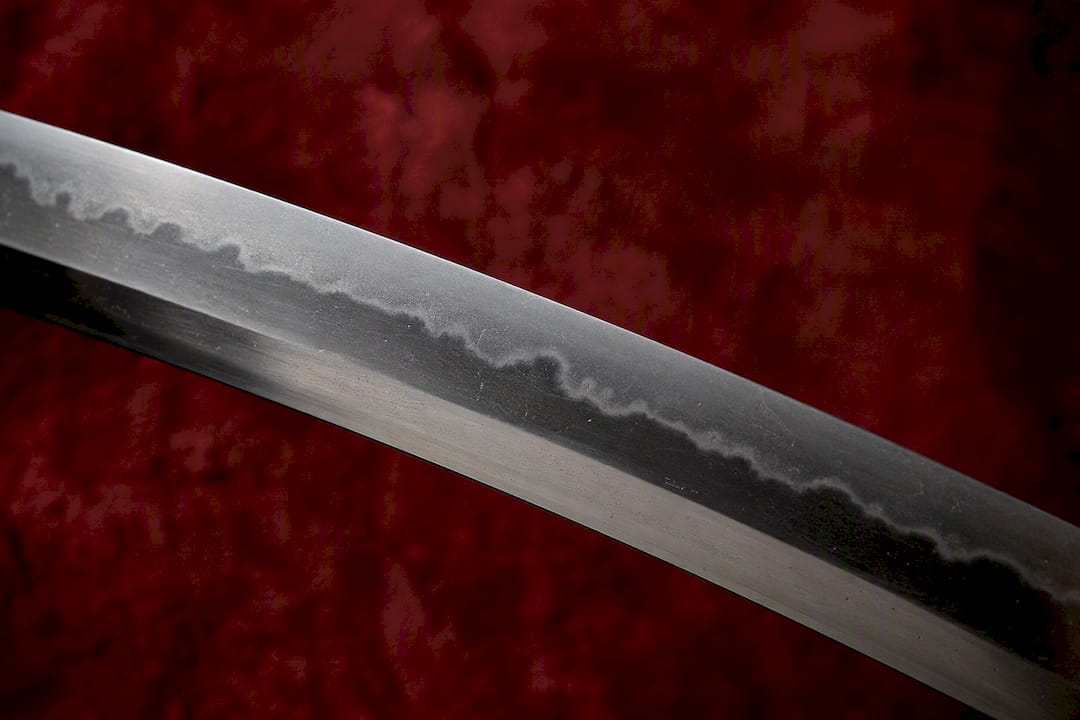
Nioi is the second major giveaway. Under a loupe, authentic nioi looks like a fine, sparkly, almost granular texture running along the temper line, made up of countless tiny martensite crystals catching light at slightly different angles. Fake hamon under the same magnification looks smooth or uniformly rough, with none of that crystalline sparkle. Community-tested inspection guides consistently flag this as the single most reliable non-destructive check a buyer can do without special equipment.
A few more cues worth checking before you commit to a blade:
- Organic irregularity: real hamon transitions have natural variation, waves, and asymmetry; fakes often look mechanically repeated.
- Boshi behavior: the hamon pattern at the tip (the boshi) should flow naturally into the tip curve, not stop abruptly or look pasted on.
- Polish interaction: hadori polishing (the white powder finish some traditional polishers use) should reveal the existing hamon, not manufacture one that wasn’t there.
- Granularity under raking light: you should see texture, not just a color change.
It costs less than a good sharpening stone and it’s the single fastest way to separate real hamon from fake without touching the blade.*
Common Fake Hamon Techniques and How to Spot Them
Most fake hamon on the market comes from one of four processes, and each leaves its own signature if you know where to look.
- Acid etching produces a flat, high-contrast line with no depth and no nioi under a loupe. It’s also strangely consistent. If a seller has five “different” blades with an identical wavy pattern, that’s an etching template, not five different tempers.
- Sand or media blasting creates a matte, uniformly textured band that looks more like frosted glass than crystallized steel. The transition edges tend to be too clean and evenly spaced.
- Wire brushing and painting leave physical evidence: brush striations running one direction, or pigment pooling in the grain lines and grooves near the edge.
- Flame hardening actually does harden steel locally, but it produces a soft, blurry gradient rather than the sharp, organic hamon line clay tempering creates, and it rarely produces visible nioi at all.
Your Step-by-Step Hamon Authenticity Test
You don’t need a lab to run a credible check. Work through these five steps in order, whether you’re standing in front of the blade or scrutinizing an online listing.
- Rotate the blade under grazing light. Hold it so light skims almost parallel to the surface, then slowly turn it. A real hamon brightens, dims, and shifts as the angle changes. A flat line that looks identical from every angle is a red flag.
- Inspect with a 10x loupe for nioi. Look for a sparkly, granular texture along the temper line rather than a smooth painted or etched edge. Genuine nioi has uneven crystal boundaries that catch light unpredictably, almost like sugar crystals under a magnifying glass.
- Check the boshi at the tip. The hamon should curve naturally into the point with some irregularity. A boshi that looks perfectly symmetrical or cuts off sharply usually signals a template rather than a hand-tempered edge.
- Examine the polish for signs of acid enhancement. Ask for unedited, high-resolution close-ups of any area that looks unusually crisp or high-contrast; legitimate sellers rarely hesitate to provide them.
- Request provenance and rotating video. Ask who forged the blade, what steel was used, and for a short video of the sword turning under natural daylight, not studio lighting.
Pro Tip: Do steps 1 and 5 first, even before you fall in love with the price. A seller’s willingness to hand over a daylight rotation video tells you almost as much as the hamon itself.
What Photos Hide When You’re Buying a Katana Online
Photography flatters hamon more than almost any other feature on a sword. Studio lighting, HDR processing, and heavy contrast editing can make a mediocre or entirely fake temper line look dramatic and three-dimensional in a single still photo. Hadori polish compounds this, since a skilled polisher can visually emphasize an existing hamon in ways that read differently once you have the blade in hand under normal light.
Watch for a few specific red flags in listings: identical wavy patterns across multiple “unique” blades from the same seller, suspiciously sharp contrast that looks retouched, or photos that only ever show the blade in one fixed lighting setup. Community buying guides consistently point to the same fix: insist on a rotating video shot in natural daylight, unedited close-up photos of the hamon zone, and documentation naming the maker or forge.
How Moonswords Verifies Every Clay-Tempered Hamon
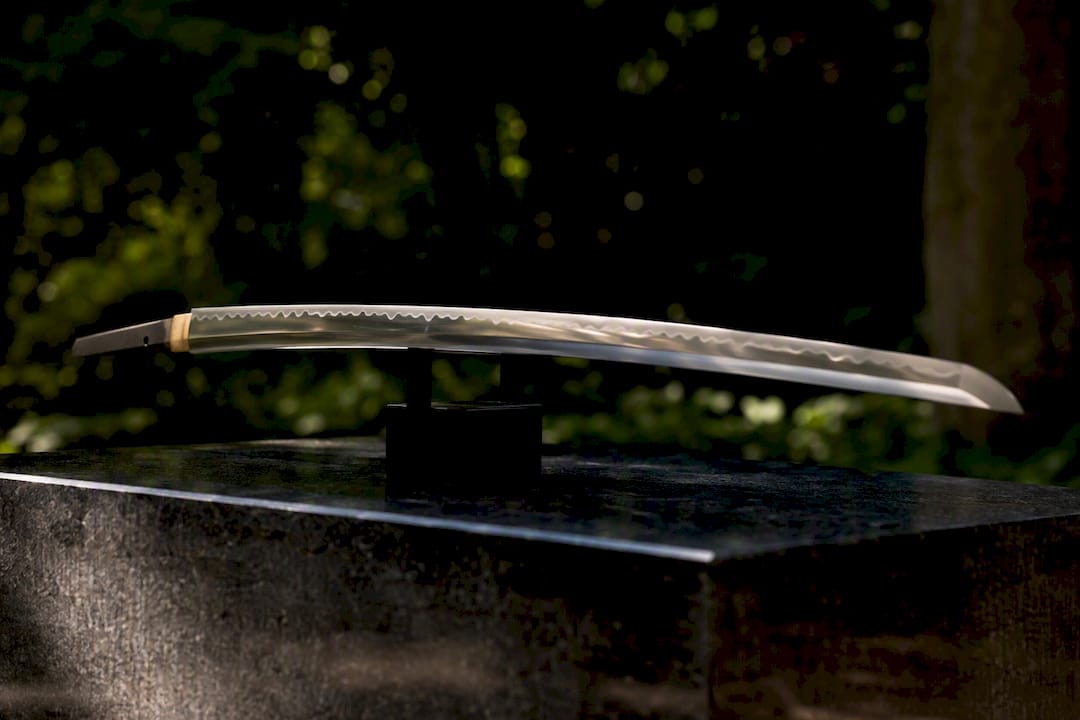
Our approach to authenticating hamon starts at the forge, not after the fact. Every clay-tempered blade in our collector’s guide to hamon types goes through documented differential hardening, and we keep forging notes tied to the specific artisan and technique used on that piece.
Before a blade ships, we require the same evidence we recommend you ask any seller for: maker records, notes on the clay and quench process, and macro photography of the hamon zone that shows nioi under magnification rather than hiding it behind editing. Our team also runs the same loupe checks outlined above internally, because a temper line that can’t survive close inspection has no business being sold as authentic.
Pro Tip: If a seller can’t produce forging notes tied to an actual smith, that absence is itself useful information about what you’re buying.
The Quick Verdict on Real Hamon vs Fake
Run the grazing light test, check for nioi under a loupe, and ask for provenance. That three-part sequence catches the overwhelming majority of fakes without any lab work.
Walk away, or at least slow down, if you see any of these:
- The seller refuses to send a rotating video or unedited photos.
- Multiple “different” blades share an identical hamon pattern.
- There’s no maker, forge, or steel-type information available at all.
- The hamon looks flat and unchanged no matter the lighting angle.
Documented clay-tempered blades with real maker provenance consistently sell for more than unmarked reproductions, which tracks with how much labor and skill actually goes into producing a genuine temper line. If you want that certainty built in rather than verified after the fact, a documented piece from a known forge removes most of the guesswork.
Myths About Hamon That Cost Collectors Money
A surprising number of buyers assume any visible wavy line on a blade automatically proves clay tempering. It doesn’t. Etching, sandblasting, and painting all produce wavy lines; the pattern’s shape tells you almost nothing on its own, since fake hamon can be styled to look like any traditional style you’d recognize.
Another common myth: that a plain, straight hamon (suguha) is less “authentic” than a wildly active one like gunome or choji. Straight hamon is simply a different traditional style, often associated with certain schools and eras, and it’s no easier to fake convincingly than an active pattern. In fact, some forgers find dramatic, busy patterns easier to fake believably in a photo, since irregularity can mask the absence of real depth.
A third misconception treats price as a reliable authenticity signal by itself. Price often correlates with genuine clay tempering because the process takes real skill and time, but a high price tag isn’t proof, and a modest price doesn’t automatically mean fake. The visual and microscopic tests outlined earlier matter more than what a listing charges. Finally, some buyers assume a factory-forged blade can’t have a real hamon. That’s false. Differential hardening is a process, not an exclusive of hand-forging, though hand-forged pieces from named smiths tend to carry more consistent documentation.
Why This Distinction Still Matters to Me
I’ve watched enough listings to know that a convincing photo and a real temper line are two different things, and only one of them holds up under a loupe. Authentic hamon carries centuries of metallurgical tradition in a few millimeters of steel, and that’s worth protecting with a little patience. Take the extra ten minutes to check before you buy, and lean on resources like Moonswords’ hamon type guide when you want to go deeper.
— Kenji Smith
See Moonswords’ Verified Clay-Tempered Katanas
Every katana in our High-End Katana Collection is hand-forged using genuine differential clay tempering, the same process outlined throughout this guide, not an etched or sandblasted approximation. That’s the practical difference between shopping with us and gambling on an unverified online listing: you get documented forging notes and maker details up front, instead of chasing down provenance after your money has already changed hands.

We provide macro photography of the hamon and nioi on request, along with details on the steel and tempering method used for each piece, so you can run your own loupe check against real documentation rather than a single flattering photo. If you’re weighing a specific blade, pieces like the Kyōjin 狂刃 Katana show what a fully documented, clay-tempered tamahagane sword looks like in practice. Browse the full katana catalog or reach out directly for provenance details on any piece before you buy.
Sources
FAQ
Is It Illegal to Own a Japanese Sword?
In the United States, owning a katana or other Japanese sword is legal for most adults, though a handful of state and local laws restrict blade length or carrying swords in public, so check your local regulations before transporting one.
What Are the Different Types of Hamon?
Common traditional styles include suguha (straight), gunome (undulating), choji (clove-shaped), and midare (irregular), each tied to particular schools and eras, as detailed in Moonswords’ hamon type guide.
How Much Is a Real Samurai Sword Worth?
Prices vary enormously based on age, maker, and documentation, but blades with verified clay tempering and clear provenance consistently sell for more than unmarked or reproduction pieces, since the labor and skill involved in genuine differential hardening simply cost more to produce.
Can a Katana Break Easily?
A well-made, differentially hardened katana is built specifically to resist breaking, since the softer spine flexes under stress while the hardened edge holds its shape; blades that snap easily are usually poor-quality steel or improperly heat-treated rather than a flaw in the traditional design itself.