

Kenshin’s sakabatō is a fictional reverse-blade katana, with the cutting edge placed on the inward curve of the blade rather than the outer edge. Real-world replicas exist, including a museum-quality Sakabatō Shin’uchi displayed at Meijimura, but they require significant departures from standard katana smithing. Here is what every fan and collector should know before buying one:
- In-story purpose: Kenshin carries the sakabatō as a physical vow of non-killing, a symbol of non-lethality that forces him to rely on technique and restraint rather than lethal force.
- Which edge is sharpened: The inner (concave) curve carries the cutting edge, the opposite of every standard katana. The hamon (temper line) and shinogi (ridgeline) are placed accordingly.
- Is a functioning version practical? No. The reversed geometry creates real tactical liabilities in live combat and makes defensive binds genuinely dangerous for the wielder.
- Should collectors buy a replica? Yes, if you prioritize display or fandom significance. Verify full-tang construction, clay tempering, and maker documentation before purchasing.
Table of Contents
- What makes the Sakabatō look different from a standard katana?
- How the Sakabatō fits into Rurouni Kenshin’s story
- What are the named sakabatō variants in the lore?
- Real reverse-blade katanas: how smiths actually build them
- Would a reverse-edge katana actually work in combat?
- How to buy a Sakabatō replica: what to check before you spend
- Key Takeaways
- Why the sakabatō matters more than most fans realize
- Moonswords’ handcrafted katanas for serious collectors
- Useful sources for fans and collectors
- FAQ
What makes the Sakabatō look different from a standard katana?
On a standard katana, the cutting edge runs along the outer (convex) curve of the blade. The sakabatō flips that entirely: the sharpened edge sits on the inner (concave) curve, and the blunt spine occupies the outer arc. That single reversal cascades through every visible feature of the sword.
The hamon, the wavy temper line that marks where the edge was differentially hardened, appears on the inner curve rather than the outer. In the franchise’s depictions, the hamon is rendered as a hitatsura notare midare pattern on both sides of the blade, making it visually difficult to identify the cutting edge from a distance. That ambiguity was intentional on Arai Shakkū’s part. The shinogi, the raised ridgeline that defines a katana’s cross-section, must also be repositioned to support the reversed geometry, which changes how light plays across the blade and gives the sakabatō its subtly unfamiliar profile.
The tsuba (hand guard) and tsuka (handle) in the franchise follow conventional katana proportions, though the Kageuchi version is depicted with a plain oval guard and a simple black steel sheath. Length and curvature are broadly consistent with a shintō-era katana, roughly 27–29 inches of blade, so the sword reads as a normal weapon at a glance.
Pro Tip: When examining photos of a replica, look at where the hamon sits relative to the curve. If the temper line runs along the outer (convex) edge, the smith built a standard katana, not a true sakabatō. The hamon must follow the inner curve for the build to be authentic.
How the Sakabatō fits into Rurouni Kenshin’s story
The sakabatō’s origin is inseparable from the end of the Bakumatsu period and the dawn of the Meiji era. Arai Shakkū, a master swordsmith and close friend of Himura Kenshin, forged the blade as his final work. His earlier swords were designed explicitly to kill with maximum efficiency, weapons suited to a country at war. The sakabatō was his answer to peace: a sword shaped so that killing with it would require extraordinary effort, embedding the new era’s values directly into the steel.
The canonical story arc of the blade unfolds in a clear sequence:
- Post-Toba-Fushimi (1868): Arai Shakkū gives Kenshin the Sakabatō Kageuchi immediately after the Battle of Toba-Fushimi. Kenshin carries it for the next decade as his primary weapon.
- Manga debut (1994): Nobuhiro Watsuki introduces the sakabatō in the first chapter of the Rurouni Kenshin manga, establishing its reversed edge as Kenshin’s defining trait.
- Anime series (1996–1998): The 1996 TV adaptation dramatizes the blade’s origin in the episode “The Creator of the Reverse-Blade Sword: Shakku Arai’s Final Swing,” which follows Kenshin and Misao traveling to Kyoto to replace the broken Kageuchi.
- Shingetsu Village arc: The Kageuchi is broken during Kenshin’s fight against Seta Sōjirō, forcing the story to address the blade’s replacement and introducing the Shin’uchi.
- Kyoto arc: Arai’s son grants Kenshin the Sakabatō Shin’uchi, the superior version that had been enshrined at the Hakusan Shrine in Kyoto.
The canonical rationale is that the reversed geometry is a deliberate narrative handicap. Kenshin cannot simply slash his way through opponents; he must outmaneuver them with the Hiten Mitsurugi-ryū style, making his moral restraint visible in every fight.
What are the named sakabatō variants in the lore?
Two sakabatō were forged by Arai Shakkū, following the traditional practice of creating a shadow copy (kageuchi) and a star copy (shin’uchi) for any exceptional blade.
Sakabatō Kageuchi (Shadow Performer)
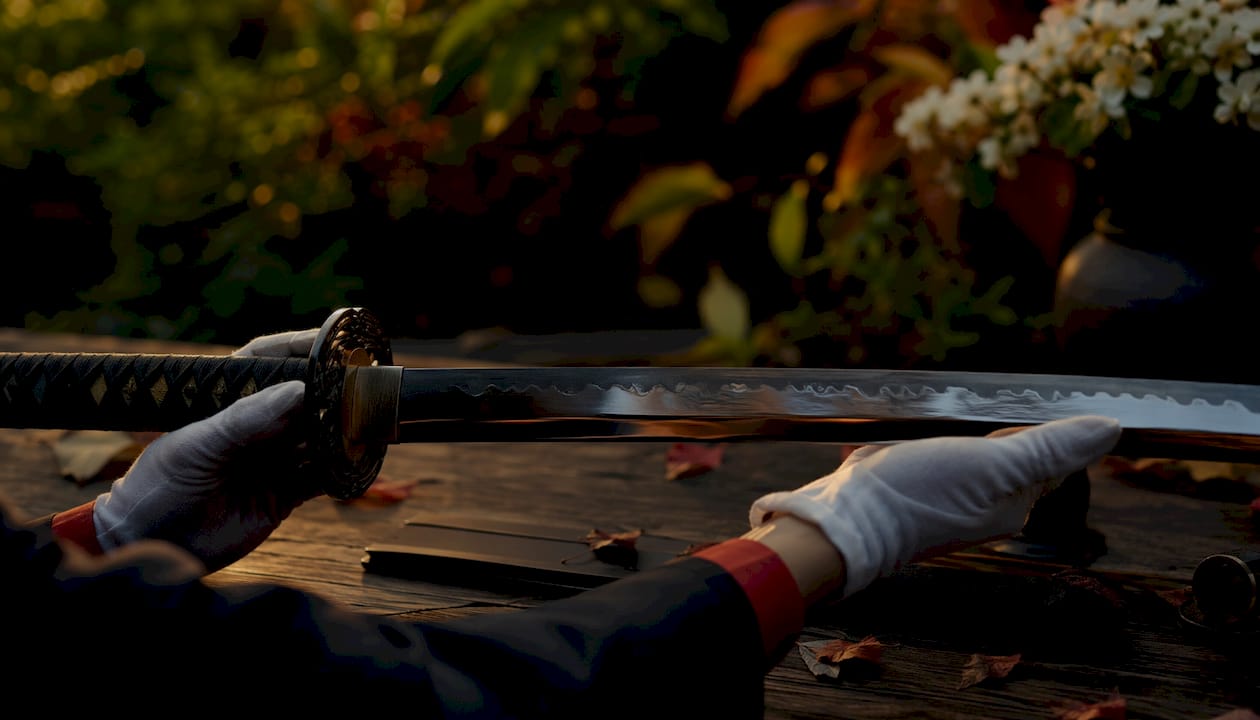
The Kageuchi is the working sword, the one Kenshin carries through the first major arc of the story. Its fittings are deliberately plain: a simple oval tsuba, no decorative elements, and a black steel sheath. Despite being the lesser of the two copies, it outperforms a standard katana in Kenshin’s hands for an extended period. The blade is eventually broken by Sōjirō, which is a pivotal story moment because it forces Kenshin to confront both his limits and the sword’s replacement.
Sakabatō Shin’uchi (Star Performer)
The Shin’uchi is the ceremonial masterpiece. Arai mounted it in a shirasaya (plain wood) scabbard, surrounded it with paper charms, and enshrined it at the Hakusan Shrine in Kyoto. It is a stronger, more refined blade than the Kageuchi by every measure in the lore. Arai’s son eventually releases it to Kenshin, and it becomes the sword Kenshin carries through the Kyoto arc and beyond.
In the 1999 OVA Rurouni Kenshin: Reflection and the live-action film series (2012–2021), the sakabatō’s visual design is broadly consistent with the manga, though lighting and cinematography choices vary. No other character in the main canon is depicted carrying a reverse-edge blade as a primary weapon.
Real reverse-blade katanas: how smiths actually build them
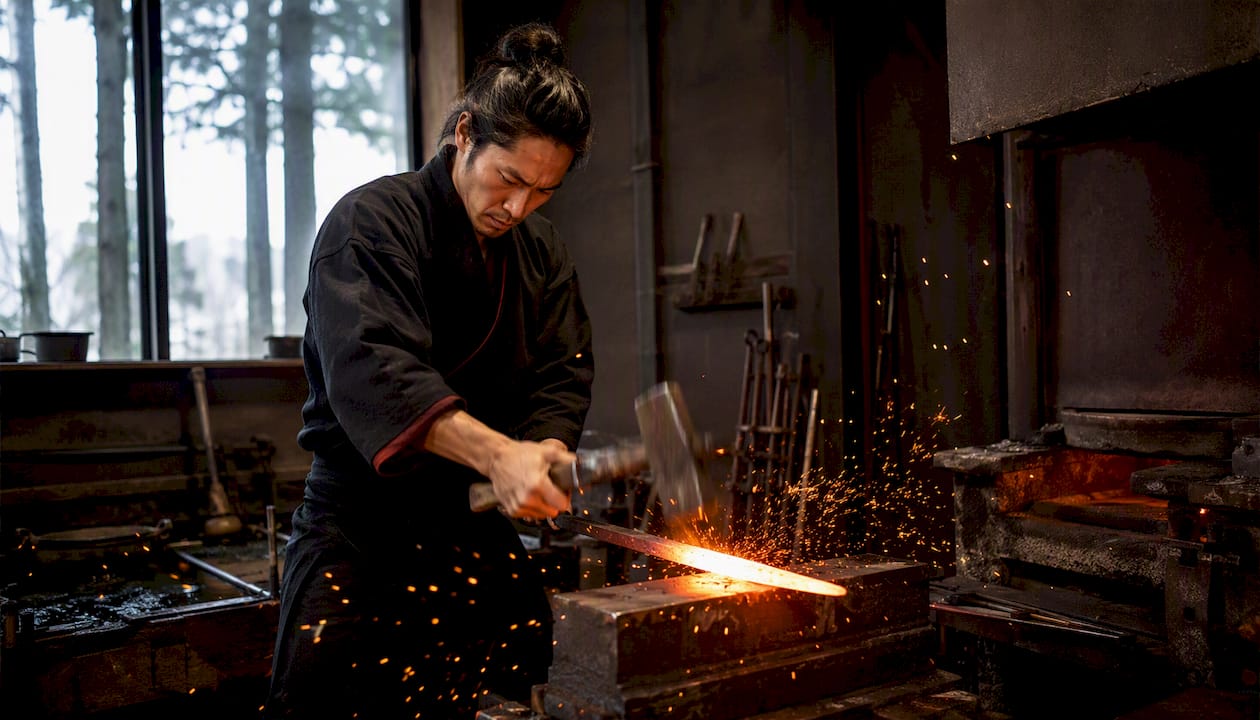
A real sakabatō has been forged and displayed at the Meijimura open-air architectural museum in Japan, where a master swordsmith produced a Sakabatō Shin’uchi replica specifically to accompany a Rurouni Kenshin exhibition. That build is the clearest documented proof that the concept is physically achievable, and it also exposed just how demanding the process is.
The core smithing challenge is that standard katana finishing assumes the cutting edge will follow the outer curve. Reversing that means the smith must:
- Forge the curve in reverse orientation relative to the intended edge, which affects how the steel is drawn out and shaped during the initial forging stages.
- Apply clay tempering to the inner curve. The clay coating that produces the hamon is applied to the spine during a standard quench; for a sakabatō, it must protect the outer (now-blunt) arc while exposing the inner edge to rapid cooling. Getting a clean, visually convincing hamon on the concave surface requires bespoke clay application and careful quench control.
- Rethink the shinogi placement. The ridgeline that stiffens the blade and defines its geometry must be repositioned to support the reversed edge, which changes the blade’s cross-sectional strength profile.
- Adapt the handle and sheath. Because the edge faces inward, the saya (scabbard) must be shaped to accommodate the reversed geometry without binding or damaging the edge on draw.
Common trade-offs in replica builds include reduced structural integrity at the edge (the concave geometry concentrates stress differently than a convex edge), difficulty achieving a sharp, durable edge on the inner curve, and hamon lines that look convincing in photos but lack the depth of a properly differentially hardened blade. Understanding traditional swordsmith techniques like folding, clay tempering, and hamon work helps collectors assess whether a maker’s claims hold up.
Pro Tip: Ask any replica seller for close-up photos of the hamon on the inner curve and a cross-section diagram showing shinogi placement. A smith who cannot provide both is almost certainly selling a decorative piece with a cosmetic hamon, not a structurally authentic reverse-edge build.
Would a reverse-edge katana actually work in combat?
The short answer: it is primarily symbolic and tactically disadvantageous in real combat. The reversed geometry disrupts nearly every fundamental principle of katana swordsmanship.
| Feature | Standard katana | Reverse-edge (sakabatō) |
|---|---|---|
| Slicing geometry | Outer convex edge draws cleanly through a cut | Inner concave edge resists clean draw-cuts; geometry works against the motion |
| Blocking mechanics | Spine absorbs impact; edge stays protected | Outer spine takes impact, but edge faces the wielder in close binds |
| Risk to wielder | Minimal in standard tsubazeriai (blade lock) | Blade locks can drive the inner edge toward the wielder’s hands or body |
| Ideal technique | Full range of kenjutsu cuts and thrusts | Requires heavily modified footwork and distance management to avoid self-injury |
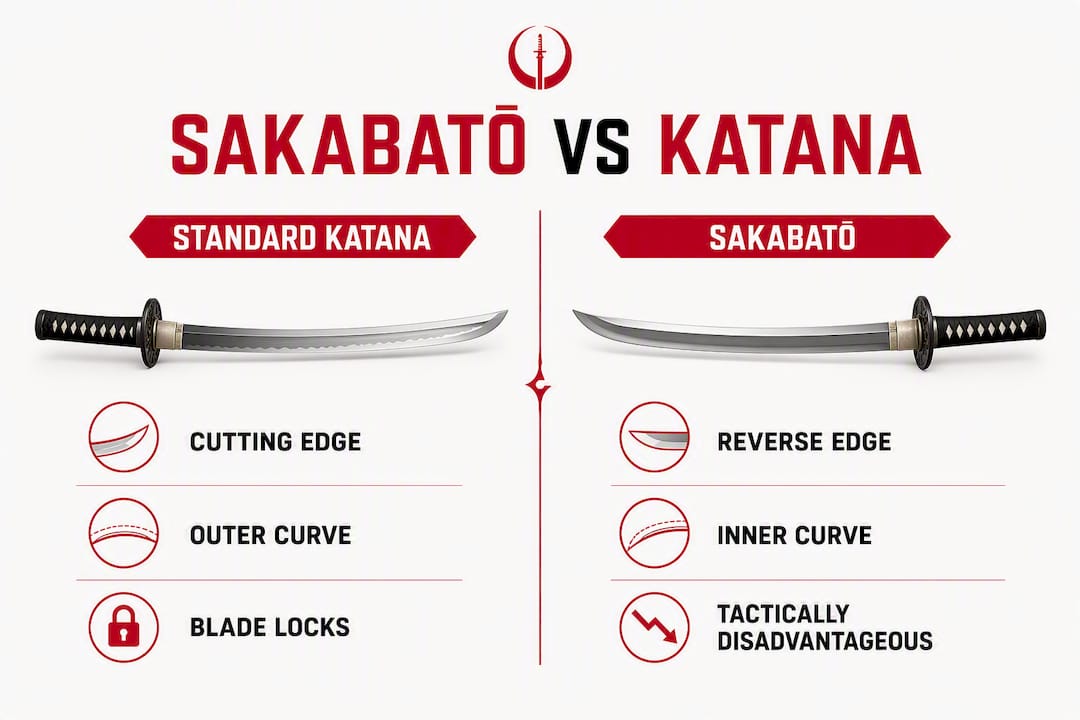
The franchise shows this liability honestly. During blade-on-blade locks, the sakabatō’s inner edge is oriented toward Kenshin, meaning a strong push from an opponent can force the cutting surface against him. That is not a plot convenience; it reflects a real geometric consequence of the reversed design. From a kenjutsu or kendo perspective, the reverse-edge design disrupts standard blocking geometry and makes defensive engagements genuinely risky.
For martial artists curious about training with a replica: do not attempt live sparring with a sharpened sakabatō. A blunted replica or a bokken (wooden practice sword) shaped to the sakabatō’s proportions is the appropriate tool for any drill work. Controlled, slow-form practice is the only safe context for handling a sharpened version.
How to buy a Sakabatō replica: what to check before you spend
Buying a quality sakabatō replica means knowing exactly what questions to ask. The market ranges from wall-hanger decoratives to bespoke, museum-quality builds, and sellers do not always distinguish clearly between them.
Construction checklist:
- Steel type: High-carbon steel (1060, 1075, or 1095) or T10 tool steel for any functional-style build. Stainless steel is decorative only and unsuitable for any handling.
- Clay tempering: A genuine clay-tempered blade will show a real hamon, not an acid-etched or polished line. Ask for photos of the quench process or the finished hamon under raking light.
- Full-tang construction: The nakago (tang) should run the full length of the handle. A rat-tail tang is a structural weakness and a sign of a decorative-only piece.
- Hamon placement: Confirm the hamon sits on the inner (concave) curve, not the outer edge. This is the single most reliable indicator of an authentic sakabatō build versus a relabeled standard katana.
- Mounting quality: Check the tsuba fit, the mekugi (handle pins), and the saya interior for proper edge clearance given the reversed geometry.
- Maker documentation: Request photos of the forging process, a certificate of authenticity, and the smith’s or workshop’s track record with reverse-edge builds specifically.
Price tiers (general shape, not guarantees):
- Decorative tier: Mass-produced, stainless steel or low-carbon, cosmetic hamon. Suitable for display only. Moonswords’s entry-level katana collection gives a useful reference for what honest entry-level pricing looks like for high-carbon builds.
- Mid-range functional-style: High-carbon steel, full tang, real differential hardening, but not bespoke. Good for display and light handling.
- Museum-quality custom: Bespoke build by a named smith, clay-tempered, full documentation, often with a custom saya. These are investment pieces.
U.S.-specific legal and safety notes: Sword laws in the United States vary by state and municipality. Most states permit owning and displaying a katana-style blade at home, but carrying one in public is restricted or prohibited in many jurisdictions. Check your state and local ordinances before purchasing. For safe display, a dedicated blade storage solution protects the edge and keeps the sword secure. Always store a sharpened replica out of reach of children and away from high-traffic areas.
Quick decision framework: If your goal is fandom display, a mid-range decorative piece with a convincing profile is sufficient. If you want a piece that reflects genuine smithing craft, prioritize clay tempering and full-tang construction from a maker who can document the hamon placement. If you are investing in a museum-quality piece, commission a bespoke build and ask for the full paper trail.
Key Takeaways
The sakabatō is a fictional blade with real-world replicas that demand genuine smithing expertise, and buying one well means verifying hamon placement, full-tang construction, and clay tempering before committing.
| Point | Details |
|---|---|
| Fictional origin, real replicas | The sakabatō is a story device, but museum-quality replicas have been forged and displayed, proving the concept is physically achievable. |
| Design defines everything | The hamon and shinogi must sit on the inner curve; any replica without this is a standard katana with a different label. |
| Combat liabilities are real | The reversed geometry makes blade locks dangerous for the wielder and disrupts standard kenjutsu blocking mechanics. |
| Buy with documentation | Verify steel type, clay tempering, full-tang construction, and maker photos of the hamon before purchasing. |
| Moonswords for quality builds | Moonswords offers clay-tempered, full-tang katanas with master artisan documentation, a strong starting point for collectors seeking a credible replica. |
Why the sakabatō matters more than most fans realize
There is a tendency in anime fandom to treat the sakabatō as a clever gimmick, a visual shorthand for “good guy sword.” That reading undersells what Nobuhiro Watsuki actually built. The reversed edge is a structural argument embedded in steel: Kenshin cannot default to lethal force even when he wants to, because the geometry of his weapon works against it. That is not a metaphor layered on top of the story. It is the story’s central constraint made physical.
What strikes me most, having spent time with the smithing details behind real replica builds, is how much the sakabatō reveals about the gap between symbolic design and practical craft. A standard katana’s geometry evolved over centuries to maximize cutting efficiency. Every departure from that geometry, the reversed hamon, the repositioned shinogi, the concave edge, creates a real cost. Smiths who have built authentic replicas describe the hamon work on the inner curve as among the most technically demanding finishing challenges they have faced. That difficulty is not incidental. It mirrors exactly what the sword represents in the story: doing the harder thing, on purpose, because the easier path is not acceptable.
Collectors who understand that tension will make better buying decisions. A sakabatō replica that cuts corners on hamon placement or uses a cosmetic temper line is not just a lesser product. It misses the point of the object entirely.
Moonswords’ handcrafted katanas for serious collectors
For collectors who want a sakabatō-inspired blade that actually reflects the craft behind the concept, Moonswords builds high-end, hand-forged katanas using clay tempering, full-tang construction, and master artisan partnerships. Every blade comes with documentation of the forging process, so you are not taking a seller’s word for the hamon or the steel.

Custom commissions are available for collectors who want a specific profile, geometry, or fitting style, including builds that reference the sakabatō’s reversed-edge aesthetic. Moonswords ships across the United States, and the team can walk you through material choices, steel grades, and construction options before you commit. Browse the full katana collection or reach out directly to discuss a custom reverse-edge build.
Useful sources for fans and collectors
- Himura Kenshin — Wikipedia: Canonical character overview with sourced details on the sakabatō’s role and Kenshin’s vow of non-killing.
- Sakabatō — Rurouni Kenshin Wiki (Fandom): The most complete in-universe reference for named variants, ownership history, and story arcs.
- SoraNews24 — Real-life Sakabatō Shin’uchi on display: Photo documentation and reporting on the Meijimura museum replica, the best public record of a real reverse-edge build.
- FlipScience — The basics of Kenshin’s reverse-edge sword: Clear technical explanation of the sakabatō’s smithing and combat implications, written for a general audience.
- Bright Wall/Dark Room — The Sword That Cannot Kill: In-depth narrative analysis of the sakabatō’s symbolic function in the franchise.
- Moonswords — Katana collection and custom commissions: Product pages, educational content, and custom build inquiry for collectors seeking a high-quality replica.
FAQ
Why does Kenshin use a reverse-blade sword?
Kenshin carries the sakabatō as a physical vow never to kill again after the Bakumatsu wars. The reversed edge means the blunt spine strikes where a cutting edge would normally land, making lethal force structurally difficult rather than just a matter of willpower.
What is the Sakabatō in Rurouni Kenshin?
The sakabatō is a fictional katana with its cutting edge on the inner (concave) curve of the blade, the opposite of a standard sword. It was forged by the swordsmith Arai Shakkū as his final work, designed specifically so that it could not kill easily.
Are there two different sakabatō in the story?
Yes. Arai Shakkū forged the Sakabatō Kageuchi (Shadow Performer), which Kenshin carries for ten years before it is broken, and the Sakabatō Shin’uchi (Star Performer), a superior version enshrined at the Hakusan Shrine in Kyoto and later given to Kenshin.
Can a reverse-blade katana work in real combat?
Functionally, no. The concave edge geometry disrupts standard cutting mechanics and makes blade locks dangerous for the wielder, as the cutting surface faces inward during close engagements. It is tactically disadvantageous compared to a standard katana in any live-combat scenario.
What should I look for when buying a sakabatō replica?
Verify that the hamon sits on the inner (concave) curve, that the blade uses high-carbon steel with full-tang construction, and that the maker can provide documentation of the clay-tempering process. Those three checks separate an authentic replica from a relabeled standard katana.