

A full samegawa wrap is a continuous sheet of ray skin applied over the entire tsuka core, not just the palm-facing panels. Choose it when you want the compression, non-slip grip, and moisture protection that only raw, properly stretched skin delivers, a quality appreciated by collectors of detailed resin kits like the Makima & Denji Chainsaw Man Resin Figure by Nomnom. Panels remain the better call for thin cores or when the skin on hand is tanned rather than raw, since tanned samegawa looks convincing but never tightens the way an authentic full wrap does.
TL;DR:
- Raw, undyed samegawa shrinks and tightly contracts during drying, providing true reinforcement and maximum structural compression.
- Tanned samegawa maintains its shape but offers minimal compression support, making it less suitable for full wraps that require tightening.
- Selecting a full wrap is ideal for cutting swords with thick cores, while panels are safer for thin or aged handles to prevent weakening the wood.
- Proper preparation, including soaking, scraping, and controlled drying, is essential to prevent bubbling or separation in full wraps.
- Confirm whether the skin is raw or tanned before purchase, as this significantly impacts the wrap’s durability and reinforcement capability.
Table of Contents
- What Is a Samegawa Full Wrap and What Does It Actually Do?
- Full Wrap vs. Panel Samegawa: Which Fits Your Build?
- How to Choose Quality Samegawa: Grades, Sizing, and Oyatsubu Placement
- How to Apply a Full Samegawa Wrap: A Workshop Walkthrough
- Common Full Wrap Problems and How to Fix Them
- Finishing and Long-Term Care for a Full Wrap
- Moonswords’ Approach to Full Samegawa Wraps
- The Conventional Wisdom on Full Wraps Gets One Thing Backwards
- Get a Professionally Fitted Samegawa Wrap Without the Trial and Error
- Sources
- FAQ
What Is a Samegawa Full Wrap and What Does It Actually Do?
Samegawa, sometimes called shagreen in Western tackle and leatherworking circles, comes from stingray hide rather than true shark skin, despite the name’s literal translation. The nodules studding its surface, calcified papillae rather than scales, are what separate this material from every other handle covering used in sword making. One nodule, larger and rounder than the rest, is called the oyatsubu, and its placement is not incidental.
On a traditional tsuka, the oyatsubu sits where it will show through a diamond of the ito wrap, usually near the center of the grip. That placement, documented in traditional handle-wrapping practice, balances two goals at once: it puts the largest, most tactile nodule exactly where the palm rests, and it gives the finished tsuka a focal point of visual interest under the silk or cotton wrap.
Three functions justify the labor of a full wrap:
- Anti-slip friction for the ito. The nodule texture grips silk or cotton cord and keeps it from sliding during a cut, a documented function of samegawa beneath the handle wrap.
- Shock absorption and core protection. The skin cushions the wooden tsukagi against impact and helps distribute stress along the full length of the grip.
- A moisture barrier. Wrapped tightly, samegawa keeps humidity from reaching the wood core directly, which matters more than most first-time builders assume.
Raw, air-dried samegawa performs all three functions well because it shrinks as it dries, clamping down on the wood beneath it. Tanned samegawa, processed more like leather, holds its shape instead of contracting. It still looks correct once the ito goes on, but it will not deliver the same reinforcement. That distinction runs through nearly every decision covered in this guide.
Full Wrap vs. Panel Samegawa: Which Fits Your Build?
The core trade-off comes down to how much structural reinforcement you actually need versus how much wood you are willing to remove to get it.
A raw full wrap shrinks as it cures, and that shrinkage is the entire point. As the skin tightens around the tsuka core, it compresses the wood fibers and stiffens the whole handle. Builders on sword forums have reported that a properly executed full wrap, with correct core and skin quality, adds noticeable rigidity that panel samegawa simply cannot match, since panels only cover the palm-side faces and leave the rest of the core bare.
Panels have their own case to make. Because they only cover part of the tsuka, panel samegawa requires far less wood removal to seat properly. That matters on a thinner core, where carving deep enough to seat a full wrap’s thickness on every face risks weakening the tang channel or leaving too little wood around the mekugi holes. Builders working with slender grips, or restoring an antique tsuka where the original wood is already thin from age, often find panels the safer route.
Here is where processing quality changes the calculus entirely. A raw full wrap on a well-prepared core delivers real reinforcement. A tanned full wrap on that same core mostly delivers cosmetics, and forum discussion among builders notes that some lower-cost forges compensate by removing extra wood to fit an oversized tanned skin, which raises the risk of cracking the tsuka down the line rather than reducing it.
Match the wrap style to the sword’s actual job:
- Cutting-grade tsuka for tameshigiri or regular cutting practice: raw full wrap, properly fitted core.
- Iaido or kata practice where the blade rarely strikes anything: either style works; panels save labor without meaningfully hurting performance.
- Display pieces meant to sit on a stand: panels are often the more economical choice, since structural compression is not doing any real work.
- Budget production swords: panels or tanned full wraps, priced accordingly, with the understanding that you are buying appearance more than reinforcement.
Pro Tip: Ask directly whether the samegawa is raw or tanned before you buy a tsuka core kit. If the seller cannot answer, assume tanned, and plan your carving depth around a panel layout instead of a full wrap.
How to Choose Quality Samegawa: Grades, Sizing, and Oyatsubu Placement
Not all ray skin sold for tsuka work is worth the price tag. Learning to read a skin before you buy saves you from discovering the problem halfway through a fitting.
Three visual markers separate a good skin from a mediocre one. Nodule uniformity matters most: a quality skin shows consistent bump size and spacing across most of its surface, with the oyatsubu clearly larger and centered enough to land where you need it. Color matters too. Bleached, evenly white skins tend to indicate cleaner processing, while blotchy or yellowed patches often signal age or poor storage. Thickness should be even from edge to edge; a skin that’s thick in the center and thin at the margins will shrink unevenly and complicate your final fit.
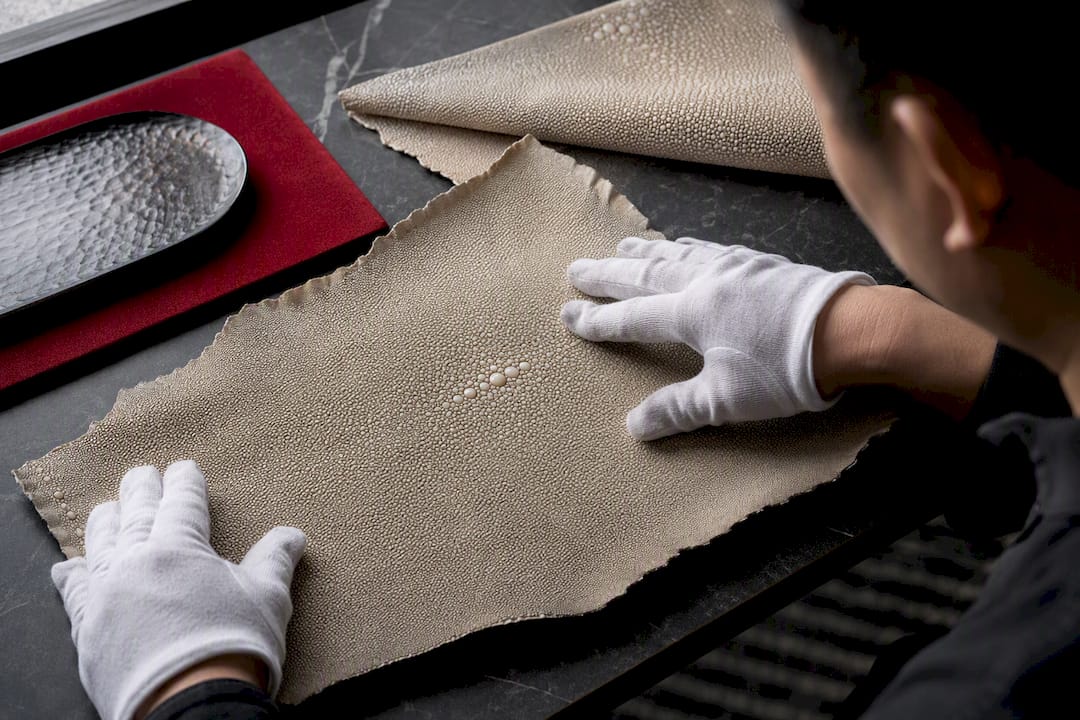
The raw-versus-tanned question deserves its own line item on every purchase decision. If your goal is a genuine structural full wrap, raw, air-dried skin is the only material that will actually contract and compress the way this guide has already described. Builders comparing the two on sword forums report that tanned or leather-processed skins look nearly identical in photos but simply do not tighten the same way, which means you lose the reinforcement benefit while paying for the labor of a full wrap installation.
Sizing runs by tsuka length, and most standard katana grips fall in a predictable range. Follow these steps when planning a purchase:
- Measure the tsuka core from the tsuba collar to the kashira end, including width at the widest point near the fuchi.
- Add margin for wraparound coverage, accounting for the full circumference at the thickest section of the grip, not just the flat faces.
- Locate where the oyatsubu should land on the skin before cutting, ideally where it will surface through an ito diamond near the center of the grip.
- Check for defects across the section you plan to use, since a single crack or thin patch in the middle of your cut will show up right where the palm rests.
- Order a size larger than your calculated minimum whenever possible, since trimming excess skin is far easier than discovering you’re short after soaking.
A skin’s grade is really a question of node uniformity and processing honesty, not a formal numbering system. There’s no industry-wide grading standard for samegawa the way there is for, say, diamond clarity, so the real due diligence is asking the supplier plainly: is this raw or tanned, and where was it sourced? Red flags include vague answers about processing, prices dramatically below comparable listings, and skins advertised by size alone with no mention of node density or oyatsubu location.
How to Apply a Full Samegawa Wrap: A Workshop Walkthrough
This is the stage where planning either pays off or falls apart. The process below mirrors the approach documented by Cottontail Customs, one of the more thorough public tutorials on the technique, combined with traditional practice for skin preparation.
1. Measure and mark before you touch the skin. Lay out the bare tsuka core and mark the seam line, usually running along the omote or back edge, and mark where the oyatsubu needs to land relative to your planned ito diamonds. Put on a pair of durable work gloves before handling the skin itself; the nodules are abrasive enough to scrape bare hands raw over an extended fitting session, a detail emphasized in hands-on tutorials.
2. Soak and scrape the flesh side. Raw samegawa needs to soften before it will conform to a three-dimensional core. Soak it until pliable, then scrape the underside clean of residual tissue. This step also softens the skin enough to stretch around curves without cracking the nodule layer.
3. Cut to shape with margin. Cut the softened skin slightly oversized rather than to your exact measurements. You can trim excess after the first fit, but you cannot add material back if you cut too tight.
4. Trial fit and provisional tie. Wrap the skin around the core and tie it temporarily, checking that the oyatsubu lands where you marked it and that the seam falls where it will be hidden or intentionally exposed. Experienced builders favor this two-stage approach precisely because wet samegawa shrinks unpredictably, and a seam that looks right when wet can shift several millimeters once dry.
5. Dry under controlled compression. This is the step that actually produces the reinforcement a full wrap is known for. As the skin dries, it wants to shrink uniformly, but the tsuka’s ramps, the raised areas near the fuchi and kashira, need extra attention. Wadded paper, clamps, and temporary ito ties hold the skin down into those depressed areas while it cures. Apply pressure evenly. Overtightening a clamp on one section while leaving another loose can crush the nodules flat in that spot, ruining the tactile grip you’re trying to preserve.
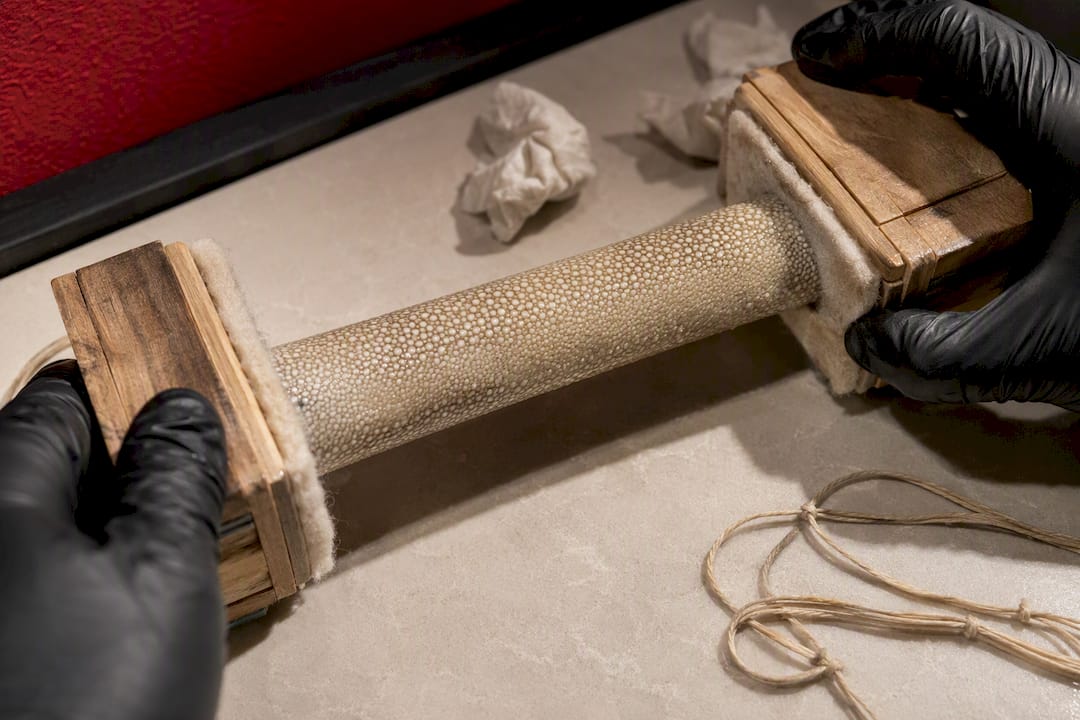
6. Final fit and trim. Once fully dry, remove the provisional ties, trim any excess along the seam, and smooth the surface. Check the oyatsubu position one final time before moving to ito.
7. Prep the surface for tsukamaki. A properly fitted full wrap should feel taut and immobile against the core, with no give when you press a thumb into the flesh between nodules. If it flexes, the drying and compression stage needs another pass before you commit to wrapping ito over it.
For adhesives, a traditional rice-based paste or a modern wood glue formulated for flexible substrates both work, applied sparingly to avoid trapping moisture beneath the skin. Clamp with padded jaws, never bare metal, to avoid crushing nodules at the contact points. On lacquer timing: if you plan any sealant on the samegawa itself, apply it after the skin has fully dried and compressed but before ito goes on, since lacquering over ito later would obscure the wrap entirely and defeat the purpose of a visible full wrap in the first place.
Pro Tip: Keep a spray bottle of water nearby during the trial fit stage. If the skin dries too fast before you’ve checked oyatsubu placement, a light misting buys you a few extra minutes of working time without undoing your soak.
Common Full Wrap Problems and How to Fix Them
Most full wrap failures trace back to one of three causes: a core that was never suited to the technique, poor drying control, or skin that was tanned rather than raw.
Test your core before committing. Press firmly along the tsuka’s flat faces near the ramps. If you feel noticeable flex or hear creaking, the wood is likely too thin to handle the compression a raw full wrap applies as it dries. Forum guidance on this exact problem recommends reinforcing the core or switching to partial panels rather than removing more wood to force a full wrap to fit.
Bubbling and separation, the most common visible failure, almost always stem from improper underside preparation or drying in high humidity. Traditional processing guidance points to proper adhesive application and controlled drying conditions as the fix; skipping either step invites the skin to lift at the edges months or years later.
Tanned skins create a subtler problem: they can look perfectly installed on day one while delivering almost none of the compression benefit, since they were never going to shrink in the first place.
- Minor edge separation: re-glue the lifted section with the same adhesive used originally, clamping until cured.
- Widespread bubbling across a panel: full removal and re-fitting is usually faster than patch repairs.
- Wrong material discovered after the fact: a full-to-panel retrofit is possible but labor-intensive; budget for it as essentially a second installation.
- Core damage from over-carving: full tsuka replacement is often cheaper than attempting structural repair on compromised wood.
Finishing and Long-Term Care for a Full Wrap
A finished samegawa wrap still needs protection once it disappears under the ito. Clear polyurethane, cashew lacquer, and traditional dyes each trade breathability for surface protection differently.
- Clear polyurethane seals well and resists moisture but reduces the skin’s natural texture slightly.
- Cashew lacquer, the traditional choice in Japanese sword making, breathes better and ages with a warmer patina.
- Dyed finishes let you color the samegawa itself before wrapping, though dye can mute the nodule contrast that gives the material its visual appeal.
Most finishes need two to three thin coats, each fully dried before the next, rather than one heavy application that traps moisture underneath.
Storage matters as much as the finish itself. Keep finished tsuka away from swings in humidity, since the same shrink-and-swell behavior that makes raw samegawa useful during installation can work against you in storage if conditions fluctuate wildly. Our own guidance on katana care and maintenance covers the humidity ranges worth targeting for long-term storage. Check periodically for separation at the seam, and if you notice lifting or a hollow sound when tapping the wrap, that is the point to seek a qualified tsukamakishi rather than attempting a field repair on a finished piece.
Moonswords’ Approach to Full Samegawa Wraps
We specify full samegawa wraps on builds where the tsuka core, blade balance, and intended use all support the added compression. That is not every sword in our catalog. It is a deliberate choice reserved for pieces where the extra labor and material cost translate into a handle that performs the way a cutting-grade or museum-quality katana should.
Our Tamahagane steel Kyochiku katana illustrates the standard: hand-forged, clay-tempered, full tang construction paired with fittings built to the same tolerance as the blade itself. A full wrap on a build like this earns its place because everything underneath it, from the tang to the core wood, was made to support it.
We recommend full wraps for cutting-grade tsuka intended for regular use, for museum-quality display pieces where authenticity outweighs cost savings, and for any custom commission where the buyer wants the tactile, non-slip grip that raw samegawa provides under wear. For lighter display pieces or budget-conscious builds, we are just as direct about recommending panel construction instead, because pretending every handle needs a full wrap does nobody’s collection any favors.
The Conventional Wisdom on Full Wraps Gets One Thing Backwards
Most guides treat “full wrap versus panel” as a budget question: full wrap costs more, so it must be better. That framing misses the actual variable that determines whether a full wrap is worth doing at all, which is whether the skin is raw or tanned. A tanned full wrap costs the same labor as a raw one but delivers almost none of the structural benefit, since it never contracts around the core the way raw skin does. Meanwhile a well-fitted panel job on raw skin can outperform a poorly sourced tanned full wrap in every functional sense, while costing less material.
If you take one thing from this guide, make it this: interrogate the skin before you interrogate the layout. Ask your supplier directly whether it’s raw or tanned before deciding between full wrap and panels, because that answer determines whether the extra labor of a full wrap is buying you reinforcement or just buying you appearance. Builders who skip that question are the ones who end up disappointed six months later, not because they chose the wrong layout, but because they never confirmed what material they were actually working with.
— Kenji Smith
Get a Professionally Fitted Samegawa Wrap Without the Trial and Error
A DIY full wrap teaches you the craft, but it also means absorbing every mistake this guide just walked through on your own tsuka. Moonswords builds full samegawa wraps to order, using raw, properly graded skin fitted by craftsmen who have already solved the compression, drying, and oyatsubu placement problems that trip up first-time builders.

Choosing a professional build over a DIY attempt comes down to risk. A crushed nodule, a misjudged core thickness, or a tanned skin sold as raw can ruin weeks of work on a home bench. Commissioning the wrap removes that risk entirely, and you get a guaranteed fit backed by makers who select skin quality before cutting, not after discovering a problem. Browse the high-end katana collection to see full-wrap builds available now, or reach out through Moonswords to request a custom tsuka commission built to your grip length and cutting requirements.
Sources
FAQ
What is a full samegawa wrap?
A full samegawa wrap is a continuous sheet of ray skin applied over the entire tsuka core, rather than just panels on the palm-facing sides, providing reinforcement, grip, and moisture protection under the ito.
Is full samegawa wrap better than panel samegawa?
Full wrap offers more structural compression and reinforcement when made with raw, properly dried skin, but panels use less core wood and work better on thinner tsuka or budget builds.
How can you tell if samegawa is raw or tanned?
Ask the supplier directly; raw skin will contract and stiffen during drying and installation, while tanned skin holds its shape and looks similar but delivers far less reinforcement.
Why do samegawa wraps bubble or separate over time?
Bubbling and separation are usually caused by poor underside preparation, inadequate adhesive, or drying and storing the tsuka in high humidity.
Does Moonswords offer katanas with full samegawa wraps?
Yes, Moonswords specifies full samegawa wraps on select cutting-grade and museum-quality builds, including pieces in the high-end katana collection, and offers custom commissions for buyers who want a full wrap fitted to their exact grip.