

A saya is the precision-fitted wooden scabbard made specifically for Japanese blades: katana, wakizashi, and tanto. Unlike a general “scabbard,” a catchall term for any rigid sword housing, or a “sheath,” which usually means a flexible leather or synthetic cover for a knife, a saya) is hollowed by hand to match one specific blade’s curve, then lacquered and often reinforced with horn at the mouth. The practical consequence matters more than the vocabulary: a mismatched fit or the wrong material can dull an edge, trap moisture against polished steel, or split the wood outright.
Here’s the short version of what separates them:
- Scabbard is the umbrella term. It covers any rigid case built to hold a bladed weapon, regardless of origin or precision.
- Sheath usually implies a softer or more flexible covering, think leather knife sheaths or nylon tactical covers, rather than a hard-shell fit.
- Saya is a specific Japanese craft object. It’s individually hollowed, lacquered, and fitted to one blade’s exact curvature, not mass-produced to a generic profile.
We’ll walk through the anatomy, the materials, the storage rules collectors often get wrong, and how to know when your saya needs attention or replacement.
Key Takeaways
A saya protects a katana through precision hollowing and mune-contact fit, not through lacquer or decoration alone, which is what separates it from a generic scabbard.
| Point | Details |
|---|---|
| Saya is precision built | Each saya is hollowed to one blade’s exact curvature, unlike mass-produced scabbards or flexible sheaths. |
| Mune contact is essential | The blade’s spine, not its edge, should touch the interior wood to prevent dulling and scratching. |
| Honoki wood is standard | Magnolia wood resists resin bleed and stays stable across humidity changes, protecting polished steel. |
| Shirasaya is for storage | Plain, unlacquered shirasaya prevents the moisture-trapping risk that lacquered koshirae carries long term. |
| Moonswords builds fitted mountings | Moonswords commissions custom saya and shirasaya matched to each blade’s individual curvature and reinforcement needs. |
Table of Contents
- Saya vs Scabbard Terminology: Parts of a Katana Sheath
- Why Honoki Wood and Lacquer Define Saya Construction
- Saya vs Scabbard vs Sheath: What Actually Performs Better
- What Is a Shirasaya, and Why Every Collector Needs One
- How to Store and Inspect a Saya Without Damaging the Blade
- Commissioning a Saya or Shirasaya: What to Ask a Maker
- What We Check Before Calling a Saya Well Made
- Getting the Fit Right Is the One Thing Owners Skip
- Commission a Fitted Saya or Shirasaya Through Moonswords
- Sources
- FAQ
Saya vs Scabbard Terminology: Parts of a Katana Sheath
Once you know the vocabulary, product listings, auction descriptions, and repair quotes start making a lot more sense. A saya isn’t a single piece of shaped wood. It’s an assembly of named parts, each doing a specific job, and each one tells you something about quality when you’re examining a piece.
Here’s what to look for and why it matters:
- Kurikata (sometimes called kurigata) — the small knob on the side of the saya, near the koiguchi, through which the sageo (carrying cord) threads. It’s functional first, decorative second, and its placement affects how the sword sits when worn.
- Kojiri — the end cap at the tip of the saya. On formal koshirae, this is often metal or horn; on plainer mountings, it may just be shaped and lacquered wood.
- Shitodome — small metal eyelets or grommets, usually found reinforcing the kurikata where the cord passes through, protecting the wood from cord friction.
- Mune contact vs. ha contact — this is the detail most owners never think about until something goes wrong. The blade should rest inside the saya so its spine (mune) makes the internal contact, never the cutting edge (ha). A correctly hollowed saya is shaped asymmetrically inside for exactly this reason.
That last point deserves emphasis, because it’s the single biggest functional difference between a well-made saya and a cheap one. If the interior geometry is off, even by a millimeter, the edge can drag against the wood on every draw. That dulls the blade, scratches a polish that may have taken a professional days to complete, and eventually chews up the interior of the saya itself. Decorative fittings like a lacquered kojiri or a silver-inlaid kurikata are worth admiring, but they’re cosmetic. The mune-contact geometry is the part that actually protects your sword.
Why Honoki Wood and Lacquer Define Saya Construction
Materials aren’t an afterthought in saya-making. They’re the entire reason the object works.
Honoki (magnolia) wood is the near-universal choice for traditional saya, and it’s not an aesthetic preference. Honoki is soft enough to hollow with precision hand tools, doesn’t have a strong grain that could scratch polished steel, and resists resin bleed that would otherwise stain or corrode the blade over time. It’s also relatively stable across humidity swings compared to harder woods, which matters enormously when you’re storing a piece of high-carbon steel that rusts if it sits in the wrong microclimate for even a few days.
Construction follows a workflow that hasn’t changed much in centuries:
- The saya starts as two halves of honoki, split along the grain.
- Each half is hollowed by hand to the exact curvature (sori) of the specific blade it will house, not a generic profile.
- The two shells are joined, traditionally with rice paste, which holds firmly but can be reopened cleanly if the saya ever needs repair or refitting.
- The exterior is shaped, sanded, and finished, often followed by black or colored lacquer for the wearable koshirae version.
- Horn or metal reinforcement is added at the koiguchi, and sometimes the kojiri, before final assembly.
Lacquer does double duty here. It’s the finish that gives a saya its glassy black or deep red shine, and it also forms a moisture barrier over the wood. But that barrier cuts both ways, a detail we’ll come back to in the storage section, because lacquer that keeps moisture out can just as easily trap moisture in if a blade goes into long-term storage inside a lacquered mounting.
Pro Tip: Run a finger just inside the koiguchi before you buy or accept a saya. If you feel roughness, debris, or a horn collar that’s already loose, that’s a fit problem waiting to scratch your blade on the very first draw.
Saya vs Scabbard vs Sheath: What Actually Performs Better
The terminology differences matter because they map directly onto performance differences. A generic scabbard, especially a mass-produced one meant to fit “a katana” in the abstract rather than your katana, is built to an average profile. A flexible sheath, common on tactical knives or reproduction blades, trades precision for cost and manufacturing speed.
A properly fitted saya wins on the metrics that matter to a collector or practitioner:
- Edge preservation. Because the interior is hollowed for mune contact, the cutting edge never touches wood during normal sheathing, so a well-fitted saya protects a fresh polish for years.
- Draw sound and feel. Iaido and iaijutsu practitioners know the sound of a correct draw, a smooth release with a faint sound at the koiguchi, not a scrape or a rattle. That sound is a direct readout of fit quality.
- Longevity under repeated use. A reinforced koiguchi handles thousands of draw cycles without splitting. Unreinforced or mass-produced scabbards commonly fail at exactly this point, since the absence of horn reinforcement is one of the most common causes of throat splitting.
- Display integrity. A generic scabbard often looks the part in photographs but reveals its shortcuts up close: visible glue lines, an ill-fitting kojiri, or a koiguchi that’s already loose from the factory.
A flexible sheath isn’t automatically the wrong choice, it depends entirely on what the blade is and what it’s for. Leather or nylon sheaths make sense for training blades, tactical knives, or reproduction pieces where historical accuracy and edge preservation aren’t the priority. But for an authentic or high-value katana, a flexible sheath simply can’t replicate the mune-contact geometry that protects a blade for generations. Softer materials also can’t take the repeated draw friction at a fixed point the way a horn-reinforced koiguchi can.
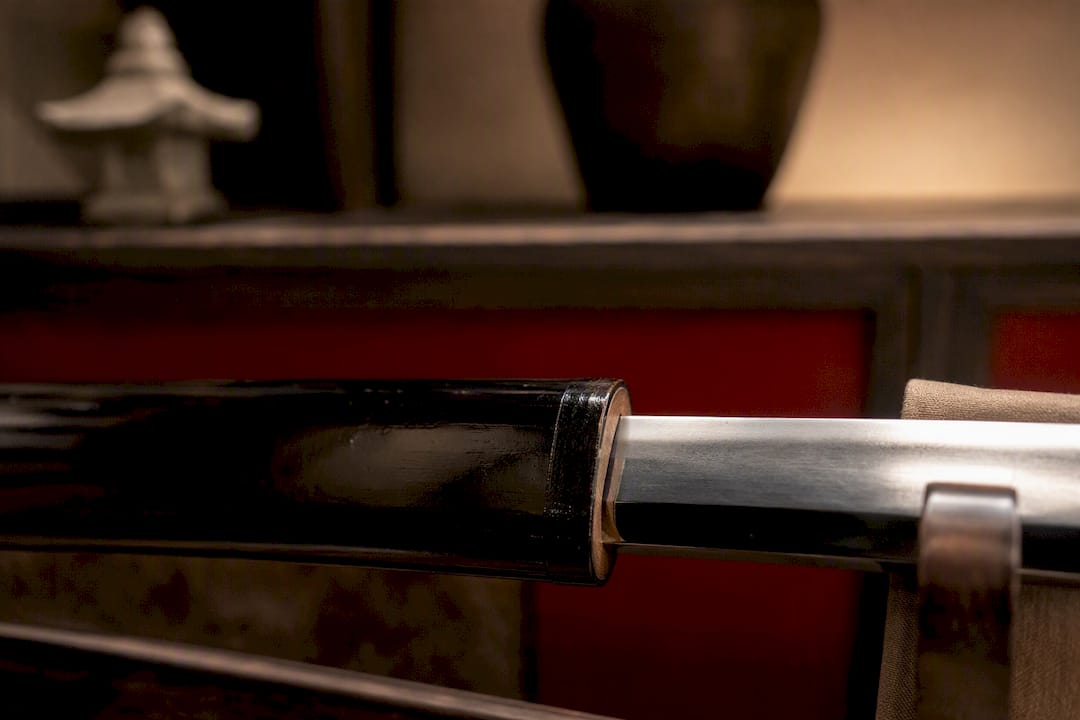
If you’re shopping for a mounted blade rather than commissioning a saya separately, look closely at how the piece is fitted before you buy. Something like the Black Dragon Katana illustrates what a properly mounted koshirae should look like: tight koiguchi, clean lacquer lines, no play between blade and wood.
What Is a Shirasaya, and Why Every Collector Needs One
A shirasaya (“white scabbard”) is the plain, unlacquered cousin of the saya, and it exists for one purpose: safe, neutral, long-term storage. It’s usually made from the same honoki wood but skips the lacquer, the decorative fittings, and often the horn reinforcement, since it isn’t meant for wearing or display.
Here’s when and why it comes into play:
- After a professional polish. Polishers routinely require a shirasaya for a freshly finished blade, because an old koshirae saya may have accumulated fine grit, dust, or debris over years of use, and any of that can scratch a brand-new polish the first time the blade goes in.
- For indefinite storage. The Japanese Sword Society tradition draws a clear line: koshirae, with its lacquer, glue, and metal fittings, is for wearing and display; shirasaya is for storage, precisely because it has none of the materials that can trap moisture or off-gas chemicals against the steel.
- When you’re not actively displaying or handling the sword. If a katana sits in a collection for months at a time, moving it into a shirasaya and keeping the koshirae saya separately (as a display piece on its own, or reunited with the blade for special occasions) is standard practice among serious collectors.
Owners who keep a blade permanently mounted in its lacquered saya are taking on unnecessary risk. It looks complete on a display stand, but lacquer and old rice-paste joints aren’t designed for years of uninterrupted contact with oiled steel. If your collection includes a piece you rarely draw, a shirasaya is worth the modest cost.
How to Store and Inspect a Saya Without Damaging the Blade
Most saya damage isn’t dramatic. It’s slow, environmental, and preventable, which means most of it is also entirely on the owner to catch early.
Start with a fit check. Draw the blade slowly and listen: a clean draw has a smooth, consistent resistance and a faint release sound at the koiguchi. A rattle, a scrape, or a grinding feel means something’s wrong internally, either debris, a warped shell, or edge contact where there shouldn’t be any. Visually inspect the koiguchi for hairline cracks, and check that any horn collar sits flush with no gap or looseness.
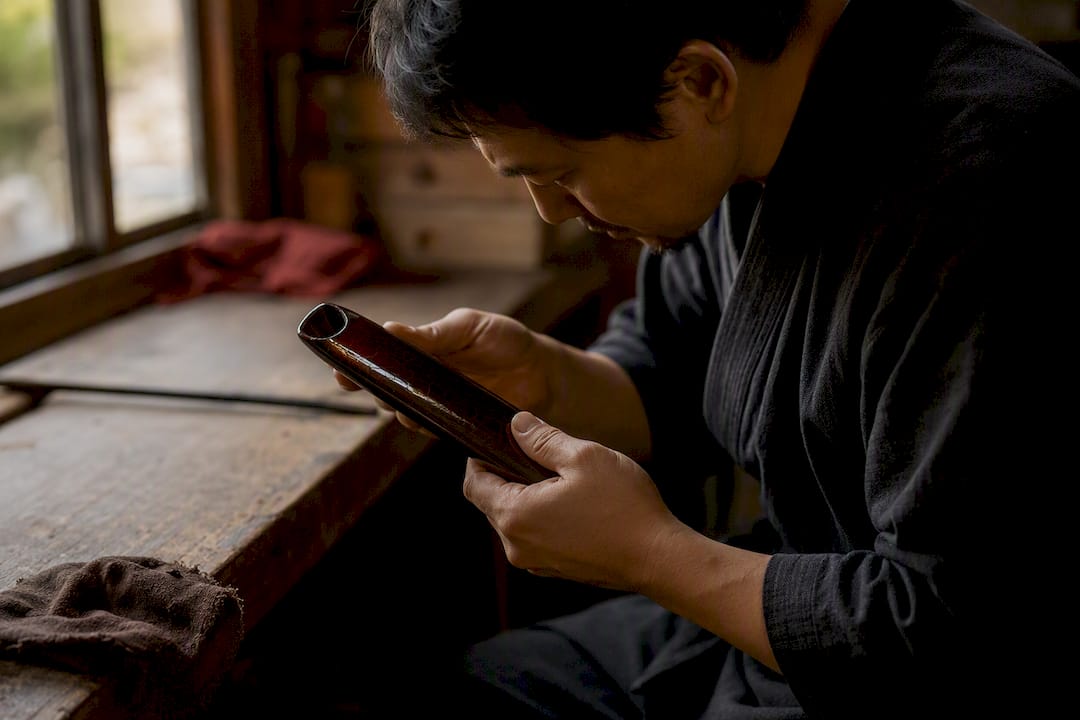
Storage conditions matter as much as the object itself. Wide humidity swings are the enemy of honoki wood, since dry air shrinks it and can loosen joints, while damp air swells it and invites the exact corrosion risk lacquer is supposed to prevent. Collectors commonly recommend removing ornate koshirae for long-term storage in favor of a shirasaya, since lacquer and adhesives can trap moisture or residual chemicals against the blade rather than keeping them out.
Watch for these red flags:
- Visible lacquer cracking, especially near the koiguchi or along the seam between the two shells.
- A koiguchi that’s gone loose or wobbly, no longer gripping the blade with even resistance.
- Any grinding or resistance during a draw that wasn’t there before.
- Fine wood dust or debris found inside the mouth of the saya.
None of these are cosmetic problems. A saya with structural fit issues is actively wearing on the blade every single time it’s used. Roughly one in three vintage swords examined by restoration specialists shows some form of internal saya wear consistent with prolonged edge contact, evidence that this isn’t a rare failure mode, it’s one of the most common preservation mistakes in the hobby.
Commissioning a Saya or Shirasaya: What to Ask a Maker
Deciding between a stock saya and a custom-fitted one comes down to one question: does your blade have a curvature, thickness, or nakago (tang) shape that differs meaningfully from a standard profile? If you own an antique, a hand-forged custom blade, or anything with an unusual sori, stock scabbards will almost never fit correctly. Custom is the only real option.
Here’s how to approach the process:
- Confirm the wood and reinforcement. Ask directly whether the maker uses honoki, and whether the koiguchi will be reinforced with horn. These aren’t upgrades, they’re baseline quality markers.
- Understand the fitting process. A reputable maker will want the actual blade, or precise measurements and a rubbing of its curvature, before hollowing begins. Fitting from a photo or generic spec sheet is a warning sign.
- Ask about lacquer type and finish options. Traditional urushi lacquer differs from modern synthetic alternatives in durability, drying time, and cost, and it affects both price and lead time.
- Get a realistic timeline. Hand-fitted saya and shirasaya both take real time to hollow, dry, and finish correctly. Rushed turnaround is one of the clearest signs of a shortcut somewhere in the process.
- Clarify pricing structure up front. Custom fitting, reinforcement, and lacquer quality all move the price, so ask for a breakdown rather than a single number.
Pro Tip: If a polish is in your near-term plans, order the shirasaya before the blade goes to the polisher, not after. That way the sword comes back to a clean, ready mounting instead of sitting exposed while a new one gets made.
If you’re still deciding what blade to build a mounting around in the first place, our guide to choosing the right katana walks through the decisions that come before the saya question.
What We Check Before Calling a Saya Well Made
At Moonswords, we treat the saya as inseparable from the blade it protects, not an accessory tacked on afterward. When we evaluate a mounting, whether one we’ve built or one a customer sends in for assessment, we run through the same short list every time.
We check the inner fit by feel first, running a cleaning rod or cloth through the length of the saya to catch debris or rough spots before the blade ever goes in. We look for koiguchi reinforcement, confirm the lacquer has no hairline cracking, and verify there’s zero play between the blade’s spine and the wood. Custom fitting exists for exactly one reason: it keeps the edge from ever touching the interior, which is what actually preserves a polish over decades, not display cases or humidity control alone.
When a blade is headed to a polisher, we recommend commissioning a shirasaya at the same time the polish is scheduled, not as an afterthought once the blade comes back.
Getting the Fit Right Is the One Thing Owners Skip
The mistake we see most often isn’t neglect, it’s owners assuming a saya is a fixed accessory rather than a fitted component that can loosen, dry out, or fall out of correct alignment over time. People check their blade’s polish obsessively and never think to check the wood around it.
Before you put any sword away for months at a time, draw it once and really pay attention to the fit. If something feels off, don’t wait for a problem to show up as a scratch on the blade. Talk to a polisher or commission a proper shirasaya first.
— Kenji Smith
Commission a Fitted Saya or Shirasaya Through Moonswords
Moonswords builds saya the way the craft demands: hollowed by hand to your blade’s exact curvature, not stamped to a generic profile that leaves gaps at the koiguchi. If you’ve read this far and started wondering whether your own mounting has the reinforcement or internal fit it should, that’s worth resolving before another season of humidity swings does the damage for you.

We offer custom-fitted koshirae for wearing and display, plain shirasaya for storage or pre-polish protection, and full replacement mountings when an old saya has split, loosened, or simply doesn’t match the blade it’s paired with. Every commission starts with your blade’s actual measurements and curvature, not a catalog average. Browse our high-end katana collection to see fully mounted examples of the fit and finish we build to, or reach out through Moonswords to request a quote on a custom saya or shirasaya. Lead times vary with lacquer type and reinforcement complexity, so the earlier you contact us before a scheduled polish, the smoother the handoff.
Sources
FAQ
What Is the Difference Between a Saya and a Shirasaya?
A saya, as part of the koshirae, is lacquered and fitted with decorative or reinforcing hardware for wearing and display, while a shirasaya is a plain, unlacquered wooden mounting made specifically for safe, long-term storage.
What Is a Saya on a Sword?
A saya is the rigid, precision-hollowed wooden scabbard made for a specific Japanese blade, custom shaped so the blade’s spine, not its edge, contacts the interior wood.
What Is the Difference Between a Sheath and a Scabbard?
A scabbard is a general term for any rigid protective case for a blade, while a sheath usually refers to a softer, flexible covering made of leather, fabric, or synthetic material, most often used for knives.
What Is the Sharpest Weapon on Earth?
There’s no single verified answer to this since sharpness depends on edge geometry and material, but the same craftsmanship principle applies to any fine edge: proper housing and internal fit determine how long that sharpness actually lasts.
Should I Keep My Katana in Its Saya or a Shirasaya Long Term?
For extended storage, move the blade into a shirasaya. Lacquered koshirae saya are built for wearing and display, and their lacquer and fittings can trap moisture against the blade over months of uninterrupted storage.