

Tachi mounts suspend the sword edge-down on hangers, meant to be slung from a belt while riding. Katana mounts carry the blade edge-up, thrust through the obi for a quick draw on foot. That single wearing orientation flips where the swordsmith’s signature sits on the tang, dictates the blade’s curve and length, and explains why one sword type eventually replaced the other on the battlefield.
TL;DR:
- Tachi mounts are longer, more curved, and hung edge-down, primarily designed for mounted combat, while katana mounts are shorter, gently curved, and worn edge-up for foot combat.
- The position of the mei on the tang reliably indicates the original mounting orientation, with tachi signatures facing outward and katana signatures inward, regardless of fittings.
- Blade geometry reflects function: tachi blades have deeper koshi-zori curves for slashing from horseback, while katana blades feature shallower curves optimized for quick draw and close-in fighting.
- The shift from tachi to katana was driven by changing battlefield tactics, favoring speed and ease of draw for foot soldiers, making edge-up wear and quicker handling more practical.
- Proper inspection of mountings, signature placement, blade curvature, and historical context is essential for authentic identification and maintaining the sword’s value and integrity.
Table of Contents
- Tachi Mount vs Katana Mount: The Key Differences at a Glance
- Reading the Tang: Why Mei Placement Beats Appearance Every Time
- Blade Geometry: How Curve and Taper Followed Function
- Why the Katana Eventually Replaced the Tachi
- A Practical Checklist for Inspecting and Caring for a Mounted Sword
- Matching Mount to Purpose: What We Recommend
- Find Correctly Mounted Katana and Tachi-Inspired Swords at Moonswords
- Where to See These Mounts in Person
- Sources
- FAQ
Tachi Mount vs Katana Mount: The Key Differences at a Glance
The two mounting systems, known as koshirae, solve completely different problems. A tachi koshirae uses two hangers, called ashi, that let the sword swing edge-down from a belt, the way a cavalry officer would carry a sidearm while mounted. A katana koshirae has no hangers at all. The scabbard, or saya, slides directly through the obi, blade turned edge-up, ready to be drawn and cut in one motion.
We see collectors get tripped up here constantly: a sword can look tachi-style just from ornamentation, but the mounting hardware, not the fittings, tells you how it was actually worn. According to Japanese sword mountings, katana typically run within a certain range of nagasa (cutting edge length), while tachi tend to be longer with noticeably deeper curvature near the hilt, called koshi-zori. Katana curve more gently and evenly along the blade, a profile generally called chū-zori or, in some examples, saki-zori toward the tip.
A few visual shortcuts help you sort one from the other quickly:
- Hanger loops on the scabbard (ashi) mean tachi koshirae; a smooth saya with an obi-himo cord for tying into the sash means katana koshirae.
- Deeper curve concentrated near the tsuka (handle) usually signals an earlier tachi-style blade rather than a katana ground with even curvature.
- Ornate metalwork, gold accents, and wrapped-cord bindings (itomaki-tachi style) often point to ceremonial tachi rather than a working weapon.
- A single mekugi peg securing the tang is standard on most katana; some tachi and older mountings use two, partly a function of the longer nakago.
- Lacquer style on the saya trends more elaborate and pictorial on ceremonial tachi, plainer and more durable on combat-oriented katana.
None of these cues is bulletproof on its own. A sword remounted centuries ago can wear the “wrong” fittings for its blade. That’s why the next identification method matters more than anything on the outside.
Reading the Tang: Why Mei Placement Beats Appearance Every Time
The single most reliable way to identify original mounting isn’t the scabbard at all. It’s the nakago, the unsharpened tang hidden inside the handle, and specifically where the smith placed the mei, or signature.
Because a tachi hangs edge-down, its mei sits on the side that faces outward, away from the wearer’s body, when the blade hangs naturally from its ashi. A katana, worn edge-up through the obi, faces the opposite way, so its mei lands on what would be the inward-facing side of a tachi tang in the same orientation. Swordsmiths signed with wearing position in mind, not blade shape, which is why this detail survives even when fittings get swapped or lost. As one authoritative summary puts it, checking the tachi tang’s signature side against known conventions remains the most dependable identification method available to collectors without lab equipment.
Here’s how to inspect a nakago responsibly, without disturbing the mounting:
- Never force the tsuka off if it’s fitted tightly. Antique bindings and lacquer can crack.
- Check for a peg (mekugi) access point. Many collector-grade mountings allow a careful, temporary handle removal for viewing the tang.
- Note the mei’s side and its position relative to the blade edge. Photograph it before drawing any conclusions.
- Look for a second, unsigned mekugi hole further up the nakago. That’s often physical evidence of shortening.
- Compare against museum tang photographs rather than memory. Reference collections make the pattern obvious fast.
Exceptions exist, and they matter. A blade shortened through suriage loses part of its original tang, sometimes taking the mei with it. Handachi mountings blend tachi aesthetics with katana wearing mechanics, muddying the usual rules. And many swords displayed in museums today sit in whatever koshirae best suits the exhibit, not necessarily the one they wore in service.
Pro Tip: If a nakago shows file marks (yasurime) that seem to stop abruptly near a second mekugi hole, you’re likely looking at a suriage blade. That’s a strong sign the sword started life longer, and possibly as a tachi, before someone shortened it for katana-style wear.
Blade Geometry: How Curve and Taper Followed Function
Length and curvature weren’t stylistic choices. They followed directly from how each sword was meant to move.
A tachi’s deeper koshi-zori curve, concentrated near the hilt, suits a slashing draw-cut delivered from horseback, where the rider’s arm swings through a wide arc. That curvature, combined with the 70 to 80 centimeter nagasa typical of authentic tachi, according to Tachi, gave cavalry swordsmen reach and cutting leverage against infantry below them.
Katana geometry answers a different question entirely: how fast can this blade come out of the obi and cut in one continuous motion? The shallower, more evenly distributed chū-zori curve lets the blade travel in a shorter, more direct arc, which matters enormously in iaijutsu, the practice of drawing and cutting as a single technique. Shorter nagasa also made katana more practical for close-quarters infantry combat and for wearing indoors, where a longer tachi would snag on doorframes and floor mats.
The point, or kissaki, tells its own story. Larger, more elongated kissaki shapes on many katana support both cutting and thrusting, useful when facing armored opponents at close range. Tachi kissaki, while varied across periods, generally reflect the sword’s primary role as a mounted slashing weapon rather than a foot soldier’s precision tool.
A few structural details worth watching for:
- Taper (fumbari), the narrowing of blade width from base to tip, tends to be more pronounced on older tachi-era blades than on later katana.
- Distal taper, the thinning of blade thickness toward the point, affects balance and swing speed regardless of mount type.
- Suriage shortening doesn’t just remove tang length. It can also flatten the original curvature ratio, since the deepest part of a tachi’s koshi-zori often sits closest to the hilt, the very section that gets cut away.
- Remounted blades frequently show a mismatch between blade proportions and koshirae style, a red flag experienced collectors learn to spot within seconds.
That geometry mismatch is exactly why so much of Japanese sword scholarship treats the blade and its mounting as separate objects with separate histories, even when they’ve traveled together for centuries.
Why the Katana Eventually Replaced the Tachi
The shift from tachi to katana wasn’t a fashion trend. It tracked a real change in how battles were fought.
Tachi dominated the earlier Kotō period, when samurai warfare centered on mounted archers and cavalry engagements. An edge-down mount suspended from a belt makes sense on horseback: gravity and hanger placement keep the blade steady and out of the horse’s way, and a wide slashing draw works naturally from the saddle. As Seki Sensei’s practitioner-focused history explains, the uchigatana, ancestor of the katana, rose alongside a shift toward foot-based combat during the Muromachi period, as battlefield tactics and armor design changed.
That shift rewarded a different kind of readiness. A katana thrust edge-up through the obi lets a foot soldier draw and cut in one fluid motion, without needing the momentum a rider gets from horseback. Speed off the draw mattered more than reach once combat moved to closer, faster, more chaotic infantry skirmishes. By the Edo period, the katana had become the standard sidearm of the samurai class, worn daily, paired with the shorter wakizashi as the iconic daishō set.
Tachi didn’t disappear so much as change jobs. Many surviving examples, including the itomaki-tachi mountings documented at institutions like the Metropolitan Museum of Art, became ceremonial and procession pieces rather than combat weapons, richly decorated with gold fittings and silk cord wrapping. Edo-period sumptuary customs reinforced this split: certain tachi mountings signaled rank and court status, while the working katana handled everything practical. For a deeper look at how that transition played out, Moonswords’ history of the shift from tachi to katana walks through the social and military pressures behind it.
- Kotō period: tachi standard for mounted samurai.
- Muromachi period: uchigatana and katana rise alongside foot combat.
- Edo period: katana becomes the everyday sidearm; ornate tachi survive mainly for ceremony.
- Throughout: suriage shortening routinely converted old tachi blades into katana-length swords.
A Practical Checklist for Inspecting and Caring for a Mounted Sword
Whether you’re evaluating a sword for purchase or simply want to understand what’s sitting in your display case, a methodical inspection beats a glance every time.
- Start outside the koshirae. Note hanger presence (ashi) versus a smooth saya, curvature depth, and lacquer style before touching anything internal.
- Count the mekugi. A single peg is typical of most katana mountings; two pegs often point toward older or tachi-style construction.
- Check the nakago and mei carefully, following the safe-inspection steps outlined earlier, and photograph everything for later comparison.
- Look for suriage evidence: an extra, unused mekugi hole or file marks that seem to stop short of the current tang end.
- Assess fitting consistency. Ornate, gold-accented fittings paired with a plain, undecorated blade can indicate a later remount rather than an original ceremonial commission.
A few red flags deserve a professional opinion before you buy or restore anything. Mismatched wear patterns between blade and fittings, fresh-looking lacquer over an obviously old nakago, or a signature that seems inconsistent with known smith conventions are all reasons to pause. Because remounting was common practice throughout Japanese sword history, a mismatch doesn’t automatically mean fraud, but it does mean you should verify before assuming a sword’s full provenance.
For storage, shirasaya, plain undecorated wooden mounts, protect blades far better than display koshirae during long-term storage, since ornamental lacquer and metal fittings can trap moisture against the steel. Keep humidity controlled, apply a light coat of choji oil periodically, and avoid handling the nakago with bare hands.
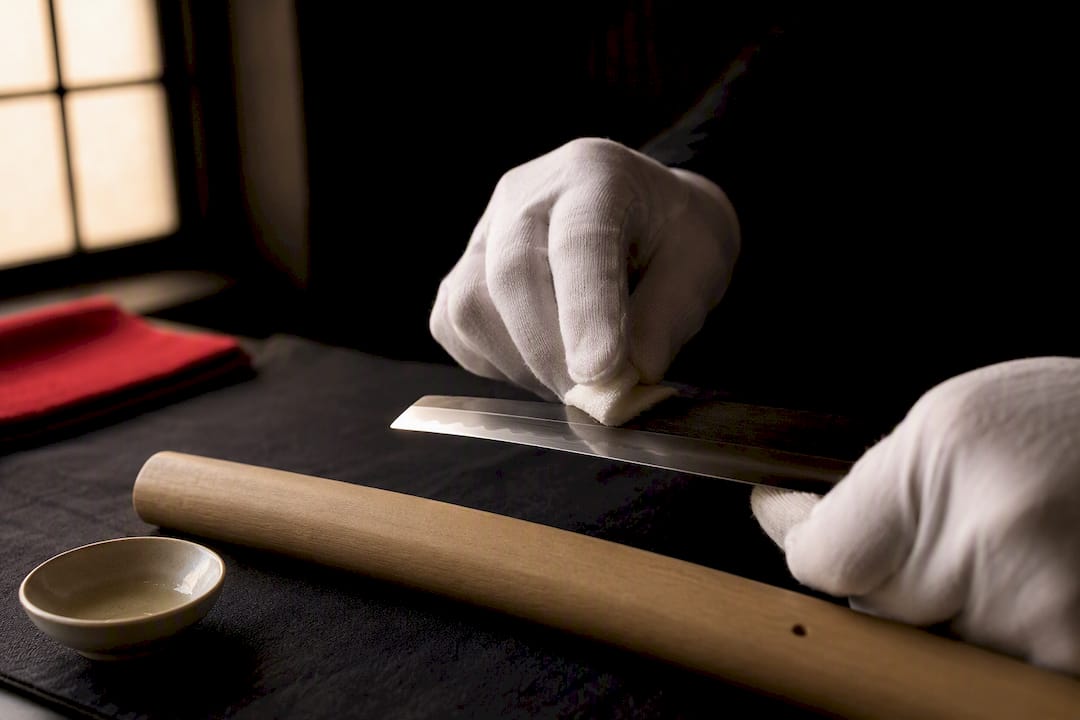
Pro Tip: If you’re storing a sword long-term in its display koshirae rather than a shirasaya, wipe the blade and check for condensation more often. Ornate mountings look wonderful on a wall, but they’re not built for humidity control the way a plain storage mount is.
When a sword’s koshirae doesn’t match its blade era or style, or when original fittings have degraded beyond safe use, custom remounting from an experienced workshop preserves both the blade’s integrity and its display value.
Matching Mount to Purpose: What We Recommend
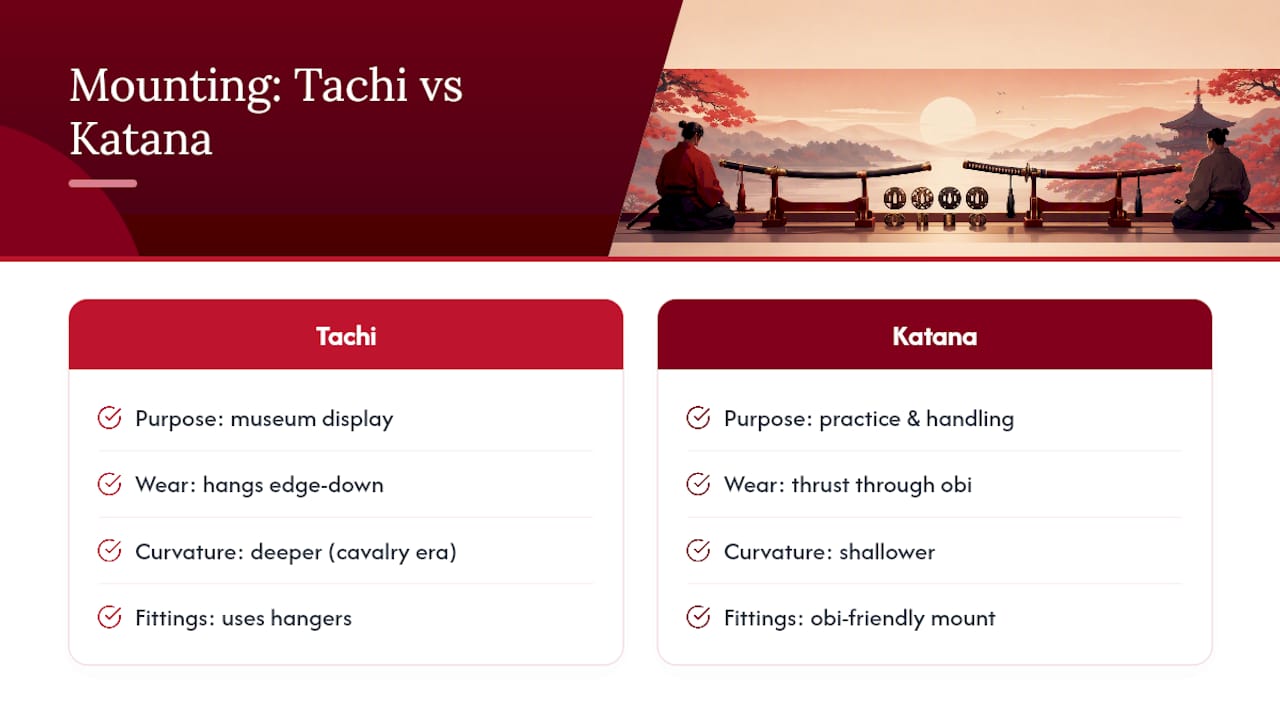
Choosing between tachi-style and katana-style mounting isn’t about which looks more impressive on a wall. It comes down to intent. A historically faithful tachi koshirae, with its hangers and deeper curvature, suits collectors building a museum-style display or studying cavalry-era swordsmanship. A katana mount, thrust through the obi, serves anyone doing light training, iaido practice, or simply wanting a sword that handles the way most people picture a samurai blade handling.
Authenticity in mounting protects value just as much as blade quality does. A mismatched koshirae, wrong curvature for the fittings, wrong hardware for the blade era, tells a knowledgeable buyer that something got altered along the way. Matched, correctly proportioned mounts hold their appeal far longer, whether you’re buying to display or to train.
— Kenji Smith
Find Correctly Mounted Katana and Tachi-Inspired Swords at Moonswords
Getting the mount right isn’t optional if you want a sword that displays, handles, and holds value the way it should. Moonswords forges every blade with full tang construction and traditional clay tempering, then pairs it with koshirae proportioned correctly for that blade’s length and curve, so you’re never stuck untangling a mismatch later.

Our katana collection covers everything from entry-level swords built for practical handling to the high-end katana collection, where museum-quality fittings meet blades made for real cutting work. If you’re drawn to tachi history specifically, our piece on the samurai’s cavalry sword covers how those mounts evolved before you commit to a purchase. Ready to see a properly matched koshirae in person? Browse the high-end katana collection and pick the mount that fits how you actually plan to use your sword.
Where to See These Mounts in Person
The Metropolitan Museum of Art’s itomaki-tachi entry shows gold ceremonial fittings dated roughly 1615 to 1868. Wikipedia’s pages on Tachi and Japanese sword mountings offer reliable reference photos for comparing tang and hanger placement firsthand.
Sources
FAQ
What is the difference between tachi and katana?
A tachi is worn edge-down on two hangers (ashi), typically longer and more curved, while a katana is worn edge-up through the obi, shorter, and evenly curved for a fast draw.
Is tachi better than katana?
Neither is objectively better. Tachi suited mounted combat and later became ceremonial, while katana suited foot combat and everyday carry, so the right choice depends on intended use, display or light training.
Did samurai use tachi or katana?
Samurai used both, but at different times. Tachi dominated the earlier Kotō period among mounted warriors, while katana became the standard sidearm from the Muromachi period onward.
Why did the katana replace the tachi?
The katana replaced the tachi mainly because foot combat became more common as armor and battlefield tactics changed, and an edge-up mount through the obi allowed a much faster draw on foot than a hanging tachi mount.