

Ancient smiths worked with six core technique categories: native metal working, smelting and extraction, casting (open, bivalve, and lost-wax), forging and cold hammering, annealing and quenching, and refining through cupellation. Each solved a different problem. Native metal working shaped nuggets found in nature. Smelting pulled metal out of rock that hid it. Casting turned molten metal into repeatable or intricately detailed forms. Forging consolidated and strengthened metal through controlled hammering. Heat treatment let smiths trade hardness for flexibility, or the reverse, depending on what a blade or tool needed to survive.
These techniques did not arrive together. They developed in a rough sequence that archaeologists call the progression from native metal to ore-stage metallurgy to iron-stage metallurgy, and that sequence still shapes how we classify metalwork today.
- Native metal working: cold hammering of naturally occurring copper or gold nuggets, no smelting required
- Smelting and extraction: chemically reducing ore into workable metal, usually with charcoal and heat
- Open mould casting: pouring metal into a simple carved cavity for basic shapes
- Bivalve mould casting: two-part reusable moulds for standardized, repeatable objects
- Lost-wax casting: a wax model encased in clay, melted out, then replaced by molten metal for intricate one-off pieces
- Forging and cold hammering: shaping heated or unheated metal through repeated impact
- Annealing and quenching: heat treatments that restore ductility or lock in hardness
- Refining and cupellation: separating silver from lead ore at temperatures near 1,000°C
Copper working, documented as early as roughly 8,000 to 5,000 BCE, opened the door from native metal use into deliberate ore smelting, a shift that eventually made the Bronze Age and, much later, the Iron Age possible.
Table of Contents
- Historical Stages of Ancient Metallurgy Techniques
- The Seven Ancient Metals and Their Working Alloys
- How Smelting and Extraction Actually Worked
- Casting Methods: Open, Bivalve, and Lost-Wax
- Forging, Cold Hammering, and Heat Treatment Explained
- Furnaces, Bellows, and Workshop Technology
- Regional Case Studies in Ancient Metallurgy
- Metallurgical Innovation Through History: a Quick Timeline
- An Artisan's Eye: Reading Heat, Color, and Craft
- Master Ancient Metallurgy Techniques Through Every Stage
- What the Record Actually Tells Us
- Sources
- FAQ
Historical Stages of Ancient Metallurgy Techniques
Every technique on that opening list belongs to one of three developmental stages, and knowing which stage you're looking at tells you what a culture could and couldn't produce. This is the framework archaeologists actually use, and it's the backbone of how ancient civilizations smelt metal at all: capability builds in layers, not leaps.
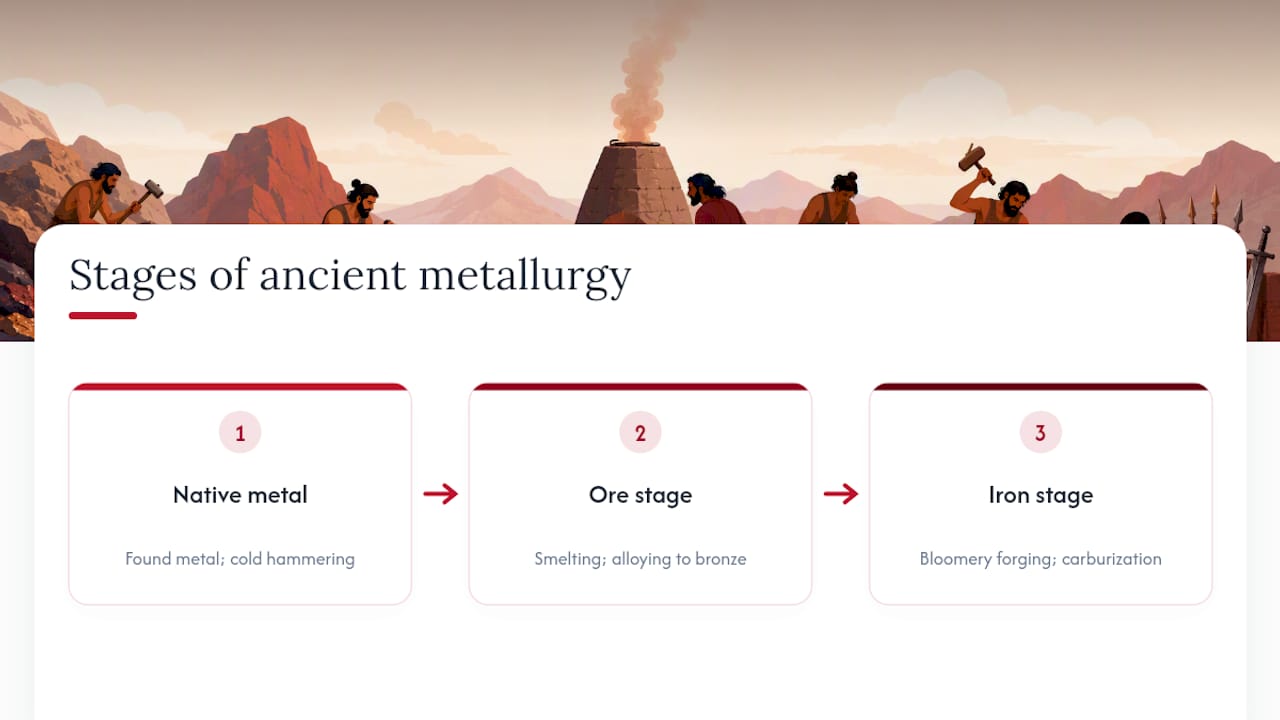
1. The native metal stage. Early metalworkers didn't smelt anything. They found copper, gold, and occasionally meteoric iron already in metallic form and simply hammered it cold into beads, pins, and small ornaments. No furnace, no chemistry, just percussion. This stage produced soft, malleable objects with limited structural use, mostly jewelry and ritual items rather than tools that needed to hold an edge. Archaeological finds from this period show hammer marks without any evidence of melting, a clear signature that separates native metalwork from anything smelted.
2. The ore stage. This is where metallurgy actually becomes metallurgy. Someone figured out that certain colored rocks, when heated with charcoal in a controlled environment, release metal that was chemically locked inside. Copper smelting, emerging within that same early window of copper working, marks this transition, and it changed everything downstream. Once smelting worked, alloying followed almost immediately: mix molten copper with tin or arsenic, and you get bronze, a metal that pours better into moulds and holds a sharper edge than pure copper ever could. The ore stage is also when casting techniques exploded in variety, because liquid metal opened possibilities that hammering nuggets never could. Bronze Age societies used this new fluidity to mass-produce weapons, tools, and fittings at a scale native metal working never allowed.
3. The iron stage. Iron should have been easy. It's far more abundant in the earth's crust than copper or tin. But iron ore requires much higher reduction temperatures, and pure iron pulled from a bloomery furnace comes out as a spongy, slag-riddled mass called a bloom, not a clean ingot. Smiths had to repeatedly reheat and hammer that bloom to squeeze out impurities, a laborious process bronze never demanded. Iron's real advantage showed up later, when smiths learned carburization, the process of adding carbon to iron's surface through prolonged contact with charcoal, which converts soft iron into steel capable of holding a far superior edge. That single discovery is arguably the most consequential piece of historical metallurgy processes ever developed, because it decoupled sharp, durable tools from the tin trade routes that bronze production depended on.
The jump from stage two to stage three wasn't really about desire. Bronze remained superior in some applications for centuries after iron entered use. It was about scarcity: tin deposits are geographically rare, while iron ore is nearly everywhere, and once smiths solved the temperature and carburization problems, iron's abundance won out.
The Seven Ancient Metals and Their Working Alloys
Seven metals defined the ancient metallurgical world, and each one earned its place through a specific combination of melting point, workability, and visual appeal that dictated exactly which technique could be used on it.
- Gold: melts at a workable temperature, resists corrosion completely, and takes intricate detail through casting or hammering, which is why it dominated ornamental and ceremonial objects
- Silver: softer than gold, prone to tarnish, but prized for coinage and often extracted from lead ore through cupellation rather than mined in pure form
- Copper: the gateway metal, workable cold in its native state and smeltable from ore, forming the base for nearly every early alloy
- Tin: rarely used alone because it's too soft and low-melting, but essential as bronze's hardening partner
- Lead: low melting point, extremely malleable, historically mined alongside silver because argentiferous galena ore contains both
- Iron: abundant but stubborn, requiring far higher smelting temperatures and additional carburization to reach its full potential as steel
- Mercury: liquid at room temperature, used in antiquity mainly for gilding through amalgamation rather than structural objects
This list, commonly cited as the seven metals of antiquity, reflects everything that was technically accessible to smiths before industrial-era chemistry expanded the periodic table of usable metals.
Alloying is where things get genuinely clever. Pure copper is soft enough to bend under moderate pressure, which limits its use for anything that needs to hold an edge or bear weight. Add arsenic, even at low percentages, and you get arsenical copper, a material that casts more cleanly and comes out noticeably harder. But tin bronze eventually won out as the dominant pre-iron alloy, typically mixed at 8 to 12 percent tin, because it flowed better into moulds during casting and produced a harder, more durable finished object than arsenical copper could reliably deliver. Brass, an alloy of copper and zinc, appeared later and served more decorative and coinage purposes than structural ones, since zinc ore smelting presented its own technical hurdles that most ancient cultures didn't solve until relatively late.
Melting point told smiths which technique to reach for. Gold and silver, with their forgiving melting temperatures, lent themselves to fine casting work. Iron's stubbornly high melting point pushed smiths toward forging and solid-state working instead of casting for most of the ancient period, since ancient furnaces struggled to reach iron's full liquid state at all.
How Smelting and Extraction Actually Worked
Getting metal out of rock is chemistry, not magic, and ancient smiths ran that chemistry through repeatable steps long before anyone wrote down why it worked.
The process started with ore preparation. Miners crushed raw ore into smaller fragments to increase surface area, then often washed it to separate lighter waste rock (gangue) from the denser metal-bearing material. Sulfide ores, common sources for copper, needed an extra step called roasting: heating the crushed ore in open air before smelting, which converts metal sulfides into oxides that reduce much more easily in the furnace. Roasting typically ran between 500°C and 800°C, hot enough to drive off sulfur as gas without melting the ore outright.
Reduction is the actual extraction step, and it depends on a straightforward chemical trade. Charcoal burning in a low-oxygen furnace environment produces carbon monoxide, which is chemically hungrier for oxygen than the metal is. That hunger strips oxygen away from the metal oxide, leaving free metal behind and releasing carbon dioxide as the byproduct. The temperature required to drive this reaction differs sharply by metal, which explains why copper metallurgy predates iron metallurgy by thousands of years.
Cupellation deserves special attention because it is refining, not extraction in the usual sense. Ancient metalworkers rarely found pure silver deposits. Instead, they mined argentiferous galena, a lead ore that carries silver as an impurity. Cupellation separates the two by roasting the lead-silver mixture in an oxidizing atmosphere at temperatures around 1,000°C, first desulfurizing the galena and then reducing the resulting litharge. The lead settles out at the bottom, while the silver, which resists oxidation at that temperature, stays behind in an alloy that still requires further refining. This same process let ancient metalworkers recycle old lead objects to recover trace silver content, an early form of metal recycling driven purely by economic incentive.
Casting Methods: Open, Bivalve, and Lost-Wax
Ancient foundry workers had three real casting options, and each one traded detail against repeatability in a different way.
- Open mould casting poured molten metal into a single carved cavity, open on top, producing flat-backed objects like simple axe heads or ingots; fast and cheap, but limited to basic shapes with no fine detail on the exposed face
- Bivalve mould casting used two matched mould halves that clamped together, creating a fully three-dimensional cavity that could be reused dozens of times for identical tools, weapons, and fittings
- Lost-wax casting started with a wax model, encased it in clay or plaster, then melted the wax out through a channel before pouring in molten metal, allowing extraordinary detail impossible with rigid moulds
Bivalve moulds mattered enormously for anyone producing weapons or tools at scale, because the same mould could turn out consistent spearheads or axe blanks across a full production run. That repeatability is exactly what distinguished standardized weapon and tool manufacturing from one-off luxury casting in most ancient bronze-working cultures.
Lost-wax casting solved the opposite problem. Bivalve moulds simply cannot capture undercuts, fine surface texture, or complex interior hollows, because the two halves have to separate cleanly. Lost-wax removes that constraint entirely, which is why ancient jewelry, ceremonial figures, and ornate fittings so often show lost-wax signatures under close examination. The tradeoff is permanent: the ceramic investment mould must be broken to free the finished casting, so every lost-wax piece is genuinely one of a kind, never a duplicate of the exact mould used before it.
Finishing work followed every casting method regardless of technique. Fresh castings arrived from the mould with rough surfaces, flash lines where mould halves met, and internal porosity from trapped gas. Smiths filed, ground, and often cold-hammered the surface to close pores and refine the final shape, a step easy to miss when looking at a polished museum piece but essential to understanding the full production sequence.
Pro Tip: If you're examining a cast bronze object for its production method, check the surface for a faint seam line running around the piece. A visible seam usually points to a bivalve mould; a completely seamless, highly detailed surface with no parting line often signals lost-wax casting instead.
Forging, Cold Hammering, and Heat Treatment Explained
Casting shapes metal in liquid form. Forging shapes it hot and solid, and it's the technique most directly tied to the blades Moonswords works with today.

A basic forging sequence starts with heating the metal, usually a bloom, ingot, or partially worked billet, until it glows. The smith then hammers it against an anvil, and that impact does two jobs at once: it drives the metal into the desired shape, and it physically consolidates the material, squeezing out trapped slag and internal voids left over from smelting. One heating and hammering cycle is rarely enough. Smiths reheated the piece repeatedly, hammering a little further each time, because metal cools and stiffens fast once it leaves the fire.
Cold hammering, working metal without heat, appears earlier in the archaeological record and works fine for soft native metals like gold and copper. But repeated cold hammering has a cost: it makes the metal progressively harder and more brittle, a phenomenon called work hardening. Push it too far without intervention and the piece cracks.
- Annealing reverses work hardening by reheating the metal to a moderate temperature and letting it cool slowly, which restores the crystalline structure disrupted by hammering and allows further shaping without breakage
- Quenching does the opposite for carbon steel: rapid cooling from high heat locks the microstructure into a hard, brittle state ideal for cutting edges
- Tempering follows quenching with a gentler reheat, trading away some hardness for the toughness needed so a blade doesn't shatter under stress
None of this ran on thermometers. Ancient smiths judged temperature entirely by the glowing color of the metal, a skill built through years of repetition rather than instruments. A dull red signaled one working range; a bright orange or yellow meant something else entirely, and pushing past the correct color risked burning the metal's structure beyond recovery. Pro Tip: Color judgment still matters in traditional forging today. A blade heated past its correct hardening color loses carbon at the surface and becomes brittle exactly where it needs to be strongest, the edge.
Failure was common and expected. Overheating burned carbon out of steel. Uneven hammering left internal stress that cracked a blade during quenching. Skipping annealing after repeated cold work is one of the most reliable ways to produce a piece that shatters under load rather than bends, a lesson every apprentice smith eventually learned the hard way.
Furnaces, Bellows, and Workshop Technology
None of the techniques above work without the right hardware, and furnace design is really what separated a village smith from a production center capable of arming an army.
Airflow was the single biggest constraint on ancient furnace performance. A fire smothered in its own smoke never gets hot enough to reduce ore or melt copper. Bellows, whether simple bag bellows worked by hand or foot-pumped versions used in later Chinese and European workshops, forced a steady stream of air into the furnace base, raising combustion temperature well beyond what natural draft alone could achieve. Better draft meant hotter fires, and hotter fires meant faster, more reliable extraction.
- Bloomery furnaces: shaft-style furnaces built for direct iron reduction, producing a solid, slag-mixed bloom that required extensive hammering to purify
- Crucible furnaces: smaller, contained vessels that melted metal (or in South Asia's case, produced true liquid steel) inside a sealed clay container, isolated from direct furnace atmosphere
- Pit and simple shaft furnaces: the earliest copper-smelting setups, often little more than a clay-lined hole with a bellows nozzle feeding air from one side
The distinction between bloomery and crucible methods matters because they produce fundamentally different end materials, not just different shapes. A bloomery gives you solid iron requiring mechanical purification through hammering. A crucible furnace, run hot and sealed long enough, can produce fully liquid steel with far more uniform carbon distribution, a technical leap that took centuries to reach in most regions.
Workshop scale depended on fuel logistics as much as furnace design. Charcoal production consumed enormous amounts of wood, and a smelting operation running continuously needed a steady supply chain of charcoal burners feeding it. Regions with abundant timber and accessible ore could scale production into genuine industrial centers; regions without one of those two resources stayed limited to small-batch, artisanal output regardless of how skilled the smiths were.
Regional Case Studies in Ancient Metallurgy
Technique descriptions stay abstract until you see where they actually happened. Five regions show the clearest, most distinct pictures of these methods in practice.
1. Egypt. Egyptian workshops left extraordinary preserved evidence, thanks largely to tomb burial practices that sealed tools, jewelry, and even mummified craft materials away from decay. Gold working reached remarkable sophistication through casting and hammering, while copper tools supported the massive stone construction projects that define Egyptian archaeology.
2. The Near East and Mediterranean. This region essentially invented large-scale bronze production, and its bivalve mould workshops turned out standardized weapons and tools across trade networks that stretched for hundreds of miles. Tin, critically scarce locally, moved along dedicated trade routes to feed that bronze industry.
3. China. Chinese metallurgists achieved something Europe wouldn't manage for centuries: cast iron production dating to the 5th century BC, with blast-furnace ironworking maturing over the following centuries. Chinese smiths also developed methods to decarburize brittle cast iron into usable wrought iron and steel, solving a problem that limited cast iron's usefulness elsewhere.
4. South Asia. This region produced crucible steel, sealed clay-vessel steelmaking that generated the legendary high-carbon steel later prized across trade networks reaching the Middle East and beyond, known for exceptional edge quality and distinctive surface patterning.
5. The Americas. Metallurgy here followed a genuinely different path before European contact. Cold-working traditions, particularly with gold, silver, and copper, produced remarkable ornamental and ceremonial objects, but large-scale smelting and iron-stage metallurgy simply never developed the way it did across Afro-Eurasia, a divergence tied more to available ore types and cultural priorities than to any lack of skill.
Metallurgical Innovation Through History: a Quick Timeline
Line these technologies up chronologically and a pattern emerges: each major leap in metallurgy reshaped trade routes, warfare, and social organization almost immediately.
- Roughly 8,000–5,000 BCE: earliest documented copper use, still native metal working rather than true smelting
- Bronze Age (varying by region): tin bronze alloying takes hold, driving demand for long-distance tin trade and enabling standardized bivalve-cast weapons at scale
- Lost-wax casting spreads: luxury and ceremonial object production diversifies alongside standardized bronze tool manufacturing
- 5th century BC onward in China: cast iron and blast furnace technology mature, decades or centuries ahead of comparable European developments
- Crucible steel emerges in South Asia: sealed-vessel steelmaking produces a material prized well beyond its region of origin
The economic ripple effects were immediate and large. Bronze production tied entire economies to tin availability, since copper is common but tin is not. That scarcity shaped alliances and conflict over trade corridors for centuries. Iron's arrival flipped that dynamic: because iron ore is widely distributed, iron-stage metallurgy loosened the geographic monopoly that tin-rich regions had held, letting more societies arm themselves independently.
Diffusion patterns tell their own story. Bronze technology likely spread through contact and trade across the Near East and Mediterranean. China's ironworking innovations, by contrast, developed largely independently of Near Eastern iron traditions, arriving at similar solutions, cast iron, decarburization, through a separate technical path entirely. That kind of parallel invention shows up again in the Americas, where cold-working traditions flourished without ever converging on smelting the way the rest of the world did.
An Artisan's Eye: Reading Heat, Color, and Craft
Sensory judgment is the piece most written accounts of ancient metallurgy skip past, and it's the piece that actually separates a competent smith from a master one. Reading the color of heated steel, dull red through bright orange into yellow, tells an experienced eye almost everything a modern pyrometer would show, just without the numbers attached. That skill took years to build in antiquity, and it still takes years today.
The sequence matters as much as the temperature. Forge, anneal to relieve stress, forge again, then quench and temper at exactly the right moment. Skip a step or rush the color reading, and the steel remembers that mistake permanently, usually as a crack you don't see until the blade is under load.
Reproducing these methods with modern safety standards adds real constraints ancient smiths never faced. Furnace ventilation, protective gear, and controlled fuel sources all change the physical experience of forging even when the metallurgical goal, a properly hardened and tempered edge, stays identical to what a Bronze Age or Iron Age smith was chasing. The traditions behind blade folding and differential hardening, detailed further in how differential tempering actually works, trace a direct line back to these ancient sensory methods, and Moonswords' deeper look at samurai sword-making traditions walks through how that lineage survives in blades forged today.
Handcraft never fully disappears from good metalwork, no matter how many centuries separate the smith from the ore.
Master Ancient Metallurgy Techniques Through Every Stage
Ancient metallurgy succeeded through a layered progression: native metal working gave way to ore smelting, which gave way to iron and steel production, each stage unlocking techniques the previous one physically couldn't support.
| Point | Details |
|---|---|
| Three developmental stages | Native metal, ore smelting, and iron stages each unlock distinct techniques and limit what a culture can produce. |
| Casting method choice matters | Bivalve moulds suit standardized tools; lost-wax suits one-of-a-kind detailed pieces that require breaking the mould. |
| Alloying changed performance | Tin bronze at roughly 8 to 12 percent tin outperformed arsenical copper for casting and durability. |
| Heat treatment requires sequence | Annealing restores ductility after hammering; quenching and tempering balance hardness against toughness. |
| Furnace design set the ceiling | Bellows-driven draft and fuel supply determined whether a workshop stayed artisanal or scaled to production. |
For collectors who want that same layered craftsmanship in a modern blade, Moonswords builds every katana around these same principles, differential heat treatment, full tang construction, and forging methods passed down through generations of bladesmiths. The high-end katana collection shows clay tempering and traditional forging in finished form, while pieces like the Kyōjin 狂刃 tamahagane katana carry the same metallurgical DNA covered throughout this article, straight from ore-stage thinking into a blade you can actually hold.
What the Record Actually Tells Us
The conventional framing of ancient metallurgy treats it as a tidy ladder: native metal, then bronze, then iron, each rung better than the last. The archaeological record doesn't really support that tidiness. Bronze remained superior to early iron for generations after iron entered use, and plenty of cultures ran bronze and iron technologies in parallel rather than one cleanly replacing the other.
What gets underweighted in most popular accounts is how much of this was sensory craft rather than formula. There was no thermometer telling a Bronze Age founder when bronze was ready to pour, no gauge confirming a bloomery had reached reduction temperature. Every technique in this article rode on trained human judgment, refined through failure, passed master to apprentice.
If you take one thing from this catalog, take this: technique choice was never arbitrary. Smiths picked casting over forging, bronze over iron, bivalve over lost-wax, based on hard tradeoffs between detail, repeatability, and available resources. That same logic, matching method to purpose, still separates competent modern bladesmithing from the merely decorative.
Sources
These sources informed the technical details throughout this article and offer deeper reading for anyone pursuing the subject further.
- Copper — an ancient metal (Dartmouth)
- Ancient Metallurgy. An Overview for College Students (UCSD)
- Elements of technology and use of metals – Ancient Mines of the Mediterranean (CNR)
- History of wax carving / lost-wax casting (British Art Journal / BAJ)
- Paleo-metallurgical techniques and their signatures on ancient bronzes (AncientBronzes)
- History of ferrous metallurgy (Wikipedia)
FAQ
What are the different types of metallurgy?
Ancient metallurgy breaks down into native metal working, smelting and extraction, casting (open, bivalve, and lost-wax), forging and cold hammering, heat treatment (annealing and quenching), and refining through cupellation.
What are the seven common methods of ancient metal processing?
The seven core methods are smelting, cold hammering, forging, annealing, quenching, casting, and refining or cupellation, with casting further dividing into open mould, bivalve, and lost-wax variations.
What are the seven ancient metals?
The seven ancient metals are gold, silver, copper, tin, lead, iron, and mercury, each known to and worked by early civilizations before more advanced metals entered use.
Did any Native Americans practice metallurgy?
Metalworking existed across the Americas before European contact, mostly cold-working traditions with gold, silver, and copper for ornamental and ceremonial objects, but large-scale ore smelting and iron-stage metallurgy never developed there the way it did across Afro-Eurasia.
Why did iron take so long to replace bronze?
Iron ore requires much higher reduction temperatures than copper, and raw bloomery iron comes out full of slag, demanding extensive hammering before it's usable; bronze also outperformed early iron in several applications for generations after iron entered use.