

Buyers ask us to pick a side in the 1095-versus-T10 debate more than almost any other steel question we get, so here is the straight answer: T10 carries more carbon and a trace of silicon, which lets it reach a higher as-quenched hardness and hold an edge longer. 1095 has a simpler composition that is more forgiving to heat-treat consistently, which is why it's such a reliable mid-to-high-tier choice. Neither one is the "wrong" choice. The alloy sets a ceiling; the clay-temper is what actually determines how a blade performs.
Both steels share a nearly identical carbon backbone, in the 0.90% to 1.04% range depending on the mill. What separates them is the small amount of everything else — silicon and trace tungsten in T10, a cleaner iron-carbon-manganese recipe in 1095 — and that difference shows up at the forge, in the quench tank, and on the cutting mat.
Key Takeaways:
- T10's higher carbon and trace silicon raise its achievable hardness; 1095's simpler chemistry is more forgiving in the forge. Composition sets the ceiling, but the clay-temper decides whether a blade gets close to it.
- Both are non-stainless, high-carbon steels. Both need the same routine: wipe, oil, and dry storage. Neither has a rust advantage over the other.
- Moonswords clay-tempers both steels for a visible hamon rather than through-hardening to one uniform spec. T10 is our broadest clay-tempered line, spanning entry-level through high-end; 1095 sits in our mid-range and high-end tiers alongside select Damascus and Tamahagane pieces.
Table of Contents
- 1095 vs T10: Composition and Mechanical Snapshot
- Why Carbon and Trace Alloying Change Blade Behavior
- What Are the Best Heat Treatment Ranges for 1095 and T10?
- How Do Toughness, Edge Retention, and Hamon Compare in Actual Use?
- Forging, Clay-Tempering, and Working These Steels
- Which Moonswords Katana Use 1095 vs T10?
- What Do Bladesmiths and Collectors Report?
- How Moonswords Chooses Steel for Production Blades
- A Bladesmith's Take on the 1095 vs T10 Debate
- Get a Katana Built in 1095 or T10
- Sources
- FAQ
1095 vs T10: Composition and Mechanical Snapshot
The numbers tell most of the story before you get near a forge. Here's how the two steels stack up on paper, based on published composition ranges and heat-treat data.
- 1095's makeup: 0.90% to 1.03% carbon, 0.30% to 0.50% manganese, with phosphorus and sulfur capped low. A plain, high-carbon steel with almost nothing else added, per metallurgical composition data for SAE-AISI 1095.
- T10's makeup: 0.95% to 1.04% carbon, silicon up to 0.35%, plus trace chromium, tungsten, and vanadium that 1095 doesn't carry, per T10 tool steel composition data. It's classified as a Chinese-standard carbon tool steel, and those trace elements are what push its achievable hardness above 1095's.
Reference data puts T10's water-quenched hardness at 62 HRC and up, straight out of the tank. 1095, quenched and tempered at a comparatively mild 205°C, lands around 58 HRC, and softens predictably as the temper climbs, down to the low 30s HRC by 650°C. That gap in ceiling hardness, not toughness or edge geometry, is the actual difference between these two steels.
Why Carbon and Trace Alloying Change Blade Behavior
Carbon is what lets any steel harden at all. Above roughly 0.6% carbon, a steel can form enough martensite on a fast quench to hold a real edge, and both 1095 and T10 are well past that threshold. The question is what the rest of the recipe does once carbon has done its job.
1095 keeps things simple. Manganese improves hardenability slightly and helps control sulfur, but there's no silicon, chromium, or tungsten fighting for space in the microstructure. That simplicity is an advantage at the forge: fewer variables, more predictable grain behavior, and a steel that has been a bladesmithing standard for generations because it does what you expect.
T10 adds a small amount of silicon and trace carbide-formers like tungsten and vanadium — essentially 1095's recipe with extra silicon worked in to push edge retention and strength further. The trade-off is that T10 also demands tighter control in the forge; per the composition data above, it has limited hardenability and its wear resistance drops off above roughly 250°C, so a smith who gets sloppy with temperature has less margin for error than with 1095.
What Are the Best Heat Treatment Ranges for 1095 and T10?
Heat treatment is where these two steels either earn their reputation or ruin a good forging job.
For 1095, published data lists austenitizing (hardening) at 790°C to 815°C for a water or brine quench, or 815°C to 870°C for an oil quench, followed by tempering anywhere from 204°C to 649°C depending on the target hardness. It's a wide, forgiving window, which is part of why 1095 shows up in so many production blades industry-wide.
T10 runs a narrower path. Reference data puts its quenching temperature at 760°C to 780°C with a water quench, producing an as-quenched hardness of 62 HRC or higher. That's a higher ceiling than 1095 reaches, but the window to hit it cleanly, without cracking a thin cross-section, is tighter. This is exactly why T10 blades are typically differentially hardened with clay rather than through-hardened: the clay slows the cooling rate along the spine, protecting a section of the blade from the full quench stress while the edge still hits that high hardness.
How Do Toughness, Edge Retention, and Hamon Compare in Actual Use?
On paper, T10's higher achievable hardness should translate to better edge retention, and in practice it generally does — T10 holds a working edge longer between touch-ups. 1095, tempered a bit softer, gives up a little edge life in exchange for a wider safety margin against chipping on a hard target.
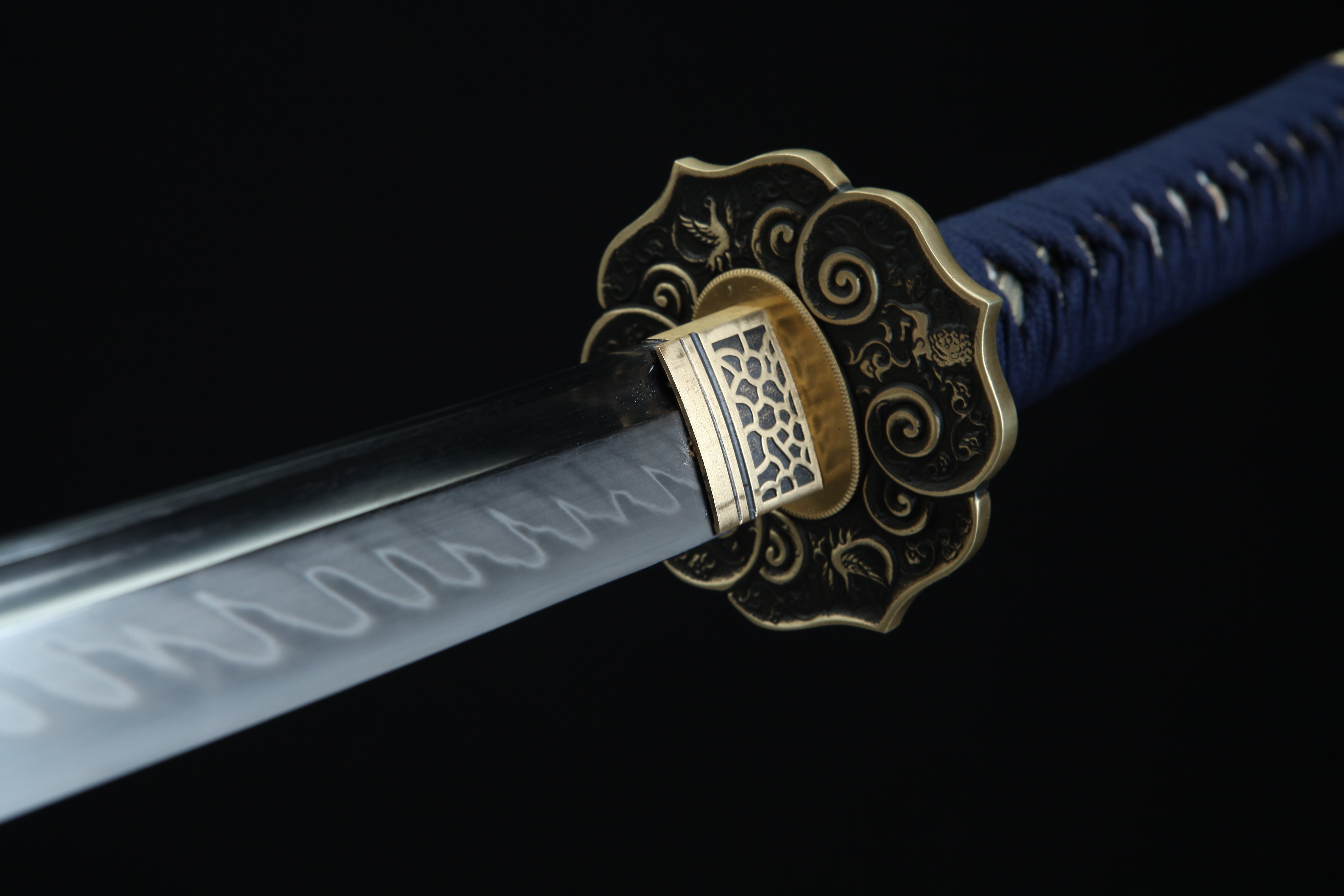
Both steels produce a genuine, visible hamon when clay-tempered, since both are simple enough alloys to show a real hardness transition line rather than a cosmetic acid-etched one. T10 in particular tends to throw a sharper, more vivid hamon line when differentially treated, which is one reason we use it across such a wide range of our katana, from entry-level up through select high-end pieces.
Neither steel has a meaningful corrosion advantage. Both are non-stainless high-carbon steels, so the maintenance routine is identical regardless of which one you own: wipe down after handling, oil the blade, and store it dry. See our guide to maintaining a high-carbon steel blade for the full routine.
Forging, Clay-Tempering, and Working These Steels
At the forge, 1095 is the more forgiving of the two. Its wider hardening window and simpler chemistry mean a smith has more room to be slightly off on temperature or soak time and still get a sound blade out of the quench.
T10 rewards precision. Because its hardenability is more limited and its useful wear resistance tapers off above about 250°C in service, both the forging heat and the clay-temper process need tighter control. That's also why T10 is a common choice where a maker wants a harder edge and a crisp hamon and is willing to control the process closely enough to get it.
Pro tip: if you're comparing test cuts or reviews between 1095 and T10 blades from different makers, weight the heat-treat description more heavily than the alloy name. A well-tempered 1095 blade will outperform a poorly-tempered T10 blade every time.
Which Moonswords Katana Use 1095 vs T10?
T10 is our broadest clay-tempered steel line by far — it's the one steel we use across every price tier, from an accessible entry-level katana like the Makai Katana up through high-end pieces like the Chi no Bara Katana and the Gaifū Katana. All of it is clay-tempered, full-tang construction, so the fit and finish scales with the tier rather than the steel changing underneath you. See the full lineup on our T10 Steel page.
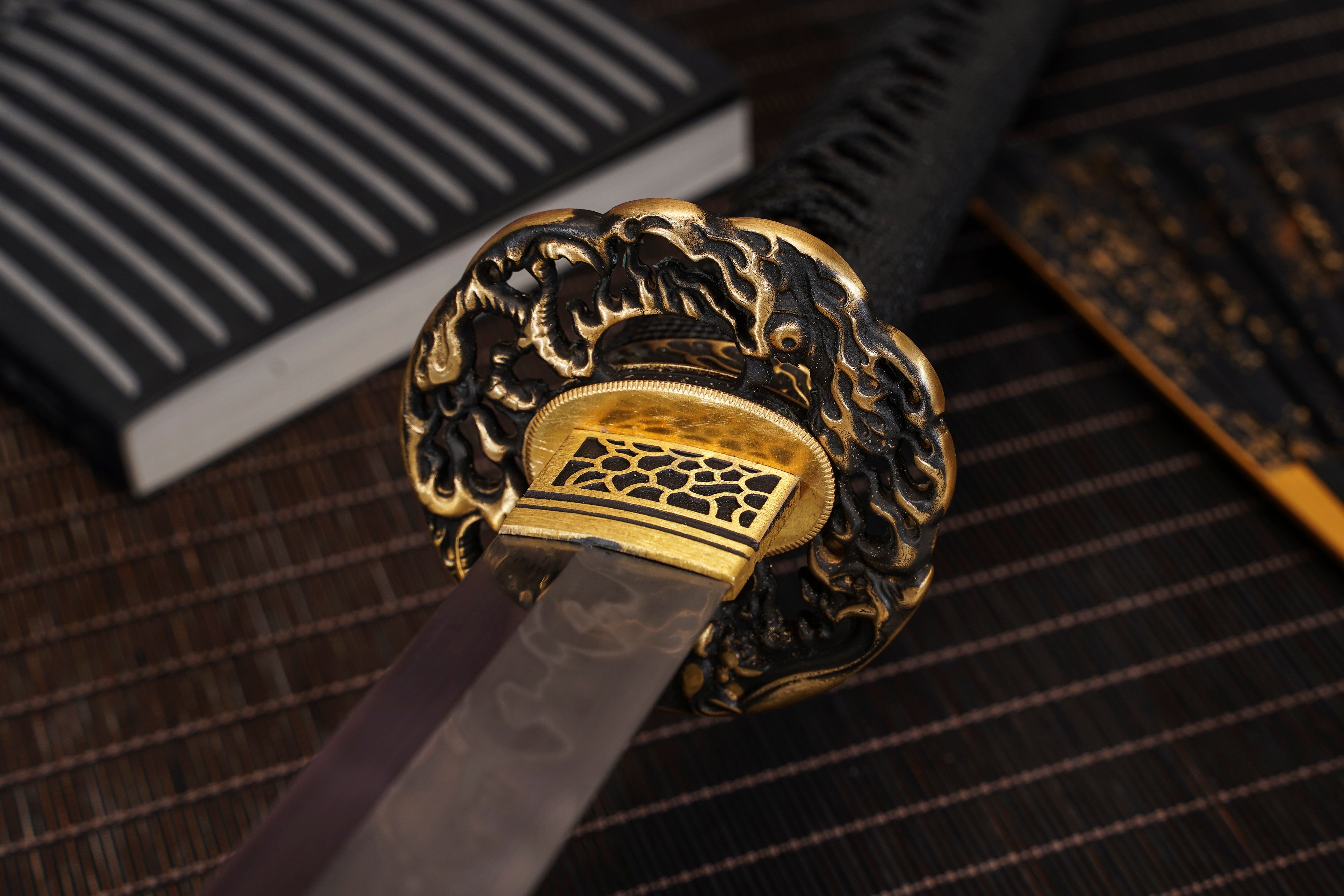
1095 sits differently in the catalog: it currently has no entry-level pieces, starting instead in our mid-range tier with katana like the Harugasumi Katana and running up through high-end pieces like the Karyū Katana and Mōko Katana, including the Shuren Katana pictured above. Full details are on our 1095 Steel page.
Our true entry-level steels are T8 and high-manganese steel, which anchor the low end of our entry-level katana collection — T10 is the one higher-carbon steel that also reaches down into that tier, while 1095 stays in mid-range and up. For a broader look at where tool steels fit into a sword lineup generally, see our piece on tool steel katana and modern metallurgy.
What Do Bladesmiths and Collectors Report?
Across collector and bladesmith communities, the consensus on T10 lines up with the lab data: it's treated as a step up from 1095 in achievable hardness and edge retention, without a dramatic jump in cost or a loss of toughness when the heat-treat is done right. The tradeoff buyers report most often isn't performance, it's that T10 blades reward, and sometimes require, a maker who controls the clay-temper carefully, since the same higher hardness that gives T10 its edge retention will crack a blade if the quench is rushed.
1095's reputation is simpler and has held up over decades of use in production blades: predictable, well-understood, and hard to get badly wrong. That's not a knock on the steel, it's the reason it remains a bladesmithing standard across the industry.
How Moonswords Chooses Steel for Production Blades
We don't through-harden to a single uniform Rockwell spec and call it done. Every 1095 and T10 blade we produce is clay-tempered, insulating the spine so the edge hits a higher hardness than the rest of the blade while the spine stays tougher, which is what produces a genuine hamon rather than an etched or painted one.
What that means for where each steel lands in our lineup:
- T10 across the full range. It's the steel we reach for most often precisely because it works well from an accessible entry-level build up through a high-end piece — consistent clay-temper results at every price point.
- 1095 in the mid-range and up. Its wide, forgiving heat-treat window makes it a dependable choice once you're past our entry tier, where its simpler composition and classic, crisp hamon are the draw.
A Bladesmith's Take on the 1095 vs T10 Debate
If you're picking your first katana and don't yet have a strong opinion on heat-treat nuance, 1095 is the more honest recommendation almost every time. Not because it's objectively better steel, but because it's more forgiving of the small variances that happen in any production run. T10's higher carbon and trace silicon are a genuine performance advantage — longer edge retention, a crisper hamon — but that advantage only shows up fully when the clay-temper is executed with real precision.
That should reframe how most buyers think about steel selection generally: the alloy sets the ceiling, but the smith's discipline determines whether a blade ever gets close to it. Composition data and lab hardness numbers are a useful starting point, not the whole answer.
Get a Katana Built in 1095 or T10
Browse our T10 Steel page for our full lineup of clay-tempered T10 katana, wakizashi, and tanto across every tier, or our 1095 Steel page for the mid-range and high-end 1095 line, including our tachi and tanto options. If you're still deciding between sword types, our collector's guide to Japanese sword types is a good next stop.
Sources
- SAE-AISI 1095 High Carbon Steel: Composition, Heat Treat, and Hardness — TheWorldMaterial
- T10 Tool Steel: Chemical Composition, Mechanical Properties & Equivalent — TheWorldMaterial
FAQ
Is T10 steel better than 1095 steel for a katana?
Neither is categorically better. T10 carries more carbon and a touch of silicon, so it can be pushed to a higher as-quenched hardness (62 HRC and up) and holds an edge longer. 1095 has a simpler, more forgiving composition that is easier to heat-treat consistently. Most buyers notice the clay-temper and geometry long before they notice the alloy.
What is the carbon content of 1095 and T10 steel?
1095 runs 0.90% to 1.03% carbon with 0.30% to 0.50% manganese. T10 runs slightly higher at 0.95% to 1.04% carbon, with trace silicon, chromium, and tungsten that 1095 does not have.
Does T10 steel rust more than 1095 steel?
Both are non-stainless high-carbon steels with no meaningful chromium content, so both need the same oiling and dry-storage routine. Neither has a corrosion-resistance advantage over the other.
Why does Moonswords offer both 1095 and T10 katana?
T10 is our most widely used clay-tempered steel — it's the one we build across every tier, from entry-level through high-end. 1095 covers our mid-range and high-end tiers with a simpler, more forgiving composition and a classic hamon, alongside select Damascus and Tamahagane options in the same higher tiers.