

Asymmetry in sword displays is defined as the deliberate use of unequal visual weight, varied orientation, and contrasting decorative motifs to create dynamic, culturally resonant presentations. The role of asymmetry in sword displays goes far beyond aesthetic preference. It functions as a visual language, communicating status, symbolism, and narrative depth in ways that perfectly balanced arrangements simply cannot. From the koi-themed saya of Japanese koshirae mounts to the phoenix carvings documented in the 2026 Nagoya exhibition, intentional imbalance transforms a sword from a static object into a story worth reading.
How does asymmetry influence the visual impact of sword displays?
Asymmetry creates visual tension, and visual tension holds attention. When a viewer’s eye has no single axis to rest on, it travels across the composition, engaging with each element in sequence. This is the core principle behind asymmetrical sword display techniques, and it explains why a single katana mounted at an oblique angle on a bare wall often commands more presence than three swords arranged in a rigid, mirrored formation.
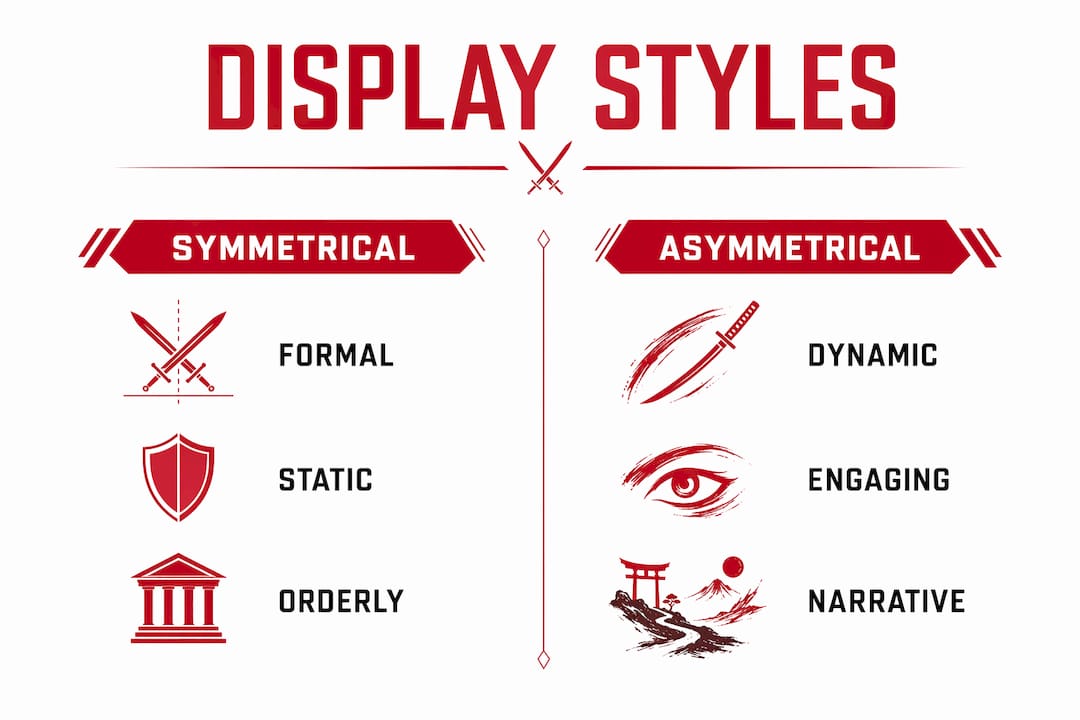
The psychological effect is well documented in design theory. Symmetry signals order and formality. Asymmetry signals energy, individuality, and narrative. For sword collectors and decorators, this distinction matters because a display is not just decoration. It is a statement about the object’s history and the collector’s understanding of it.

| Feature | Symmetrical display | Asymmetrical display |
|---|---|---|
| Visual effect | Formal, static, predictable | Dynamic, engaging, narrative-driven |
| Emotional response | Calm, institutional | Curious, personal, evocative |
| Cultural alignment | Western classical tradition | Japanese wabi-sabi, ma (negative space) |
| Best suited for | Ceremonial or formal settings | Private collections, living spaces |
| Storytelling capacity | Low | High |
The comparison above shows why asymmetrical display arrangements consistently generate stronger viewer engagement in private collections. Symmetry has its place in ceremonial contexts, but for a collector who wants guests to ask questions, asymmetry is the more powerful tool.
Pro Tip: When arranging multiple swords, use the “rule of odds.” Groups of three or five pieces, placed at varied heights and angles, read as intentional and curated rather than incomplete or careless.
What historical and cultural examples show intentional asymmetry in sword mounts?
The most compelling evidence for intentional asymmetry comes not from theory but from the objects themselves. Japanese koshirae (the complete decorative mounting of a sword, including tsuba, fuchi, kashira, and saya) were designed as unified artistic programs, and asymmetry was a deliberate compositional choice within them.
A 2026 Nagoya exhibition displaying 31 unique sword mounts illustrates this with particular clarity. The exhibition includes koi-themed saya where the fish motif wraps around the scabbard in a spiraling, non-repeating pattern, and phoenix carvings positioned off-center to suggest movement and flight. These are not accidents of craftsmanship. They are studied decisions by artisans who understood that a symmetrical phoenix looks frozen, while an asymmetrical one looks alive.
Medieval European sword makers also embraced asymmetry, though for different reasons. Historical swords commonly display uneven tips and grips, reflecting both ergonomic requirements and the natural variability of hand-forging. A grip shaped to fit the dominant hand’s pull is inherently asymmetrical, and that asymmetry is a record of use and human intention.
Key historical examples worth knowing as a collector:
- Koi saya from the Nagoya collection: The koi motif wraps the scabbard in a continuous, asymmetrical spiral, symbolizing perseverance and transformation.
- Phoenix tsuba carvings: Positioned off-center to imply motion, these fittings use negative space on one side to amplify the energy of the figure on the other.
- Waka inscription mounts: Poetic inscriptions carved along the length of a saya follow the natural flow of calligraphy, which is inherently non-symmetrical.
- Ergonomic Japanese grips: Asymmetrical grips are typical in Japanese swords, with one side straighter and one more curved to guide the hand into the correct grip.
“The quirky and unique mounts in this exhibition are not just decorative. They are narrative elements that communicate the culture and values of the sword’s era.” — Curatorial framing, 2026 Nagoya sword exhibition
The Technical Museum Brno’s European sword exhibitions take a similar curatorial position, framing asymmetry as part of evolution in both technology and cultural expression. Across traditions, the message is consistent: asymmetry is not a flaw. It is a feature.
How can collectors apply asymmetry effectively in sword display techniques?
Applying asymmetry well requires understanding what you are trying to communicate, not just where to hang things. The importance of asymmetry in display design lies in its ability to guide the viewer’s attention and create a sense of movement through a static arrangement. Here is a practical framework we recommend at Moonswords.
-
Establish a visual anchor. Choose one sword as the focal point of the display. This is typically the most significant piece, whether by age, craftsmanship, or personal meaning. Position it at a height slightly above eye level and at a slight angle rather than perfectly horizontal.
-
Vary heights deliberately. If you are displaying two or more swords, avoid placing them at the same height. A difference of 15 to 20 centimeters between mounts creates visual rhythm without looking accidental.
-
Mix blade orientation with intention. Edge orientation choices affect both cultural meaning and perceived symmetry. A katana displayed edge-up (ha-mune) reads differently from one displayed edge-down, and combining both orientations in a single display adds a layer of visual contrast that rewards close inspection.
-
Pair asymmetrical mounts with clean blades. A heavily decorated koshirae displayed alongside a minimalist shirasaya (plain wooden mounting) creates a dialogue between ornament and restraint. This contrast is itself a form of asymmetry.
-
Use negative space as an active element. Japanese interior design practice treats empty space, known as ma, as a compositional element equal in value to the objects themselves. Leaving deliberate open space around a sword mount draws the eye to the piece and amplifies its presence.
-
Avoid overcrowding. Japanese sword display guides consistently recommend spacing pieces so each can be read individually before the eye moves to the next. Overcrowding collapses the asymmetry into visual noise.
Pro Tip: Before mounting anything permanently, photograph your proposed arrangement from the viewing distance you expect guests to use. What looks balanced in person often reads differently in a photo, and the photo reveals the true visual weight of each element.
What role does asymmetry play in communicating cultural narratives?
Asymmetry is not just a visual strategy. It is a storytelling medium. Ornamental asymmetry in sword fittings can signal status, cultural affiliation, or a specific narrative the original owner wanted to project. Understanding this transforms how you read a display and how you build one.
The symbolic vocabulary embedded in asymmetrical sword mounts is rich and specific:
- Koi motifs represent perseverance and the courage to swim upstream. Placing a koi in a spiraling, asymmetrical pattern on a saya suggests ongoing struggle and transformation rather than a static achievement.
- Phoenix carvings positioned off-center imply rebirth and forward motion. A centered phoenix is a symbol. An off-center phoenix is a story in progress.
- Waka inscriptions follow the natural flow of classical Japanese poetry, which does not conform to rigid geometric rules. The inscription’s path across the mount mirrors the poem’s emotional movement.
- Mixed metal tsuba with contrasting inlays on opposing sides use material asymmetry to represent duality, such as the balance between martial skill and poetic sensitivity, a core samurai ideal.
“Intentional asymmetry in sword mounts transforms displays from static objects into engaging visual narratives.” — Moonswords editorial insight
Museum curators at the 2026 Nagoya exhibition frame this explicitly: the varied and quirky mounts in the collection are presented as narrative elements, not merely decorative ones. Collectors who understand this distinction engage with their displays on a deeper level and communicate that understanding to anyone who views their collection. Asymmetry, applied with knowledge, is the difference between a wall of swords and a curated argument about history.
Key takeaways
Asymmetry in sword displays functions as both a visual design principle and a cultural communication tool, making it the single most powerful element a collector can apply to transform a static arrangement into a meaningful narrative.
| Point | Details |
|---|---|
| Asymmetry drives visual engagement | Unequal arrangements hold viewer attention longer than symmetrical ones by creating visual tension. |
| Historical use was intentional | Koshirae artisans and medieval smiths used asymmetry deliberately for symbolism and ergonomics, not by accident. |
| Display technique follows clear principles | Varying heights, mixing orientations, and using negative space are the three core tools for effective asymmetrical displays. |
| Motifs carry specific meaning | Koi, phoenix, and waka inscriptions each carry defined symbolic content that asymmetrical placement amplifies. |
| Collector value increases with narrative depth | Ornamental asymmetry signals uniqueness and story depth, which directly affects a piece’s appeal and investment value. |
Why asymmetry is the most underrated tool in a collector’s display vocabulary
I have spent years looking at sword collections in private homes, at exhibitions, and in dealer showrooms, and the pattern is consistent: the displays that stop people in their tracks are almost never the symmetrical ones. The perfectly mirrored pair of katanas on matching stands is impressive for about three seconds. The single tachi mounted at an angle, with a koi-wrapped saya resting below it on a lower bracket, holds attention for three minutes.
What most collectors get wrong is treating asymmetry as a lack of order rather than a different kind of order. The Japanese concept of wabi-sabi, finding beauty in imperfection and incompleteness, is not an excuse for carelessness. It is a disciplined aesthetic philosophy that requires more thought than symmetry, not less. When you place a sword off-center, you are making a claim about what matters in the composition. That claim needs to be defensible.
The other misconception I see regularly is the idea that asymmetry belongs only to Japanese sword traditions. The swordsmithing history of China, Persia, and medieval Europe all contain examples of intentional decorative imbalance, whether in blade geometry, grip construction, or scabbard ornamentation. Asymmetry is not a cultural artifact of one tradition. It is a universal response to the human preference for things that feel alive rather than frozen.
My honest recommendation: start with one piece displayed asymmetrically and observe how visitors respond to it. The conversation it generates will tell you everything you need to know about its power.
— Kenji Smith
Explore Moonswords’ collection for your next display
At Moonswords, we design and source swords with the collector’s display in mind, not just the blade’s function. Our hand-forged katanas, crafted by master artisans using clay tempering and full tang construction, feature koshirae mounts with the kind of ornamental detail that makes asymmetrical display not just possible but natural. Whether you are building a focused Japanese collection or a cross-cultural display that spans traditions, our premium katana collection includes pieces with the decorative depth and cultural specificity to anchor a meaningful arrangement. Browse the full range at Moonswords and find the piece that starts the conversation you want your display to have.
FAQ
What is the role of asymmetry in sword displays?
Asymmetry in sword displays creates visual tension and narrative depth by using unequal arrangements, varied orientations, and contrasting decorative motifs. It transforms a static collection into a culturally communicative composition that engages viewers intellectually and emotionally.
Why did historical sword makers use asymmetry in koshirae mounts?
Japanese koshirae artisans used asymmetry deliberately to convey symbolism and movement, as seen in koi spirals and off-center phoenix carvings documented in the 2026 Nagoya exhibition. Medieval European smiths also produced asymmetrical features due to ergonomic requirements and the natural variability of hand-forging.
How does asymmetry affect the value of a sword for collectors?
Ornamental asymmetry in sword fittings signals uniqueness and story depth, both of which increase a piece’s appeal and investment value. Collectors respond strongly to mounts that communicate a specific cultural narrative rather than generic decorative repetition.
What are the most effective asymmetrical sword display techniques?
The most effective techniques include varying mount heights by 15 to 20 centimeters, mixing edge-up and edge-down blade orientations, pairing decorated koshirae with plain shirasaya, and using deliberate negative space to frame each piece individually.
Does asymmetry apply only to Japanese sword displays?
No. While Japanese koshirae traditions offer the most documented examples of intentional decorative asymmetry, European and Chinese sword traditions also incorporate asymmetrical elements in blade geometry, grip construction, and scabbard ornamentation as both practical and symbolic choices.