

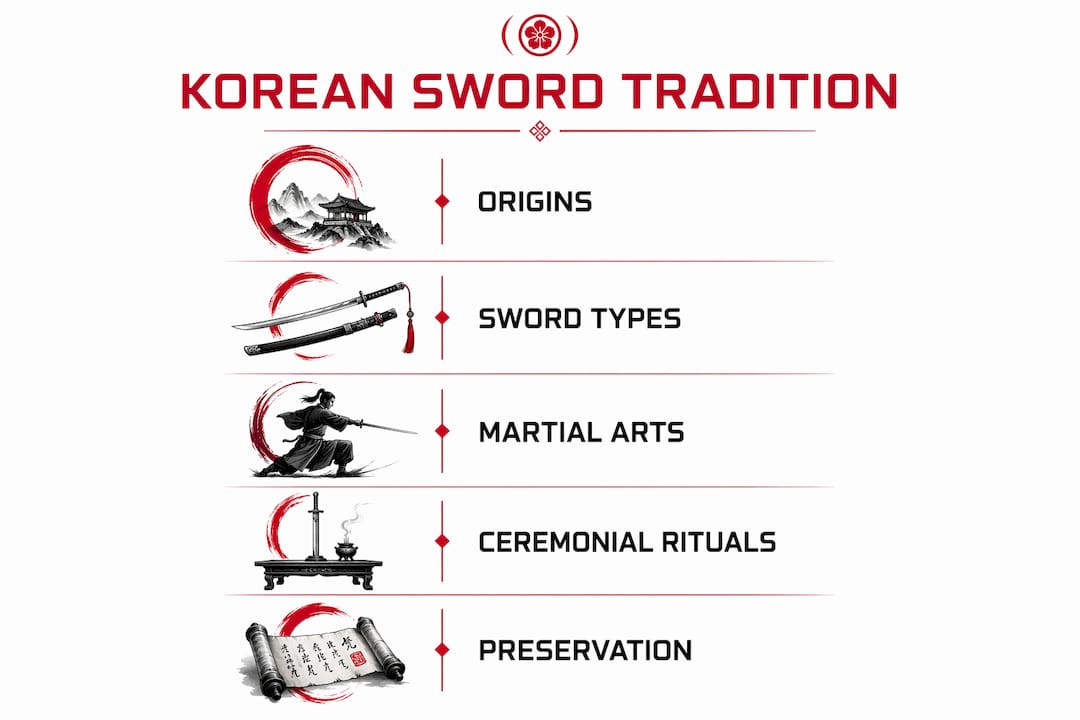
Korean sword tradition is defined as an integrated cultural system linking sword craftsmanship, martial arts practice, and ceremonial ritual across more than a thousand years of Korean history. This system is formally known in Korean scholarship as geomdo culture, though the term “Korean sword tradition” captures its full scope for modern audiences. It spans weapons like the Hwandudaedo ring-pommel sword and the Hwando military saber, martial arts like kumdo, and ritual performances like the Seungjeonmu sword dance. Understanding what a Korean sword tradition truly means requires looking beyond any single practice. It is a living continuum of craft, discipline, and ceremony that reflects Korea’s deepest cultural values.
What is a Korean sword tradition, and where does it begin?
Korean sword tradition is a cultural system linking sword design, martial arts, and ritual across multiple historical periods. It is not a single art or weapon type. It is a layered inheritance that connects the battlefield to the royal court, and the forge to the ceremonial stage.
The earliest physical evidence appears in the Three Kingdoms period (57 BCE to 668 CE), when Korean smiths produced the Hwandudaedo, a ring-pommel sword with elaborate decorative designs that signaled military rank and spiritual authority. These blades were not purely functional. Their ornate pommels and inlaid metalwork communicated power in a society where a warrior’s sword was an extension of his identity.
By the Joseon dynasty (1392 to 1897), Korean sword culture had developed a clear taxonomy of blade types:
- Geom: a double-edged straight sword used in both combat and ceremony
- Do: a single-edged curved saber optimized for battlefield use
- Hwando: a lightweight single-edged military sword carried by Joseon soldiers, prized for its balance and speed
- Jikdo: a straight single-edged sword associated with formal military dress
- Ssang Soo Do: a two-handed long saber demanding considerable strength and technique
Each type carried a distinct military and symbolic role. The Hwando, for instance, was the standard-issue blade of the Joseon infantry, while the Jikdo appeared in officer ceremonies. This differentiation shows that Korean sword culture was never monolithic. It adapted to context, whether that context was open-field combat, palace ritual, or spiritual protection.
The most authoritative record of these traditions is the Mu Ye Do Bo Tong Ji, a royal-commissioned martial manual compiled in 1790 by order of King Jeongjo. The manual documents 24 categories of Korean military arts, including detailed sword techniques with illustrated sequences. UNESCO has recognized it as a Memory of the World, confirming its status as a document of global cultural significance. That recognition matters because it positions Korean swordsmanship not as regional folklore but as state-level military knowledge worthy of international preservation.
| Sword Type | Period | Primary Role |
|---|---|---|
| Hwandudaedo | Three Kingdoms | Status symbol and military blade |
| Hwando | Joseon | Standard infantry weapon |
| Jikdo | Joseon | Officer ceremony and formal dress |
| Ssang Soo Do | Joseon | Two-handed battlefield saber |
| Ingeom (Tiger Sword) | Joseon | Spiritual protection and ritual |
How does Korean swordsmanship manifest in martial arts practice?
Korean sword-based martial arts today are most widely represented by kumdo, which translates literally as “the way of the sword.” Kumdo is a modern Korean sword art that evolved substantially after 1945, when Korea regained independence from Japanese occupation. During the occupation period of 1910 to 1945, Japanese kendo was introduced into Korean schools and military training. After liberation, Korean martial artists made deliberate institutional choices to differentiate their practice through distinct terminology, philosophical framing, and organizational structures.
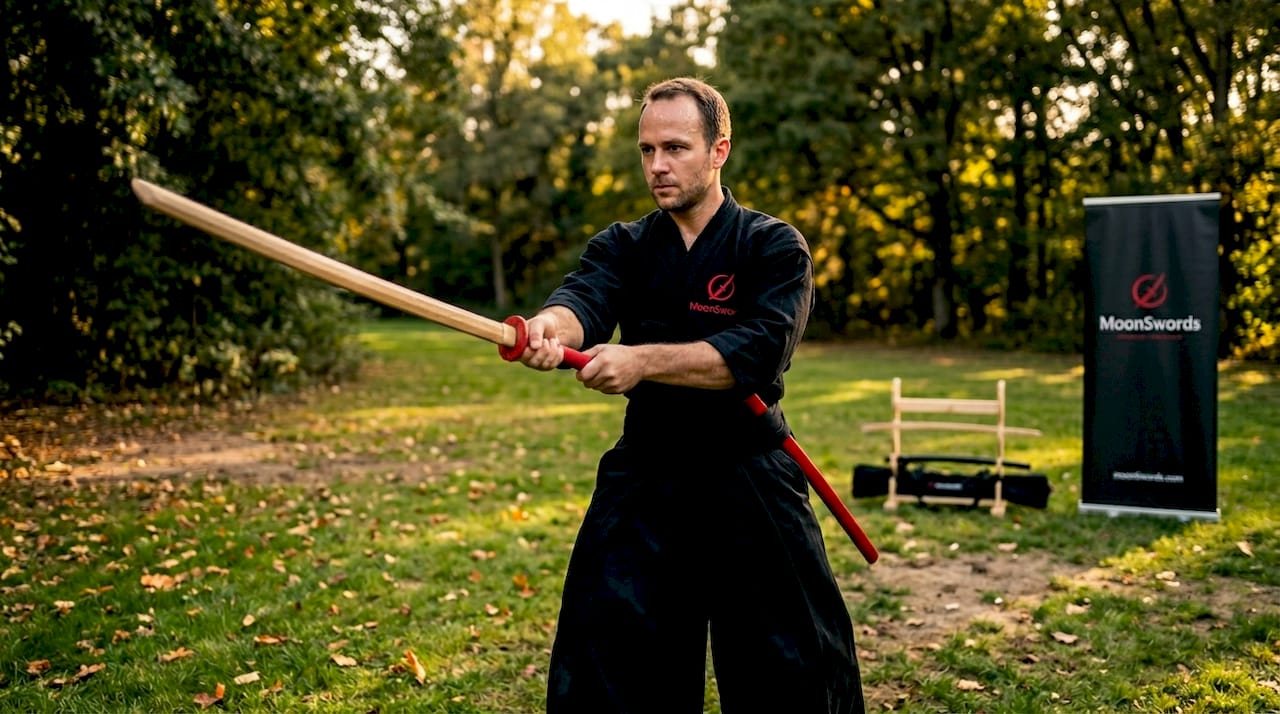
This distinction matters to practitioners and historians alike. Kumdo shares technical roots with kendo but reflects a Korean cultural identity formed through conscious post-occupation development. The Korea Kumdo Association, established in the mid-20th century, codified these differences and shaped the art’s philosophy around Confucian values of discipline, respect for elders, and self-cultivation. These principles govern not just technique but the entire culture of the training hall, from how students bow to how they handle their blades.
Alongside kumdo, the style known as Haidong Gumdo takes a different approach. Where kumdo emphasizes controlled sparring and sport competition, Haidong Gumdo focuses on reconstructed battlefield techniques, including multiple-opponent scenarios, cutting sequences, and forms derived from historical military practice. The two styles are not rivals so much as different lenses on the same tradition.
Here is how a practitioner typically progresses through Korean sword martial arts training:
- Foundation forms (gibon): Basic cutting angles, footwork, and grip are drilled repeatedly to build muscle memory before any live blade work begins.
- Poomsae (forms practice): Structured sequences of techniques performed solo, preserving historical movement patterns from manuals like the Mu Ye Do Bo Tong Ji.
- Sparring with shinai or bokken: Controlled partner practice using bamboo or wooden training swords to develop timing and distance without injury risk.
- Tameshigiri (test cutting): Cutting rolled tatami mats or similar targets to confirm that technique, not just strength, is producing clean results.
- Philosophical study: Reading texts on Korean martial ethics and the historical context of the sword arts, which serious schools treat as inseparable from physical training.
Pro Tip: No manual, including the Mu Ye Do Bo Tong Ji, can fully transmit the timing and tactile nuance of sword technique on its own. Authentic learning requires instructor-guided transmission because the tacit knowledge embedded in movement cannot be captured in illustrations alone.
What role do ceremonial swords and rituals play in Korean sword traditions?
A common misconception is that Korean sword tradition is synonymous with modern martial arts practice. The ceremonial dimension is equally deep and, in some ways, more directly connected to Korea’s royal history. The Seungjeonmu sword dance is the clearest example. Designated as a South Korean Important Intangible Cultural Property in 1968, Seungjeonmu is a court ritual dance that uses real swords to pray for military victory. Its historical links trace to Admiral Yi Sun-sin, the 16th-century naval commander who defeated Japanese invasions during the Imjin War.
The dance is not decorative performance. At its climax, two real swords are skillfully twirled by the performer to absorb heavenly energy and channel auspicious power toward the military cause. This act of ritual sword use reflects a worldview in which the blade is a conduit between the human and spiritual realms, not merely a weapon.
Beyond Seungjeonmu, Korean history produced several categories of ceremonial swords with specific spiritual functions:
- Ingeom (Tiger Sword): Engraved with tiger imagery and used in exorcism rituals and royal protection ceremonies during the Joseon dynasty. The tiger is a guardian figure in Korean shamanic tradition, and the sword bearing its image was believed to repel malevolent forces.
- Chilseong Geom (7-Star Sword): Inscribed with symbols corresponding to the seven stars of the Big Dipper constellation. Taoist and shamanistic practitioners used these blades in royal and spiritual ceremonies for divine guardianship.
- Geommu performance swords: Lighter blades specifically crafted for sword dance performances, balancing visual impact with the safety demands of choreographed movement.
“The sword in Korean tradition is never only a weapon. It is a text written in steel, carrying meaning across martial, spiritual, and artistic registers simultaneously.”
This layered symbolism is what separates Korean sword culture from a purely martial reading of the tradition. Sword-making itself was understood as a sacred craft in many cultures, and Korea was no exception. The smith who forged a ceremonial blade was participating in a ritual act, not simply a manufacturing process.
How are Korean sword traditions preserved and interpreted today?
The preservation of Korean sword tradition operates on two levels: the tangible, meaning physical swords and forging techniques, and the intangible, meaning the martial forms, ritual dances, and philosophical frameworks that give those objects meaning. Both require active stewardship.
The Mu Ye Do Bo Tong Ji remains the central reference document for historical Korean martial arts reconstruction. Scholars and practitioners use its illustrated sequences to reconstruct techniques that fell out of continuous practice during the Japanese occupation period. However, the manual’s limitations are real. Tacit knowledge in movement cannot be fully conveyed through illustrations. Timing, pressure, and the feel of a blade in motion require a living teacher to transmit. This is why serious reconstruction projects pair textual study with instructor-led practice rather than treating the manual as a self-sufficient guide.
Since the late 20th century, South Korea has invested significantly in reviving both sword-making and sword arts. The government’s designation of Seungjeonmu and other sword-related practices as Important Intangible Cultural Properties provides institutional support for master practitioners to teach and perform. Kumdo schools now operate in dozens of countries, and Haidong Gumdo has established an international federation that promotes Korean sword arts globally.
Contemporary collectors and enthusiasts also play a role in this preservation. Acquiring historically informed blades, studying their construction, and supporting artisans who use traditional forging techniques all contribute to keeping the knowledge alive. Understanding sword forging ceremonies and the rituals surrounding blade creation deepens appreciation for why these objects carry such cultural weight.
Pro Tip: When engaging with Korean sword tradition as a collector or student, treat the tangible and intangible as inseparable. A sword displayed without knowledge of its historical context is an artifact. A sword understood within its martial and ceremonial tradition is a piece of living culture.
Key takeaways
Korean sword tradition is a unified cultural system where craftsmanship, martial discipline, and ceremonial ritual reinforce each other across more than a millennium of Korean history.
| Point | Details |
|---|---|
| Tradition as a system | Korean sword culture integrates forging, martial arts, and ritual rather than treating each as separate. |
| Historical documentation | The Mu Ye Do Bo Tong Ji (1790) is the authoritative manual, now recognized by UNESCO as a Memory of the World. |
| Kumdo’s distinct identity | Kumdo evolved post-1945 with deliberate differences from kendo in terminology, philosophy, and training structure. |
| Ceremonial depth | Swords like the Ingeom and Chilseong Geom served spiritual and royal functions entirely separate from combat. |
| Living preservation | Authentic transmission requires instructor guidance alongside historical manuals and institutional support. |
Why Korean sword tradition deserves more than a martial arts label
I have spent years studying how different cultures encode their values into edged weapons, and Korean sword tradition consistently surprises people who come to it expecting a straightforward martial art. What they find instead is a civilization’s philosophy made physical.
What strikes me most is the deliberate way Korean culture refused to separate the warrior from the scholar, the fighter from the ritualist. The same blade that a Joseon soldier carried into battle against Japanese invasions could appear in a royal court ceremony weeks later, its meaning transformed entirely by context. That flexibility is not inconsistency. It reflects a cultural sophistication that understood the sword as a symbol capable of holding multiple truths at once.
The post-occupation reconstruction of kumdo is another layer that deserves more attention. The Koreans who rebuilt their sword arts after 1945 were not simply recovering a lost practice. They were making a statement about cultural identity and sovereignty. Every institutional choice, from terminology to training philosophy, was an act of cultural reclamation. Modern practitioners carry that history whether they know it or not.
For collectors and enthusiasts, this means that acquiring or studying a Korean-influenced blade is never just an aesthetic decision. You are engaging with a tradition that has survived occupation, documented itself through royal commission, and encoded its values in steel and movement for over a thousand years. That is worth approaching with genuine respect and curiosity.
— Kenji Smith
Explore authentic blades with Moonswords
At Moonswords, we share the same respect for tradition and craftsmanship that defines Korean sword culture. Our collection of hand-forged blades is built by master artisans using centuries-old techniques, including clay tempering and full tang construction, that mirror the dedication found in historical Korean and East Asian sword-making. Whether you are a collector drawn to the ceremonial depth of traditional swords or a martial arts enthusiast looking for a practice-ready blade, our catalog offers options at every level. For those beginning their collecting journey, our functional katanas under $300 provide an accessible entry point into the world of authentic, historically inspired edged weapons.
FAQ
What is the Korean sword tradition in simple terms?
Korean sword tradition is a cultural system combining sword craftsmanship, martial arts like kumdo, and ceremonial practices like the Seungjeonmu sword dance. It spans over a thousand years of Korean history and reflects the country’s martial, spiritual, and artistic values.
How is kumdo different from Japanese kendo?
Kumdo is a modern Korean sword art that evolved after 1945 with distinct Korean terminology, philosophy, and organizational structures, despite sharing technical roots with kendo introduced during Japan’s occupation of Korea from 1910 to 1945.
What is the Mu Ye Do Bo Tong Ji?
The Mu Ye Do Bo Tong Ji is a 1790 royal-commissioned manual documenting 24 categories of Korean military arts, including illustrated sword techniques. UNESCO recognizes it as a Memory of the World.
What are ceremonial Korean swords used for?
Ceremonial swords like the Ingeom (Tiger Sword) and Chilseong Geom (7-Star Sword) were used in royal and spiritual ceremonies for exorcism, divine protection, and ritual during the Joseon dynasty. They were never intended for combat.
Can I learn Korean sword arts today?
Yes. Kumdo schools operate internationally, and Haidong Gumdo has an established global federation. Authentic learning requires in-person instruction because, as research on the Mu Ye Do Bo Tong Ji confirms, manuals alone cannot transmit the full tacit knowledge of sword technique.